
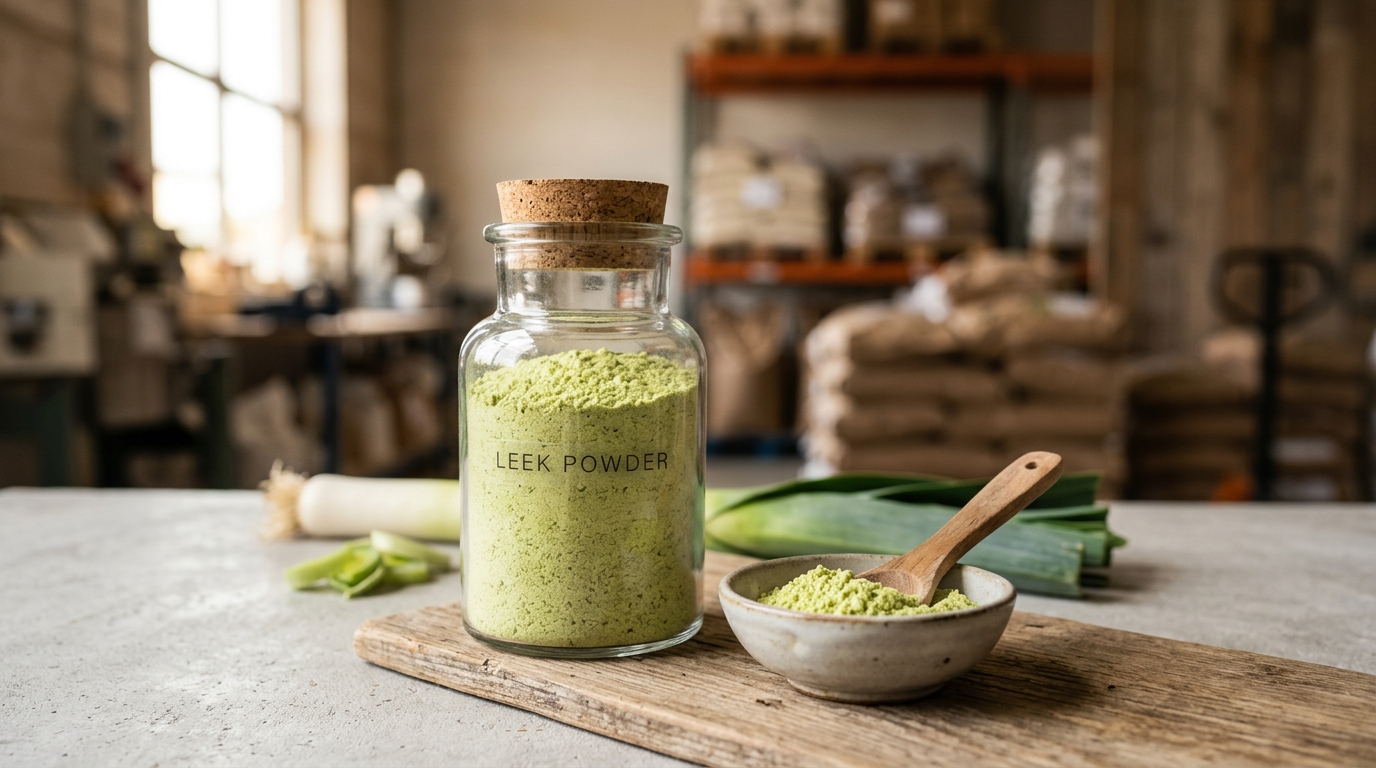
Leek powder origin decisions look like a simple $/kg comparison, but in practice they are a choice between different operating models (crop + dehydration capacity + QA discipline + logistics lanes). This brief is written for category managers who know procurement well but don’t live in dried alliums every day—so it focuses on the few origin-driven variables that most reliably move total cost of ownership (TCO), supply continuity, and governance outcomes.
Insight: In leek powder, “origin” is shorthand for a whole operating model—farm labor intensity, dehydration energy economics, QA maturity, and logistics reliability—so origin choice shows up as TCO (rework, holds, safety stock), not just $/kg.
Data (validated/corrected): Leek powder generally sits under HTS heading 0712: “Dried vegetables… whole, cut, sliced, broken or in powder, but not further prepared.” Correct classification and documentation discipline can materially affect landed cost and clearance risk. [1]
Procurement Impact: If you’re comparing offers only on unit price, you’ll underweight the two biggest levers that move your real cost: (1) lot-to-lot spec drift (drives yield loss and line disruption) and (2) lead-time volatility (drives inventory and expediting).
Insight: There is no universally “best” origin; the right choice depends on whether your binding constraint is cost, QA risk tolerance, or lead-time certainty.
Data (validated, with caveat): Public trade data is clearer for dried onions/garlic than for leek powder specifically, but it is directionally useful because dried alliums share processing footprints and trade corridors. For example, World Bank/WITS data shows the Netherlands functioning as an import/re-export hub for dried onions, with Egypt, Belgium, India, Germany and China among exporters into NL—consistent with the “EU hub” dynamic described here. [3]
Procurement Impact: Your negotiation posture and qualification sequencing should change by origin: the cheapest origin is rarely the fastest to remediate a quality incident, and the most consistent origin often has less price flexibility.

| Option (Typical origin model) | Cost | Quality | Risk | Lead Time | Availability | Bottom line |
|---|---|---|---|---|---|---|
| China (large-scale dehydrated veg export base) | Low–Medium | Medium (wide spread by supplier tier) | Medium–High | Medium–Long | High | Best for cost-driven programs if you enforce tight incoming QA + change control. |
| Egypt (export-oriented dehydration hub) | Low–Medium | Medium | Medium | Medium–Long | Medium–High | Strong value when you need a cost alternative to Asia with decent scale; manage micro/residue diligence. |
| EU (NL/FR/ES/PL processors/blenders) | Medium–High | High | Low–Medium | Short–Medium | Medium | Best when your brand risk is high and you need consistency, audit readiness, and faster corrective actions. |
| U.S./North America packer (often re-pack / blend / sometimes process) | High | High (if tight spec + supplier-managed inventory) | Low–Medium | Short | Medium | Best when service level and responsiveness beat unit cost; watch margin stacking in repack models. |
Insight: The biggest cost swing in leek powder is not milling—it’s dehydration yield + energy + labor for trimming/cleaning, which vary structurally by origin.
Data (validated as category mechanics): In dehydrated vegetables, energy intensity and fresh-to-dried mass loss are structurally important; costs like validated microbial reduction, QA testing, and packaging barrier become material when specs tighten. (Use your internal cost breakdowns to quantify.)
Procurement Impact: Build a landed-cost-to-TCO bridge: add expected costs for (a) QA holds and re-testing, (b) yield loss from weaker flavor intensity, (c) caking-driven scrap/rework, and (d) safety stock carrying cost.

Insight: Leek powder quality failures are usually “manufacturing pains” (caking, color drift, inconsistent flavor strength) rather than obvious non-conformances—until you hit a micro/foreign-matter event.
Data (validated/corrected): Low-moisture foods are not “risk-free.” Research and FDA materials describe how pathogens like Salmonella can persist in low-moisture foods, and FDA has specifically assessed pathogen/filth risks in spices (a close analog category in terms of low aw and supply-chain controls). [4]
Procurement Impact: Your spec should be written to protect line performance, not just a COA:
Insight: Leek powder supply tightens when crop variability meets constrained dehydration capacity; the shortage shows up first as longer lead times and “spec exceptions,” then as allocation.
Data (validated, reframed): Trade concentration and hub behavior is observable in dried alliums (e.g., Netherlands as a hub for dried onion trade). That concentration is exactly why single-region shocks can propagate into processed ingredient availability and lead times. [3]
Procurement Impact: Convert risk into triggers and playbooks:
Insight: Leek powder is shelf-stable but moisture-sensitive; logistics failures show up as caking and aroma loss, not always as a failed COA.
Data (validated/updated for 2026): Ocean routing and schedule reliability are still affected by Red Sea/Suez disruption; many services have rerouted around the Cape of Good Hope at times, adding transit time and variability. [2]
Procurement Impact: Write logistics into the spec and contract:
Insight: Scalability is constrained more by dehydration throughput and sorting labor than by milling capacity.
Data: Dehydration hubs exist because they can aggregate raw material and run high-throughput drying; when capacity utilization rises, lead times and MOQs typically increase (category mechanics).
Procurement Impact: Don’t “discover” scalability during a disruption—pre-qualify it:
Insight: Sustainability claims in dehydrated vegetables are only as strong as traceability depth and audit artifacts; origin choice changes how easy it is to evidence.
Data (validated/corrected): Import governance levers are real and practical: HTS classification, documentation completeness, and audit artifacts are foundational to smooth clearance and defensible sourcing decisions. [5]
Procurement Impact: Make sustainability and compliance measurable:
Insight: A usable comparison table must separate “supplier capability” from “origin baseline,” because top-tier suppliers in any origin can outperform weak suppliers in a ‘better’ origin.
Data (validated as logic): Concentrated hubs/corridors are visible in dried alliums trade; that’s why risk scoring is meaningful (single-region shocks propagate). [3]
Procurement Impact: Use the table below as a first-pass filter, then force supplier-specific proof (audit, COAs, performance history).
| Dimension | China | Egypt | EU (NL/FR/ES/PL) | U.S./NA packer |
|---|---|---|---|---|
| Typical unit cost index (EU = 1.00) | 0.75–0.90 | 0.80–0.95 | 1.00 | 1.10–1.30 |
| Hidden TCO risk (holds/rework/buffer stock) | Medium–High | Medium | Low–Medium | Low–Medium |
| Spec consistency (color/flavor/mesh) | Medium | Medium | High | High |
| Food safety / compliance execution (by baseline) | Medium | Medium | High | High |
| Logistics volatility to U.S. | Medium–High | Medium | Low–Medium | Low |
| Scalability (industrial volumes) | High | Medium–High | Medium | Medium |
| Overall risk score (High/Med/Low) | Medium–High | Medium | Low–Medium | Low–Medium |
| Risk dimension | China | Egypt | EU | U.S./NA |
|---|---|---|---|---|
| Quality drift risk | High | Medium | Low | Low |
| Regulatory/document hold risk | Medium | Medium | Low | Low |
| Lead-time shock risk | Medium–High | Medium | Low–Medium | Low |
| Single-supplier dependency risk (if you choose 1 vendor) | High | High | Medium | Medium |
Insight: The “best” origin depends on your constraint: cost-down, audit risk, or service level; the wrong choice usually comes from skipping qualification gates or writing specs that don’t protect production.
Data (validated/corrected): Rather than tying this to “leek powder outbreaks,” anchor it to what regulators and research consistently emphasize: low-moisture categories can carry pathogen persistence risk, and preventive-control systems (supplier controls, verification, and documented programs) are expected under FSMA for applicable facilities. [6]
Procurement Impact: Use situational recommendations to align Procurement, QA, Ops, and Finance on a single decision logic.
| Your top priority | Best-fit option | Why it wins |
|---|---|---|
| Aggressive cost-down | China / Egypt | Lower unit cost; scalable volumes |
| Lowest brand/recall risk | EU / U.S./NA | Stronger documentation + faster remediation |
| Fastest lead time | U.S./NA, then EU | Shorter transit and simpler coordination |
| Resilience (avoid allocation) | Dual-source: China or Egypt + EU | Independent capacity + risk hedge |
| Tight sensory consistency | EU / U.S./NA | Better lot-to-lot control and change management |
Insight: The highest-leverage move in leek powder is not switching origins—it’s building a two-origin bench with pre-agreed specs, qualification gates, and triggers that tell you when to shift volume.
Data (validated/updated): 2026 freight routing uncertainty remains a planning variable (not an exception), and low-moisture categories still require disciplined preventive-control thinking. [2]
Procurement Impact: You reduce stockout probability and incident-driven TCO by replacing reactive spot buying with a governed dual-sourcing design.
Logical Next Step (analysis, not promotion): The hard part is timing—knowing when a price increase is supplier-specific vs. market-wide, and when a lead-time slip is a one-off vs. the start of allocation. That’s a data problem: you need consistent visibility into comparable supplier offers, capacity/lead-time signals, and early-warning risk indicators to decide whether to renegotiate, pre-buy, or shift volume before your plant feels the shortage.
(Analyzed at: Sep, 2026)
If you’re renewing leek powder supply in late 2026, write the contract as if logistics variability is “normal,” not exceptional: lock packaging/humidity controls and a clear documentation gate up front, then split 20–30% of volume into a qualified second origin with pre-agreed specs and a fast switch mechanism. The reason this works is simple: in 2026, ocean schedules are still exposed to Red Sea/Suez uncertainty and rerouting effects, and low-moisture ingredients still carry non-trivial quality and safety downside if you’re forced into rushed substitutions. [7] The stake is usually not pennies on unit price—it’s avoiding a single expedite + QA hold event that can erase a quarter’s negotiated savings.


