INDUSTRY TRENDS

Kumquat Concentrate Supply Chain Map (For Procurement): Specs, Nodes, Cost Drivers, and 2026 Risk Triggers

Author
Team Tridge
DATE
July 16, 2026
8 min read
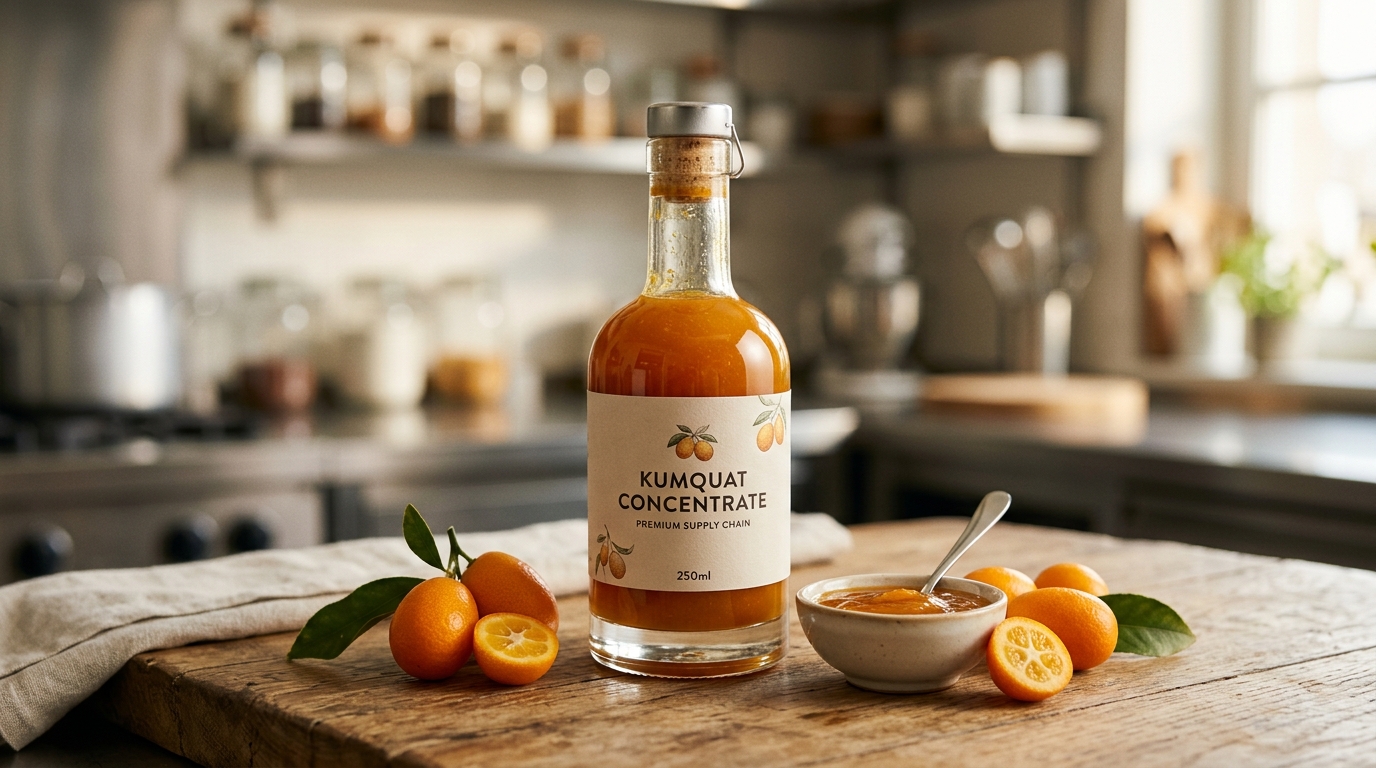
kumquat-concentrate Cover
Unlock Full Data
Kumquat Concentrate Market Intelligence
Prices · Trends · Origins · Forecasts

This guide maps how kumquat concentrate actually moves, where cost and risk “lock in,” and which spec lines procurement should treat as commercial levers (not QA afterthoughts). It’s written for sourcing leaders who know procurement, but don’t live in niche citrus—so you can align QA/R&D/ops early, reduce mid-year surprises, and negotiate with a clearer view of what’s structurally fixed vs. flexible.

Executive Summary

  • Flow reality: Kumquat concentrate is typically campaign-processed (short harvest window → pack → inventory carry), so supply continuity is more about what got packed + how it stores than “annual capacity.”
  • Spec reality: Many citrus concentrates sit around ~62–70° Brix depending on product type and standardization approach; tighter sensory specs (bitterness/oil) usually mean extra unit ops + yield loss. [1]
  • Cost reality: Your biggest structural anchors are fruit usable yield, energy/time in concentration, and pack format physics (aseptic vs. frozen).
  • 2026 risk backdrop: Citrus supply chains remain exposed to extreme weather shocks (e.g., frost impacts in Türkiye) and HLB/citrus greening pressure in the U.S., both of which can tighten availability and raise premiums. [2]

1) How Kumquat Concentrate Physically Moves (and Where Cost “Locks In”)

Kumquat concentrate is a campaign-processed, niche citrus ingredient: most cost is structurally set by (1) short harvest windows, (2) peel-driven processing complexity, and (3) packaging/logistics choices (aseptic vs. frozen) that determine storage and freight physics. The chain is simple on paper but tight in practice because small volumes amplify fixed costs (QA, drums, minimum runs) and variability (flavor/bitterness, Brix/acid balance).

  • Insight: The physical flow is orchard → extraction/puree → concentration/standardization → aseptic or frozen pack → ocean/inland distribution → industrial use.
  • A left-to-right supply chain flow diagram showing: Orchards/Harvest & Grading → Primary Processing (wash/sort, crush/pulp or juice extraction; peel-contact control) → Secondary Processing (vacuum evaporation and/or membrane concentration; blending/standardization to target Brix/acid/color; optional de-oiling/debittering) → Packaging & QA (aseptic bag-in-drum/tote OR frozen drums/blocks; COA/residue/micro testing) → Logistics & Distribution (ambient vs cold chain; ocean + inland) → Industrial Use (blenders/flavor houses/food manufacturers), with callout tags at cost anchors (fruit usable yield; energy/time + yield loss in concentration; pack format physics) and a legend for Cost Anchor and Risk Gate (docs/COA release).
  • Data (validated/adjusted): Typical citrus concentrate targets frequently sit in the ~62–70° Brix range depending on the product and method; some citrus concentrates may also be produced/handled at lower Brix (e.g., mid-40s to low-50s) when recombined with pulp/volatiles or when sold as a different “base” rather than a high-Brix concentrate. [1]
  • Procurement Impact: The biggest “non-negotiable” cost anchors are fruit yield + energy for concentration + pack format; everything downstream (handling, storage, freight, claims) is downstream of those physical choices.

Supply chain flow (ground truth)

  • Upstream / Raw material: Kumquats harvested and graded (fresh vs. processing).
  • Primary processing: Wash/sort → crush/pulp or extract single-strength juice/puree; peel contact managed.
  • Secondary processing: Vacuum evaporation and/or membrane concentration; blending to a target Brix/acid/color; optional de-oiling/debittering.
  • Packaging & QA: Aseptic bag-in-drum/tote or frozen drums/blocks; COA and compliance testing.
  • Logistics & distribution: Ambient (aseptic) or cold-chain (frozen) to blenders/flavor houses/food manufacturers.

2) Where Value Is Added (and Lost): Cost & Margin by Supply Chain Node

Insight: In kumquat, “value add” is often “variability removal”—standardizing Brix/acid, controlling bitterness, and protecting aroma from oxidation. Those controls cost money (energy, yield loss, QA), but they also prevent downstream waste (rework, flavor correction, claims).

1. Upstream / Raw Material (Orchards + Harvest)

  • Insight: Fruit economics are dominated by labor and by the tug-of-war between fresh-market pull and processing demand; processors often get what the fresh market rejects, but still need minimum internal quality (sound fruit, low rot).
  • Data: The structural drivers are (a) hand harvest intensity, (b) yield variability from weather at flowering/fruit set, and (c) grading losses when rot or damage exceeds processing tolerance.
  • Procurement Impact: Your eventual concentrate cost is “pre-loaded” by harvest labor and usable yield; a tight harvest window increases the likelihood of supply gaps if labor or weather disrupts picking.

2. Primary Processing (Washing, Sorting, Extraction / Pulping)

  • Insight: Kumquat’s high peel-to-pulp ratio makes peel management a first-order cost and quality lever; peel gives signature aroma but can drive bitterness and oil instability.
  • Data (validated): Kumquat peel is a key reservoir for essential oils and aroma compounds; peel chemistry and oil content vary with fruit development/variety, which is why peel contact control can materially change sensory outcomes. [3]
  • Procurement Impact: Variability introduced here shows up as flavor drift and bitterness in concentrate; tighter micro controls and peel/oil management reduce claim risk but raise conversion cost.

3. Secondary Processing (Concentration + Standardization)

  • Insight: Energy and yield loss dominate. Concentration (vacuum evaporation or membrane) is where cost per kg can swing structurally based on plant efficiency and the chosen flavor-protection approach.
  • Data (validated): “Debittering” in citrus systems is commonly tied to bitter compounds such as limonoids; reducing bitterness can require additional processing steps (physical/chemical/biological) and can create yield or throughput penalties. [4]
  • Procurement Impact: A spec that requires low bitterness, tight color, or clarified concentrate usually implies extra unit operations and yield loss; you’re not just buying “more processing,” you’re buying tighter variability control.

4. Packaging & QA (Aseptic vs. Frozen; COA + Compliance)

  • Insight: For niche volumes, packaging is not a rounding error—drums, liners, aseptic bags, and sterile handling create meaningful fixed costs, and QA testing scales poorly at small lots.
  • Data (validated/clarified): Aseptic packaging is designed to deliver a commercially sterile product filled into sterilized containers in a sterile environment; for acidic juice-type products, shelf-stable expectations are commonly ~12–18 months when stored appropriately (supplier-specific conditions apply). [5]
  • Procurement Impact: Packaging format determines your storage and freight physics for the next 6–12 months; QA depth determines how confidently lots can be released across markets with different residue expectations.

5. Logistics & Distribution (Ambient Aseptic vs. Cold Chain)

  • Insight: Logistics cost is less about distance and more about handling constraints: LCL exposure, port dwell time, temperature abuse risk, and inventory carrying requirements between campaign packs.
  • Data: Cost drivers are (a) container utilization (small volumes often ship LCL), (b) inland drayage and port fees/demurrage, (c) cold storage + reefer premiums if frozen, and (d) insurance and working-capital tied up in seasonal inventory.
  • Procurement Impact: The same concentrate can have materially different landed cost depending on pack format and lane reliability; logistics instability often shows up as quality risk (oxidation, sensory fade) rather than obvious damage.

Product-Level Cost Breakdown (Illustrative Ratios)

A grouped bar chart comparing three product types—(A) Juice Concentrate (Aseptic), (B) Puree Concentrate (Aseptic or Frozen), and (C) Clarified/De-oiled Concentrate—showing five cost nodes as colored bars with range whiskers: Raw Material (fruit), Primary Processing, Secondary Processing, Packaging & QA, and Logistics & Distribution, using the percentage ranges from the tables and annotating that Secondary Processing plus Packaging/QA increase as specs tighten and volumes shrink.

A) Kumquat Juice Concentrate (Aseptic, Industrial)

Supply Chain Node Cost Ratio (% of Final Landed Cost) Notes
Raw Material (fruit) 35–50% Driven by harvest labor, usable yield, fresh-market competition.
Primary Processing 8–12% Extraction efficiency, sanitation, campaign throughput.
Secondary Processing 15–25% Energy-intensive concentration; blending to spec.
Packaging & QA 8–14% Aseptic bags/drums + micro/residue testing; fixed-cost heavy at small lots.
Logistics & Distribution 10–18% LCL penalties, port dwell, inland drayage; ambient storage.

B) Kumquat Puree Concentrate (Often Higher Pulp, Aseptic or Frozen)

Supply Chain Node Cost Ratio (% of Final Landed Cost) Notes
Raw Material (fruit) 30–45% Puree can tolerate more cosmetic defects but not rot.
Primary Processing 10–16% Pulping and screen sizes affect texture and yield.
Secondary Processing 15–28% Concentration + viscosity handling; potential debittering steps.
Packaging & QA 8–15% Higher viscosity can increase filling complexity; same compliance testing needs.
Logistics & Distribution 12–22% Frozen option adds cold storage/reefer; aseptic reduces cold-chain cost.

C) Clarified / De-oiled Kumquat Concentrate (Specialty, Flavor-Sensitive)

Supply Chain Node Cost Ratio (% of Final Landed Cost) Notes
Raw Material (fruit) 30–45% Still anchored in fruit economics.
Primary Processing 8–12% Peel contact control is critical to reduce downstream correction.
Secondary Processing 20–35% Clarification/filtration + de-oiling/debittering adds yield loss and consumables.
Packaging & QA 10–16% More stringent sensory release + stability checks are common.
Logistics & Distribution 10–18% Often shipped in smaller lots; higher exposure to LCL and dwell time.

Typical Technical Specification Map (What Actually Gets Controlled)

  • Insight: Most kumquat concentrate specs are built to control three failure modes: (1) bitterness/oil harshness from peel, (2) oxidation-driven flavor fade, and (3) micro growth (yeast/mold) in high-sugar acidic matrices.
  • Data (validated/clarified): Common parameters include Brix (often aligning with broader citrus concentrate practice in the ~62–70° Brix band for many products), titratable acidity range, Brix/acid ratio window, pH, pulp/insolubles (for puree forms), color (visual or instrumental), sensory notes (bitterness threshold), microbiology (yeast/mold, APC), and contaminant compliance (pesticide residues, heavy metals). [1]
  • Procurement Impact: If specs don’t explicitly define bitterness/oil limits and pulp/insolubles, suppliers may meet Brix and acidity yet still fail in application—leading to downstream flavor correction costs and lot rejections.
Unlock Full Data
Kumquat Concentrate Market Intelligence
Prices · Trends · Origins · Forecasts

3) Structural Realities That Don’t Change (and Why They Matter)

Reality 1: Campaign processing forces “inventory carry” economics

  • Insight: Kumquat is not a year-round steady-state factory input; it behaves like a campaign pack that must last until the next harvest.
  • Data: Short harvest windows mean plants run hard for a limited period, then rely on stored concentrate (aseptic ambient or frozen) to supply the rest of the year.
  • Procurement Impact: Physical availability is constrained by what got packed during the campaign and how well it stores; storage format and stability become as important as nominal capacity.

Reality 2: Peel chemistry creates unavoidable sensory variability

  • Insight: Kumquat’s signature comes from peel aromatics, but peel also brings limonoids/oils that can read as bitter or harsh—and that varies by orchard, maturity, and processing contact time.
  • Data (validated): Limonoids are widely recognized contributors to citrus bitterness, and kumquat peel is a major source of essential oils/aroma compounds—both of which can vary and drive lot-to-lot sensory drift. [4]
  • Procurement Impact: Sensory acceptance and application performance are structurally tied to process controls, not just lab numbers; the “same spec” can behave differently in beverages vs. bakery fillings.

Reality 3: Compliance is lot-specific, not supplier-specific

  • Insight: Food safety systems are necessary but not sufficient; residue compliance and traceability are ultimately lot-by-lot realities.
  • Data: Citrus supply chains often aggregate fruit from multiple orchards; residue profiles can differ materially across farms and spray programs, and export markets can have different MRL expectations.
  • Procurement Impact: Documentation completeness (traceability depth, COAs, residue panels) is a physical gating factor for shipment release and can delay logistics even when product is “made.”

Key Insights (What to Remember Before You Read Any Strategy Guide)

  • Insight: Kumquat concentrate cost is structurally anchored in three places: fruit yield economics, energy/yield loss in concentration, and packaging/logistics physics.
  • Data: Expect meaningful variation by product form (juice vs. puree vs. clarified/de-oiled), with secondary processing and packaging/QA taking a larger share as specs tighten and volumes shrink.
  • Procurement Impact: If you want predictable supply and consistent application performance, the physical map tells you where to focus technical alignment: peel/bitterness control upstream, energy/yield loss at concentration, and stability protection via pack format and lane handling.

4) The Bottom Line for Your Next Contract

(Analyzed at: Jul, 2026)

Write your next kumquat-concentrate contract so pack format + shelf-life at defined storage conditions + lot-level documentation cadence are commercial terms, not “QA attachments.” This works because campaign-packed inventory is only as reliable as its stability and traceability through the lane, and 2025/26 citrus has shown how quickly weather shocks (e.g., frost-reduced output in Türkiye) and ongoing disease pressure (HLB/citrus greening) can tighten supply and shift leverage to sellers. [2]

Teams that hard-code release requirements (COA + residue panel scope + traceability depth) and pre-agree remedies for late/missing docs typically avoid the expensive mid-year scramble—where expedite freight, spot buys, and rework can quietly add ~5–12% to total landed cost on a niche ingredient, even if the unit price looked “fixed” on paper.

Unlock Full Data
Kumquat Concentrate Market Intelligence
Prices · Trends · Origins · Forecasts

References

  1. sciencedirect.com
  2. apps.fas.usda.gov
  3. sciencedirect.com
  4. link.springer.com
  5. fsis.usda.gov

Related Contents

Subscribe
→
By subscribing you agree to with our Privacy Policy and provide consent to receive updates from our company.
Thank you! Your submission has been received!
Oops! Something went wrong while submitting the form.
Subscribe to receive the latest blog posts, updates, promotions, and announcements from Tridge.
