

Krill oil sourcing behaves less like a “commodity oil buy” and more like a controlled, time-sensitive bioprocess. For procurement leaders, the practical takeaway is that cost, service level, and quality risk are largely determined upstream (harvest + stabilization) and then “released” downstream through analytical capacity, documentation readiness, and conversion constraints.
Krill oil is built on a short, capital-intensive upstream (a small fleet operating in the Southern Ocean under CCAMLR management) and a spec-driven downstream (refining/standardization, QA release, then bulk or softgel manufacturing). The biggest structural reality is that quality and usable yield are “baked in” early—hours matter between catch, stabilization, and extraction—while most commercial value is realized later through standardization and documentation.
Krill oil’s supply chain is less like a commodity oil chain and more like a controlled bioprocess chain: time-to-process, oxygen exposure, and batch traceability determine how much of the catch becomes sellable oil.
Typical physical flow is: Antarctic harvest → onboard/near-port stabilization & primary processing (crude oil) → secondary refining/standardization (phospholipids/EPA-DHA/oxidation) → bulk drums/IBCs or softgel fill → finished packs → distribution.
Your landed cost and service risk are structurally tied to (1) vessel/processing capacity, (2) the harvest window/seasonality, and (3) the QA release + documentation bottleneck—long before any commercial packaging happens.
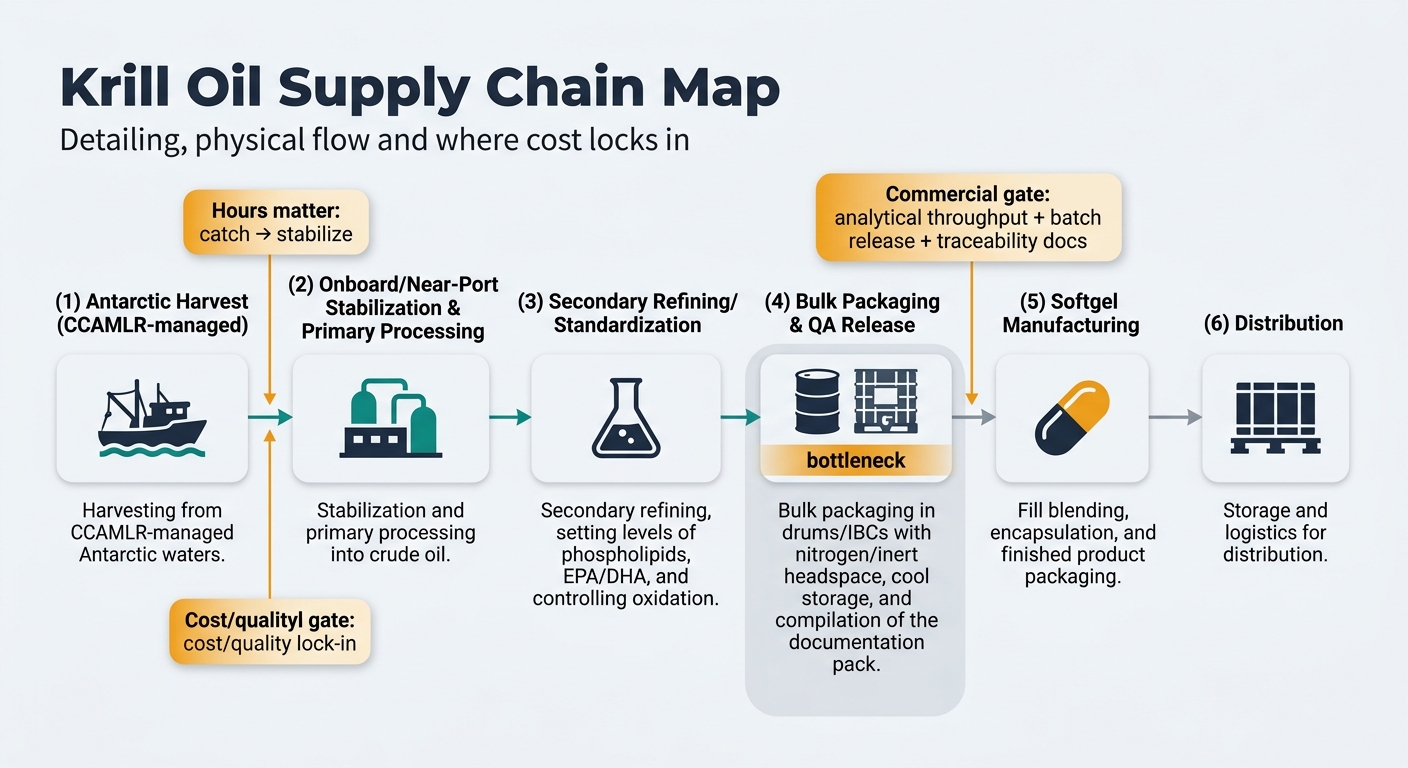
Costs compound at each node, but not evenly: upstream is dominated by quota-compliance + vessel economics; midstream is dominated by yield protection + analytical release; downstream is dominated by conversion (softgels), packaging, and documentation overhead.
Krill oil is typically sold as (a) bulk standardized oil (ingredient), (b) softgel fill blend, or (c) finished softgels. Each step adds both cost and “spec certainty.”
Even without discussing buying strategy, you can predict where suppliers will be inflexible: nodes with hard capacity limits (vessels, extraction/refining lines, softgel lines) and nodes with non-negotiable compliance work (batch testing, chain-of-custody, traceability packs).
The upstream node is a capacity-and-compliance business, not a farming business—vessel days, fuel, and monitoring requirements dominate, and the harvest window constrains throughput.
Fixed cost drivers typically include specialized vessel CAPEX/depreciation, crew, fuel/bunkers, Antarctic logistics, and continuous monitoring/recordkeeping under CCAMLR rules; quality loss accelerates if krill isn’t stabilized quickly (rapid enzymatic breakdown is a known handling challenge in krill fisheries). [1]
Upstream constraints show up downstream as allocation risk and spec variability (especially oxidation and sensory). If upstream handling slips, downstream “rework” is limited—lots may be downgraded, blended, or fail tighter customer specs.
Primary processing is where usable yield is determined: process speed, oxygen control, and separation efficiency decide how much crude oil is recoverable and how much is lost to degradation or ends up in co-products.
Cost drivers include onboard/near-port processing equipment, energy, maintenance, and in-process QC. Co-product economics (e.g., meal for feed) can partially offset net oil cost, but only if co-products meet downstream specs and demand.
Variability at this node expresses later as batch-to-batch differences in oxidation markers, phospholipid content, and odor/color—directly impacting downstream standardization effort and release timelines.
This node converts “crude oil” into a consistent ingredient by removing variability and meeting tight supplement specs; it is the main technical value-add step for ingredient-grade krill oil.
Major cost drivers include filtration/purification, antioxidant systems, nitrogen blanketing/inert handling, and high-frequency lab testing (EPA/DHA assay, phospholipids, oxidation markers such as PV and p-anisidine, plus contaminants aligned to customer/regulatory expectations). Industry frameworks commonly reference PV/p-AV/TOTOX concepts, and TOTOX is typically calculated as (2 × PV) + p-AV. [3]
This is the bottleneck for “documentation-ready” material: the cost isn’t only equipment—it’s analytical throughput and batch release discipline. Expect longer lead times when labs are congested or when lots require additional testing, investigation, or rework.
Bulk handling is deceptively expensive because the product is oxidation-sensitive; packaging is a quality-control system (barrier + inert headspace), not just a container.
Costs include food-grade drums/IBCs, nitrogen flushing, oxygen barrier liners, temperature-controlled warehousing (cool storage), sampling/retain management, and full CoA/documentation packs (traceability from vessel/batch, allergen statements for crustacean, and change-control records). Chain-of-custody certification (e.g., MSC CoC) is an established mechanism to maintain traceability integrity through the chain. [4]
Small “handling” deviations—warm docks, poor headspace control, slow turnover—can translate into oxidation drift and shortened shelf-life, which later appears as higher reject rates or tighter inbound QC at your plant/CMO.
Softgels are a manufacturing conversion business with high fixed overhead: line utilization, shell material, and packaging components can outweigh the incremental processing cost of the oil itself.
Key cost drivers include softgel line OEE (overall equipment effectiveness), gelatin (or alternative shells), plasticizers, encapsulation labor, in-process QA (leakers, fill weight, seam integrity), and finished-pack components (bottles/blisters, desiccants, labels, tamper evidence). Heat exposure control matters during processing and storage.
Finished-product availability is often constrained by encapsulation capacity and packaging component lead times—not by oil availability alone—so the physical chain’s “last mile” can become the service-level limiter.
| Supply Chain Node | Cost Ratio (% of Final Cost) | Notes |
|---|---|---|
| Upstream Harvest & Stabilization | 35% | Vessel economics + compliance + fuel; yield protection starts here. |
| Primary Processing (Crude Oil) | 15% | Separation efficiency, energy, maintenance; co-product offsets vary. |
| Secondary Refining & Standardization | 25% | Purification + antioxidant systems + intensive testing/release. |
| Bulk Packaging & QA Release | 10% | Nitrogen blanketing, drums/IBCs, cool storage, documentation pack. |
| Logistics & Distribution | 15% | Temperature-managed freight, insurance, import compliance; longer lanes add financing cost. |
| Supply Chain Node | Cost Ratio (% of Final Cost) | Notes |
|---|---|---|
| Standardized Bulk Krill Oil Input | 45% | Ingredient cost is still the anchor, but not the whole story. |
| Blend Prep & In-Process QA | 10% | Antioxidants/tocopherols, inert handling, blend uniformity, sampling. |
| Bulk Packaging (Fill) & Release | 10% | Oxygen control, retains, batch records for CMO/brand. |
| Logistics & Storage | 15% | Temperature management + scheduling to avoid warm holds. |
| Converter Margin/Overhead | 20% | Fixed overhead recovery depends on utilization and batch sizing. |
| Supply Chain Node | Cost Ratio (% of Final Cost) | Notes |
|---|---|---|
| Standardized Oil (or Fill Blend) | 30% | Oil is critical, but conversion dominates total cost. |
| Encapsulation (Softgel Conversion) | 20% | Line time, labor, yields (leakers/rejects), cleaning/changeovers. |
| Packaging Components & Packing | 18% | Bottles/blisters, caps, labels, inserts, tamper evidence, desiccants. |
| QA/QC & Compliance Documentation | 12% | Finished-product testing, stability, batch records, allergen controls. |
| Logistics & Distribution | 10% | Warehousing + outbound; heat protection still matters. |
| Wholesale/Retail Margin | 10% | Channel markups vary widely by route-to-market. |

Krill oil’s biggest constraints are physical and regulatory: a concentrated harvesting geography with limited seasons, a small number of industrial-scale operators, and a QA/documentation burden that scales with claims and market access.
These constraints persist even when demand is flat because they’re driven by fleet capacity, Antarctic operating conditions, CCAMLR catch controls, and the time required for analytical release and traceability documentation (including chain-of-custody where required). The CCAMLR framework includes an interim trigger level of 620,000 tonnes (Area 48) with subarea distribution rules, which shapes effective availability and allocation behavior. [1]
Planning errors show up as either (a) service failures due to capacity/seasonality, or (b) quality failures due to oxidation drift and documentation gaps—both expensive to fix late in the chain.
Insight: Upstream concentration amplifies single-point failures.
Data: Antarctic harvesting requires specialized vessels and strict monitoring; weather/ice can reduce effective fishing days and harvest outcomes, and peak season is typically January–May. [2]
Procurement Impact: Any disruption upstream propagates quickly because there are fewer “swing” suppliers with spare capacity and equivalent handling discipline.
Insight: Oxidation control is a chain property, not a lab result.
Data: PV/p-AV/TOTOX outcomes (and broader oxidation stability) are influenced by time-to-stabilize, oxygen exposure during processing, inerting during bulk fill, and temperature history in storage/transport; TOTOX is commonly expressed as (2 × PV) + p-AV. [3]
Procurement Impact: Two suppliers can hit the same CoA today but diverge in stability over shelf life if their handling controls differ; this becomes a hidden cost via rejects, rework, or shortened expiry.
Insight: Documentation is a physical workload with its own bottlenecks.
Data: Traceability (vessel-to-batch), allergen controls (crustacean), sustainability credentials (often MSC fishery + chain-of-custody), and change-control records require disciplined batch record systems and periodic renewals/audits. [4]
Procurement Impact: When documentation lags, material can be “physically available but commercially unusable,” delaying launches and increasing expediting costs.
Insight: The earliest hours of the chain (catch → stabilization → processing) determine the ceiling for quality and yield.
Data: Rapid decomposition of unprocessed krill is a known constraint, which is why krill is often processed into oil/meal quickly; downstream refining can standardize within limits but cannot fully “undo” poor early handling. [5]
Procurement Impact: Supplier assessments must treat onboard/primary processing capability as a first-order quality driver, not a background detail.
Insight: Secondary processing and QA release are the technical value-add and the schedule gate.
Data: Standardization to phospholipids/EPA-DHA targets plus oxidation/contaminant limits requires high analytical throughput and controlled bulk handling.
Procurement Impact: Lead times and service levels often hinge on lab capacity, batch release discipline, and documentation completeness.
Insight: Finished softgels are constrained by conversion and packaging capacity as much as by oil supply.
Data: Encapsulation yields, changeovers, and component lead times can dominate the last mile.
Procurement Impact: Supply continuity risk can sit downstream even when bulk oil is available.
(Analyzed at: Jul, 2026) Contract for “release-ready supply,” not just kilograms of oil: require your supplier/CMO to provide (a) batch-level chain-of-custody/traceability continuity (where MSC claims are in-scope), and (b) objective handling evidence (inerting method, storage temperature range, and time-out-of-control limits) as deliverables alongside the CoA.
This works because krill supply is structurally capped by CCAMLR controls (including the 620,000-tonne trigger level in Area 48), while oxidation performance is accumulated across nodes and can’t be fixed at receipt. [1]
What’s at stake is typically a quiet but material cost band—often mid-single-digit percent of landed cost—showing up as shelf-life loss, rejects, and expedite fees when “physically available” lots become commercially blocked by documentation gaps or stability drift.


