
INDUSTRY TRENDS

Konjac Powder Supply Chain Map for QA-Led Procurement: Critical Nodes, Cost Lock-In, and Spec Controls

Author
Team Tridge
DATE
August 28, 2026
8 min read
konjac-powder Cover
Unlock Full Data
Konjac Powder Market Intelligence
Prices · Trends · Origins · Forecasts

Konjac powder sourcing risk is rarely just “availability.” For Quality/Safety/Compliance-led purchasing, the real variability comes from where the wet corm is stabilized into chips, how crude flour is refined/standardized, and whether moisture is controlled through packaging and logistics. This guide maps those physical nodes so your supplier approval and specification governance match where quality actually “locks in.”
Executive Summary

  • Two-step conversion is the constant: wet corm → chips → refined/standardized KGM powder; drying and refining are where performance and compliance risk concentrate [1].
  • Mesh is not performance: hydration/viscosity behavior is strongly influenced by particle size distribution and powder morphology, not just a mesh label [2].
  • Moisture is a supply-chain variable: konjac is moisture-sensitive; packaging and transit humidity control materially affect caking and usability even when “COA passes” [3].
  • Compliance specs are real and test-method dependent: ash/viscosity/impurity limits differ by grade and jurisdiction (e.g., additive specs), so COA comparability matters [4].
  • Market reality (Aug 2026): Southeast Asia (porang/konjac chips) continues to build export corridors into China, reinforcing why “chips” are a strategic node to map—not just finished powder exporters [5].
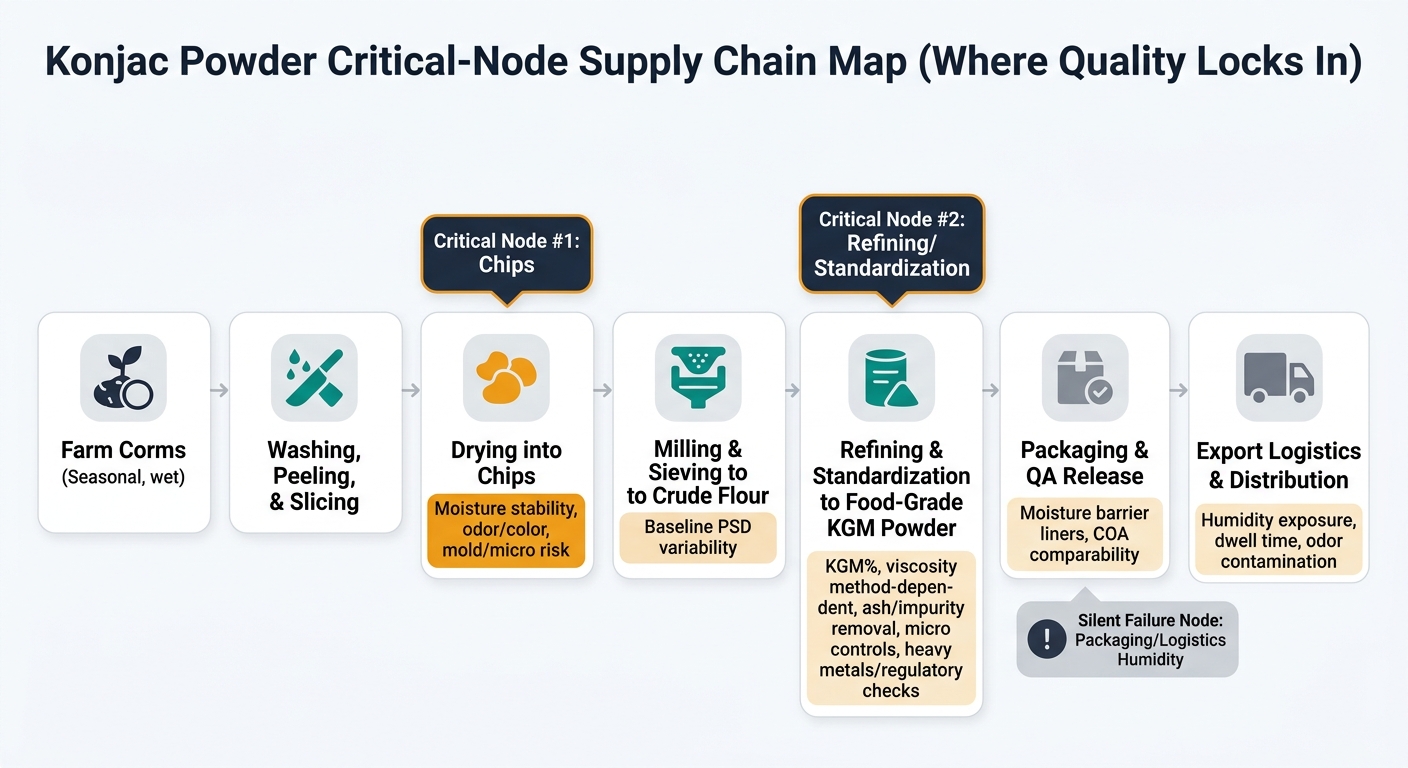
A left-to-right supply chain flow showing the physical build of konjac powder with clearly labeled nodes and “lock-in” callouts, including farm corms through export logistics, with emphasis badges for Critical Node #1: Chips, Critical Node #2: Refining/Standardization, and a smaller badge for Silent Failure Node: Packaging/Logistics Humidity.

1) How Konjac Powder Is Physically Built (and Where Costs “Lock In”)

Insight: Konjac powder is not a single-step “milled crop.” It is an agricultural corm that is stabilized into chips, then refined into functional hydrocolloid grades where most value (and most quality risk) is created [1].

Data: The physical flow typically runs: farm corms → washing/peeling/slicing → drying into chips → milling into crude flour → refinement/standardization into food-grade konjac glucomannan (KGM) powder → packing/QA release → export distribution. The biggest fixed cost drivers are drying energy, yield loss during refinement/clean-up, and QA/testing + documentation required by food buyers [6].

Procurement Impact: If you only map “origin country → exporter,” you miss the two nodes that determine performance and compliance: chip production (moisture stability/odor/color/mold risk) and refining/standardization (KGM%, viscosity, ash/impurity removal, micro controls, and lot consistency). Your spec and approval workflow should reflect these physical nodes, not just the final packer.

2) Where Cost and Margin Accumulate by Node (What Each Step Must Pay For)

Insight: Konjac powder’s economics are dominated by conversion steps—stabilizing a wet, seasonal crop into a storable intermediate, then converting that intermediate into standardized functional grades.

Data: Across suppliers, cost share shifts by grade: standard food-grade powder is more raw-material and energy driven; high-viscosity/high-purity (lower ash/impurities) grades carry higher refinement yield loss and higher QA overhead, because more material is removed and more verification is needed to hold tighter limits [4].

Procurement Impact: When two offers look similar on paper, the underlying cost base may differ because one supplier is absorbing higher refinement losses, tighter classification/PSD control, or micro/hygiene controls—all of which typically show up later as fewer holds or fewer performance complaints.
1. Upstream / Raw Material (Corm Farming + Aggregation)

  • Insight: The chain starts with a seasonal, high-moisture corm; quality is set early by cultivar, maturity, and post-harvest handling.
  • Data: Farm cost is driven by planting material, harvest labor, and yield variability; glucomannan content and downstream functional potential vary with source and handling [7].
  • Procurement Impact: “Origin” is not a label detail here—it predicts functional variability. If you see unexplained viscosity swings lot-to-lot, the root cause often traces back to raw corm quality and aggregation discipline rather than downstream packing.

2. Stabilization (Washing, Slicing, Drying into Konjac Chips)

  • Insight: Drying is the first major conversion step; it reduces spoilage risk and creates the storable intermediate that enables year-round milling.
  • Data: Fixed drivers are fuel/electricity for drying, water use for washing, and losses from trimming/peeling. Moisture control is critical: chips that re-absorb humidity can develop odor/discoloration, mold risk, or downstream caking [1].
  • Procurement Impact: For QA-led buying, chips are the “hidden node” behind many downstream issues: off-odor, color drift, and micro load often start with inadequate drying or poor humidity control in storage.

3. Primary Processing (Milling/Sieving into Crude Konjac Flour)

  • Insight: Crude flour is a variable intermediate; it is not yet a consistent functional ingredient.
  • Data: Costs come from milling energy, wear parts, sieving labor, and yield loss from removing coarse fiber/impurities. This node also determines baseline particle size distribution (PSD) before refinement.
  • Procurement Impact: If your application is sensitive to hydration speed or gel texture, crude-flour variability can show up later even if the COA lists a similar “mesh.” Mesh alone does not fully describe PSD, fines fraction, or surface morphology that drives hydration behavior [2].

4. Secondary Processing / Manufacturing (Refining + Standardizing Food-Grade KGM)

  • Insight: This node creates “buyable” konjac powder: purification/clean-up, controlled milling/classification, and standardization to hit KGM% and viscosity targets.
  • Data: The largest cost drivers are refinement yield loss (removing ash/impurities and tightening color/odor), controlled milling/classification, and in-process QC (viscosity testing, moisture, ash, micro, and—depending on market—contaminants such as heavy metals). Regulatory additive specifications also differentiate impurity limits between konjac gum and konjac glucomannan (e.g., ash/protein/starch limits), which is why grade definition and test methods matter [4].
  • Procurement Impact: This is where supplier capability differences matter most. Two suppliers can both sell “food grade,” but one may be built for stable high-viscosity / lower-ash output while another is optimized for throughput. Your spec should mirror the performance-critical attributes (viscosity method and conditions, KGM%, ash ceiling, moisture cap, PSD window), not just a generic grade name.

5. Packaging, QA Release, and Compliance Documentation

  • Insight: For konjac, packaging is a functional control: it protects moisture-sensitive powder and preserves flowability and viscosity performance.
  • Data: Cost drivers include multiwall bags + PE liners, optional desiccants, metal detection/sieving, batch coding, and COA generation. Many supplier PDS documents explicitly call out “store cool and dry / away from moisture,” reflecting that moisture control is part of maintaining spec conformance over time [3].
  • Procurement Impact: If you see frequent “hard lumps” or poor dispersion, it is often a packaging/humidity control failure rather than a formulation issue. Packaging specs (liner gauge, sealing integrity, pallet wrap, warehouse RH expectations) are part of the physical supply chain, not an afterthought.

6. Export Logistics & Distribution (Ambient Dry Freight)

  • Insight: Konjac powder ships ambient, but it is humidity- and odor-sensitive; logistics quality can change usability even when lab specs pass at release.
  • Data: Key cost components are inland drayage, container freight, warehousing, and protective measures against humidity (container liners, desiccants). Moisture exposure risk increases with long dwell times and humid ports/warehouses.
  • Procurement Impact: If you receive lots that meet COA but behave inconsistently, investigate transport/storage conditions (humidity exposure, prolonged port dwell time, shared-warehouse odor contamination) as a physical root cause.

Product-Level Cost Breakdown (Indicative Ratios)

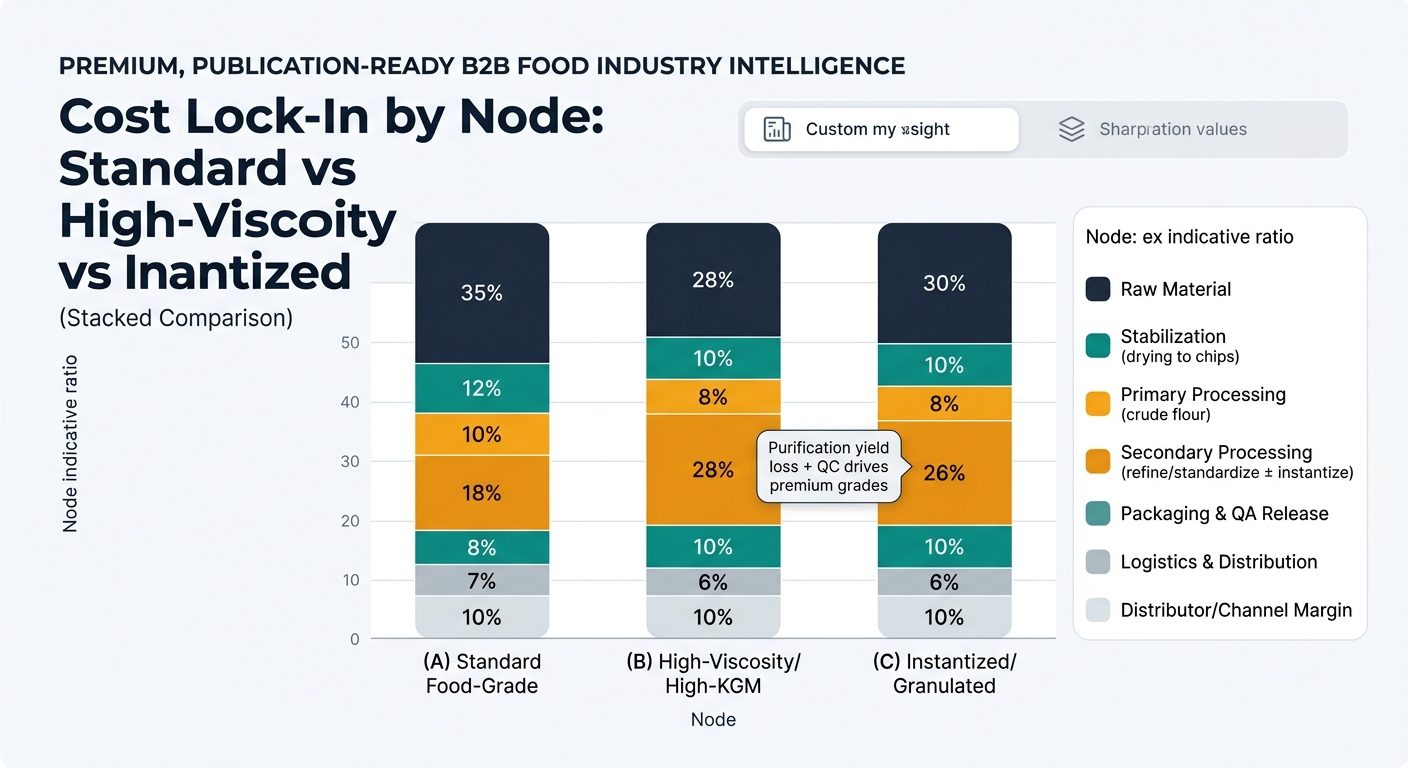
A stacked bar chart comparing cost lock-in by node across three konjac powder grades (Standard Food-Grade, High-Viscosity/High-KGM, Instantized/Granulated), segmented by raw material, stabilization, primary processing, secondary processing, packaging & QA release, logistics & distribution, and distributor/channel margin, using the indicative ratios from the tables and noting that purification yield loss and QC drive premium grades.

A) Standard Food-Grade Konjac Powder (General Thickening)

Supply Chain Node Cost Ratio (% of Final Cost) Notes
Raw Material (corms/chips value) 35% Seasonal corm/chip economics dominate baseline cost.
Stabilization (drying to chips) 12% Energy-intensive drying + storage losses.
Primary Processing (crude flour) 10% Milling/sieving + yield loss.
Secondary Processing (refine/standardize) 18% Purification + controlled milling; moderate QA intensity.
Packaging & QA Release 8% Moisture barrier liners + COA/testing.
Logistics & Distribution 7% Ambient freight + humidity protection.
Distributor/Channel Margin 10% Varies by region and pack size.

B) High-Viscosity / High-KGM Konjac (Performance-Critical Grades)

Supply Chain Node Cost Ratio (% of Final Cost) Notes
Raw Material (corms/chips value) 28% Better raw inputs reduce downstream variability but cost more.
Stabilization (drying to chips) 10% Tighter moisture control, better storage discipline.
Primary Processing (crude flour) 8% More controlled milling/sieving to protect functionality.
Secondary Processing (refine/standardize) 28% Higher purification yield loss + tighter classification.
Packaging & QA Release 10% More frequent verification; tighter moisture controls.
Logistics & Distribution 6% Similar freight, higher protection expectations.
Distributor/Channel Margin 10% Often sold through specialty ingredient channels.

C) Instantized/Granulated Konjac (Dispersion-Focused)

Supply Chain Node Cost Ratio (% of Final Cost) Notes
Raw Material (corms/chips value) 30% Similar raw dependence; dispersion consistency starts upstream.
Stabilization (drying to chips) 10% Moisture stability is critical to prevent granule collapse.
Primary Processing (crude flour) 8% Baseline milling before granulation/instantizing.
Secondary Processing (refine + instantize/granulate) 26% Added processing step (agglomeration/instantizing) + yield loss.
Packaging & QA Release 10% Flowability protection; anti-caking controls.
Logistics & Distribution 6% Humidity protection remains key.
Distributor/Channel Margin 10% Higher value-add product positioning.
Sourcing Window Radar
Konjac Powder — Global Harvest Calendar
CHINA SEASON ACTIVE
🇨🇳 China
JAN — DEC
🇮🇳 India
JAN — JAN
JanFebMarAprMayJunJulAugSepOctNovDec

3) Structural Facts That Don’t Change (Even When the Market Does)

Insight: The konjac supply chain has a few “constants” that shape availability, quality variance, and compliance workload regardless of price cycles.

Data: Three structural realities show up repeatedly across regions and supplier types.

Procurement Impact: If your internal governance ignores these constants, you end up solving the same problems repeatedly (performance drift, COA gaps, and surprise changes).

  • Insight: Konjac is a two-step conversion chain (wet crop → chips → refined powder), and each conversion step can permanently change downstream performance.
  • Data: Drying and refinement introduce the largest irreversible shifts: moisture stability, odor/color, impurity/ash reduction, and viscosity potential [1].
  • Procurement Impact: Treat chips and refining as “critical nodes” in your supplier mapping; the final exporter/packer may not control the real variability drivers.
  • Insight: “Mesh” is not a complete spec for functional performance.
  • Data: Hydration behavior depends on PSD (fines vs. coarse fraction) and particle morphology; studies on commercial KGM show large differences in hydration time and viscosity development linked to these powder properties [2].
  • Procurement Impact: For performance-critical uses, specs typically need a tighter definition of PSD/dispersion expectations (and aligned test methods) than mesh alone.
  • Insight: Moisture is a quality and logistics variable, not just a lab number.
  • Data: Packaging systems (liners/films and optional desiccants) are widely used to prevent powder caking driven by moisture ingress during packing and distribution [8].
  • Procurement Impact: Packaging and logistics controls (liners, sealing, warehouse segregation, container humidity management) are part of the physical spec and should be treated as such.

4) Key Insights to Carry into Your Next Spec Review

Insight: Most downstream issues (holds, complaints, inconsistent viscosity) trace back to a small set of physical levers: raw material variability, drying discipline, refinement yield trade-offs, and moisture control through logistics.

Data: The highest-cost nodes are typically drying (energy) and refinement/standardization (yield loss + QC); the highest “silent failure” node is often packaging/logistics humidity exposure.

Procurement Impact:Key Takeaways: (1) Map suppliers by who controls chips and refining—not just who ships the bag. (2) Keep specs anchored to functional drivers (viscosity method, KGM%, ash, moisture, PSD/dispersion) rather than grade names. (3) Treat packaging and humidity controls as technical requirements because they protect usability, not just appearance.

5) The Bottom Line for Your Next Contract

(Analyzed at: Aug, 2026)

Southeast Asian chip export capacity (notably Indonesia’s porang/konjac chip corridors into China) is expanding, which increases the odds that your “powder supplier” is indirectly exposed to multi-tier chip sourcing and changeovers [5]. The most effective contract move is to require site-level disclosure and change-control specifically for the chip source and the refining/standardization site, and to contractually tie any change to a defined verification package (updated COA methods + retain sample + targeted incoming tests for viscosity/ash/moisture/PSD). It works because chips and refining are where performance irreversibly locks in, while moisture exposure is where “COA-pass, plant-fail” events are born. If you don’t do this, the cost shows up as avoidable holds and rework—often a few cents per pound in unit price saved turning into tens of thousands of dollars per incident in downtime and disposition.

Konjac PowderSupply Chain Intelligence
130 countries tracked
10
Exporters
10
Importers
$35M
Top Export Value
Top Exporters (2024)
🇹🇷
Turkey
$35M
🇪🇸
Spain
$34M
🇪🇬
Egypt
$29M
🇳🇱
Netherlands
$23M
🇩🇪
Germany
$21M
+125 more
Top Buyers
🇺🇸 United States $121M🇩🇪 Germany $92M🇳🇱 Netherlands $57M🇮🇹 Italy $38M🇯🇵 Japan $34M

References

  1. pmc.ncbi.nlm.nih.gov
  2. sciencedirect.com
  3. cagcolloids.com
  4. efsa.onlinelibrary.wiley.com
  5. karantinaindonesia.go.id
  6. ams.usda.gov
  7. sciencedirect.com
  8. patents.google.com

Related Contents

Subscribe
→
By subscribing you agree to with our Privacy Policy and provide consent to receive updates from our company.
Thank you! Your submission has been received!
Oops! Something went wrong while submitting the form.
Subscribe to receive the latest blog posts, updates, promotions, and announcements from Tridge.
