INDUSTRY TRENDS

King Oyster Mushroom Powder Sourcing (Pleurotus eryngii): Cost Drivers, Risk Triggers, and Procurement Control Points

Author
Team Tridge
DATE
April 2, 2026
10 min read
king-oyster-mushroom-powder Cover
Tridge Eye Data Intelligence Solution

This report is powered by Tridge Eye Data Intelligence.

Every data point, price signal, and supply risk insight in this analysis comes from the same platform that procurement and sourcing leaders worldwide rely on daily. As you read, consider what this level of market intelligence could do for your sourcing decisions.

Explore Tridge Eye →

This guide is written for Procurement & Sourcing Management teams who are comfortable buying other dehydrated ingredients, but want a clear “how the chain works + where to intervene” view for king oyster mushroom powder. The core message: treat it as a dehydration-economics + compliance-sensitive ingredient—where drying yield, energy exposure, micro/spec governance, and border/documentation discipline drive most of the landed-cost and continuity outcomes.

Executive Summary

  • Supply chain reality: Value and risk concentrate at dehydration, QA release, and cross-border logistics, not evenly across “a generic powder.”
  • Structural driver: Fresh king oyster mushrooms are ~89% moisture in published literature, so fresh-to-dry yield + drying energy create a price floor and volatility channel [1].
  • Border/compliance is a continuity lever: FDA Import Alert 25-05 explicitly references mushroom powder and pulverized/ground mushrooms as subject to DWPE conditions under the alert—meaning documentation and firm history can become the bottleneck [2].
  • EU buyer expectations (benchmark): EU importers commonly ask exporters of dried mushrooms for lab tests for Salmonella, Listeria, E. coli, Staphylococcus and often heavy metals—useful as a governance baseline even if you sell in the US [3].
  • Spec stringency can be “nonlinear” cost: Finer mesh, lower moisture/aw, and tighter micro limits can increase rejects/rework and effective cost even when fresh mushroom prices are flat.
  • Cost tables are illustrative: The ratio tables below are modeled to focus team effort; they are not industry “standards.” (They do sum to 100%.)

Key Insights

Analyzed at: Apr, 2026

  • Strategy: Hold
  • Reliability: Medium
  • Potential Saving: 6% ~ 12%
  • Insight: In 2026, the most reliable savings lever for king oyster mushroom powder is typically spec-normalized competitive tension (2+ qualified supply options) plus contract mechanics that separate energy/yield-driven moves from margin expansion. Use a 60–90 day sprint to (1) lock moisture/aw + mesh + micro release rules, (2) benchmark quotes on identical Incoterms/MOQs, and (3) add at least one alternate region/channel to reduce DWPE and route concentration exposure (FDA Import Alert 25-05 explicitly calls out mushroom powder/ground dried mushrooms) [2].

1) What the Supply Chain Really Looks Like (So You Don’t Source It Like a “Generic Powder”)

King oyster mushroom powder (Pleurotus eryngii) is an indoor-cultivated, high-moisture crop turned into a shelf-stable powder via energy-intensive dehydration and milling. The procurement “truth” is that your cost and risk exposure is not evenly distributed—it concentrates at dehydration, QA release, and cross-border logistics.
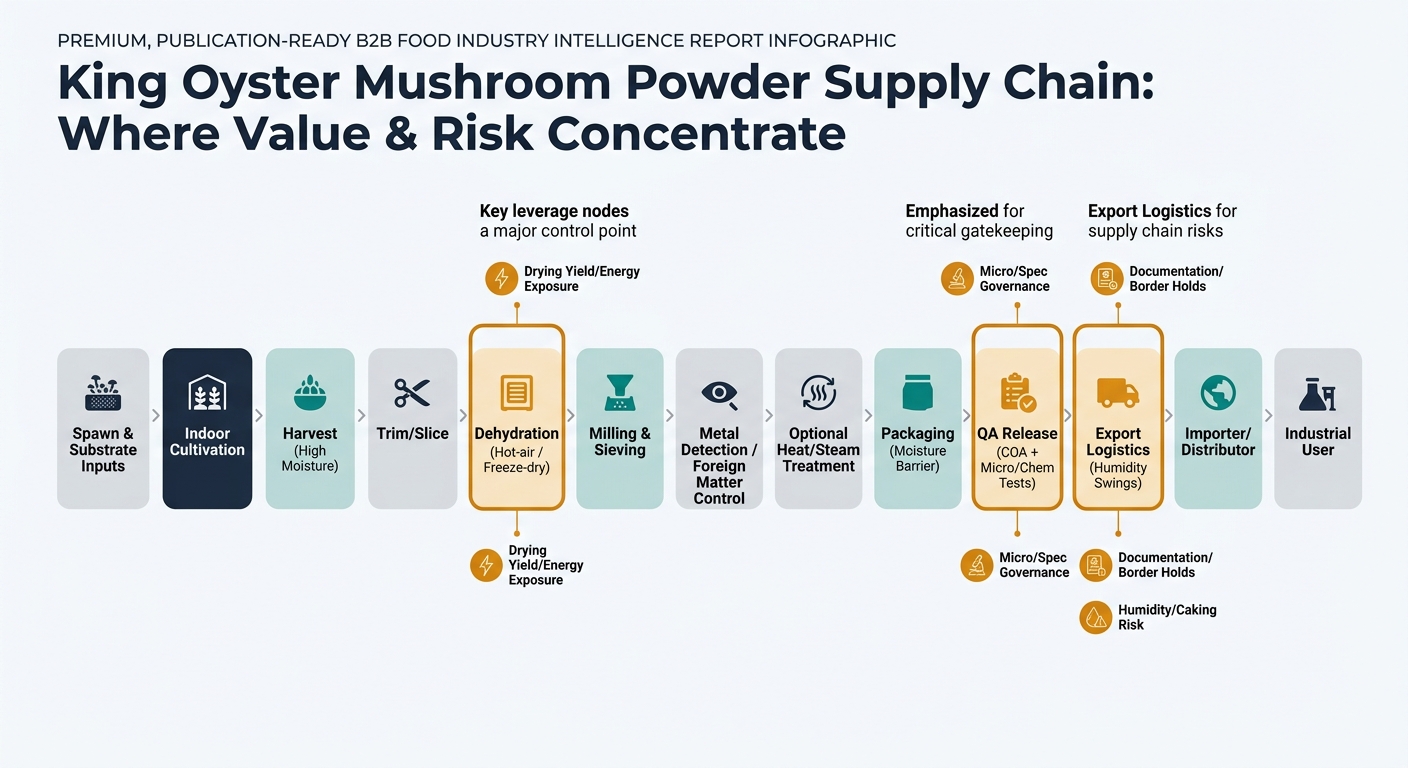
Ground-truth flow (typical B2B ingredient route)

  1. Spawn & substrate inputs → inoculation and indoor growing (bags/bottles)
  2. Fresh king oyster harvest (high moisture; highly perishable)
  3. Primary processing: trim/slice → drying (hot-air most common; freeze-dry premium)
  4. Secondary processing: milling → sieving/metal detection → (optional) heat/steam treatment → blending/standardization
  5. Packaging & QA: moisture barrier liners, COA, micro/chem testing, traceability
  6. Export logistics: ambient shipment but humidity-sensitive (caking risk)
  7. Importer/distributor (common in US/EU) → industrial users (seasoning, soups, snacks, meat analogs)
A left-to-right supply chain diagram for king oyster mushroom powder showing stages from spawn/substrate inputs through cultivation, harvest, trimming/slicing, dehydration (hot-air or freeze-dry), milling/sieving, metal detection, optional heat/steam treatment, packaging, QA release, export logistics, importer/distributor, and industrial user. The diagram highlights dehydration, QA release, and cross-border logistics as key value/risk control points with callouts for drying yield/energy exposure, micro/spec governance, documentation/border holds, and humidity/caking risk.

Why this matters for Procurement & Sourcing Management

  • Fresh mushrooms are ~89% water in published literature for P. eryngii, which means drying yield economics dominate and make powder pricing structurally sensitive to both input availability and energy [1].
  • Powder is often made from dried slices/chips as an intermediate; inventory coverage creates price “lag” (your supplier may quote based on their dried inventory position, not today’s fresh market).
  • Food safety and compliance risk is not theoretical: FDA has an import alert specifically referencing mushroom powder / ground dried mushrooms under detention without physical examination conditions [2].

2) Where the Money Actually Accumulates (Cost Stack by Node, Not Just $/kg)

Key insight

For king oyster mushroom powder, dehydration + QA release + logistics are the leverage points. Farming is important, but procurement outcomes are usually decided by:

  • Fresh-to-dry yield (mass loss) driven by starting moisture and drying endpoint
  • Energy intensity (drying + climate-controlled cultivation) and energy price volatility
  • Spec control costs (micro, foreign matter, particle size distribution)
  • Landed-cost friction (MOQs, packaging, container humidity controls, port variability)

Below is a practical cost-and-margin walk through each node.

2.1 Upstream / Raw Material (Indoor cultivation inputs + fresh mushrooms)

What’s happening operationally

  • Indoor cultivation reduces direct weather exposure, but increases dependence on hygiene controls, labor, and energy reliability.
  • Fresh P. eryngii is high moisture (~89%), so the “raw material” you buy is mostly water that must be removed later [1].

Main cost drivers

  • Substrate materials (sawdust/ag byproducts + supplements)
  • Labor (bagging/inoculation/harvest)
  • Facility overhead + sanitation
  • Losses from contamination events (farm-level shutdowns)

Margin behavior you’ll see

  • Grower/processor integrated models can hide margin shifts between “farm” and “processing” lines; your visibility depends on whether you buy powder vs dried slices vs fresh.

2.2 Primary Processing (Slicing + dehydration)

What’s happening operationally

  • Drying is the conversion step that creates shelf life and tradability.
  • Drying can reduce some microbial loads versus fresh, but it is not a guarantee of pathogen control without validated process controls and buyer-defined release criteria.

Main cost drivers

  • Energy (electricity/gas/steam)
  • Throughput constraints (dryer capacity becomes a bottleneck during demand spikes)
  • Yield loss and rework (over-drying, color impact, flavor loss)

Margin behavior you’ll see

  • In volatile energy markets, suppliers often push increases here; if you don’t separate “input vs energy vs yield,” you end up negotiating blind.

2.3 Secondary Processing (Milling, sieving, standardization, optional kill-step)

What’s happening operationally

  • Milling and sieving drive particle size distribution (mesh), which impacts dispersibility and flavor release.
  • Optional steps (steam/heat treatment) may be used to improve micro performance but can affect sensory and may change your COA profile (so align with R&D/QA).

Main cost drivers

  • Milling energy + wear parts
  • Sieving/metal detection and foreign matter controls
  • Blending/standardization to hit color/flavor targets

Margin behavior you’ll see

  • Ultra-fine mesh specs can increase cost disproportionally (yield loss + slower milling + more rejects).

2.4 Packaging & QA Release (where governance becomes cost)

What’s happening operationally

  • Powder is ambient, but moisture ingress drives caking and quality complaints.
  • QA release depends on the buyer’s spec stringency (micro, heavy metals, residues, allergens) and the supplier’s ability to produce consistent, audit-ready documentation.

What buyers commonly require (examples, not a universal standard)

  • EU importers commonly request testing for microorganisms including Salmonella, Listeria, E. coli, Staphylococcus, and also heavy metals (e.g., cadmium/lead/mercury) for dried mushrooms [3].
  • For specific regulated categories like vitamin D2 mushroom powder on the EU novel foods list, published specifications include explicit limits for moisture, water activity, heavy metals, and microbiological criteria (useful as a reference point for “tight spec” governance even if your product is not vitamin-D fortified) [4].

Main cost drivers

  • Moisture barrier liners, drums/cartons, palletization
  • Lab testing, COA generation, traceability documentation
  • Certification upkeep (GFSI-benchmarked schemes such as BRCGS / SQF / FSSC 22000, plus organic, halal/kosher where applicable)

2.5 Logistics & Distribution (ambient ≠ low-risk)

What’s happening operationally

  • Ocean transit is common; humidity swings create caking risk and can trigger re-sieving or rejection at receiving.
  • Importer/distributor margins are material when you’re not buying direct.

Risk reality

  • FDA import enforcement can directly disrupt continuity; Import Alert 25-05 explicitly includes mushroom powder and pulverized/ground mushrooms as products subject to detention conditions under the alert [2].

Product-level cost breakdown (illustrative, modeled)

Note: These are indicative ratios to help procurement teams focus effort. Actual ratios vary by origin, certification set, order size, and whether you buy direct from processor or via distributor.

A grouped stacked bar chart with three 100% bars labeled: (A) Commodity-grade (hot-air dried), (B) Premium clean label/tighter micro, (C) Freeze-dried. Each bar is segmented by the same nodes—Upstream/Raw Material, Primary Processing (Drying/Freeze-drying), Secondary Processing (Milling/Sieving/Optional treatment), Packaging & QA, Logistics & Distribution, Importer/Distributor Margin—using the article’s modeled percentages and a consistent color legend, with brief annotations highlighting changes across tiers such as higher freeze-drying share, higher Packaging & QA under tighter micro, and margin share changes with channel.

A) Commodity-grade King Oyster Mushroom Powder (industrial, hot-air dried)

Supply Chain Node Cost Ratio (% of final delivered cost) Notes
Upstream / Raw Material 30% Fresh supply + labor + farm overhead; yield sensitivity
Primary Processing (Drying) 22% Energy + capacity + yield loss
Secondary Processing (Milling/Sieving) 12% Mesh control + metal detection
Packaging & QA 10% Liners/drums + COA + micro/heavy metals testing
Logistics & Distribution 14% Ocean freight, insurance, duties, warehousing
Importer/Distributor Margin 12% Common when not buying direct

B) Premium “Clean Label / Tighter Micro” Powder (added controls, tighter release specs)

Supply Chain Node Cost Ratio (% of final delivered cost) Notes
Upstream / Raw Material 28% Higher selectivity/trim standards
Primary Processing (Drying) 20% More controlled drying profile, potential lower throughput
Secondary Processing (incl. optional treatment) 16% Extra step(s) + more rejects to hit spec
Packaging & QA 14% More frequent testing, tighter documentation
Logistics & Distribution 12% Similar freight but higher handling discipline
Importer/Distributor Margin 10% Often reduced if buying more direct

C) Freeze-dried King Oyster Powder (premium sensory/nutrition positioning)

Supply Chain Node Cost Ratio (% of final delivered cost) Notes
Upstream / Raw Material 24% Similar cultivation but higher selection
Primary Processing (Freeze-drying) 32% High capex/energy; throughput constraint
Secondary Processing (Milling/Sieving) 14% Milling may be gentler but still controlled
Packaging & QA 12% Often higher spec expectations
Logistics & Distribution 10% Higher $/kg reduces freight share
Importer/Distributor Margin 8% Depends on channel

3) The Structural Fact That Explains Most Price Behavior

King oyster powder is a “dehydration economics” ingredient.

Two non-negotiables drive procurement outcomes:

  1. Fresh material is mostly water (published ~89% moisture for P. eryngii), so the cost of removing water (energy + time + yield loss) becomes a structural price floor [1].
  2. Compliance and border controls can become the bottleneck, not production capacity—especially if your product is classified/handled like other dried fungi where import enforcement is active [2].

Practical implication: if you only benchmark supplier quotes on $/kg powder without normalizing for moisture/aw, mesh distribution, micro limits, and documentation completeness, you will misread “cheap” vs “expensive.”

4) The Critical Insight: Why Your Powder Price Can Move Even When Fresh Mushrooms Don’t

Procurement teams often expect a simple linkage: “fresh mushroom price up → powder price up.” In practice, you get disconnects because:

  1. Inventory lag
  2. Many processors convert in batches and hold dried intermediates. Powder quotes can reflect older energy/input costs until inventories turn.
  3. Energy and throughput shocks
  4. Drying is energy-intensive; energy spikes can move powder pricing even if fresh supply is stable.
  5. Spec-driven yield loss
  6. Tightening moisture, finer mesh, or stricter micro limits increases rejects/rework—raising effective cost without any change in farm gate.
  7. Border enforcement / documentation events
  8. A single detention event, documentation failure, or supplier listing issue can force re-routing to higher-cost channels or emergency buys. Import Alert 25-05 explicitly references mushroom powder/ground dried mushrooms within its scope [2].

5) Where Procurement Teams Typically Get This Wrong (Patterns That Inflate Cost and Risk)

  1. Treating “mushroom powder” as a commodity spec
  2. Missing controls on moisture/aw, particle size distribution, and foreign matter → leads to caking, inconsistent flavor release, or line issues.
  3. Using COA presence as a proxy for COA quality
  4. COAs can be incomplete or inconsistent lot-to-lot; governance needs defined test methods, frequency, and release rules.
  5. Single-sourcing because qualification is slow
  6. When the disruption hits (port delays, enforcement, plant incident), you qualify under pressure and accept weaker terms.
  7. Negotiating without a should-cost narrative
  8. Suppliers attribute increases to “raw material” even when the driver is energy, yield loss, or packaging/QA scope creep.
  9. Underestimating humidity risk in transit
  10. Ambient shipping still needs moisture barrier packaging discipline; otherwise you pay for rework, claims, and expedited replacements.

6) How an Intelligence-Driven Service Changes the Outcome (Decision-by-Decision, Not Feature Dumping)

Below is how procurement intelligence changes specific decisions for king oyster mushroom powder.

Decision A: “Is this quote fair for the spec we’re buying?”

Signals to monitor

  • Price benchmarks normalized by: moisture spec (and ideally aw), mesh, micro limits, certification set, Incoterms, MOQ
  • Cost drivers: energy trends (drying), FX (if cross-border), packaging inputs

Actions it enables

  • Build a spec-normalized bid comparison (avoid selecting a low $/kg that fails micro or arrives caked)
  • Use driver-based negotiation: separate energy pass-through from margin expansion

KPIs to track

  • Landed cost variance vs benchmark
  • Price variance explained by drivers (% explained vs “unexplained”)

Decision B: “How do we reduce disruption exposure without ballooning QA workload?”

Signals to monitor

  • Supplier concentration by region; lead-time stability; port/route exposure
  • Enforcement and compliance signals relevant to dried fungi/mushroom powders (detention risk)

Actions it enables

  • Maintain a pre-qualified longlist by certification + capability (mesh, micro controls, export readiness)
  • Trigger qualification before disruption (when risk indicators rise)

KPIs to track

  • Supplier concentration (% volume top supplier / top region)
  • Time-to-qualify alternate supplier
  • OTIF and lead time standard deviation

Decision C: “How do we stop spec drift and documentation churn?”

Signals to monitor

  • Lot-to-lot deviations in moisture, micro, color, mesh
  • COA completeness and on-time submission

Actions it enables

  • Centralize vendor/spec governance: required tests, methods, cadence, corrective action rules
  • Performance scorecards tied to claims and nonconformances

KPIs to track

  • Nonconformance/claim rate
  • COA compliance rate (on-time, complete)
  • Supplier corrective action cycle time

7) Strategic Use Cases Procurement Leaders Actually Run (30-60-90 Day Plan)

Use case 1: Reduce landed-cost volatility without sacrificing spec integrity

First 30 days (baseline)

  • Lock the spec: moisture/aw target, mesh distribution, micro limits, packaging, Incoterms
  • Build a benchmark set: comparable suppliers and recent transactions normalized to the spec

Days 31–60 (commercial control)

  • Introduce contract mechanics: energy/FX review triggers, escalation bands, and re-quote rules
  • Split pricing into: raw material proxy + drying/processing + packaging + freight

Days 61–90 (operationalize)

  • Monthly variance review with Finance + QA: what moved and why

Expected outcomes

  • Fewer emergency price discussions
  • Lower “surprise” increases and fewer spec compromises

Use case 2: Build a resilient supplier portfolio (dual-sourcing)

  • 30 days: Longlist by region/certifications/export readiness
  • 60 days: Shortlist 2–3 alternates; align QA test plan and documentation checklist
  • 90 days: Dual-source allocation strategy (e.g., 70/30) + contingency volumes

Expected outcomes

  • Reduced single-point-of-failure exposure
  • Faster response when logistics or compliance events hit

Use case 3: Strengthen governance for micro + documentation

  • Define mandatory tests and COA format
  • Create “no-ship” rules for missing documents
  • Track supplier performance trends and corrective actions

Expected outcomes

  • Fewer holds, rework, and customer complaints
  • Audit readiness and faster internal approvals

8) Why This Matters Beyond Mushrooms (Transferable Procurement Intelligence Patterns)

If you source king oyster mushroom powder, you likely also source other dehydration- or powder-based ingredients where the same intelligence patterns apply:

  • Onion/garlic powders: dehydration energy + crop variability + micro and foreign matter controls
  • Paprika/chili powders: spec drift (color/ASTA, heat), adulteration risk, residue controls
  • Herb powders (parsley, oregano): microbial load management, origin concentration, documentation quality
  • Fruit powders (lemon, berry): carrier systems, hygroscopicity/caking, packaging barrier requirements

The shared lesson: the best procurement outcomes come from spec-normalized benchmarking + early risk triggers + supplier governance, not from running occasional RFQs.

9) Why King Oyster Mushroom Powder Is a Strong “Proof Case” for Intelligence-Led Sourcing

King oyster mushroom powder is a compact example of why procurement intelligence pays off because it combines:

  • High conversion economics (fresh-to-dry yield + energy-intensive drying)
  • High sensitivity to spec definition (moisture/aw, mesh, micro)
  • Real border/compliance disruption potential (dried fungi enforcement environment; mushroom powder explicitly referenced in an FDA import alert context) [2]
  • Operational consequences (caking, inconsistent flavor performance, line stops, claims)

For procurement leaders, it’s a category where better intelligence directly translates into measurable improvements in:

  • Landed cost stability
  • Continuity of supply
  • Supplier optionality
  • Governance and audit readiness
Tridge Eye Data Intelligence Solution

Make Faster, Data-Driven Sourcing Decisions

The insights in this report are just the starting point. Tridge Eye is the data intelligence solution that gives procurement and sourcing leaders real-time market signals, price benchmarks, and supply risk alerts — so you can act before the market moves.
Explore Tridge Eye →

References

  1. sciencedirect.com
  2. accessdata.fda.gov
  3. cbi.eu
  4. eur-lex.europa.eu
Subscribe
By subscribing you agree to with our Privacy Policy and provide consent to receive updates from our company.
Thank you! Your submission has been received!
Oops! Something went wrong while submitting the form.
Subscribe to receive the latest blog posts, updates, promotions, and announcements from Tridge.