
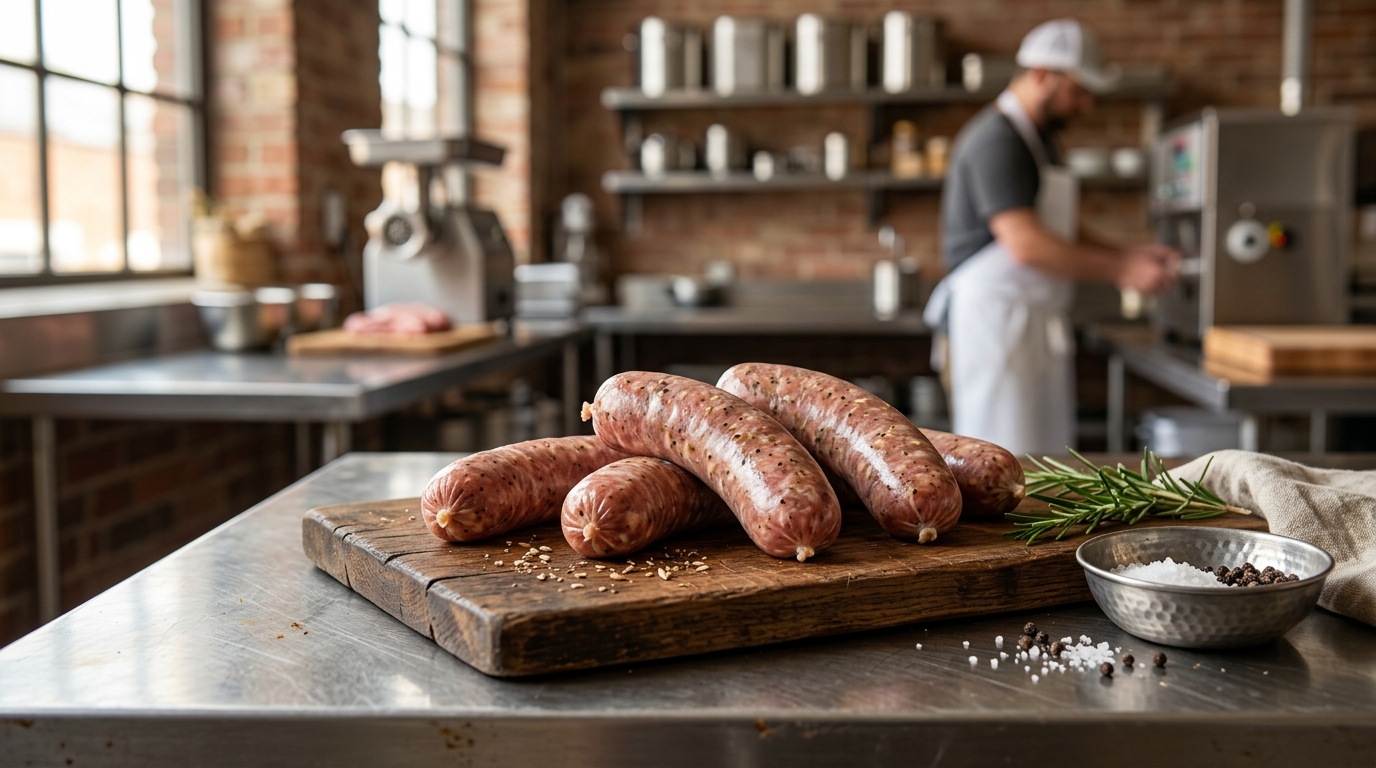
This guide helps customer-facing teams explain—credibly and simply—why Italian sausage cost and service outcomes are “locked in” by a few physical decisions (trim, casing/form factor, packaging + cold chain) well before commercial negotiation. Use it to run better discovery, frame trade-offs, and translate supplier quotes into total cost-to-serve for fresh, cooked, and frozen programs.
Italian sausage is a pork-trim-driven product where the physical constraints—slaughter/boning throughput, trim standardization, casing availability, and cold-chain discipline—set the cost floor long before any commercial discussion happens. The chain is short on paper (hog → trim → grind/stuff → pack → ship), but it contains multiple “point-of-no-return” steps where yield loss, food-safety controls, and shelf-life limits become fixed cost drivers.
Insight: The product’s economics are set by three physical levers: (1) lean/fat trim streams and yields, (2) casing form-factor and stuffing throughput, and (3) chilled shelf-life management through packaging + cold chain.
Data: A typical fresh Italian sausage spec targets a defined lean-to-fat ratio (commonly ~70/30 to ~80/20 depending on customer and cook performance), uses either natural hog casings (variable diameter/strength) or collagen (more uniform), and relies on rapid chilling with tight time/temperature control to protect shelf-life. (Lean/fat targets vary by customer; treat these as common ranges, not a standard.)
Procurement Impact: Even without touching “strategy,” you can map which node is structurally dominant for your SKU: trim (formulation cost), co-man throughput (capacity cost), or packaging/cold-chain (shrink + service failures).

Insight: Italian sausage is a “conversion” business: value is created by turning commodity pork streams into a spec-controlled, shelf-life-limited finished good. Costs stack at each conversion step, and margins (for each actor) depend heavily on yield, downtime, and rework—not just input prices.
Data: Across processed meats, the largest cost block is typically meat input (trim), followed by labor + overhead in processing, then packaging and cold-chain logistics; the exact mix swings by format (fresh vs. cooked vs. frozen) and package type (MAP vs. vacuum).
Procurement Impact: Your SKU’s cost structure can be explained as a physical bill of materials (trim + casings + spice + pack) plus conversion losses (yield, purge, cook loss) plus cold-chain cost-to-serve.

| Supply Chain Node | Cost Ratio (% of Final Cost) | Notes |
|---|---|---|
| Raw Material Cost (pork + trim streams) | 55% | Dominated by lean/fat trim availability and standardization losses. |
| Primary Processing | 8% | Slaughter/boning labor, chilling energy, sanitation and inspection overhead. |
| Secondary Processing | 14% | Grinding/mixing/stuffing labor + downtime; temp control reduces defects. |
| Ingredients (casings + spices) | 6% | Natural casings add sorting/break risk; spices add QA burden. |
| Packaging & QA | 9% | MAP materials + label complexity + hold/release time cost. |
| Cold-Chain Logistics & Distribution | 8% | Reefer transport + cold storage; shelf-life compression raises effective cost. |
| Supply Chain Node | Cost Ratio (% of Final Cost) | Notes |
|---|---|---|
| Raw Material Cost (pork + trim streams) | 58% | Similar meat dominance; sometimes more formulation flexibility than links. |
| Primary Processing | 8% | Throughput and chilling remain key. |
| Secondary Processing | 16% | Mixing/portioning; fewer casing-related stoppages but still OEE-driven. |
| Ingredients (spices + functional) | 7% | Spice verification and allergen control are central. |
| Packaging & QA | 5% | Simpler bags/chubs; QA still consumes shelf-life. |
| Cold-Chain Logistics & Distribution | 6% | Often larger cases, fewer retail handling steps. |
| Supply Chain Node | Cost Ratio (% of Final Cost) | Notes |
|---|---|---|
| Raw Material Cost (pork + trim streams) | 48% | Meat still dominant, but downstream costs rise. |
| Primary Processing | 7% | Same structural drivers. |
| Secondary Processing (incl. thermal) | 20% | Cooking energy + cook loss + higher QA controls; more complex line. |
| Ingredients (casings + spices) | 6% | Similar inputs; tighter control for consistency in cooked bite. |
| Packaging & QA | 9% | Often higher barrier packaging; more coding/traceability demands. |
| Cold-Chain Logistics & Distribution | 10% | Freezing, frozen storage, and frozen freight add structural cost. |
Insight: Sausage doesn’t start from a single “cut”; it starts from trim streams that are created by carcass fabrication choices and competing end-market demand.
Data: When demand shifts toward certain primals, the quantity and composition of trim available for grinding can change, increasing blending and standardization work.
Procurement Impact: Specs that require narrow lean-point bands or strict visual lean definition structurally depend on stable trim streams and can force more costly standardization when the carcass is “spoken for” elsewhere.
Insight: The casing decision sets line speed, scrap rate, and link uniformity; it is a mechanical interface with the stuffing system.
Data: Natural casings vary by diameter and strength; collagen is more uniform and can reduce breakage/downtime but changes sensory attributes.
Procurement Impact: If a program requires natural casing for brand/texture reasons, conversion cost and supply continuity become more sensitive to casing grading, sorting labor, and import logistics.
Insight: Fresh sausage’s sellable life is a shrinking window that starts at production, not at receipt.
Data: QA holds, distribution dwell time, and minor temperature abuse accelerate purge and sensory decline; packaging choice changes oxygen exposure and appearance.
Procurement Impact: Two physically similar SKUs can have materially different realized shrink and service performance depending on QA release time and cold-chain stability.
(Analyzed at: Jul, 2026)
Write your next Italian sausage contract like a risk-and-physics document, not just a price sheet: lock (a) an explicit lean/fat tolerance and allowable trim substitution rules, (b) casing type plus acceptable alternates (e.g., collagen pre-approved if natural casings are disrupted), and (c) minimum remaining shelf-life at receipt with a defined QA hold/release expectation.
This works because current USDA outlooks point to tighter late-2026 hog inventories (which can amplify trim volatility) while refrigerated freight remains capacity-constrained, making on-time, in-temp execution a real cost driver—not a rounding error. [1]
If you don’t codify these flex points, the “same price per lb” can easily turn into a 2–5% swing in realized cost-to-serve through purge, short-code write-offs, and expedited reefer moves when the system tightens.


