
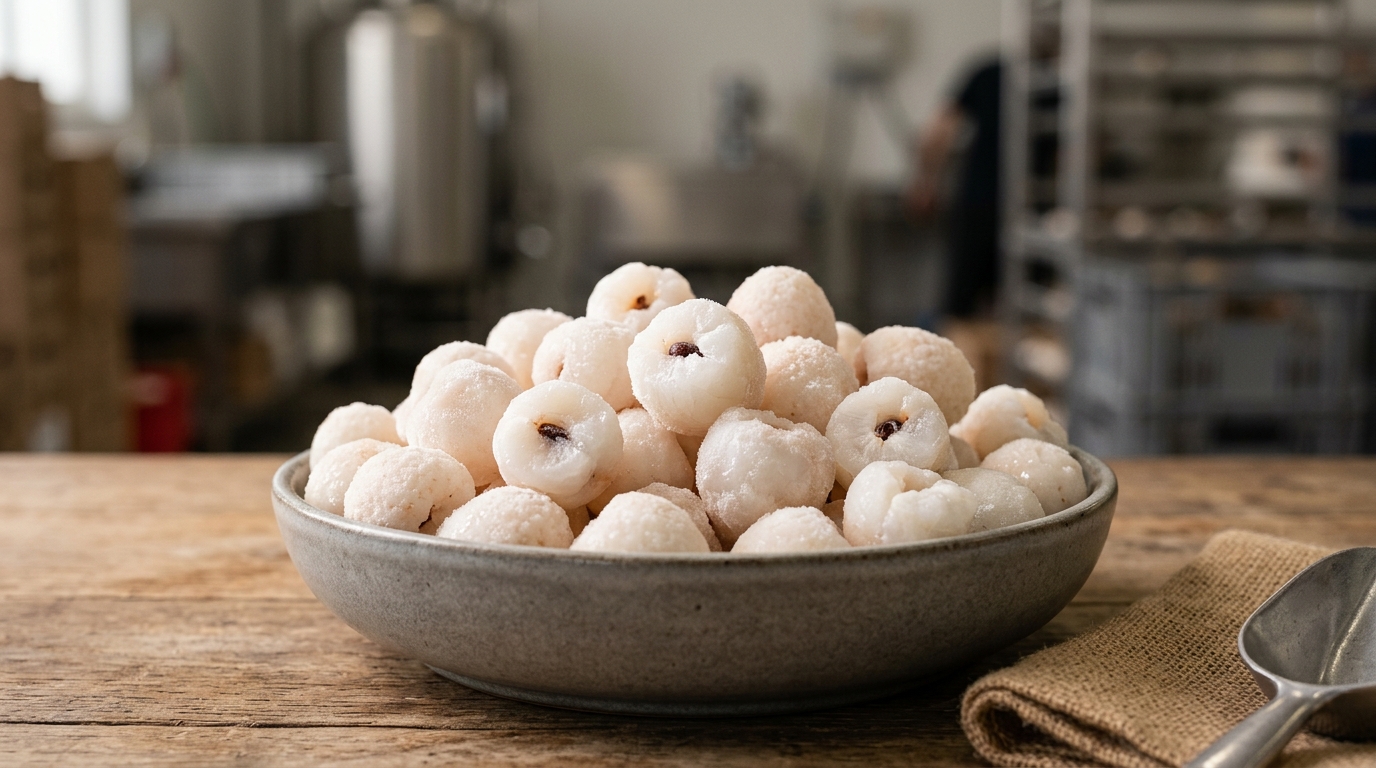
IQF lychee is a “conversion + cold-chain” category: most of your cost, quality, and claims exposure is locked in during fresh-to-frozen conversion (peel/de-seed + sorting) and then protected (or destroyed) by time–temperature control through export and import handling. This guide maps the physical flow, highlights where procurement specs tighten or widen the supplier pool, and clarifies which cost drivers are structural vs. negotiable.
IQF lychee is not “just frozen fruit.” It’s a fast-perishing tropical fruit that must be converted near-orchard into stable, frozen flesh through labor-heavy peeling/de-seeding and energy-heavy freezing—then protected by an unbroken cold chain.
The supply chain is short in number of steps but unforgiving: most cost and quality outcomes are set before the product ever enters a reefer container.
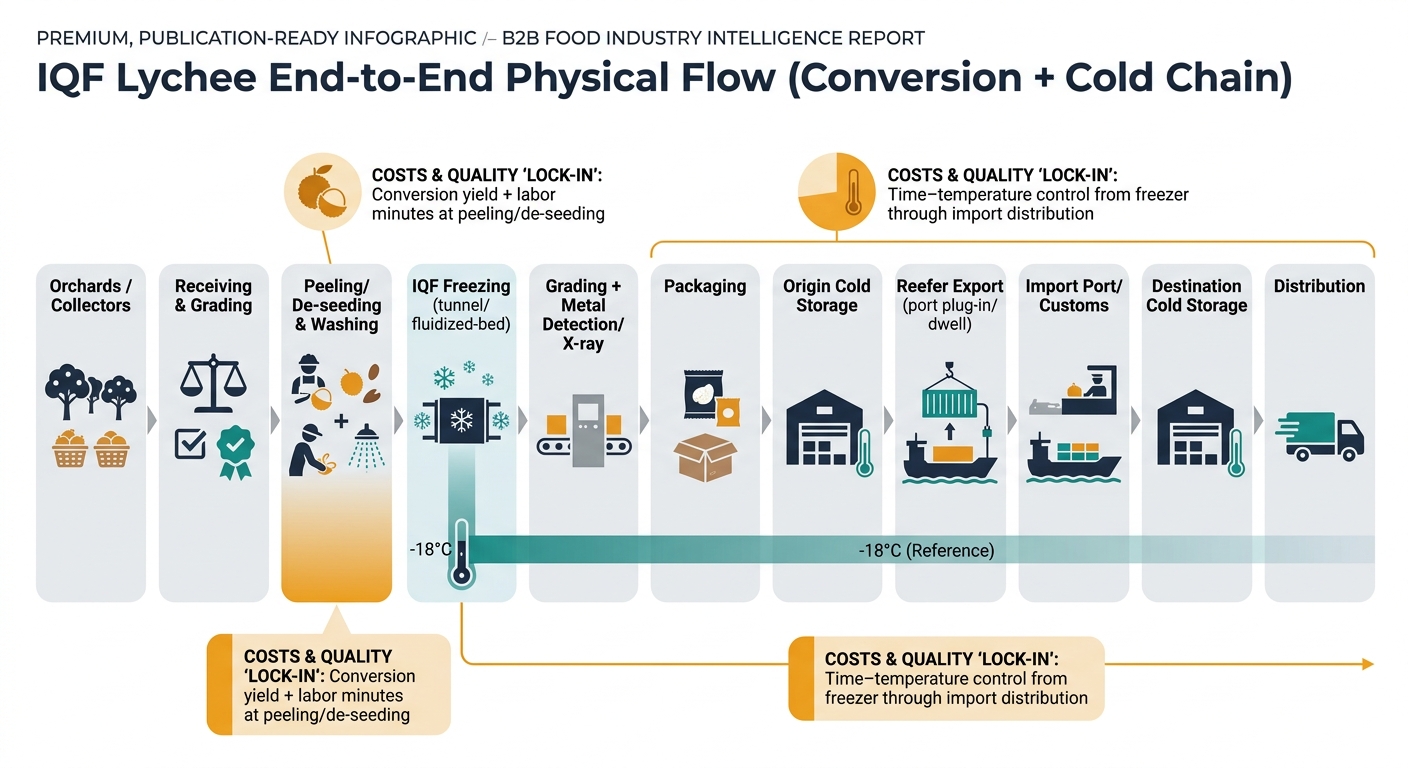
Typical physical flow runs: orchards/collectors → receiving & grading → peeling/de-seeding & washing → IQF freezing → grading/metal detection → packaging & cold storage → reefer export → import cold storage → distribution.
Your “unit price” is the sum of (1) yield loss at conversion, (2) labor intensity at peeling/de-seeding, and (3) energy + cold-chain integrity from freezer to destination. If any one of these nodes fails, the failure shows up downstream as drip loss, texture collapse, browning, foreign matter claims, or temperature deviations—often after you’ve already paid freight and tied up inventory.
IQF lychee’s cost stack is dominated by three structural constants—harvest seasonality, conversion yield, and frozen-chain overhead—so “processing” is not a single line item; it’s a sequence of irreversible cost additions.
Farmgate cost is highly seasonal and quality-gated; processors pay for usable fruit, not harvested volume.
Lychee deteriorates quickly post-harvest (enzymatic browning and microbial growth accelerate with time/heat), so time-to-packhouse and gentle handling drive defect rates (cracking, bruising, oxidation). Weather near harvest (rain/heat) can sharply raise rejects.
Even though you buy frozen, upstream handling determines downstream yield and defect tolerance headroom. Higher defect fruit forces more trimming and higher waste at peeling, which mechanically raises conversion cost per finished kg.
This is the most labor-intensive node and the biggest “hidden” cost lever because it converts fresh fruit into saleable flesh.
Manual steps dominate: sorting, peeling, seed removal, and defect trimming. Yield loss is structural (shell + seed + defects). Small fruit or large-seed varieties reduce flesh yield; cracked fruit increases trim loss. Sanitizer systems, water use, and hygiene controls add fixed overhead.
Two suppliers quoting the same frozen spec can have very different cost bases depending on (a) labor availability/wage inflation, (b) line organization and defect-removal discipline, and (c) typical inbound fruit size/seed ratio. This node also sets foreign matter risk (seed fragments, peel remnants) that later becomes a claims driver.
Freezing turns a fragile fresh fruit into inventory—but the energy and throughput constraints create a hard capacity ceiling during peak season.
IQF lines (tunnel or fluidized-bed) require high electricity load plus cold-room stabilization to core temperature. For quick-frozen foods, Codex guidance uses -18°C as the reference temperature for storage/distribution through the cold chain (subject to tolerances set by authorities).
This node is where “availability” becomes physical: if freezing capacity or cold-room space is constrained, product simply cannot be produced at the required pace. It’s also where texture outcomes are set: slow freezing or temperature fluctuations increase cell damage, leading to drip loss and soft bite after thaw.
Packaging/QA is not cosmetic; it’s the control point that converts a frozen bulk into a compliant, auditable lot.
Typical controls include grading for size uniformity and defects, metal detection (sometimes X-ray), microbiological testing, and lot traceability documentation. Packaging formats (10 kg bulk vs. 2.5 kg bags vs. retail pouches) materially change labor, line speed, and material cost.
Tight defect specs (browning, fragments, peel, seed) increase sorting time and reject rate, raising true cost per shipped kg. Packaging choice also determines damage risk and handling cost at destination (case count, pallet pattern, and picking efficiency).
Frozen logistics is a continuous-cost system: you pay to keep temperature, not just to move cartons.
Costs include cold-store rent, electricity, pallet handling, inspections, and reefer container plug-in/dwell. Temperature abuse risk rises with port congestion and long pre-gate waits. Documentation and inspection holds can add demurrage and power charges.
Landed cost volatility often comes from “days in the system” rather than distance. Longer dwell increases both cost and quality risk (surface dehydration, freezer burn, and temperature excursions), which can convert into higher claims and write-offs.
The last mile is where small temperature failures become expensive because the product is already fully cost-loaded.
Importers typically incur port handling, customs clearance, cold-store receiving, inventory finance, and domestic frozen transport. Repeated door openings and cross-docking increase temperature cycling risk.
If your receiving specs include strict temperature and packaging integrity checks, this node determines pass/fail at delivery. It also drives working capital: IQF lychee is often held for months to bridge off-season demand, so storage and financing are real components of total cost.
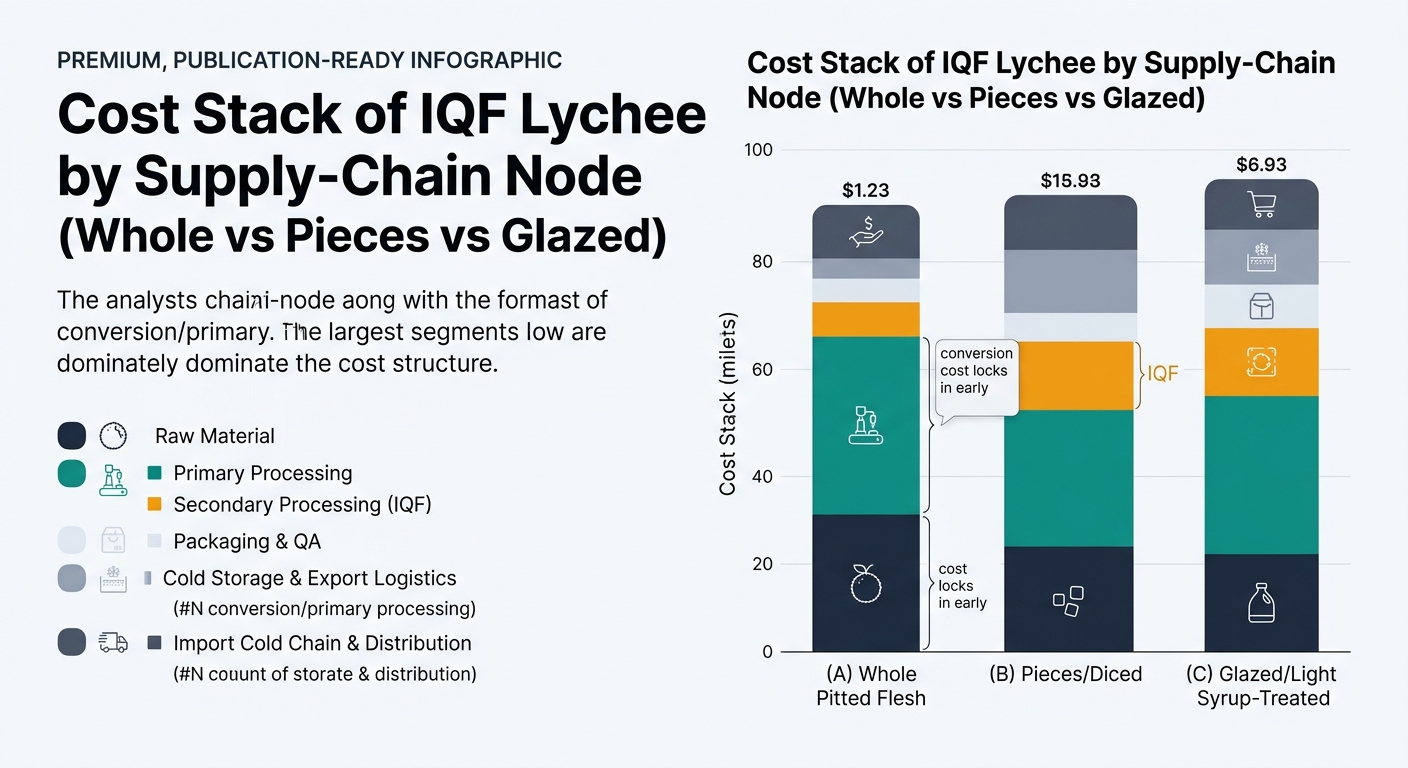
| Supply Chain Node | Cost Ratio (% of Final Cost) | Notes |
|---|---|---|
| Raw Material (fresh lychee) | 30% | Seasonality and fruit size/seed ratio influence effective cost per usable kg. |
| Primary Processing (peel/de-seed/wash) | 25% | Labor + yield loss + trimming/defect removal are structural drivers. |
| Secondary Processing (IQF freezing) | 12% | Energy intensity + line throughput + cold-room stabilization. |
| Packaging & QA | 10% | Bags/cartons, metal detection, lab tests, traceability release. |
| Cold Storage & Export Logistics | 13% | Origin cold store, reefer plug-in/dwell, port handling, documentation. |
| Import Cold Chain & Distribution | 10% | Destination cold store, handling, domestic frozen transport. |
| Supply Chain Node | Cost Ratio (% of Final Cost) | Notes |
|---|---|---|
| Raw Material (fresh lychee) | 28% | Can use slightly more variable size, but defects still penalize yield. |
| Primary Processing | 27% | Extra cutting step + higher surface area increases handling and defect exposure. |
| Secondary Processing (IQF freezing) | 12% | Smaller pieces freeze faster, but fragmentation control becomes critical. |
| Packaging & QA | 11% | More emphasis on sieve grading, fragment control, and foreign matter prevention. |
| Cold Storage & Export Logistics | 12% | Similar to whole; more sensitive to dehydration/freezer burn due to surface area. |
| Import Cold Chain & Distribution | 10% | Similar to whole; more risk of clumping if temperature cycles. |
| Supply Chain Node | Cost Ratio (% of Final Cost) | Notes |
|---|---|---|
| Raw Material (fresh lychee) | 26% | Lower share because added water/syrup increases shipped weight. |
| Primary Processing | 23% | Same labor base; additional handling to prepare for treatment. |
| Secondary Processing (IQF + glazing/treatment) | 16% | Added water/syrup prep, application control, and extra freezing load. |
| Packaging & QA | 12% | Net drained weight control, glaze % verification, label compliance. |
| Cold Storage & Export Logistics | 13% | Heavier gross weight can raise freight-per-net-kg economics. |
| Import Cold Chain & Distribution | 10% | Similar, but glaze integrity is sensitive to temperature cycling. |
IQF lychee behaves like a “conversion-and-cold-chain” category more than a simple fruit commodity; constraints are physical, not negotiable.
Finished IQF kg is a yield outcome, not a harvest outcome.
Shell/seed removal and defect trimming create unavoidable mass loss; smaller fruit and higher defect intake reduce flesh yield and raise labor minutes per finished kg.
Spec decisions that increase trimming (tight browning/fragment tolerances) raise cost non-linearly because you pay labor twice: once to remove defects and again through lower output.
Temperature stability determines texture, drip loss, and appearance after thaw.
Codex guidance defines quick-frozen food as maintained at -18°C or colder at all points in the cold chain (within permitted tolerances). Temperature excursions and cycling increase ice crystal growth and cell damage; repeated handling (port dwell, cross-dock) raises risk of clumping, dehydration, and freezer burn.
Your acceptance criteria should treat temperature records and packaging integrity as part of “product quality,” because failures show up as downstream waste and customer complaints.
In IQF lychee, tighter specs often require slower lines, more sorting, and higher rejects.
Controls like metal detection/X-ray, sieve grading, and defect sorting add labor and reduce throughput; retail-ready packaging adds additional line constraints.
If you require both premium appearance and high throughput, you’re asking for two opposing manufacturing outcomes. The physical system will choose one: either slower output (capacity constraint) or higher cost.
(Analyzed at: Sep, 2026)
Lock your next IQF lychee contract around two measurable control points—conversion yield evidence and cold-chain evidence—because 2026 conditions are amplifying both risks. With parts of Vietnam reporting lower crop output and higher fresh prices (which can pull fruit away from processors) and ocean networks showing weak reliability (around 56.4% schedule reliability in July 2026), late shipments and tighter processor allocation are more likely than a “normal” season. Put yield reporting (incoming defect %, flesh yield, foreign-matter rejects) and temperature-record requirements (origin cold store to delivery) into the commercial terms, not just the QA appendix; otherwise you’ll pay full freight and storage on product that fails at receipt. In this market, that discipline can realistically protect several points of landed cost by preventing avoidable claims, rework, and emergency spot buys.


