
This guide is written for procurement and sourcing leaders who already manage frozen fruit categories, but need a practical map of what makes IQF elderberry structurally different: a short harvest window, a narrow qualified processor base, and a cost stack dominated by conversion yield and temperature integrity, not “admin” line items.
IQF elderberry is a short-season crop that becomes a year-round frozen ingredient by converting highly perishable berries into stable, cold-stored inventory within days of harvest.
The physical flow is tightly sequenced: harvest/collection → rapid intake/cooling → de-stemming + washing + foreign material removal → IQF freezing → frozen storage → reefer export/import → destination cold storage → repack/blend or industrial use.

The biggest “fixed” cost drivers are not negotiable levers—they are physical necessities: fast field-to-plant handling, multi-pass cleaning to hit foreign material tolerances, energy-intensive freezing, and continuous cold chain storage/transport.
IQF elderberry’s landed cost is built from a small number of unavoidable cost pools—raw berries, yield loss during cleaning, energy/capex for freezing, and cold-chain logistics—layered across multiple custodians (grower/collector, processor/freezer, cold store, exporter/importer, repacker).
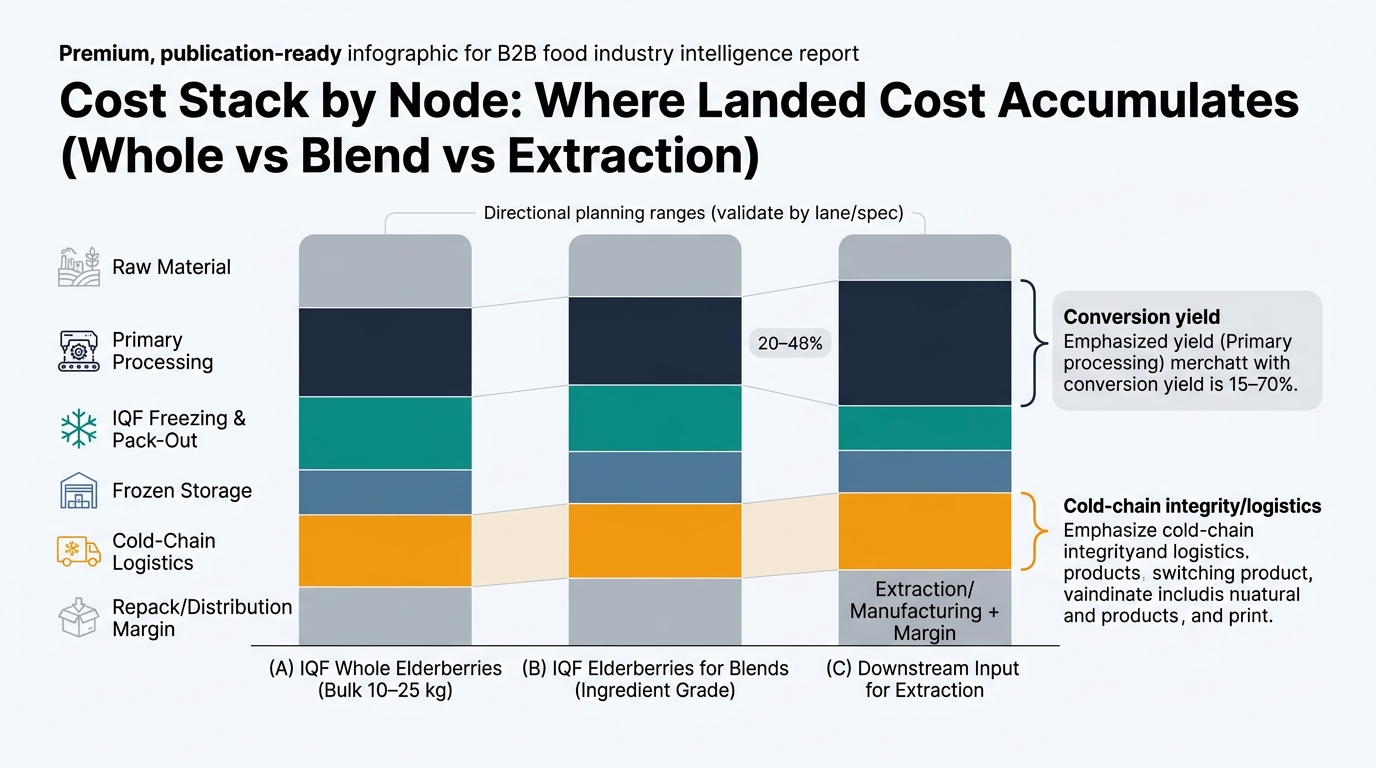
| Supply Chain Node | Cost Ratio (% of Final Cost) | Notes |
|---|---|---|
| Raw Material (berries) | 35% | Farmgate/collection cost + field-to-plant transport; highly yield-sensitive. |
| Primary Processing | 15% | De-stemming, washing, multi-pass sorting; shrink is embedded here. |
| IQF Freezing & Pack-Out | 18% | Energy + capex recovery + labor; pack materials (liners/cartons). |
| Frozen Storage (Origin) | 7% | Inventory carry, energy, handling, shrink control. |
| Cold-Chain Logistics (Export/Import + Destination) | 15% | Reefer trucking + ocean + port dwell + destination cold store. |
| Repack/Distribution Margin | 10% | Importer/repacker handling, QA rechecks, distribution overhead. |
| Supply Chain Node | Cost Ratio (% of Final Cost) | Notes |
|---|---|---|
| Raw Material (berries) | 33% | Similar upstream exposure; quality threshold may be lower. |
| Primary Processing | 12% | Fewer passes may be acceptable; still must manage foreign material. |
| IQF Freezing & Pack-Out | 18% | Freezing physics unchanged; packaging may be optimized for industrial use. |
| Frozen Storage (Origin) | 7% | Same cold-store dependency. |
| Cold-Chain Logistics | 16% | Logistics share can rise if moved in smaller lots or via multiple DCs. |
| Repack/Blend/Distribution Margin | 14% | Blending, additional handling, and lot management add cost. |
| Supply Chain Node | Cost Ratio (% of Final Cost) | Notes |
|---|---|---|
| Raw Material (berries) | 28% | Input cost diluted by downstream processing value-add. |
| Primary Processing | 10% | Purity still matters (stems/foreign material) to protect equipment and yields. |
| IQF Freezing & Pack-Out | 14% | Sometimes packed for industrial handling; freezing still energy-heavy. |
| Frozen Storage | 6% | Dwell time varies by extractor scheduling. |
| Cold-Chain Logistics | 12% | Similar reefer needs; lane and dwell time drive share. |
| Extraction/Manufacturing + Margin | 30% | Crushing/pressing, filtration, concentration/extraction, QA, and compliance overhead. |
IQF elderberry behaves like a “capacity-and-quality constrained” frozen ingredient, not like a generic commodity berry—because the crop is seasonal, the supplier base is narrower, and purity/yield are physically expensive to achieve.
Three structural constraints show up repeatedly across origins and suppliers:
(Analyzed at: Jul, 2026)
Write your next IQF elderberry contract so the two biggest hidden cost drivers are commercially enforceable: (1) conversion yield transparency (inbound kg → finished kg after de-stemming/sorting, by lot) and (2) continuous temperature history from post-freeze storage through delivery at the -18°C reference setpoint (with clear excursion rules and claim mechanics). [1] With 2026 cold-chain capacity expanding but still pricing energy and congestion risk into storage and handling, you don’t win by haggling carton cost—you win by preventing the 5–15% “silent tax” that shows up later as shrink, rework, clumping, and line yield loss. [3]


