
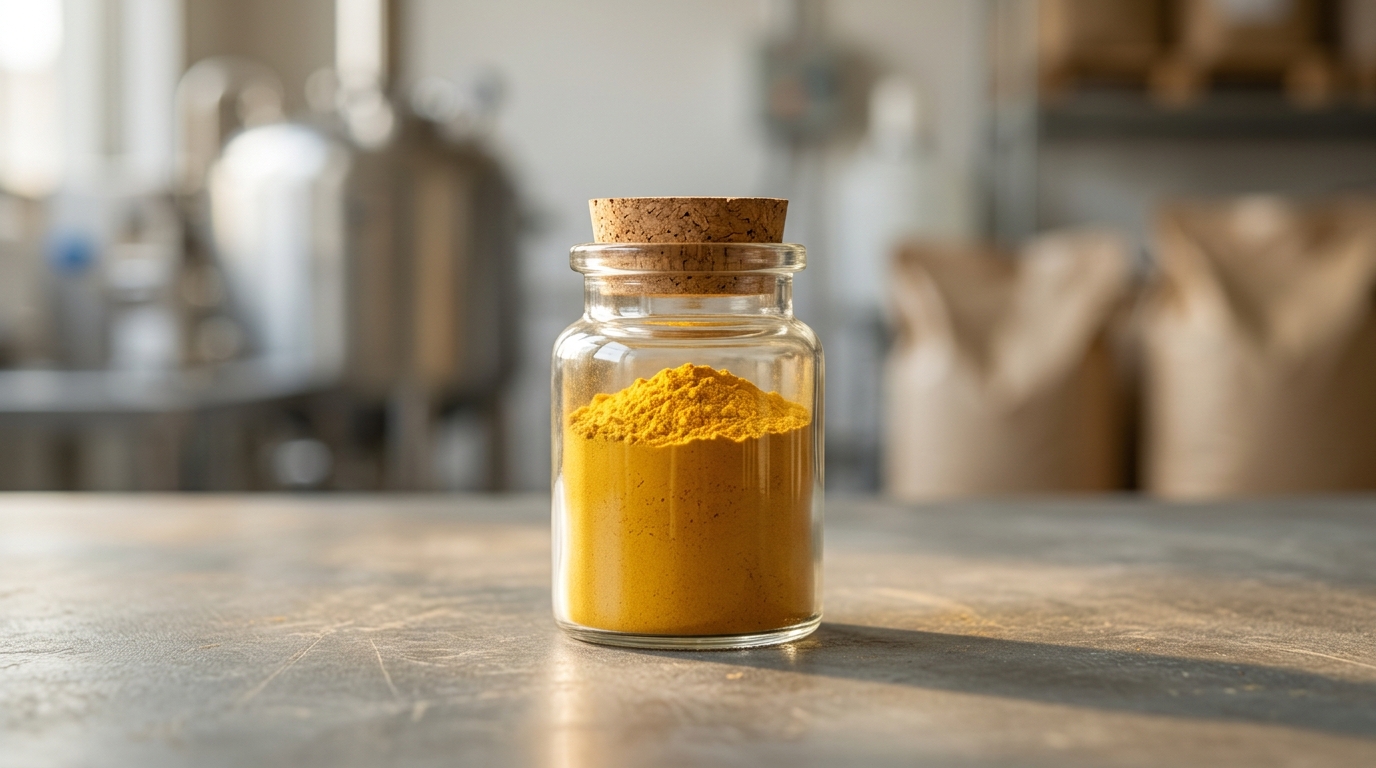
Pharma‑grade turmeric starch origin decisions are really decisions about controllability: how reliably you can lock a CTQ spec, defend impurity controls, and scale from R&D lots to commercial supply without change‑control surprises. This comparison translates “origin” into practical sourcing consequences—testing burden, audit/traceability depth, lead‑time risk, and risk‑adjusted total cost.
For pharmaceutical-grade turmeric starch, “origin” is not a marketing label—it is a proxy for (1) agronomic variability, (2) wet-processing hygiene and water/effluent controls, and (3) documentation maturity that determines whether R&D trials scale cleanly into validated supply.
Botanical/spice supply chains have documented economically motivated adulteration exposure; FDA specifically notes that lead‑based dyes have been found in spices including turmeric. [1]
Your comparison should be structured around “risk-adjusted total cost” (rejections, extra testing, audit burden, change-control friction), not just unit price—because a single out-of-spec lot can erase a year of price savings.
Treat origin selection as an R&D enablement decision: “Which origin gives us the fastest path to a stable, spec-locked material with predictable change control?”
India is usually the best “availability and ecosystem” bet, Vietnam is the best “concentration-risk hedge,” and China is the best “industrial consistency potential”—but each comes with a different hidden-cost profile.
FDA’s import alert databases are updated in real time, and import alerts are a practical mechanism that can disrupt clearance/lead times when a category has recurring hazards (e.g., toxic elements). [2]
Build your shortlist so that at least two origins can meet your critical-to-quality (CTQ) spec with evidence (validated methods, traceability depth, change notification), otherwise you’re single-sourcing by default.
| Option (Origin + typical processing base) | Cost | Quality | Risk | Lead Time | Availability | Bottom line |
|---|---|---|---|---|---|---|
| India (India) | Medium | Medium–High (supplier-dependent) | Medium–High (adulteration/contaminant vigilance needed) | Medium | High | Best for breadth of supply, but you must engineer controls (testing + audits + change control) to avoid variability costs. |
| Vietnam (Vietnam) | Medium–Low | Medium (maturity varies) | Medium (lower concentration vs India-only; qualification uncertainty) | Medium | Medium | Best secondary-source candidate when you want a credible non-India lane—plan for more upfront qualification work. |
| China (China) | Medium | Medium–High (industrial process control potential) | Medium (traceability + tiering diligence required) | Medium–Fast | Medium–High | Best when you prioritize process consistency and documentation discipline—verify origin transparency and impurity controls. |

The biggest “cost” lever is not farmgate turmeric—it’s yield loss + drying energy + QA failure rate, which show up as rework, rejections, and expedited replacement lots.
FDA’s food‑fraud framing for spices (including turmeric) is a reminder that when buyers tighten impurity limits or verification after incidents, the effective compliant supply can shrink even if agricultural supply is stable. [1]
Negotiate cost using a failure-mode cost model and require suppliers to disclose: yield assumptions, drying method controls, and typical OOS drivers.
“Pharma-grade” only becomes real when your spec is CTQ-driven and testable: impurity limits + microbial limits + functional performance + method alignment.
EMA guidance on control of impurities for pharmacopoeial substances emphasizes aligning with the European Pharmacopoeia’s general monograph “Substances for Pharmaceutical Use” and related impurity-control expectations—i.e., impurity control is a documented strategy, not just a COA line item. [3]
Lock the spec early with R&D/QA/RA: define CTQs vs “nice-to-have” and align on methods/LOQs so you don’t qualify a supplier you can’t later defend in change control.
The two dominant risks are origin concentration (single-country exposure) and compliance shocks (a sudden tightening of heavy metal/adulteration scrutiny that delays shipments).
FDA describes economically motivated adulteration risks in spices (including turmeric), and import alerts are a real operational lever that can detain product and create abrupt lead‑time/availability disruptions. [1]
Design your supply strategy so that a single import detention event doesn’t halt development: pre-qualify alternates and set switching triggers tied to lead time and OOS rates.
Turmeric starch is ambient-stable but moisture-sensitive, so lead time reliability is as much about packaging/container controls as transit days.
FDA import alert infrastructure is designed to communicate and act on import compliance issues; for categories with recurring hazards, clearance time variability is a realistic planning assumption. [4]
Specify packaging and shipment controls (liners, desiccants, humidity indicators, COA-in-envelope, tamper evidence) as contractual requirements, not “nice-to-haves.”
The most common scale-up failure is not “can they make it?”—it’s can they make it the same way, repeatedly, under change control.
EMA impurity-control expectations reinforce that impurity control is tied to documented strategies and suitability for the intended use—consistency and control become harder when botanical inputs vary seasonally. [3]
Require evidence of process capability: multi-lot trend data on key CTQs (moisture, ash, viscosity, micro, heavy metals) and documented change-control triggers (raw material origin shift, dryer change, water source change).
Sustainability is not separate from compliance here—traceability depth reduces both ESG risk and quality risk (fraud, contaminants).
FDA’s economically motivated adulteration framing is explicitly about intentional contamination for economic gain, which is best addressed through supply‑chain controls and verification—not just end testing. [1]
Build supplier scorecards that weight: farm/aggregator mapping, water/effluent controls, labor/audit posture, and documented chain-of-custody—because these correlate with fewer surprises and lower total cost volatility.
You can’t “audit your way out” of a structurally risky lane; you need a dual-origin design plus spec equivalency testing to make switching realistic.
Import alerts and fraud/contaminant realities mean disruptions can occur with little notice; categories with heavy metal/fraud exposure require proactive verification. [5]
Use the tables below to structure RFQs, supplier interviews, and R&D equivalency protocols.
| Dimension | India | Vietnam | China |
|---|---|---|---|
| Adulteration/EMA exposure (category-level) | High | Medium | Medium |
| Heavy metals variability risk (origin-dependent) | Medium–High | Medium | Medium |
| Processor ecosystem depth | High | Medium | Medium–High |
| Documentation maturity (varies by supplier tier) | Medium | Medium | Medium–High |
| Traceability opacity risk (when buying via traders) | Medium | Medium | Medium–High |
| Logistics reliability | Medium | Medium | Medium–High |
These are practical planning ranges to help procurement quantify “hidden costs.” They are not universal market prices.
| Cost Element (annualized) | Typical driver | India (index) | Vietnam (index) | China (index) |
|---|---|---|---|---|
| Base unit price | raw material + yield + energy | 100 | 95–105 | 100–110 |
| Incoming testing intensity | risk posture + history | 110–140 | 110–130 | 105–125 |
| Rejection/rework reserve | OOS rate, moisture damage | 115–160 | 110–150 | 105–140 |
| Expedite contingency | lead-time shocks | 110–150 | 110–150 | 105–140 |

If two suppliers quote the same unit price, but one lane requires 30% more testing and has higher OOS probability, the “cheaper” option is often the one with the stronger evidence pack.
The right origin depends on whether your constraint is time-to-qualify, time-to-recover from disruption, or time-to-scale.
Import controls (including detentions) are an ongoing reality, and FDA’s emphasis on toxic elements and food fraud in spices supports designing alternates before you need them. [5]
Choose based on your bottleneck—and document the rationale so QA/RA and procurement stay aligned during change control.
| Buyer priority (what you’re optimizing) | Best fit | Why |
|---|---|---|
| Fastest shortlist + multiple quotes | India | Ecosystem depth increases shortlist speed. |
| Lowest concentration risk (resilience) | Vietnam + India dual | Dual-origin reduces single-country shocks. |
| Highest consistency potential (if tier-1) | China or top-tier India | Industrial controls can reduce variability—verify evidence. |
| Lowest risk-adjusted TCO | Supplier-dependent | The winner is the one with lowest combined testing + OOS + expedite cost, not the lowest unit price. |
The highest ROI move is to design a dual-origin qualification plan with CTQ equivalency testing before commercialization, so switching is governed rather than reactive.
FDA highlights economically motivated adulteration risks in spices (including turmeric) and uses import alert mechanisms that can disrupt supply with little notice; impurity-control expectations reinforce the need for documented, repeatable controls. [1]
A dual-origin strategy reduces downtime risk and lowers expedite premiums, while improving auditability because your switching criteria are pre-defined.
The hardest part to execute is not identifying alternates—it’s maintaining an evidence-backed view of (1) which suppliers truly meet CTQs, (2) how origin risks are shifting (crop/weather/logistics/compliance), and (3) whether price moves are driven by raw turmeric, processing constraints, or quality-driven supply shrinkage. Teams that can track those signals continuously make faster, safer change-control decisions with less total cost volatility.
Turmeric markets have been experiencing price sensitivity into 2026, and that volatility tends to magnify the value of “compliant supply” over “available supply.” insights.tridge.com
For your next pharma‑grade turmeric starch contract, lock a CTQ‑aligned spec and qualify a second origin now (even at modest volume), because FDA’s real‑time import alert environment means one detention event can turn into weeks of development delay. [2]
The teams that do this best usually don’t win on unit price—they avoid the 10–20%+ effective cost hit that shows up as extra testing, failed lots, and expedited replacements when the first lane wobbles.


