

No-sugar-added mango puree sourcing is less about “best-tasting mango” and more about choosing an origin + format combination that keeps sensory, documentation, and logistics stable from bench to launch. This comparison walks R&D/I and procurement through the real trade-offs (cost, quality, risk, lead time) so you can set specs that are achievable across seasons and avoid late-stage substitutions.
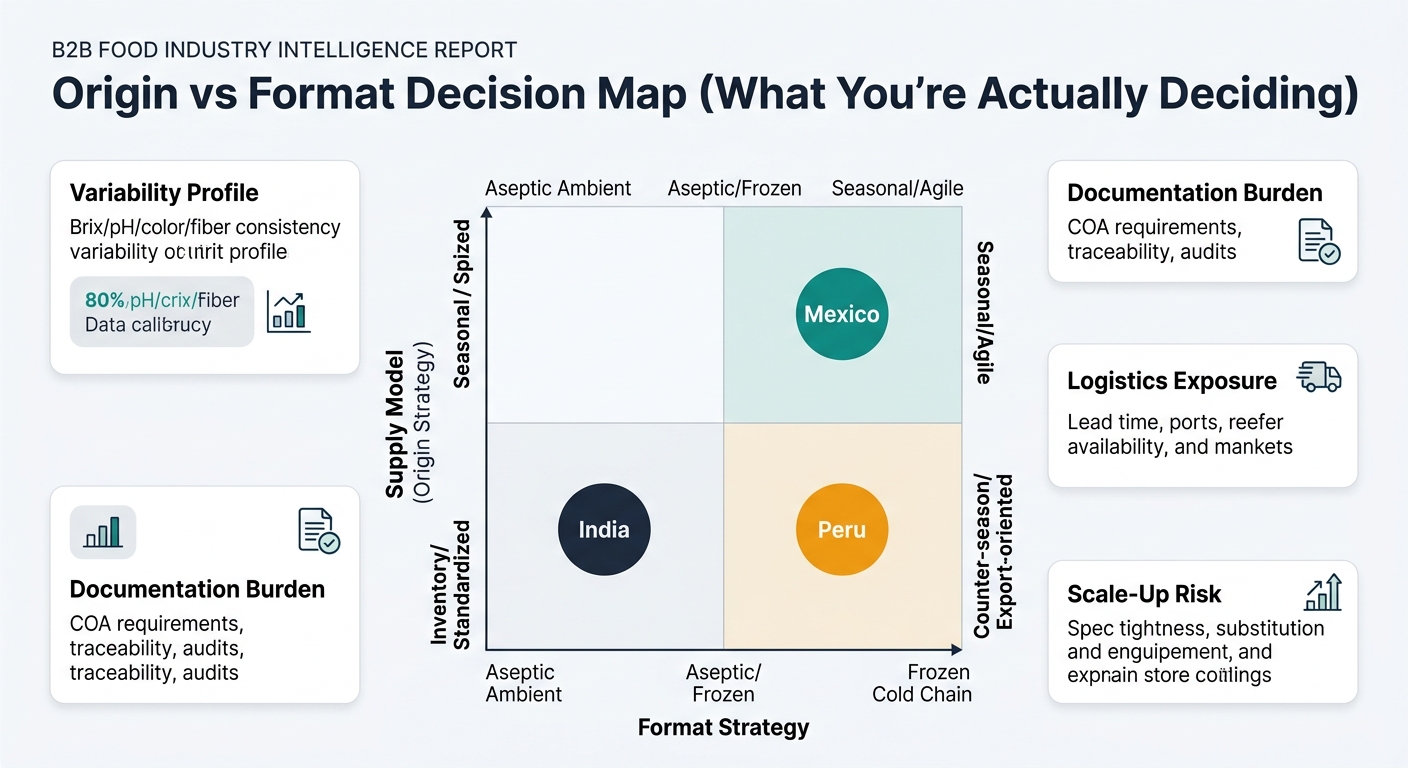
Insight: For no-sugar-added mango puree, you are not just choosing “where the mango comes from”—you are choosing a variability profile (Brix/acid/color/fiber), a documentation burden (claim protection + import compliance), and a logistics model (aseptic ambient vs frozen cold chain) that will either hold up or collapse during scale-up.
Data: Industrial mango pulp/puree is commonly traded as aseptic product packed in aseptic bags inside drums, with India positioned as a major global exporter and a large processing base; APEDA describes two main mango pulp clusters with around 65 processing units [1].
Procurement Impact: If R&D selects a “great-tasting” lot without mapping the origin/format constraints, the team typically pays later via (1) tighter specs that reduce eligible supply, (2) emergency substitutions that change sensory, and (3) delayed commercialization due to incomplete vendor packets (COA fields, traceability, audits).
Insight: Each origin can work for no-sugar-added applications, but they win for different reasons: India for scalable industrial supply, Mexico for proximity-to-US and shorter lanes, Peru for counter-seasonality and export-oriented Kent supply.
Data: Mexico’s export season is commonly described as running from late January/early February through late September, reflecting climate diversity across producing states [2]. Peru’s mango chain is heavily Kent-driven; Peru’s Piura region is reported at ~90% Kent plantings, and multiple industry/government sources describe exports as predominantly Kent [3]. India is widely cited as a major exporter of mango pulp with established aseptic processing clusters [1].

Procurement Impact: Your “best” option depends on whether your gating constraint is (a) cost-to-formulate stability, (b) year-round availability without sensory drift, or (c) risk posture (single-origin exposure, logistics, and claim integrity).
| Option (Origin focus) | Cost | Quality | Risk | Lead Time | Availability |
|---|---|---|---|---|---|
| India (industrial pulp base) | Low–Med | Med (blendable) | Med | Long | High |
| Mexico (near-US supply) | Med | Med–High (fresh flavor potential) | Med | Short–Med | Med–High |
| Peru (export-oriented Kent) | Med–High | High (color/flavor consistency potential) | Med | Med | Med (counter-seasonal) |
Insight: The biggest hidden cost driver is not the quoted $/kg—it’s spec tightness and format-driven logistics, which determine how many suppliers can actually meet your no-sugar-added performance targets consistently.
Data: Many commercial technical sheets for aseptic mango puree/pulp reference single-strength parameters around 14–16 °Brix and pH ~3.5–4.5, which is a realistic baseline for industrial programs (final ranges still depend on variety, ripeness, and standardization practices) [4].
Procurement Impact: If R&D writes a spec around a “hero lot” (tight Brix/color/fiber), you reduce eligible supply and create a structural premium (plus higher rejection risk). A looser, application-validated spec often lowers total cost of ownership by expanding the qualified supplier set.
Insight: No-sugar-added formulations have less room to hide lot-to-lot variation; Brix/acid balance and fiber/viscosity drive perceived sweetness, mouthfeel, and flavor release.
Data: Industrial pulp specifications frequently center on °Brix and pH; APEDA describes mango pulp prepared from selected varieties and highlights major processing linkages including Alphonso and Totapuri (often associated with processing supply in India) [1].
Procurement Impact: When puree sweetness perception drops (lower Brix or higher acid), R&D may compensate with flavor systems or acidulants—raising COGS and increasing reformulation risk. Your sourcing plan should explicitly decide: “Do we standardize by blending lots/origins, or do we standardize in formulation?”
Insight: The risk you feel in manufacturing is usually created upstream: origin concentration + harvest shocks + documentation gaps + integrity risk (dilution/undeclared sweeteners).
Data: In the US, FDA’s Foreign Supplier Verification Program (FSVP) places responsibility on importers to verify foreign suppliers and ensure imported food meets US requirements and is not misbranded with respect to allergen labeling [5]. In the EU, pesticide residue enforcement is anchored in MRL rules and official controls; the European Commission maintains enforcement guidance and coordinated control programs [6]. Stable isotope methods (e.g., δ13C via IRMS) are widely described in the authenticity literature as a way to detect addition of C4 sugars (e.g., cane sugar) in fruit juice-type matrices; applicability to puree programs depends on method design and matrix effects, so it should be treated as a targeted tool, not a blanket solution [7].
Procurement Impact: For no-sugar-added claims, the “worst case” is not a late shipment—it’s a claim/integrity event that forces a stop-ship, re-label, or customer delist. Higher-risk scenarios justify higher verification intensity (e.g., authenticity screening, tighter chain-of-custody, deeper traceability).
Insight: Aseptic drums reduce cold-chain risk but increase exposure to long dwell times, port congestion, and packaging component availability (drums/bags); frozen reduces some thermal abuse concerns but depends on reefer capacity and power stability.
Data: Aseptic mango pulp is commonly filled into sterile bags inside steel drums and shipped as an ambient-stable industrial format [1].
Procurement Impact: Lead time is not just ocean transit—it includes sample lead time, documentation readiness, and how quickly a supplier can allocate drums/aseptic bags during peak season. The wrong assumption here shows up as missed pilot windows or line downtime.
Insight: Many R&D programs fail because the “best sensory supplier” cannot hold spec at volume, cannot reserve capacity in harvest season, or cannot produce consistent lots across inventory carry.
Data: India’s mango pulp sector is described as having clustered processing capacity with numerous units and export orientation [1].
Procurement Impact: A scalable program needs (1) capacity signals (throughput, aseptic lines, inventory model), and (2) a dual-source plan that avoids same-risk-bucket dependency (e.g., two suppliers but same origin/port lane).
Insight: Sustainability claims only survive audits if they are backed by traceability depth, residue compliance, and documented controls—not just a certificate.
Data: EU market entry guidance commonly emphasizes that processed fruit ingredients still hinge on food safety and residue compliance expectations, even when phytosanitary requirements differ from fresh produce. (Validate market-entry specifics with your importer and destination-country requirements.) [6]
Procurement Impact: For R&D timelines, the practical question is: “How fast can this supplier assemble a complete, consistent documentation packet that passes QA and customer audits?”
Insight: Cost differences are often smaller than the variance you incur when you buy outside season, tighten specs, or change formats midstream.
Data: Mexico’s long export season (late Jan/early Feb to late Sep) can support multiple procurement windows; Peru’s Kent-heavy system supports a more consistent varietal profile; India’s export-oriented pulp base supports scale but with longer logistics lanes [2].
Procurement Impact: Use an index model to align stakeholders: if your business case can’t tolerate variance, pay for resilience (multi-origin or concentrate) rather than chasing the lowest spot price.
| Cost element (Index) | India | Mexico | Peru |
|---|---|---|---|
| Raw fruit cost volatility | 100 | 105 | 110 |
| Processing/standardization | 95 | 100 | 105 |
| Packaging (aseptic drums/bags) | 100 | 100 | 100 |
| Freight/lead-time exposure (to US/EU) | 115 | 95 | 105 |
| Spec tightness premium risk | 100 | 105 | 100 |
| Indicative total landed cost index | 105–115 | 98–108 | 105–120 |
Insight: “Risk” is multi-factor; you need to separate supply continuity risk from claim/compliance risk.
Data: Importer accountability frameworks (US FSVP) and EU residue control regimes create a compliance floor regardless of origin [5][6].
Procurement Impact: A simple scorecard prevents teams from overweighting a single factor (e.g., taste) and underweighting what causes launch delays (documentation and verification readiness).
| Dimension | India | Mexico | Peru |
|---|---|---|---|
| Supply continuity (year-round via inventory) | Low–Med | Med | Med |
| Logistics disruption exposure (long lanes/ports) | Med–High | Low–Med | Med |
| Lot-to-lot sensory variability | Med (blendable) | Med–High | Low–Med |
| Compliance/documentation friction | Med | Med | Med |
| Integrity/fraud exposure (category-level) | Med | Med | Med |
Insight: The “right” origin is conditional on your bottleneck: COGS variance, sensory consistency, or time-to-qualify.
Data: Mexico’s season breadth supports multiple buying windows; Peru’s Kent dominance supports varietal consistency signals; India’s established pulp export base supports scale [2].
Procurement Impact: You reduce rework by aligning sourcing strategy to the stage gate you’re trying to pass (bench → pilot → commercialization).
| Your top priority | Default pick | Why | What to validate first |
|---|---|---|---|
| Lowest COGS at scale | India | Industrial scale economics | Capacity allocation + inventory model |
| Fastest time-to-pilot in US | Mexico | Shorter lanes | Sample lead time + pack formats |
| Sensory consistency without sugar | Peru | Kent-heavy profile | Brix/pH window + color/fiber controls |
| Resilience (avoid single-origin shock) | Split (India + Peru/Mexico) | Different risk buckets | Spec harmonization across origins |
Insight: The highest ROI move is usually spec design for supply optionality plus pre-qualified alternates—not chasing a marginally lower spot price.
Data: Typical industrial pulp parameters (Brix/pH) are broadly available across suppliers, but compliance expectations (FSVP importer accountability in the US; EU MRL enforcement and official controls) make verification and documentation non-optional [4][5][6].
Procurement Impact: Better specs + better alternates reduce COGS variance, shorten time-to-qualify, and protect no-sugar-added claims.
The hardest part to manage without ongoing intelligence is timing: puree offers move with harvest windows, freight, and inventory carry, while your R&D gates move with pilot schedules. The procurement challenge is building a calendar that links (1) origin harvest/production windows, (2) supplier allocation signals, and (3) your internal stage gates—so you can lock volumes and specs before the market forces you into a rushed substitution.
(Analyzed at: Jul, 2026)
If you’re contracting mango puree for a no-sugar-added launch, don’t “single-origin optimize” on the first great pilot lot—lock a primary + secondary origin now and harmonize specs to a realistic single-strength window (e.g., around 14–16 °Brix and pH in the mid-3s to mid-4s, validated in your application). Mexico’s January–September season supports fast turns for North America, while Peru’s Kent-heavy export profile can stabilize sensory when variability shows up, and India remains the workhorse for large aseptic programs. The teams that skip dual-qualification typically end up paying for it in expedite freight, rework, and reformulation—often a quiet mid-single-digit percent hit to ingredient COGS that only appears after scale-up pressure hits [2].


