INDUSTRY TRENDS

Impossible-Style Mince: How It Physically Moves, Where Costs Lock In, and What QSC Procurement Should Contract For

Author
Team Tridge
DATE
August 25, 2026
8 min read
impossible-meats-mince Cover
Unlock Full Data
Impossible Meats Mince Market Intelligence
Prices · Trends · Origins · Forecasts

This guide maps the real “physics” of Impossible-style mince—from upstream crops and fermentation-derived ingredients through hygienic manufacturing, packaging, and cold-chain distribution—so Purchase (Quality/Safety/Compliance) teams can see where costs become irreversible and where risk controls actually belong. The goal is not to optimize pennies at the farmgate, but to prevent expensive downstream failures (holds, short-dates, and recalls) after conversion and cold-chain costs are already sunk.

Executive Summary

  • Cost anchors are conversion + protection steps: protein fractionation/refining, fermentation-derived heme production, and cold-chain pack-out are where cost and compliance overhead lock in.
  • The formulation is real-world verified: retail ingredient lists consistently show water + soy protein concentrate + oils + methylcellulose + flavors/yeast extracts + soy leghemoglobin. [1]
  • Packaging is a shelf-life control system: vacuum/MAP materially changes spoilage dynamics in refrigerated ground products—principles that carry over to mince analogs. [2]
  • Allergen/label risk remains a top recall driver: undeclared allergens continue to lead U.S. recall causes, making change control and label governance non-negotiable. [3]

1) The Physical Map: Where This Mince Supply Chain Is “Fixed” vs. Flexible

This product is physically constructed as a multi-ingredient, cold-chain processed food: commodity-linked crops (soy, oils, sugars) are converted into tight-spec ingredients, blended with specialty functional inputs, then packed and distributed refrigerated (sometimes frozen). The “fixed” cost-drivers are not just raw materials—they’re conversion steps (protein fractionation, oil refining, fermentation/purification), hygienic blending/packing, packaging formats, and refrigerated logistics.

Insight: Impossible-style mince is fundamentally a formulated emulsion/structured protein system; once you pick the protein base, fat system, and key functional binders, you lock in processing needs (mixing shear, thermal profile, sanitation) and packaging/cold-chain requirements.

Data (validated): Public retail ingredient lists and brand culinary materials consistently show a base of water + soy protein concentrate + sunflower/coconut oil + methylcellulose + flavors/yeast extracts, with soy leghemoglobin (heme) as a differentiating ingredient. [1]

Procurement Impact: The cost structure is dominated by conversion and compliance overhead at a few nodes (protein concentrate, refined oils, fermentation-derived heme, and refrigerated pack-out). “Simple” formulation changes can ripple into new validation, new micro/shelf-life behavior, and new packaging performance requirements.

Supply chain flow (ground truth):
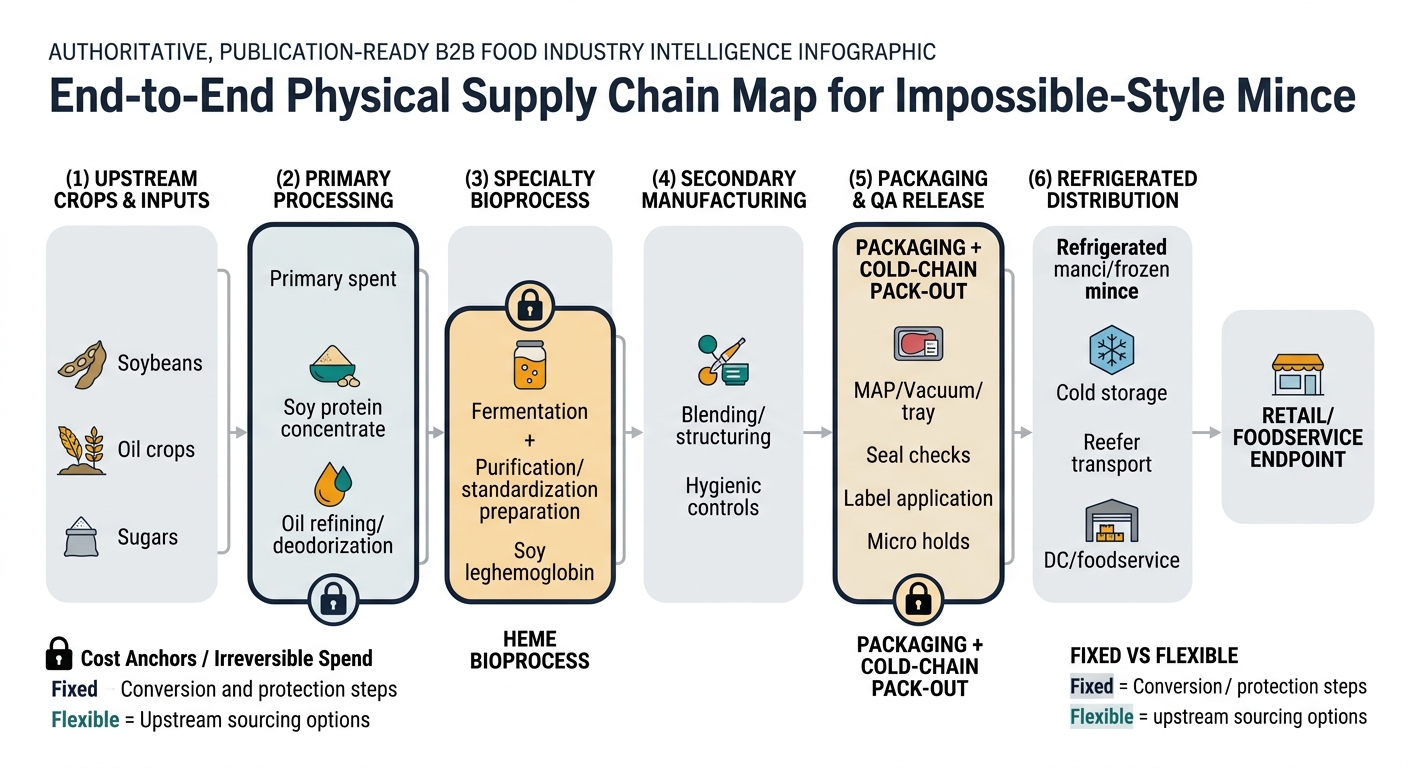
  • Upstream crops & inputs: soybeans + oil crops (sunflower/coconut) + sugars (fermentation feedstock)
  • Primary processing: soy protein concentrate; refined/deodorized oils; fermentation media inputs
  • Specialty bioprocess: fermentation + downstream purification/standardization of soy leghemoglobin preparation [4]
  • Secondary manufacturing: blending, structuring, hygienic forming to mince/ground format
  • Packaging & QA release: MAP/vacuum/tray systems, label application, finished-goods testing
  • Refrigerated distribution: cold storage + reefer transport to DCs/foodservice
A left-to-right flow diagram showing the physical movement and transformation of inputs into finished refrigerated/frozen mince, with 6–7 labeled nodes (upstream crops & inputs; primary processing; specialty bioprocess; secondary manufacturing; packaging & QA release; refrigerated distribution; retail/foodservice endpoint) and visual markers for cost anchors/irreversible spend around primary processing, heme bioprocess, and packaging plus cold-chain pack-out, including a small legend for fixed vs flexible steps.

2) Where Cost and Margin Accumulate (Node-by-Node)

Insight: In Impossible-style mince, the largest “irreversible” cost additions happen where food-grade specs are created and protected: fractionation/refining, fermentation/purification, and cold-chain pack-out.

Data (validated): Public ingredient materials confirm dependence on refined inputs (protein concentrate, deodorized oils) plus a fermentation-derived ingredient (soy leghemoglobin). [5]

Procurement Impact: Even without discussing buying strategy, you can treat these nodes as the cost anchors: they set the floor for conversion cost, documentation burden, and failure modes (oxidation, micro, label claims).

1. Upstream / Raw Material (Crops, Sugars, and “Food-Grade Starts”)

  • Insight: Commodity-linked inputs look cheap per kg, but they determine downstream yield and rework because food-grade processing rejects (off-flavor, oxidation, contaminants) are expensive once you’re in refrigerated finished goods.
  • Data (directionally accurate): The chain commonly starts with soybeans (for protein concentrate), oil crops (sunflower/coconut oils), and sugars used as fermentation feedstocks for microbial production. These are globally traded commodities with variable quality attributes (e.g., oxidation risk in oils; protein functionality variability in soy fractions).
  • Procurement Impact: Your physical risk is quality variability at the start that amplifies later: a small rise in oil oxidation potential or soy off-notes becomes a shelf-life or sensory failure after you’ve paid for blending, packaging, and cold freight.

2. Primary Processing (Soy Protein Concentrate + Oil Refining)

  • Insight: This node creates the “functional backbone” of mince—water binding, gelation/texture, and flavor neutrality—and it is inherently capital- and QA-intensive (fractionation, drying, refining/deodorization).
  • Data (supported): Authoritative references describe soy protein concentrate/isolate manufacturing as significant processing relative to flour, reflecting conversion intensity and standardization. [5]
  • Procurement Impact: Costs here are not just raw soy/oil; they’re energy (drying), yield loss, deodorization/refining steps, and analytical QA (moisture, protein, micro, flavor). Variability at this node shows up as texture drift (mince bite), cook loss/yield, and batch-to-batch sensory noise.

3. Specialty Bioprocess (Fermentation-Derived Heme Ingredient)

  • Insight: Fermentation-derived heme is a structurally different cost center: it adds bioreactor capacity constraints, media costs, downstream purification/standardization, and regulatory documentation overhead.
  • Data (validated): FDA’s GRAS response letter describes soy leghemoglobin preparation and notes production using a genetically engineered yeast strain under GMP expectations; FDA also points to the color additive pathway for color additive questions. [4]
  • Procurement Impact: This node tends to be high fixed-cost per kg (capex utilization, QC release testing, batch records). Physically, it is also a single-point-of-failure ingredient: if the heme prep is delayed or held, you can’t simply “blend around it” without reformulation and label implications.

4. Secondary Processing / Manufacturing (Blending, Structuring, Hygienic Controls)

  • Insight: Mince manufacturing is where multi-ingredient complexity becomes real cost: sanitation/CIP time, allergen line control (soy), batching accuracy, and yield management.
  • Data (validated from formulation complexity): Retail ingredient lists show multi-component formulations (water, soy protein concentrate, oils, methylcellulose, flavors/yeast extracts, cultured dextrose, etc.), implying tight sequencing and dispersion control to prevent texture failure and fat separation. [1]
  • Procurement Impact: This node accumulates cost through labor + downtime (changeovers), in-process QC (moisture/fat targets), and scrap risk if emulsion stability or particle structure is off. It’s also where micro risk is most sensitive to hygienic zoning and environmental monitoring discipline.

5. Packaging & QA Release (Shelf-Life Engineering in a Bag/Tray)

  • Insight: Packaging is not a cosmetic step; it is a shelf-life control system. Film selection, seal integrity, and atmosphere management drive oxidation and spoilage trajectory.
  • Data (validated): Ground-beef packaging research shows vacuum and MAP systems can materially affect spoilage indicators and microbial growth dynamics under refrigeration; MAP reviews also describe trade-offs (e.g., oxygen can support color but can increase oxidation). [2]
  • Procurement Impact: Costs concentrate in high-barrier films/trays, gas flush (if used), seal QA, label control, and finished-goods holds pending micro/QA release. Packaging failures are uniquely expensive because they convert into returns, short-dates, and disposal after cold-chain spend.

6. Refrigerated Logistics & Distribution (Cold Chain as a Cost Multiplier)

  • Insight: Cold chain doesn’t just add freight cost; it amplifies the cost of any upstream deviation because you’re carrying high-value, date-sensitive inventory.
  • Data (validated, market context): Recent U.S. market commentary indicates reefer capacity remains specialized and can price stronger than broader truckload markets—supporting the idea that cold-chain is a persistent cost/availability constraint. [6]
  • Procurement Impact: This node embeds storage fees, reefer transport, temperature monitoring, and shrink. Any disruption (port holds, DC congestion, temperature excursions) converts directly into lost sellable days and higher nonconformance exposure.
A stacked bar chart comparing cost anchors by node across three product formats: (A) Refrigerated Retail Pack, (B) Foodservice Bulk, and (C) Frozen. Each bar is segmented into consistent supply-chain nodes (upstream raw materials, primary processing, specialty bioprocess/heme, secondary manufacturing, packaging & QA release, cold/frozen logistics & storage, margin/fees) using the article’s percentage ratios, with callouts highlighting the top cost lock-in segments (primary processing, heme, and packaging plus cold chain).

Product-Level Cost Breakdown

A) Refrigerated Impossible-Style Mince (Retail Pack)

Supply Chain Node Cost Ratio (% of Final Cost) Notes
Upstream raw materials (crops/sugars) 18% Commodity-linked, but quality variability can cascade into rework/scrap.
Primary processing (protein concentrate + oil refining) 22% Energy, yield loss, deodorization/drying, analytical QA.
Specialty bioprocess (heme fermentation + purification) 12% Capacity + QC release + regulatory documentation overhead; single-point ingredient. [4]
Secondary manufacturing (blending/structuring) 16% Labor, sanitation/changeover time, in-process QC, yield management.
Packaging & QA release 14% High-barrier films/trays, seal QA, micro holds; packaging is shelf-life control. [7]
Refrigerated logistics & distribution 10% Reefer freight, cold storage, shrink, temperature monitoring.
Wholesale/retail margin & fees 8% Channel-dependent; not purely physical cost but tied to handling complexity.

B) Foodservice Bulk Mince (Chub/Bag, Case Pack)

Supply Chain Node Cost Ratio (% of Final Cost) Notes
Upstream raw materials 20% Similar inputs; higher batch sizes can reduce per-unit handling.
Primary processing 23% Same functional backbone; spec tightness drives rejects.
Specialty bioprocess (heme) 12% Similar contribution; constrained by bioprocess throughput. [4]
Secondary manufacturing 18% Larger runs can reduce changeover cost but increase lot-size exposure.
Packaging & QA release 8% Simpler packaging than retail; still seal integrity + label control.
Refrigerated logistics & distribution 11% Heavy cases + reefer lanes; delivery frequency affects cost.
Distributor margin & handling 8% Broadliner handling and cold storage services.

C) Frozen Mince (Where Used)

Supply Chain Node Cost Ratio (% of Final Cost) Notes
Upstream raw materials 18% Similar commodity base.
Primary processing 22% Similar conversion costs.
Specialty bioprocess (heme) 12% Similar ingredient cost center. [4]
Secondary manufacturing 15% Often includes additional thermal/freeze-step scheduling constraints.
Packaging & QA release 15% Cold-resistant films, tighter seal performance expectations, case integrity.
Frozen logistics & storage 12% Frozen warehousing can be costlier; energy intensity and capacity constraints.
Wholesale/retail margin & fees 6% Channel-dependent.
Unlock Full Data
Impossible Meats Mince Market Intelligence
Prices · Trends · Origins · Forecasts

3) Structural Facts You Can’t “Optimize Away” (Industry Constants)

Insight: Three constraints shape this supply chain regardless of supplier: (1) a specialty fermentation ingredient with regulatory/QA overhead, (2) functional ingredient dependence for texture stability, and (3) packaging + temperature as the real shelf-life gate.

Data (validated): FDA documentation confirms soy leghemoglobin’s fermentation-based production and regulatory framing; ingredient lists consistently include methylcellulose and refined fats; packaging research shows shelf-life is packaging-system dependent (MAP/vacuum). [4]

Procurement Impact: These constraints dictate the fixed cost base and the most common failure modes (hold/recall exposure, short-dates, sensory drift).

Structural reality #1 — Fermentation ingredient = capacity + documentation gravity

  • Insight: Fermentation-derived heme is not interchangeable like salt or starch.
  • Data: FDA’s GRAS response letter describes the ingredient and points to GMP expectations; FDA also references the color additive pathway context. [4]
  • Procurement Impact: Expect longer lead times for changes and higher batch-record/traceability expectations for this input than for commodity ingredients.

Structural reality #2 — Texture is engineered, not “natural”

  • Insight: The mince bite depends on hydrocolloids/protein functionality and fat phase behavior.
  • Data (validated): Methylcellulose is widely described in the scientific literature as a common binder in plant-based meat analogs, valued for reversible thermal gelation and binding functionality. [8]
  • Procurement Impact: Small spec shifts (protein solubility, oil oxidation, binder grade) can require process retuning and can change cook yield and purge.

Structural reality #3 — Packaging is the shelf-life “process step”

  • Insight: Your real shelf-life is the intersection of oxygen exposure, seal integrity, and time-temperature history.
  • Data: Refrigerated ground-product studies show packaging system materially affects spoilage trajectory; MAP reviews describe oxygen/CO2 trade-offs tied to oxidation and microbial growth. [2]
  • Procurement Impact: Packaging specs (OTR, seal strength, leak rate limits) are as consequential as ingredient specs for complaint rates and short-dates.

Key Insights (What to Remember Before You Touch Any Spec)

  • Critical cost anchors: protein fractionation/refining, heme fermentation/purification, and cold-chain pack-out are the nodes that lock in cost and compliance overhead. [4]
  • Critical technical specs: moisture/fat targets, emulsion stability, oxidation control in oils, and packaging barrier/seal integrity determine real-world shelf-life performance.
  • Critical failure modes: oxidation-driven off-notes, micro holds from hygiene/temperature excursions, and packaging leaks that convert into short-dates and returns.

4) The Bottom Line for Your Next Contract

(Analyzed at: Aug, 2026)

Put your contracting “weight” on packaging integrity + label/allergen change control, not just ingredient pricing: require measurable seal/leakerate limits, packaging material specs (including OTR where relevant), and a temperature-excursion disposition protocol—and tie any supplier-initiated formula/process/sub-supplier change to a mandatory label/allergen review before shipment.

This works because shelf-life is materially packaging- and time/temperature-dependent, and undeclared allergens remain a leading driver of U.S. recalls—so the highest-cost failures are preventable governance failures, not farmgate volatility. [2]

What’s at stake is routinely six-figure exposure from a single cold-chain short-date event or Class I recall response once inventory is already produced, packed, and in distribution—cost you won’t win back in a price negotiation.

Unlock Full Data
Impossible Meats Mince Market Intelligence
Prices · Trends · Origins · Forecasts

References

  1. target.com
  2. pmc.ncbi.nlm.nih.gov
  3. fda.gov (Food Allergies)
  4. fda.gov (Soy leghemoglobin preparation GRAS response)
  5. downloads.ctfassets.net (Impossible Burger Culinary Guide PDF)
  6. actresearch.net (Reefer rates)
  7. pubmed.ncbi.nlm.nih.gov
  8. pmc.ncbi.nlm.nih.gov (Methylcellulose in plant-based analogs)

Related Contents

Subscribe
→
By subscribing you agree to with our Privacy Policy and provide consent to receive updates from our company.
Thank you! Your submission has been received!
Oops! Something went wrong while submitting the form.
Subscribe to receive the latest blog posts, updates, promotions, and announcements from Tridge.
