
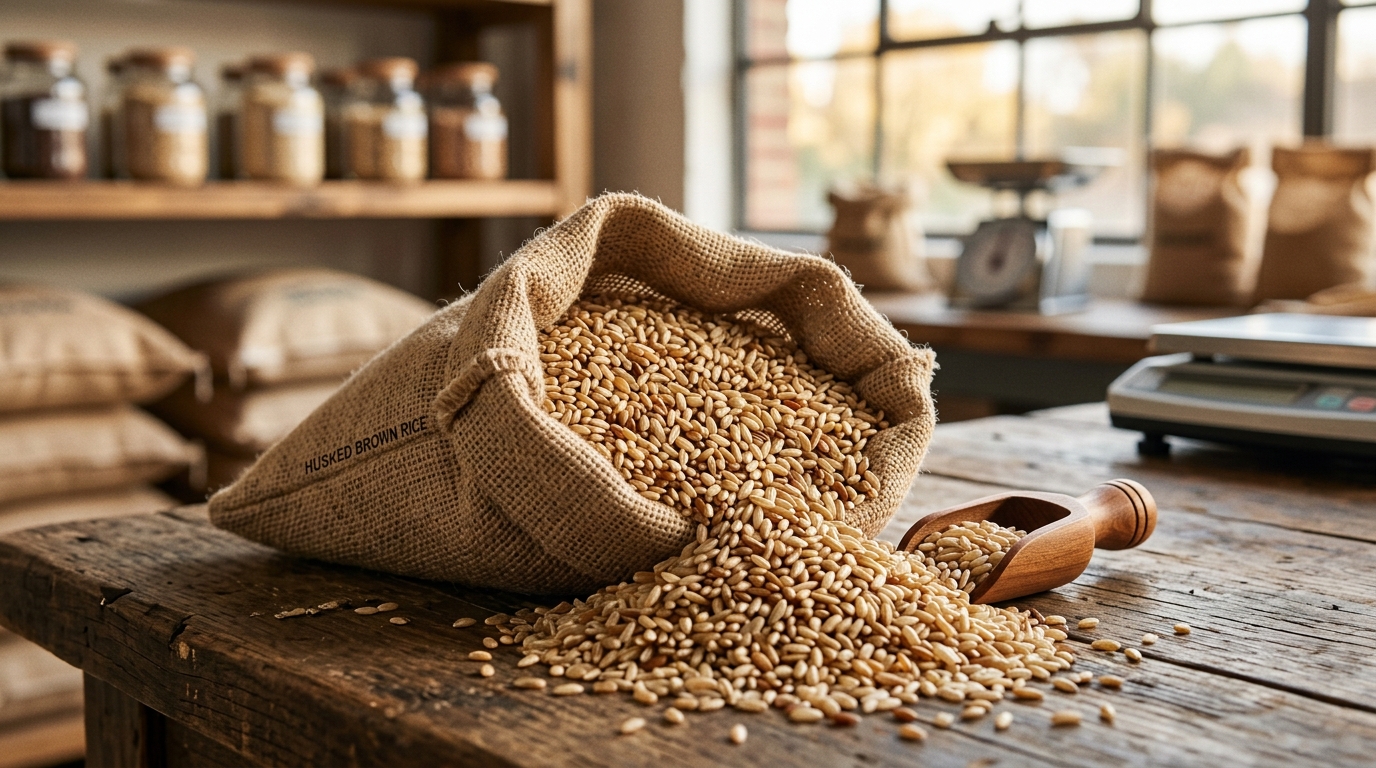
When you’re buying husked (brown) rice, most “incoming lot surprises” are created upstream—before the COA is printed. This guide maps the physical flow and the cost nodes where quality, safety, and compliance risk get locked in, so Purchase–Quality/Safety/Compliance teams can ask the few supplier questions that actually predict lot performance.
Husked rice (brown rice) sits in a narrow physical window: it’s stable enough to ship globally as a dry grain, but less chemically stable than white rice because the bran layer remains (higher lipid content → higher rancidity sensitivity). The supply chain is therefore engineered around three fixed control points that determine downstream outcomes: post-harvest drying, hulling + grading, and storage/logistics moisture + pest control.
Insight: The husked-rice chain is not “farm → export.” It is a sequence of yield-conversion steps where each node converts mass (paddy → brown rice → graded brown rice) and creates byproducts that subsidize the mill economics.
Data: Typical milling systems separate paddy into husk, brown rice, and later bran/brokens; industry references commonly show husk near ~20% of paddy weight, and brown rice recovery in the ~70–72% range (often cited as a typical presentation value; actual recovery can be higher with variety and process control). [1]
Procurement Impact: Your “spec on paper” is physically determined upstream by drying discipline, milling setup, and storage control. If those three controls are weak, you will see recurring variability in moisture, broken %, foreign matter, infestation, and shelf-life behavior—regardless of what the COA says.
Physical flow (simplified):
Paddy production → drying/tempering → cleaning → dehusking (hulling) → brown rice grading/sorting → bagging/liners → warehousing → containerization/ocean freight → destination storage/packing (or direct use).
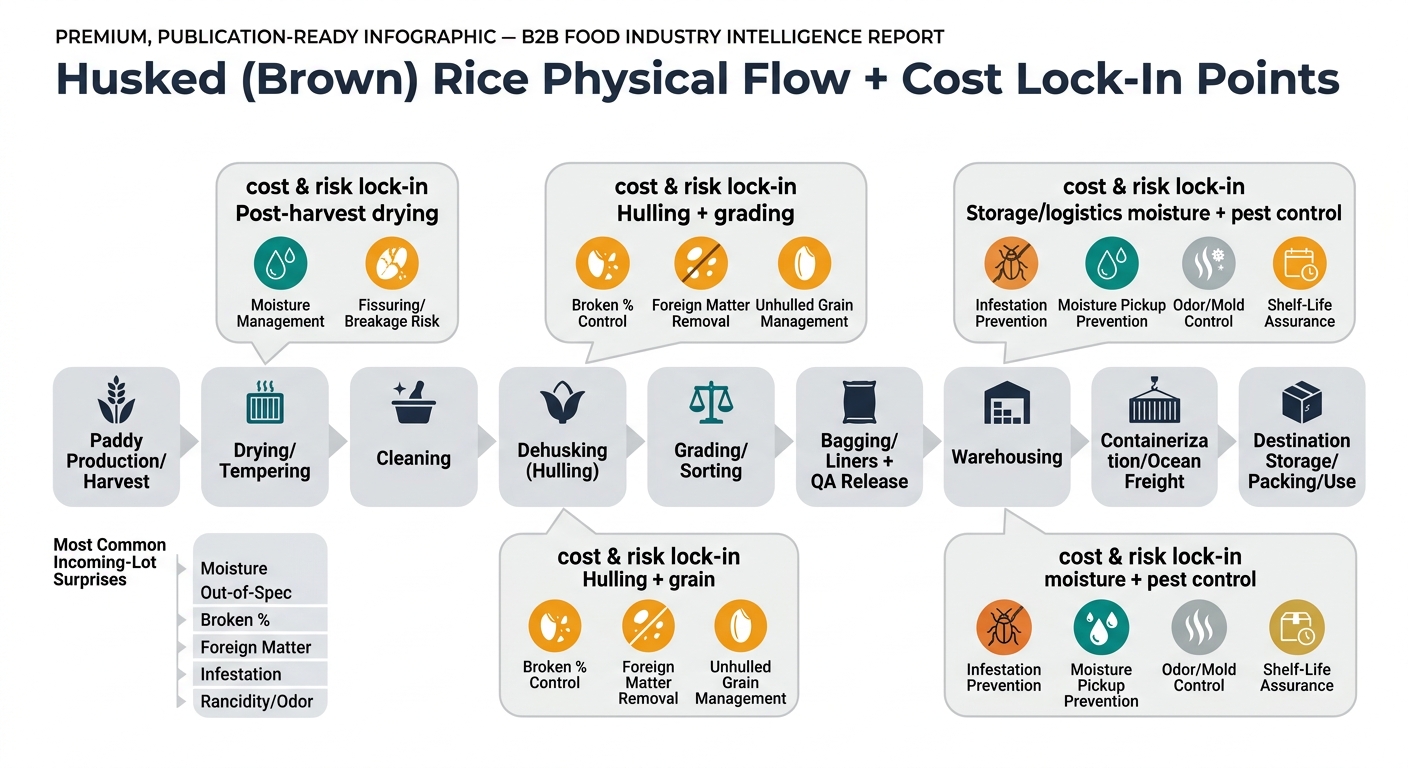
Insight: Husked rice cost is built from (a) farmgate paddy value, then (b) conversion economics (drying energy + milling yield), then (c) “keeping it dry and pest-free” through storage and shipping.
Data: Drying conditions and initial grain moisture materially affect head rice yield and breakage; technical literature consistently links moisture/drying regime to breakage and milling outcomes (directionally: poor drying control → higher fissuring/breakage risk).
Procurement Impact: Even if you do not buy milled white rice, the same yield physics apply: the supplier’s cost base (and their temptation to blend lots or relax sorting) is strongly linked to drying energy, milling yield, and byproduct value.
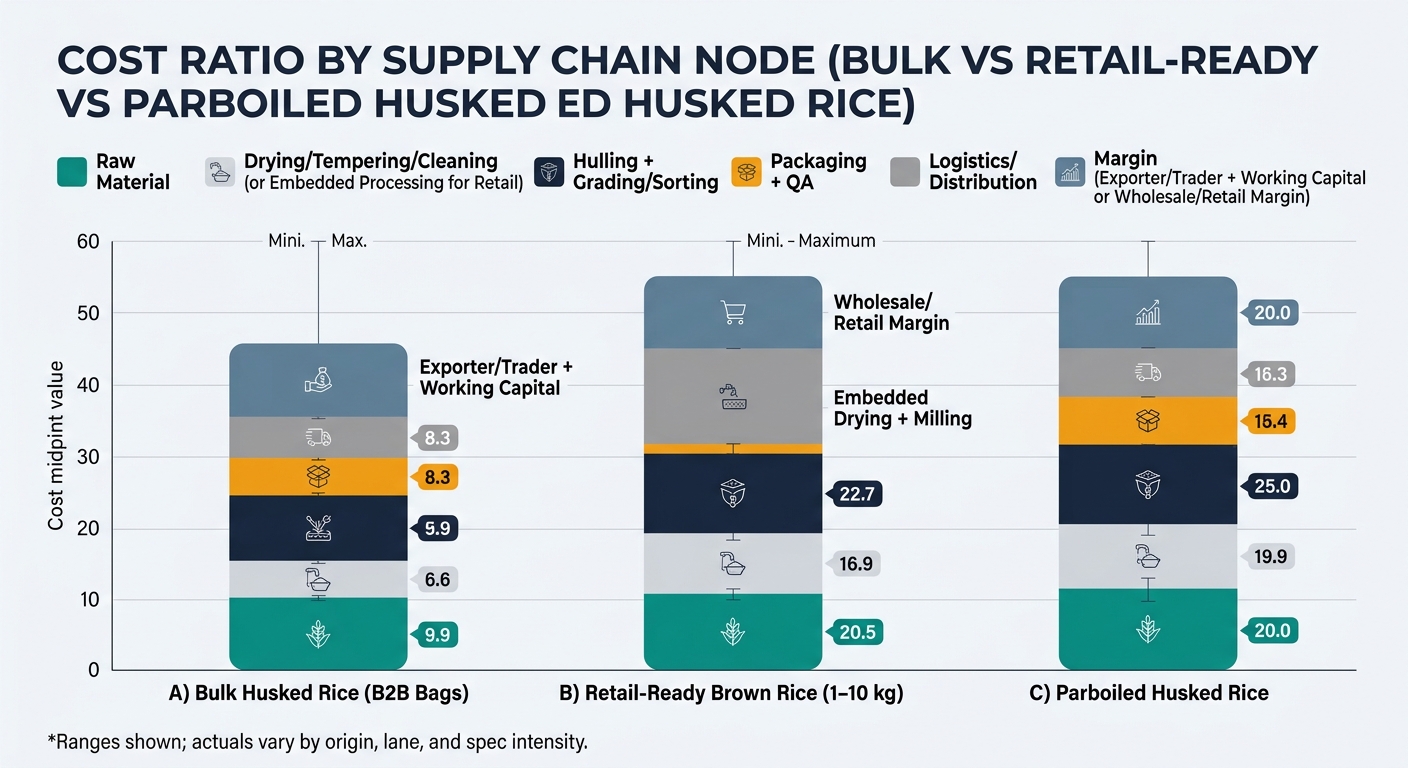
| Supply Chain Node | Cost Ratio (% of Final Cost) | Notes |
|---|---|---|
| Raw Material (paddy value embedded in brown rice) | 55–70% | Dominated by farmgate paddy and conversion yield. |
| Drying/Tempering/Cleaning | 6–12% | Energy + shrink + handling; sets storability and breakage risk. |
| Hulling + Grading/Sorting | 8–15% | Equipment depreciation, labor, sorting intensity, yield loss into brokens. |
| Packaging & QA Release | 3–7% | Bags/liners, inspection, sampling, lot segregation. |
| Inland + Ocean Logistics | 8–15% | Trucking to port, stuffing, freight, insurance, demurrage risk. |
| Exporter/Trader + Working Capital Margin | 3–8% | Financing carry, FX exposure, counterparty risk provisioning. |
| Supply Chain Node | Cost Ratio (% of Final Cost) | Notes |
|---|---|---|
| Raw Material (brown rice input) | 35–55% | Lower share because conversion/packaging/retail margin expand. |
| Drying + Milling (embedded) | 6–10% | Often embedded in supplier price; still drives quality variance. |
| Packaging Conversion + QA | 12–20% | Film/laminates, oxygen/moisture barriers, coding, metal detection. |
| Logistics & Distribution | 10–18% | Case packing, warehousing, last-mile complexity. |
| Wholesale/Retail Margin | 15–30% | Channel structure dominates final price. |
| Supply Chain Node | Cost Ratio (% of Final Cost) | Notes |
|---|---|---|
| Raw Material | 45–60% | Paddy value still dominant. |
| Parboiling (steam/water/energy) | 10–18% | Additional energy/water and equipment; alters kernel behavior. |
| Drying/Tempering (post-parboil) | 8–14% | Critical to prevent defects and manage moisture uniformity. |
| Hulling + Sorting | 8–14% | Different breakage behavior; still requires grading. |
| Packaging & Logistics | 12–22% | Similar to other forms; may require different handling practices. |
Insight: Three structural constraints shape husked rice outcomes regardless of supplier promises: yield conversion, moisture equilibrium, and byproduct economics.
Data: (1) Yield conversion is inherent: paddy separates into husk/brown rice and later into bran/brokens; widely used training/reference materials show indicative fractions (e.g., ~20% husk; ~70–72% brown rice). [1] (2) Moisture targets for safe storage are well-established in grain handling; equilibrium moisture behavior means ambient RH/temperature can re-wet product if packaging/warehousing is weak. [3] (3) Head/broken outcomes are highly sensitive to drying conditions and initial moisture (directional consensus across technical literature).
Procurement Impact:
Specify a tighter moisture-and-packaging control package at shipment—not just a destination moisture limit—by requiring (1) a defined moisture target range at bagging, (2) liner/barrier requirements suitable for brown rice, and (3) documented storage/fumigation handling steps through container stuffing. This works because the chain’s biggest preventable losses are created by moisture ingress and pest pressure after milling, when the bran layer makes quality more shelf-life sensitive. Teams that formalize these physical controls typically see fewer holds and fewer in-warehouse quality claims, with the cost impact showing up as reduced rework, fewer rejections, and less write-off rather than a lower unit price. The open question your organization will still need to solve—every season—is how to continuously verify which origins, mills, and logistics lanes are actually maintaining these controls lot after lot.
Lock your next husked-rice award on a “lane-controlled” shipment spec: moisture target at bagging plus packaging barrier minimums, and a fumigation/aeration documentation pack that is auditable. This works because brown rice is structurally more shelf-life sensitive (bran lipids) and moisture will re-equilibrate in weak lanes even if the mill dried correctly. In 2026, weather volatility and policy-driven trade shifts are keeping buyers jumpy and amplifying the real cost of a single held container—storage, demurrage, rework, and lost production time can easily dwarf a small per-ton price win. Treat lane control as a contract deliverable, not a “best effort,” and your cost-of-quality will move more than your unit price ever will. [5]


