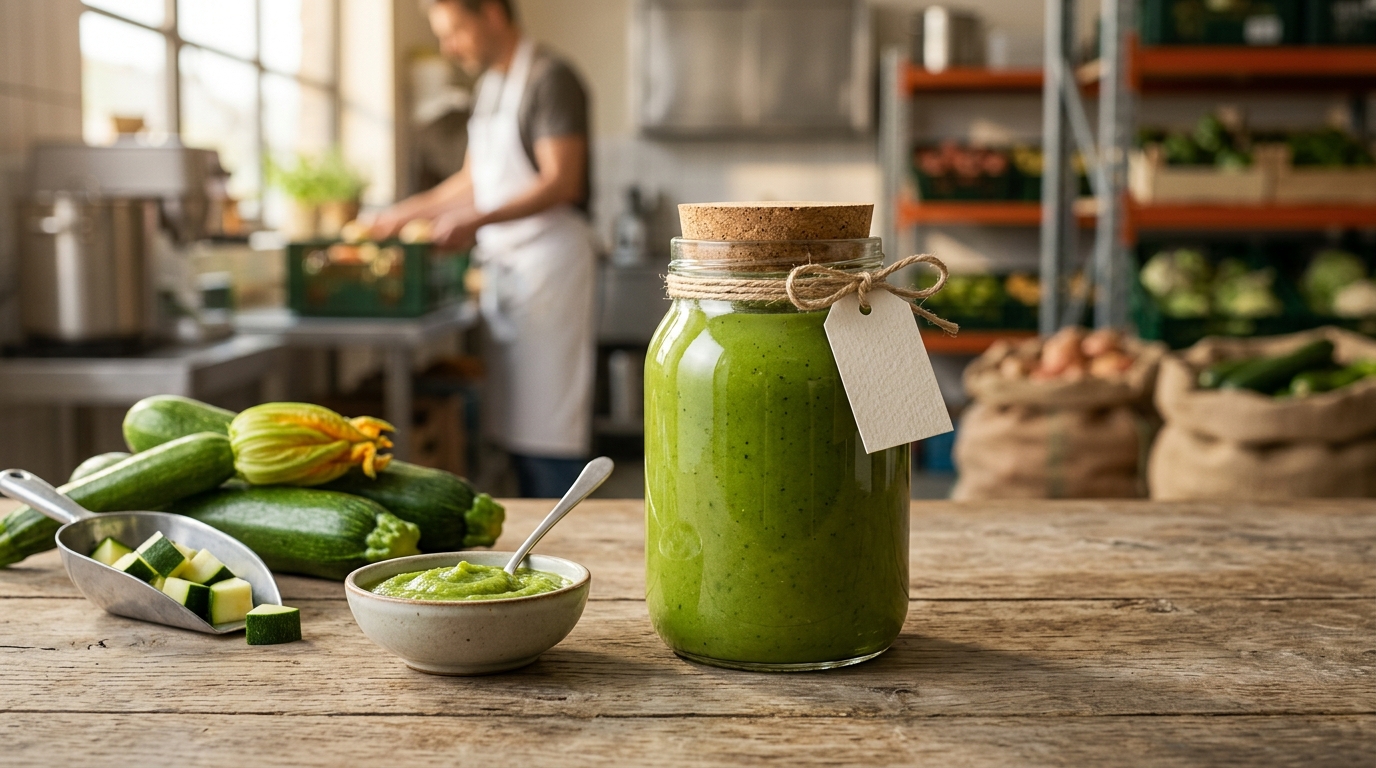
Zucchini puree is easy to underestimate because it looks like a simple, low-value vegetable input. In practice, it behaves like a seasonal processing-campaign product where perishability, stabilization choice (aseptic vs frozen), and spec discipline determine both continuity and delivered cost. This guide maps the physical flow and highlights where procurement can (and cannot) change outcomes.
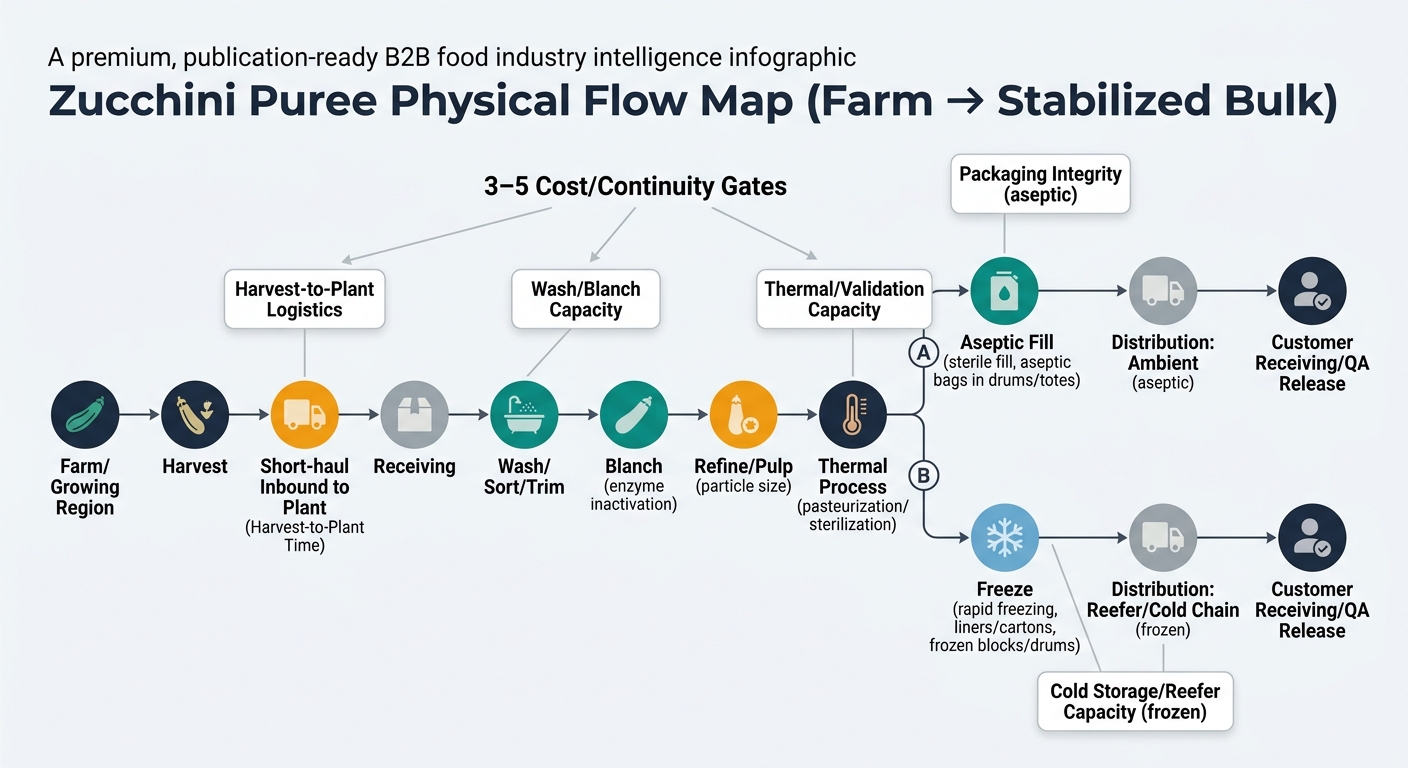
Zucchini puree is a high-water, low-acid vegetable input where time-to-process, stabilization method (aseptic vs frozen), and spec control determine what the supply chain can reliably deliver. The biggest fixed cost-drivers are not “trading” dynamics—they’re physical: harvest timing, wash/blanch throughput, thermal validation, packaging integrity, and (if frozen) continuous cold chain.
Insight: Zucchini puree behaves like a seasonal processing campaign product: raw zucchini is perishable and bulky, so cost and risk concentrate around the farm-to-plant window and the processor’s stabilization/packing capability.
Data (validated): Industrial puree supply typically follows a farm → wash/sort/trim → blanch (enzyme inactivation) → refine/pulp → thermal process (pasteurization/sterilization as applicable) → aseptic fill or freeze → drum/tote/carton distribution flow; each step adds yield loss, utilities, and QA hold time.
Procurement Impact: The “map” tells you where continuity breaks first: (1) harvest-to-plant logistics, (2) processing capacity (wash/blanch/thermal), (3) packaging + cold storage availability, and (4) QA release timing.
Insight: Zucchini puree cost is primarily a conversion-and-logistics story layered on top of an agricultural raw material: high moisture means you “ship water,” and the chain pays repeatedly for handling, energy, and packaging.
Data (validated as typical buckets): Across processed vegetable purees, typical hard-cost buckets include (a) raw veg + inbound, (b) yield loss (trim/refine), (c) utilities (hot water/steam/electric), (d) packaging (aseptic bags/drums or frozen liners/cartons), (e) QA holds/testing, and (f) storage/freight (ambient vs cold).
Procurement Impact: Even before any commercial terms, the physical cost stack sets the floor: the buyer’s biggest levers later will usually be pack format, spec tightness, and logistics design—because those change the underlying cost-to-serve.
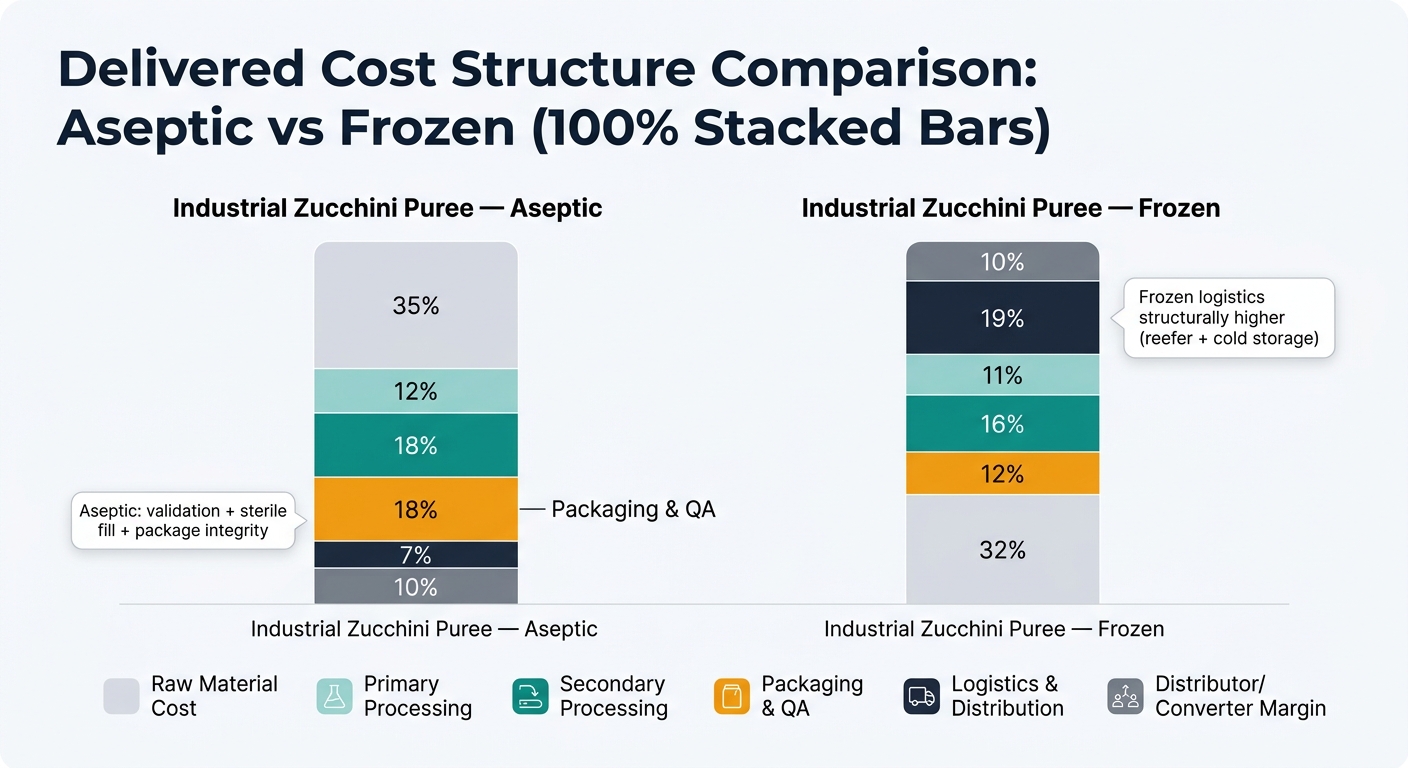
| Supply Chain Node | Cost Ratio (% of Final Cost) | Notes |
|---|---|---|
| Raw Material Cost (fresh zucchini + inbound) | 35% | Seasonal farm + harvest + short-haul to plant; quality drives trim loss. |
| Primary Processing | 12% | Wash/sort/trim labor, water/sanitizers, wastewater handling. |
| Secondary Processing | 18% | Blanch + refining + thermal process; yield loss rises with fine particle specs. |
| Packaging & QA | 18% | Aseptic bags/drums, validated sterile handling, micro testing + hold/release. |
| Logistics & Distribution | 7% | Mostly ambient freight/warehousing; packaging integrity is key risk. |
| Distributor/Converter Margin | 10% | Processor overhead + commercial margin (varies by scale and service level). |
| Supply Chain Node | Cost Ratio (% of Final Cost) | Notes |
|---|---|---|
| Raw Material Cost (fresh zucchini + inbound) | 32% | Similar upstream, but some plants accept different raw specs for frozen. |
| Primary Processing | 11% | Washing/sorting/trim; foreign matter controls remain critical. |
| Secondary Processing | 16% | Blanch/refine; thermal may be lighter than aseptic but still stabilizes quality. |
| Packaging & QA | 12% | Liners/cartons + QA holds; less aseptic complexity but still food safety critical. |
| Logistics & Distribution | 19% | Reefer freight + cold storage + energy exposure + shrink risk. |
| Distributor/Converter Margin | 10% | Service level, storage handling, and partial-ship complexity can increase margin. |
| Supply Chain Node | Cost Ratio (% of Final Cost) | Notes |
|---|---|---|
| Raw Material Cost (puree input) | 20% | Puree becomes one ingredient among packaging-heavy retail costs. |
| Secondary Processing (formulation/retort where applicable) | 10% | Blending, thermal processing, line efficiency losses. |
| Packaging & QA | 35% | Pouches/jars, caps, labels, coding, retail QA and traceability. |
| Logistics & Distribution | 15% | Case packing, palletization, DC handling, retail compliance. |
| Brand/Retail Margin | 20% | Trade spend, retailer markup, brand overhead (varies widely). |
Insight: Zucchini puree supply is constrained by physics (perishability, moisture, and stabilization needs), not by paperwork; the same constraints repeat every year regardless of market sentiment.
Data (validated as recurring constraints): Three recurring constraints shape availability and consistency: seasonal campaigns, processing bottlenecks (wash/blanch/thermal), and spec-driven eligible capacity (particle size, viscosity, micro limits, and packaging format).
Procurement Impact: If you treat zucchini puree like a generic commodity, you’ll misread lead times and overestimate switchability; if you treat it like a campaign-processed ingredient, you’ll align QA, Ops, and planning to the chain’s real cadence.
Insight: Zucchini puree cost, quality, and continuity are set by five physical questions: where the crop is grown, how fast it reaches the plant, how the plant is bottlenecked, how the puree is stabilized, and how strictly texture/micro specs are controlled.
Data (validated as the heavy nodes): The heaviest structural cost nodes are (1) farm + harvest labor and yield, (2) wash/sort/trim + wastewater capacity, (3) energy-intensive blanch/thermal processing, (4) packaging + QA holds (especially aseptic), and (5) logistics mode (ambient vs cold).
Procurement Impact: When you build internal alignment, anchor discussions on pack format (aseptic/frozen), spec criticality (texture/micro), and logistics design—because those are the physical levers that determine both cost-to-serve and operational reliability.
The Bottom Line for Your Next Contract:
(Analyzed at: Apr, 2026)
If you’re buying frozen zucchini puree, treat reefer and cold storage as a first-class sourcing variable in 2026—not an afterthought—because reefer rates and capacity have shown renewed upward pressure entering 2026, and spot exposure is where budgets get surprised. The highest-conviction move is to contract your logistics lane (or convert a portion of volume to aseptic where technically feasible) at the same time you award the puree, then lock specs to what the plant can run at campaign speed. Teams that do this typically avoid the quiet 5–12% delivered-cost leakage that comes from expedited reefer moves, temperature-claim shrink, and “special runs” to hit over-tight texture targets. What’s at stake is not just unit price—it’s whether your program is engineered for predictable execution when the season and the cold chain inevitably get tight.