INDUSTRY TRENDS

How Yeolmu Kimchi Really Moves: Where Cost Locks In (Yield, Fermentation Window, and Gas-Managed Packaging)

Author
Team Tridge
DATE
July 9, 2026
8 min read
fermented-young-radish-kimchi Cover
Unlock Full Data
Fermented Young Radish Kimchi Market Intelligence
Prices · Trends · Origins · Forecasts

Yeolmu (young-radish) kimchi is one of those categories where procurement success comes less from “finding a cheaper supplier” and more from understanding where physics and microbiology lock in cost, risk, and shelf-life. This guide maps the real nodes that drive landed cost and claims, and translates them into what sourcing teams should specify, measure, and negotiate—without assuming deep kimchi-domain expertise.

Executive Summary

  • Cost locks in early through trim + brine/drain yield loss and sanitation/water handling; you rarely “win it back” later.
  • Quality is a time–temperature problem: many references place “optimal eating” around pH ~4.0–4.5, but temperature controls how fast you pass that window. [1]
  • Packaging is part of process control because CO2 continues after packing; swelling/leakers are engineered problems (valves/CO2 absorbents/permeable films), not “warehouse mistakes.” [2]
  • Cold chain is a shelf-life lever as much as a logistics cost line—lane performance often explains clustered returns.

1) The Physical Map: Where Yeolmu Kimchi Cost Gets “Locked In”

Fermented young-radish kimchi (yeolmu-kimchi) is built on a short, perishable chain where raw radish physiology + brining yield loss + fermentation kinetics + gas-managing packaging determine what is feasible downstream. The product keeps fermenting after packing, so temperature control and package design are not “logistics details”—they are part of the manufacturing step.

Insight: The chain is structurally constrained by (1) fast radish-to-brine turnaround, (2) controlled acidification to a target pH window, and (3) packaging that can tolerate ongoing CO2 generation.

Data (validated): Multiple technical references commonly describe “optimal” kimchi eating quality around pH ~4.0–4.5 (often ~4.2), while more aged/sour products can drop further. [1]

Procurement Impact: The fixed cost-drivers show up early: harvest timing, trim losses, brine concentration control, fermentation hold-space (often refrigerated), and high-performance films/closures to prevent swelling/leakers.

Supply chain flow (typical):

Farm/field harvest → packhouse pre-cool + grading → plant washing/sanitizing + trimming → brining/salting + draining (yield loss) → seasoning mix + blending → fermentation hold (time/temperature) → fill/pack (gas management) + QA release → chilled distribution (DC → retail/foodservice).

A left-to-right flow diagram showing the typical yeolmu kimchi path from farm harvest through packhouse, washing/trimming, brining and draining yield loss, seasoning and blending, fermentation hold controlled by time–temperature to a pH ~4.0–4.5 window, fill/pack with gas management and QA release, and chilled distribution; callouts flag trim + brine/drain yield loss, fermentation window control, and gas-managed packaging to prevent CO2 swelling/leakers, with simple icons such as leafy radish, water droplet, thermometer, pH tag, package/valve, and reefer truck.

2) Cost & Margin Structure by Node (What Each Step Physically Adds)

Insight: Yeolmu kimchi accumulates cost through mass loss (trimming + brining/draining) and risk controls (micro, cold chain, packaging) more than through complex machinery.

Data (use with caution): Yeolmu is described as a fast-cycle crop with multiple harvest windows per year in intensive systems; treat this as directional context (seasonality and cycle time), not a procurement-grade agronomy spec. [3]

Procurement Impact: The largest “structural” cost levers are not optional: water handling + sanitation, yield loss management, fermentation space/time, and packaging engineered for CO2.
1. Upstream / Raw Material (Yeolmu Farming + Field Trim)

  • Insight: This node sets texture potential (tenderness, fiber, leaf integrity) and microbial load; you can’t fully “process out” poor raw radish.
  • Data (directional): Yeolmu availability can be supported by intensive cultivation with multiple harvests per year; cycle time varies by season. [3]
  • Procurement Impact: Physical variability becomes downstream cost via higher trim loss, softer texture after brining, and faster souring (higher initial micro load), which increases credits/returns risk.

2. Packhouse / Pre-Cool + Sorting (First “Yield Gate”)

  • Insight: Because yeolmu is leafy and high-water, heat removal and defect sorting are the first stability steps; delays raise respiration and spoilage pressure.
  • Data (validated conceptually): Commercial kimchi processing descriptions consistently start with trimmed/cut vegetables that are salted and seasoned before fermentation—meaning early handling is integral to final quality. [4]
  • Procurement Impact: This node drives hidden cost through (a) shrink from wilting/leaf breakage, (b) downgrade to lower-grade lots, and (c) higher sanitation burden at the plant.

3. Primary Processing (Wash/Sanitize → Brine/Salt → Drain)

  • Insight: Brining is both a flavor step and a water-activity/texture engineering step; it also creates unavoidable mass loss (drainage) and wastewater treatment cost.
  • Data (corrected): Brining/salting practices vary widely by plant and style; some references describe high-salt salting steps (including very high salt for short durations), while finished/fermenting salt levels are typically lower. Treat any single brine % as recipe-specific rather than universal. [5]
  • Procurement Impact: Fixed cost-drivers here are water, labor for trimming/sorting, salt usage, sanitation chemicals, and wastewater/effluent handling; yield loss at this node permanently raises effective ingredient cost per finished kg.

4. Secondary Processing (Seasoning Paste + Mixing)

  • Insight: Seasoning is where allergen and consistency risk concentrates (fish sauce/jeotgal, shrimp-based ingredients, spice blends), and where viscosity/water binding affects purge and package headspace.
  • Data (directional): Common kimchi formulations often include chili, aromatics, and (depending on recipe) fermented seafood ingredients, which drives allergen/cross-contact controls. [5]
  • Procurement Impact: This node adds fixed costs in ingredient staging, allergen segregation, batch documentation, and rework risk if paste salinity/solids drift (which later shifts fermentation rate and purge volume).

5. Fermentation Hold (Time/Temperature → pH Window)

  • Insight: Fermentation is a time-capacity business: tank/room space and temperature control are the “equipment,” and they determine throughput.
  • Data (validated): Technical literature commonly references an “optimal fermentation stage” around pH 4.0–4.5. Temperature materially changes the rate of acidification; studies comparing colder vs warmer conditions show much faster pH drop at warmer temperatures (e.g., 15°C vs 4°C). [1]
  • Procurement Impact: The fixed cost-drivers are chilled/controlled rooms, monitoring labor, QA sampling cadence, and working capital tied up during hold; missing the pH window converts directly into shelf-life loss and claims.

6. Packaging & QA Release (Gas Management + Leak Prevention)

  • Insight: Packaging is not passive: kimchi generates CO2 during storage, so films/closures must manage pressure without leaking brine or losing odor barrier.
  • Data (validated): Research and industry practice describe CO2 absorbents and one-way valve concepts as countermeasures; swelling and brine leakage/bursting are explicitly documented failure modes when CO2 accumulates excessively. [2]
  • Procurement Impact: Fixed costs concentrate in specialty films/tubs, seal integrity controls, headspace management, and QA checks (pH/salinity, micro verification). Packaging failures show up as returns, retailer chargebacks, and expedited rework.

7. Cold-Chain Distribution (Reefer Storage + Chilled Transport)

  • Insight: For live-ferment chilled kimchi, distribution temperature is effectively a continuation of fermentation control.
  • Data (validated framing, clarified): The pH 4.6 threshold is widely used as a food-safety classification/control line for acidified foods and related regulatory frameworks; it’s a useful reference point, but it is not a guarantee of overall product safety or quality on its own. [6]
  • Procurement Impact: Structural cost drivers are reefer capacity, temperature monitoring, and shrink from temperature excursions (over-souring, swelling, purge). Claims often trace back to lane performance, not the recipe.
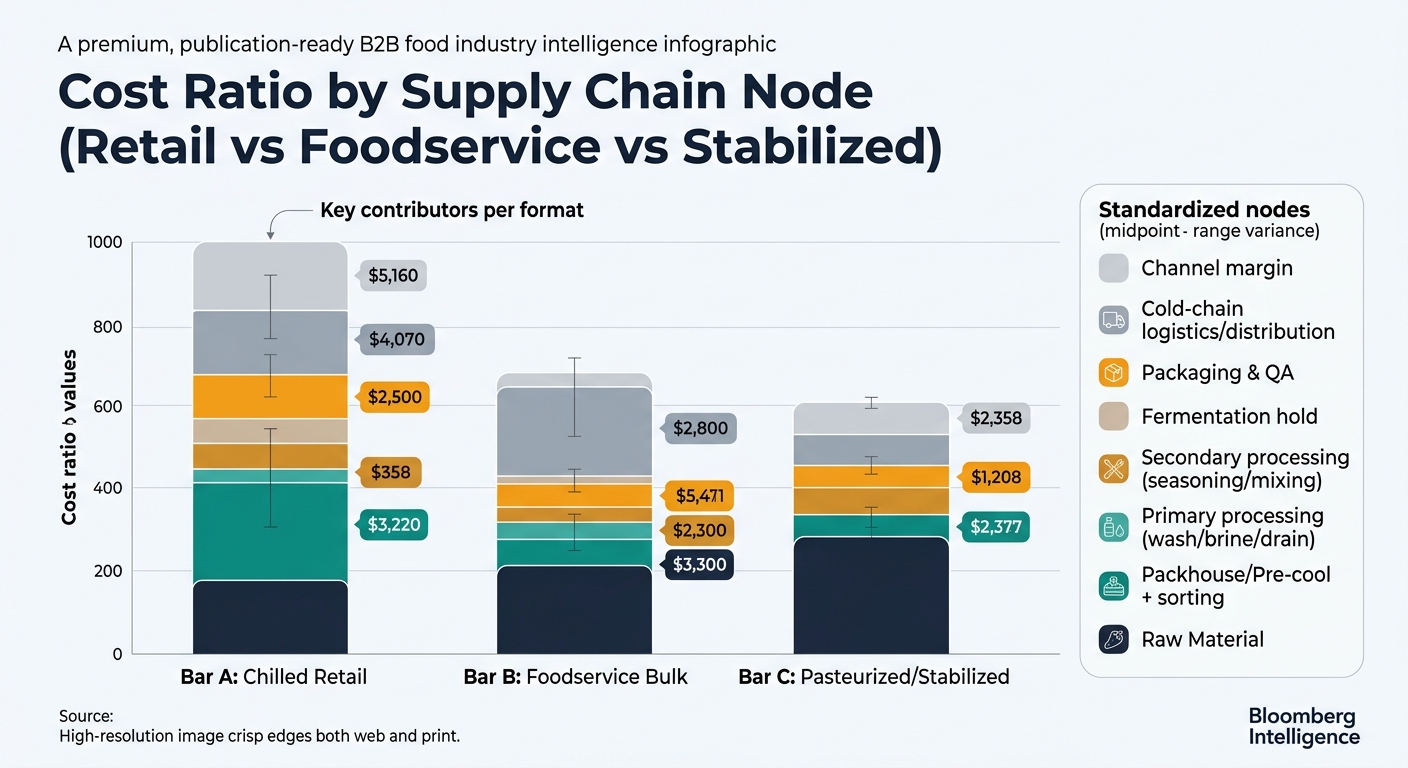
Comparative stacked bar chart with three stacked bars for chilled retail, foodservice bulk, and pasteurized/stabilized formats; each bar is divided into standardized node categories (raw material, packhouse/pre-cool and sorting, primary processing, secondary processing, fermentation hold, packaging and QA, cold-chain logistics/distribution, and channel margin) using midpoint values from the cost ratio ranges, with a legend and annotations highlighting the largest contributors per format.

Product-Level Cost Breakdown

A) Chilled Retail Yeolmu Kimchi (Pouch/Tub)

Supply Chain Node Cost Ratio (% of Final Cost) Notes
Raw Material (yeolmu + aromatics share) 18–28% Perishability + trim variability drives effective cost per usable kg.
Packhouse / Pre-cool + sorting 3–7% First yield gate; reduces downstream sanitation burden.
Primary processing (wash + brine + drain) 12–18% Labor + water + salt + wastewater + yield loss.
Secondary processing (seasoning + mixing) 12–20% Seasoning solids, allergen controls, batch documentation.
Fermentation hold (time/temp control) 6–12% Room/tank capacity + energy + working capital.
Packaging & QA 12–20% Gas-managing films/tubs, seals, labels, QA release testing.
Cold-chain logistics & distribution 10–18% Reefer warehousing + chilled transport + shrink risk.
Wholesale/Retail margin 10–20% Channel-dependent; higher where shrink/returns are priced in.

B) Foodservice Bulk Yeolmu Kimchi (Bag-in-Box / Pail)

Supply Chain Node Cost Ratio (% of Final Cost) Notes
Raw Material 20–32% Similar drivers; larger lots can reduce handling cost per kg.
Primary processing 13–20% Throughput efficiency matters; wastewater still material.
Secondary processing 12–18% Allergen + consistency controls remain.
Fermentation hold 6–12% Time-capacity constraint persists.
Packaging & QA 6–12% Lower packaging cost than retail, but higher spill/leak exposure in handling.
Cold-chain logistics 12–20% Heavy, wet product; reefer utilization is critical.
Distributor margin 8–15% Depends on service level and returns handling.

C) Pasteurized / Heat-Treated “Stabilized” Kimchi-Style (Less Common for Yeolmu)

Supply Chain Node Cost Ratio (% of Final Cost) Notes
Raw Material 15–25% Texture is harder to preserve; raw quality still matters.
Primary + secondary processing 22–35% Similar steps before stabilization.
Stabilization (pasteurization/HPP where used) 8–18% Adds equipment/energy cost; reduces live fermentation risk.
Packaging & QA 10–18% Packaging can be less gas-focused, more thermal-compatible.
Logistics & distribution 8–15% Potentially less cold-chain intensity depending on process and spec.
Channel margin 10–20% Driven by positioning and shelf-life economics.
Unlock Full Data
Fermented Young Radish Kimchi Market Intelligence
Prices · Trends · Origins · Forecasts

3) Structural Facts Every Buyer Should Know (Non-Obvious Constants)

Reality 1: “Yield Loss” Is a Built-In Cost, Not a Process Defect

Insight: Trimming + brining/draining creates unavoidable mass loss; the chain converts fresh, high-water biomass into a seasoned fermented product with different solids/water balance.

Data (validated conceptually): Kimchi production is structurally defined by trimming/cutting, salting, seasoning, and fermentation—steps that inherently remove water and discard brine. [4]

Procurement Impact: Two suppliers with the same farmgate radish price can have different finished-goods cost because their trim standards, brine management, and drainage control change finished yield.

Reality 2: Packaging Is a Fermentation-Control Component

Insight: CO2 generation continues after packing; swelling, bursting, and leakage are physical failure modes that must be engineered out.

Data (validated): CO2 absorbent systems and one-way valve concepts are documented approaches to manage pressure buildup and reduce leakage/bursting risk in kimchi packs. [2]

Procurement Impact: Packaging specification (film structure, sealant layer, permeability, headspace design) is inseparable from shelf-life and returns economics.

Reality 3: pH Targets Control Quality—but Temperature Controls the Clock

Insight: The product’s “ready” state is often defined by a pH window, but the speed to reach (and pass) that window is temperature-driven.

Data (validated): Optimal-stage pH is frequently cited around 4.0–4.5; warmer conditions drive faster acidification than refrigeration-range storage. [1]

Procurement Impact: The cold chain is a structural requirement for consistent eating quality, not just a safety checkbox; lane temperature stability directly affects sellable life.

Key Insights You Can Reuse in Internal Alignment

  • Insight: Yeolmu kimchi is a time-and-temperature-managed product where “manufacturing” continues into distribution.
  • Data (validated): Kimchi quality is often discussed around a pH window (commonly ~4.0–4.5), and packaging technologies explicitly address CO2-driven swelling during storage. [1]
  • Procurement Impact: When stakeholders debate cost, anchor the conversation on three fixed nodes: (1) yield loss at trim/brine/drain, (2) fermentation hold capacity and monitoring, and (3) gas-managing packaging + cold-chain performance.

4) The Bottom Line for Your Next Contract

(Analyzed at: Jul, 2026)

Write your next award so packaging performance and cold-chain lane performance are contracted as one system, not two separate line items. It works because CO2 pressure management is an engineered packaging/control problem (valves/absorbents/permeable structures) and temperature governs how quickly the product moves through the pH “optimal” window—both are documented drivers of swelling/leakers and quality drift. [2]

In current conditions, flexible packaging input prices have been volatile but showed declines in parts of 2025, which creates room to negotiate specs and testing rather than accept failures as “normal shrink.” [7]

What’s at stake is usually not cents per pouch; it’s avoiding clustered chargebacks/credits and emergency rework that can realistically swing delivered cost by high single digits when a single format + lane combination starts failing.

Fermented Young Radish KimchiSupply Chain Intelligence
132 countries tracked
10
Exporters
10
Importers
$365M
Top Export Value
Top Exporters (2024)
🇳🇱
Netherlands
$365M
🇮🇹
Italy
$278M
🇪🇸
Spain
$232M
🇰🇷
South Korea
$178M
🇹🇷
Turkey
$156M
+127 more
Top Buyers
🇺🇸 United States $753M🇩🇪 Germany $471M🇯🇵 Japan $358M🇰🇷 South Korea $304M🇬🇧 United Kingdom $228M

References

  1. pmc.ncbi.nlm.nih.gov
  2. sciencedirect.com
  3. en.wikipedia.org (Yeolmu)
  4. sciencedirect.com (Kimchi topic)
  5. en.wikipedia.org (Kimchi)
  6. fda.gov
  7. flexpack-europe.org

Related Contents

Subscribe
→
By subscribing you agree to with our Privacy Policy and provide consent to receive updates from our company.
Thank you! Your submission has been received!
Oops! Something went wrong while submitting the form.
Subscribe to receive the latest blog posts, updates, promotions, and announcements from Tridge.
