INDUSTRY TRENDS

How to Time Winged-Bean-Flour Buys When Prices Don’t Behave (Seed vs. Processing Spread Playbook)

Author
Team Tridge
DATE
April 22, 2026
7 min read
winged-bean-flour Cover
Tridge Eye Data Intelligence Solution

This report is powered by Tridge Eye Data Intelligence.

Every data point, price signal, and supply risk insight in this analysis comes from the same platform that procurement and sourcing leaders worldwide rely on daily. As you read, consider what this level of market intelligence could do for your sourcing decisions.

Explore Tridge Eye →

Executive Summary

  • Winged-bean seed is protein-rich and composition varies by cultivar and processing; published seed flour protein ranges are wide (roughly ~37–46% on a dry-weight basis in one classic dataset), reinforcing why “same spec” can still behave differently in use. [1]
  • Flour pricing often decouples from seed because inventory lag, yield losses, heat-treatment capacity, and QA/testing overhead create a second “processing index.”
  • Moisture and storage control matter: low-moisture foods (including flour) have pathogen-control dynamics that often drive validated heat-treatment steps and extra sampling—costs that don’t fall when seed softens. [2]
  • Best procurement outcomes typically come from (1) timing price resets to supplier inventory turns and (2) maintaining audit-ready alternates—more than from squeezing a single incumbent.

Key Insights

(Analyzed at: Apr, 2026)

  • Strategy: Hold
  • Reliability: Medium
  • Potential Saving: 4%–9%
  • Insight: Treat winged-bean flour as a two-driver category: seed replacement cost plus a processing/QA capacity premium (heat treatment, micro validation, sampling frequency, packaging/liners, and lane reliability). Because winged bean is mainly grown across South/Southeast Asia and PNG and remains underutilized/fragmented, supply is often “slot-priced” rather than commodity-priced. [3] Use an inventory-turn trigger: when seed offers/lead times improve but flour offers stay flat for ~6–10 weeks, push for a scheduled price reset tied to documented seed replacement cost and a capped processing premium—but only when at least one process-equivalent alternate is qualification-ready. This is where savings typically materialize without increasing disruption exposure.

Ready to act on these insights? Tridge Eye delivers the real-time market signals behind this analysis. Get my market intelligence →

Executive Summary (What signals you’re missing—and how to beat the index)

Winged-bean flour behaves less like a traded commodity and more like a capacity-and-inventory priced specialty ingredient. The “alpha” comes from tracking the spread between (a) upstream seed availability and (b) downstream flour offers—then acting before that spread mean-reverts.
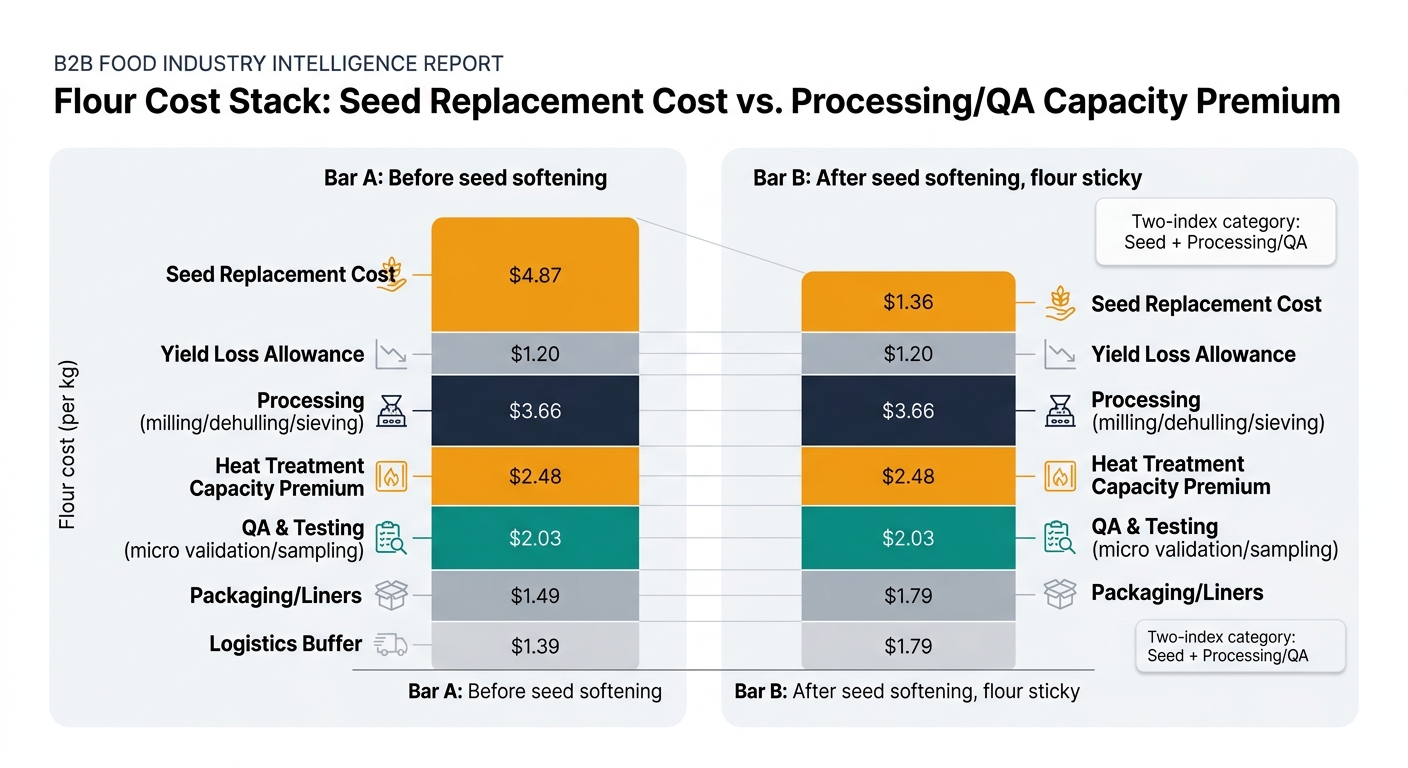
Two stacked bars comparing winged-bean flour cost components per kg before seed softening vs after seed softening with sticky flour pricing, showing seed replacement cost shrinking while yield loss allowance, processing, heat treatment capacity premium, QA/testing, packaging/liners, and logistics buffer remain relatively fixed, illustrating a two-index category (seed + processing/QA) and a resulting price floor.

What’s unusual (and exploitable)

  • Seed costs can soften while flour offers stay sticky because millers are pricing off older seed inventory, constrained milling slots, and QA/packaging overheads that don’t fall with farmgate.
  • Flour can spike even when seed doesn’t when a single node tightens (heat-treatment line downtime, export documentation delays, container rollovers), because the supplier base is thin and buyers have limited qualified alternates.
  • Quality volatility creates “false cheapness.” A low quote often embeds higher moisture, coarser grind, or inconsistent heat treatment—leading to higher cost-in-use and higher rejection risk.

Quick win

Treat winged-bean flour as a two-index category: (1) seed availability proxy + (2) processing/QA capacity proxy. When those diverge, you can renegotiate, re-time purchases, or trigger dual-sourcing before competitors do.

1) The Market Signal You Can Actually Trade: Seed vs. Flour Price Disconnects

Insight: Winged-bean flour pricing often decouples from seed pricing because processing yield, capacity, and risk buffers dominate the last 30–60 days of the cost stack.

Data (realistic, decision-grade examples)

A 12–16 week dual-line time series chart showing upstream winged-bean seed offer price proxy ($/kg) and downstream winged-bean flour offer price ($/kg), with a shaded band labeled

1) Inventory lag + yield loss makes seed moves look “small” downstream

  • Assume a supplier buys seed at $1.10/kg and sells flour at $2.35/kg.
  • A new harvest hits and seed drops 15% to $0.94/kg.
  • But the miller is holding 6–10 weeks of seed inventory purchased at the old price, and dehulling/sieving losses mean only ~85–92% effective flour yield from incoming seed lots (range depends on seed quality, dehulling intensity, and target granulation).
  • Result: the supplier may only concede 3–7% on flour near-term (e.g., $2.35 → $2.19–$2.27/kg), even though seed fell 15%.

2) Processing bottlenecks create a “price floor” independent of seed

  • Heat-treated flour (for reduced microbial risk / improved flavor stability) can carry a $0.20–$0.45/kg premium versus untreated flour because capacity is limited and energy + QA sampling is non-trivial.
  • If the heat-treatment line is booked or down, suppliers will ration supply via price—even if seed is stable.

3) Quality risk widens the spread

  • A shift from ~10–11% moisture to ~12–13% can increase clumping, shorten shelf-life, and raise micro risk—forcing buyers into extra receiving tests, rework, or tighter storage.
  • Suppliers with better drying/lot control can keep pricing firm while others discount to move borderline lots.

Procurement impact (what to do with this)

  • Stop benchmarking flour offers against “seed price” alone. Benchmark against a seed-to-flour conversion band (yield + processing type + QA load) and treat deviations as negotiation triggers.
  • When seed softens, your best window is often after incumbent inventory turns (commonly 6–10 weeks), not immediately.

Key Takeaways

  • Watch the spread, not the headline price.
  • Inventory age + yield variability explains most “why didn’t flour drop?” conversations.
  • Processing capacity (especially heat treatment) is a hidden index.

2) Three Mistakes That Quietly Inflate Landed Cost (Even When You “Win” Price)

Mistake #1: Negotiating price-per-kg instead of cost-in-use

  • What happens: Procurement accepts a $0.10–$0.20/kg cheaper flour without validating particle size distribution, moisture, and functional performance.
  • Why it fails: If water absorption/emulsification is weaker, R&D compensates with higher inclusion rates or binders. A 5–10% higher usage rate wipes out the “savings.”
  • Hidden cost: Extra receiving tests + reformulation trials + line adjustments often add an effective 2–5% to annualized cost on small-volume specialty ingredients.

Mistake #2: Treating “same spec” as “same process”

  • What happens: Two suppliers both meet protein and moisture targets, but one uses dehulling + controlled heat treatment while the other uses basic milling.
  • Why it fails: Functional and sensory outcomes differ batch-to-batch; QA incidents rise.
  • Hidden cost: A single contamination/odor event can trigger holds and expedited replacement freight; on niche ingredients, expedite can add an equivalent $0.25–$0.60/kg on the affected lots.

Mistake #3: Building a dual-source strategy that isn’t qualification-ready

  • What happens: The team “has alternates,” but no audit slot, no COA history, and no agreed acceptable ranges with QA/R&D.
  • Why it fails: During disruption, you can’t switch fast; you end up paying incumbent premiums.
  • Hidden cost: Emergency buys commonly come with short ship windows, unfavorable Incoterms, and tighter MOQs, increasing working capital and obsolescence risk.

Quick win: For each supplier, document a Process-Equivalent Profile (dehulled/whole, heat-treated/untreated, target particle size, typical micro performance). Use that to define true alternates.

3) What Changes When You Run This Category Like Intelligence-Driven Procurement

Insight: The measurable advantage comes from turning winged-bean flour into a governed, signal-based category—not a relationship-based specialty buy.

Data (before/after outcomes you can realistically target)

Dimension Traditional (quote-led) Intelligence-driven (signal-led) What improves
Price variance vs. market-clearing level +6% to +15% on portions of spend +2% to +6% Better timing + leverage from alternates
Unplanned disruption events 1–3/year 0–1/year Early triggers + qualification-ready bench
Qualification cycle time for alternates 12–20 weeks 6–12 weeks Pre-built data pack + aligned spec ranges
Quality incidents (holds/claims) Higher, sporadic Lower, trend-managed Lot history + process comparability

Procurement impact

  • You move from reactive buying to planned optionality: pre-approved alternates, lane options, and a playbook for when spreads widen.
  • You reduce “surprise premiums” because suppliers know you can switch without restarting qualification.

4) Three Situations Where Better Signals Beat Better Negotiators

Scenario A: Contract renewal in 60 days—lock or float?

Insight: If seed availability is improving but flour offers are sticky, you’re likely seeing inventory lag.

  • Action: Propose a two-step price review: fix volume/quality now, reopen price after 8 weeks with a defined seed proxy + freight check.

Scenario B: QA flags rising moisture—supplier issue or seasonal pattern?

Insight: Moisture drift can be origin-seasonal, not supplier-specific.

  • Action: Compare last 6 lots across suppliers by moisture, micro, and transit time variance. If origin-wide, negotiate tightened moisture cap + packaging/liner upgrade instead of switching blindly.

Scenario C: A competitor ties up your main processor’s capacity

Insight: Capacity capture shows up as longer lead times before price spikes.

  • Action: Trigger a contingency: allocate volumes across two process-equivalent suppliers and secure at least one alternate lane/Incoterm (e.g., FOB + your forwarder) to reduce rollover risk.

5) Why This Same Playbook Works on Adjacent Ingredients You Also Buy

Insight: Winged-bean flour is a template for other “thin market” plant ingredients where processing and QA dominate.

Data

Similar disconnect patterns show up in:

  • Chickpea/pea/fava flours: crop price can fall while milling + sieving capacity stays constrained.
  • Specialty protein blends: input costs move, but functional performance guarantees keep finished pricing sticky.
  • Heat-treated legume ingredients: micro risk management creates a capacity premium that behaves like a separate index.

Procurement impact

Build a repeatable method: input proxy + processing proxy + qualification readiness.

6) The Persuasion Point: What This Analysis Proves About Your Next Sourcing Decision

Winged-bean flour exposes a common procurement trap: when markets are thin, your biggest savings and risk reduction come from timing and optionality, not from squeezing a single supplier.

If you can’t answer—quantitatively—(1) how much of today’s offer is seed vs. processing vs. logistics, (2) how long supplier inventory cycles are, and (3) which alternates are truly process-equivalent, you’ll keep paying “uncertainty premiums” during perfectly predictable spread events.

Logical next step framing: the hard problem isn’t negotiating; it’s maintaining a living view of spreads, capacity constraints, and qualification status so you can act before the market forces your hand.

7) Key Strategic Insights (Market Timing & Intelligence Lens)

  • Strategy: Hold
  • Reliability: Medium
  • Potential Saving: 4%–9%
  • Insight: Use a spread trigger: when upstream seed availability improves (new-crop signals, lower seed offers, shorter seed lead times) but flour offers remain flat for 4–8 weeks, treat it as an inventory-lag window. Keep volumes covered short-term, but push for a scheduled price reset tied to documented seed replacement cost and a processing premium cap (heat treatment, QA testing, packaging). The edge comes from timing the reset to the supplier’s inventory turn—while your alternate bench is audit-ready—so the supplier can’t defend stickiness as “market price.”
Tridge Eye Data Intelligence Solution

Start Making These Sourcing Decisions with Live Signals

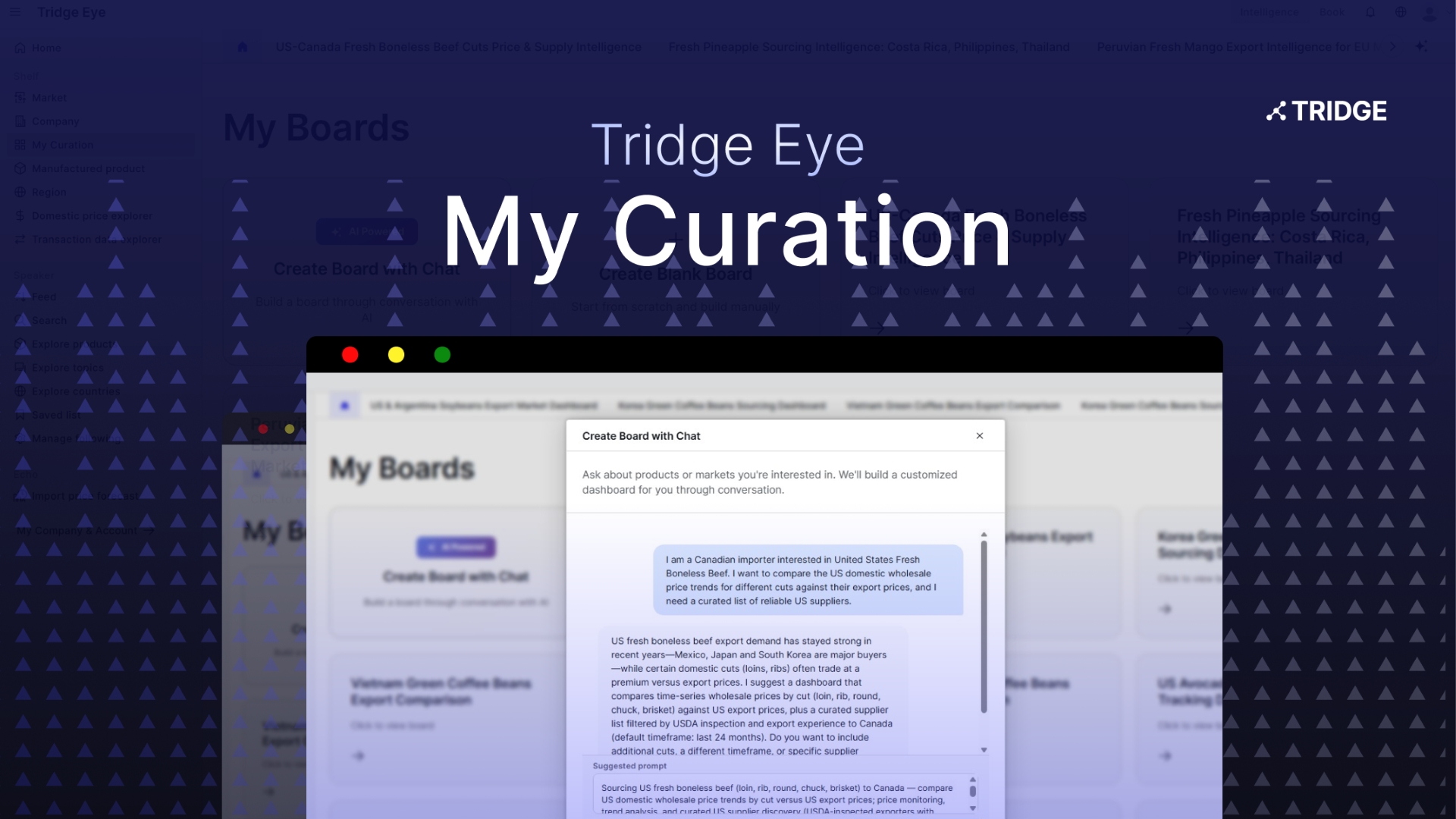
Tridge Eye — The strategy playbook above works — but only with current data feeding it. Real-time price movements, supplier risk scores, and origin alerts turn these frameworks into daily competitive advantages.
Get My Market Intelligence →

References

  1. cerealsgrains.org
  2. food-safety.com
  3. link.springer.com
Subscribe
By subscribing you agree to with our Privacy Policy and provide consent to receive updates from our company.
Thank you! Your submission has been received!
Oops! Something went wrong while submitting the form.
Subscribe to receive the latest blog posts, updates, promotions, and announcements from Tridge.