
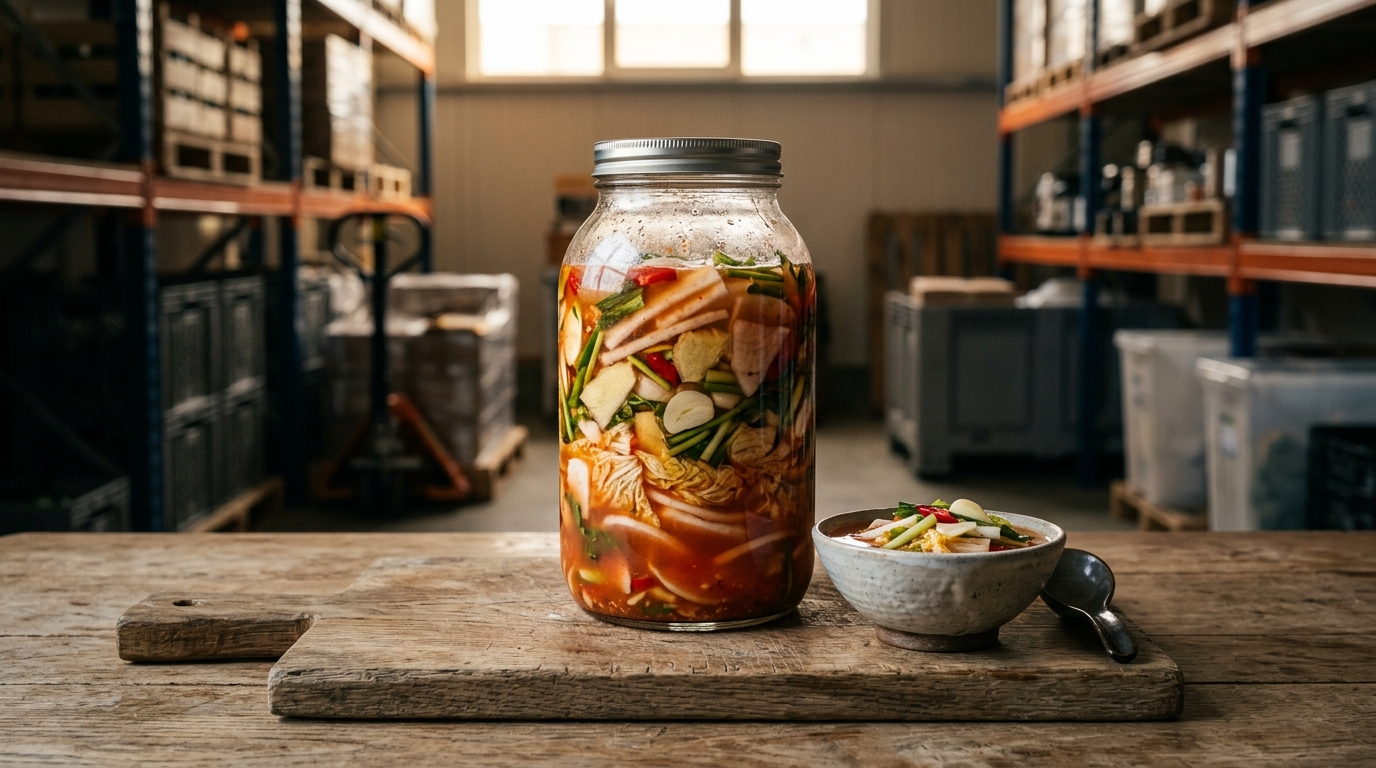
Nabak-kimchi sourcing is one of those categories where “the market” you see (vegetable prices) and the quotes you get (finished chilled product) can diverge for weeks—sometimes for good operational reasons, sometimes because the contract gives you no mechanism to force pass-through. This guide shows procurement teams how to use that disconnect to negotiate step-downs, protect service levels, and keep sustainability evidence audit-ready—without betting on perfect price forecasts.
Insight: Nabak-kimchi pricing rarely tracks vegetable markets cleanly; the category’s refrigerated inventory reality (short shelf-life, live fermentation behavior, and cold-chain constraints) creates predictable lags where upstream inputs fall while finished-goods quotes stay high—or inputs spike while suppliers delay pass-through until they must re-buy.
Insight: A radish (mu) price drop does not immediately translate into a cheaper nabak-kimchi quote because processors are still converting higher-cost inventory, and they protect margin against cold-chain and shrink risk.
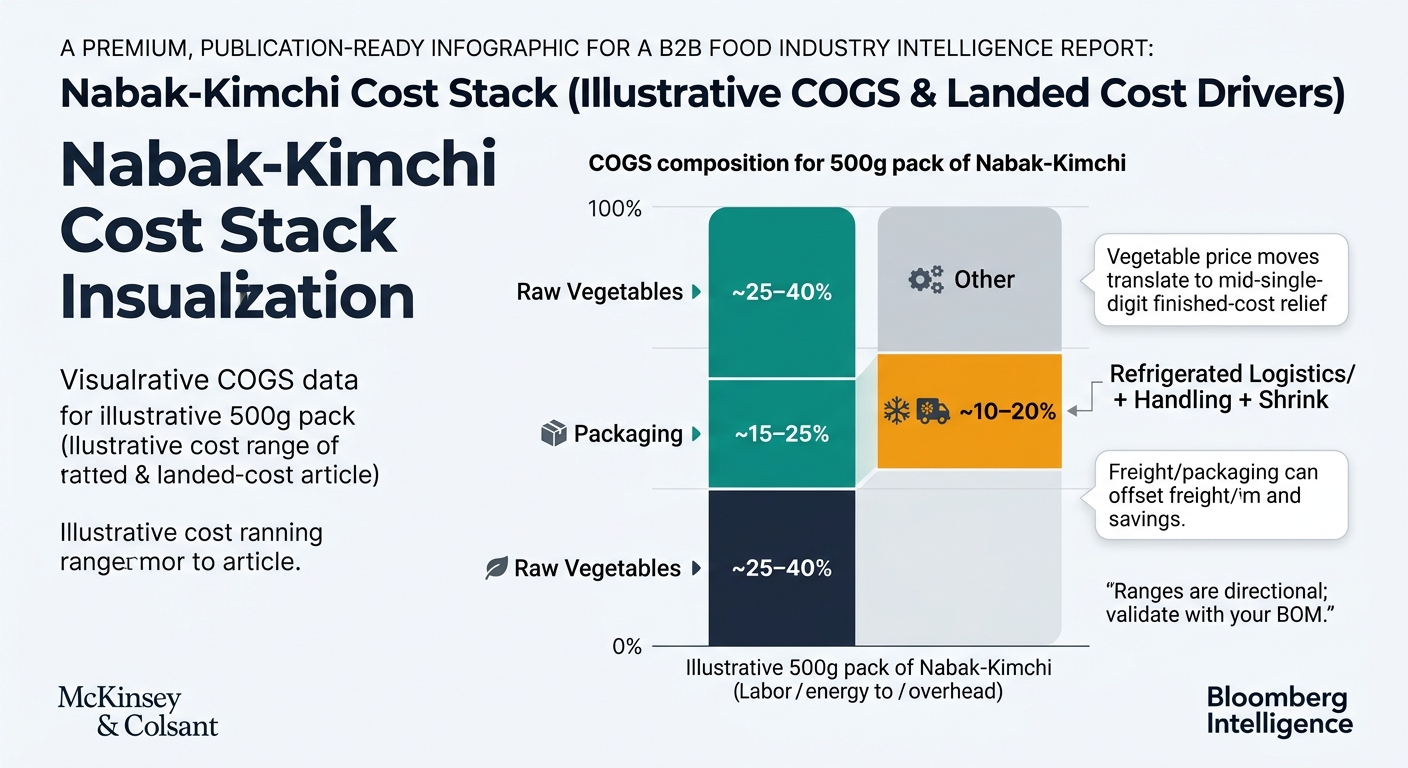
Data (validated as “directionally realistic,” not a universal rule): A practical cost stack for a 500g retail pack often has raw veg as ~25–40% of COGS, packaging ~15–25%, and refrigerated logistics/handling + shrink ~10–20% (lane- and retailer-dependent). So even a visible ~15–20% move in key vegetables typically becomes only mid-single-digit finished-cost relief once (a) only the veg portion moves and (b) the supplier actually re-buys. (Use your own BOM to confirm.)
Procurement Impact: When suppliers hold price after a visible veg correction, treat it as a lag hypothesis, not a dead end: negotiate a two-step price (near-term hold + automatic step-down tied to a veg index or documented re-buy date), instead of conceding a flat annual rate.
Insight: The opposite disconnect—inputs rising faster than finished price—often shows up right before service failures (fill-rate slips, shorter dating, or “allocation”).
Data (practice-consistent): In chilled fermentation, suppliers can’t buffer with long inventory the way shelf-stable categories can. When cabbage/radish spikes sharply (weather shock), many suppliers try to “manage” the spike for ~30–60 days via smaller pack-out runs, delayed promotions, or pushing MOQ increases—until they must reset pricing.
Procurement Impact: If you see supplier behavior changes (MOQ up, lead time stretching, fewer promo slots), treat that as an early-warning that your next PO may carry a step-up. Lock short-dated price protection (e.g., 60–90 days) only if you also lock service-level remedies (fill-rate, substitution rules, and temperature-excursion accountability).
Insight: Packaging and cold-chain costs can move against vegetables, masking true market direction.
Data (supported by current indicators): Refrigerated trucking rates and availability can swing materially by season and lane; USDA publishes refrigerated truck rate indicators that many food shippers use as a baseline reference. Separately, packaging cost/availability can shift due to resin markets, converter capacity, and compliance constraints—especially when teams introduce PCR content. FDA’s recycled-plastics guidance highlights contamination-control expectations and why “PCR” is not a simple swap in food-contact applications.
Procurement Impact: Your leverage improves when you separate “veg-driven” vs “cold-chain/packaging-driven” claims. Require quotes to show driver attribution (veg, packaging, freight, labor/energy) and negotiate the volatile components with indexation bands rather than letting everything roll into a single opaque unit price.

Quick Win: In your next renewal, ask for the supplier’s last 3 re-buy dates for cabbage/radish and the current finished-goods inventory coverage (weeks). If they can’t answer cleanly, you’re negotiating blind—and likely paying for a lag that’s already ended.
Insight: Most nabak-kimchi sourcing failures aren’t about finding “a cheaper kimchi.” They come from treating a chilled fermented product like a shelf-stable condiment—then paying for it in claims, write-offs, and audit scramble.
Quick Win: For every supplier, maintain a single-page “ship-ready file”: current certs, last audit date, packaging material declarations, temperature-control SOP, and a named escalation owner. If it’s not assembled, you don’t truly have continuity.
Insight: Intelligence-driven procurement doesn’t “predict the market.” It reduces variance: fewer surprises, faster switches, and more defensible sustainability governance.
Quick Win: Set two KPIs procurement owns (not QA): (1) % volume with a validated secondary source, and (2) % SKUs with complete evidence packs (packaging + labor + traceability). Track monthly, not annually.
Insight: Nabak-kimchi leverage shows up at specific decision moments—renewal windows, disruption signals, and spec/pack changes—not in generic annual bidding.
Insight: Your annual renewal is in 60 days and veg markets are softening, but suppliers haven’t moved.
Data (practice-consistent): Finished quotes often lag input moves by ~1–2 months due to re-buy cycles and WIP inventory.
Procurement Impact: Offer a 6–9 month award with a 30–45 day price review trigger tied to documented re-buy, instead of a flat 12-month price. You capture the lag without overcommitting if freight/packaging turns.
Insight: You receive “allocation” language or MOQ increases from the incumbent.
Data: These signals often precede either (a) raw veg spike pass-through or (b) capacity constraint at the fermentation/chilled packing line.
Procurement Impact: Activate contingency immediately: pull forward validation on your secondary, shift 10–20% volume as a live test, and negotiate service credits for missed fill-rate rather than arguing unit price.
Insight: Sustainability asks for packaging claim upgrades (recyclable, PCR content, downgauged film).
Data (category-realistic): Packaging changes can destabilize leak performance and shelf-life outcomes if seal integrity or gas management shifts; PCR content can also trigger additional food-contact substantiation steps.
Procurement Impact: Run a controlled change: dual-run old/new packaging for 1–2 cycles, with acceptance criteria and claim substantiation documents stored centrally. Negotiate who pays for line trials and scrap.
Quick Win: Treat packaging changes as a sourcing event, not a marketing task. If you don’t renegotiate liability and validation costs, you’ll pay them quietly in credits.
Insight: The “input vs finished price disconnect” isn’t unique to nabak-kimchi—it’s common in chilled, high-handling, short-life products where logistics and shrink can dominate.
Insight: Refrigerated dips/salsas show similar lag behavior.
Data: Produce costs can fall while refrigerated freight and damage rates rise, keeping quotes sticky.
Procurement Impact: Separate driver clauses and negotiate shrink accountability.
Insight: Fresh-cut and chilled pickled vegetables face the same evidence-governance problem.
Data: Claims and certifications fragment across co-packers and packaging converters.
Procurement Impact: Centralize documentation and tie completeness to renewal eligibility.
Quick Win: If a category is refrigerated + high water weight, assume freight and shrink are “silent inputs” and contract them explicitly.
Insight: This category forces procurement to connect three things most teams manage separately: market timing (veg cycles), operational risk (cold-chain), and governance (claims evidence). Doing that consistently is where the performance gap opens.
Insight: The best teams don’t win by predicting cabbage prices; they win by designing contracts and contingency paths that absorb volatility.
Data (risk logic grounded in real incidents): Avoidable losses often come from repeatable failures: late activation of alternates, unclear temperature liability, and missing evidence at audit time. Separately, chilled/RTE foods remain sensitive to pathogens that can grow at refrigeration temperatures (e.g., Listeria), so weak cold-chain and sanitation governance has outsized downside.
Procurement Impact: If your process can (1) detect the lag, (2) enforce cold-chain accountability, and (3) keep sustainability evidence audit-ready, you reduce both cost variance and reputational exposure without relying on heroics.
Quick Win: Run one cross-functional “failure pre-mortem” per quarter (Procurement + QA + Logistics + Sustainability) on your top 2 SKUs: “What would cause a delist or recall-like event in the next 90 days?” Then map each cause to a contract clause or trigger.
Insight: Use the chilled-lag window to reprice intelligently without trading away continuity.
If upstream vegetables have corrected but your nabak-kimchi quotes haven’t, don’t wait for goodwill—structure it. In your next negotiation cycle, lock a short fixed-price period (60–90 days) paired with an automatic step-down tied to the supplier’s documented re-buy of cabbage/radish (and keep packaging/freight as separate indexed adders). The window exists because finished-goods pricing typically reflects prior inventory and risk buffers, not today’s inputs. Teams that formalize the step-down capture the correction while protecting service levels—whereas spot buyers usually “win” on paper and then repay it in premium freight, credits, and audit scramble.
Insight: Nabak-kimchi price disconnects are structural (inventory lag + cold-chain/shrink + packaging), not random supplier behavior.
Data: A ~15–20% veg move often becomes only ~5–8% finished-cost relief after a ~4–10 week lag, while freight/packaging can add back ~2–4%.
Procurement Impact: Negotiate two-step pricing and driver-based clauses instead of a single opaque unit price.
Insight: Continuity risk shows up first as commercial signals (MOQ, lead time, promo pullback), not as a formal disruption notice.
Data: Suppliers manage spikes with allocation behaviors before repricing.
Procurement Impact: Use triggers to activate secondary sources early; shift 10–20% volume as a live readiness test.
Insight: Sustainability performance in this category is an evidence-management problem.
Data: Packaging claims and co-packer fragmentation create recurring audit gaps.
Procurement Impact: Make documentation completeness a renewal gate and store a ship-ready evidence pack per SKU/supplier.
(Analyzed at: Sep, 2026)
Reefer capacity and rates have stayed volatile by season and lane, and that volatility is exactly why “all-in unit price” contracts keep failing in nabak-kimchi: suppliers can plausibly attribute margin protection to freight, shrink, and packaging even when vegetables soften. Your highest-conviction move is to split the deal into (1) a short fixed base price with an automatic step-down tied to documented vegetable re-buys, and (2) separate, capped indexation for refrigerated freight using USDA’s refrigerated-truck indicators as a reference point. Done well, that structure typically protects mid-single-digit cost downside while preventing the far more expensive outcome—service failures and credits that can quietly wipe out the savings you fought for.


