
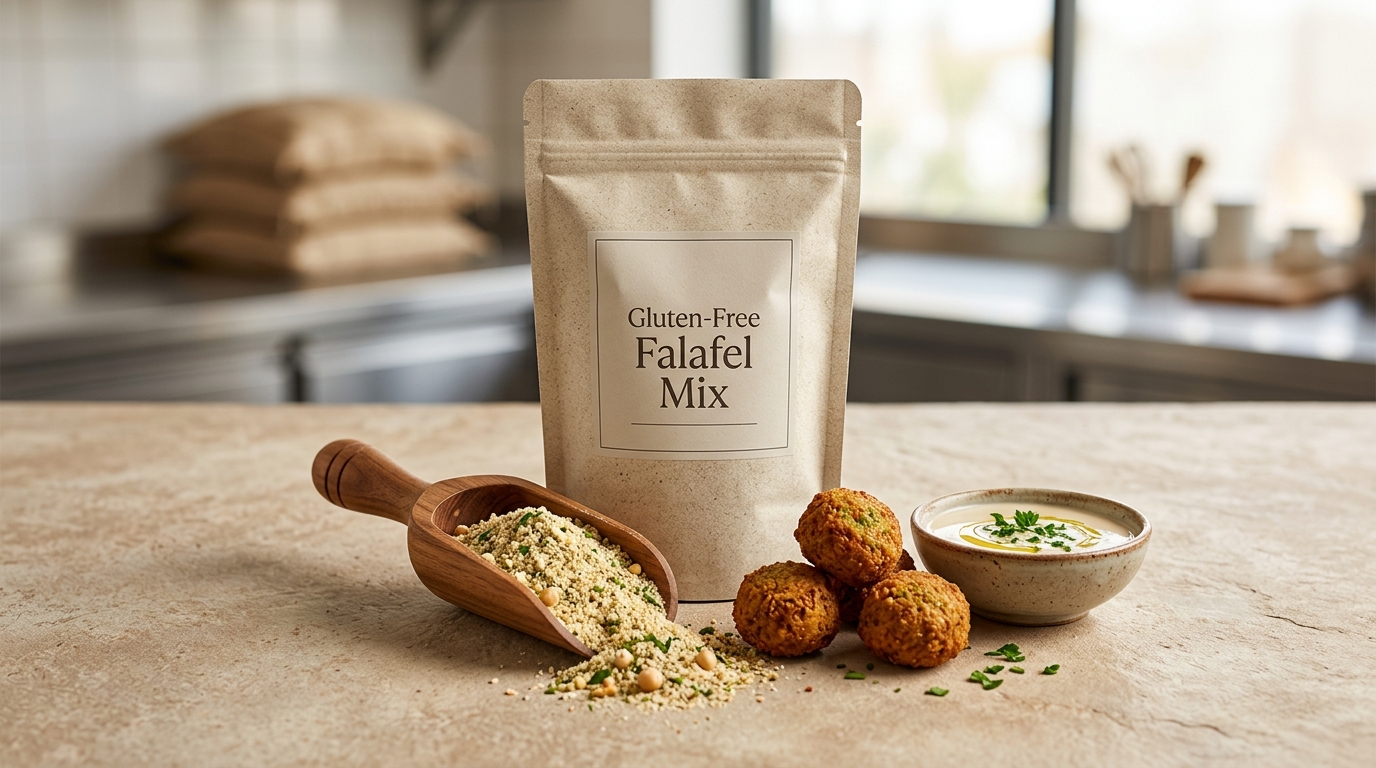
Procurement teams often expect gluten-free falafel mix quotes to “follow chickpeas” in the same month. In practice, finished-mix pricing is shaped by inventory coverage, constrained gluten-free-capable blending capacity, validated pathogen-reduction steps for low-moisture ingredients, and packaging/label lead times. This guide shows how to negotiate to the replacement-cost and capacity reality—with mechanisms you can audit.
Insight: In gluten-free falafel mix, your quoted finished-good price often won’t track chickpea or spice spot markets in the same month—and teams that assume it should end up negotiating at the wrong time.
Data: The disconnect is structural, driven by (a) inventory and contracting lags, (b) capacity constraints at gluten-free-capable blenders and pathogen-reduction steps for low-moisture ingredients, and (c) packaging/label lead times that can become the binding constraint even when chickpea costs soften.

Procurement Impact: You can create “alpha” (beat the category index) by negotiating against the supplier’s replacement cost curve (what they must buy next) rather than their historical input basket (what they already bought).
Insight: Chickpea inputs can fall while your falafel-mix quote stays flat (or rises) because suppliers are still consuming higher-cost flour/spices bought 8–16 weeks earlier.
Data: A typical blender holding 6–10 weeks of key inputs plus 2–4 weeks of finished goods effectively prices off a 2–4 month moving average. (Exact coverage varies by MOQ, shelf-life targets, and supplier cash constraints.) Public price series also show that chickpea markets can move meaningfully over quarters, not days—so the lag is operationally plausible [3].
Procurement Impact: Your best leverage window is not the week the commodity drops—it’s when you can prove the supplier’s next coverage will be cheaper and you offer volume/term structure that lets them reprice without margin risk.
Insight: Spices create “sudden step-ups” that don’t correlate with chickpeas, and they disproportionately hit gluten-free mixes because approved, treated spice supply is narrower.
Data: In many falafel formulations, spices/aromatics are only ~5–12% of weight but can be ~15–30% of ingredient cost (credible range; exact depends on cumin/garlic/onion load and whether you’re using treated spices). Spices are also a known low-moisture food safety risk area: Salmonella can persist in spices, and steam/vacuum-steam and other lethality steps are widely referenced mitigation approaches—adding both cost and supply constraint [1].
Procurement Impact: If you negotiate only against chickpea indices, you’ll concede surcharges you could have capped with (1) a defined surcharge trigger, (2) documentation requirements, and (3) a pre-approved alternate spec band for specific spices.
Insight: Gluten-free compliance and low-moisture food safety controls create a capacity premium that behaves like a hidden commodity.
Data: When certified gluten-free lines or validated pathogen-reduction capacity runs near utilization, the market clears via lead-time extension and MOQ increases—not transparent price moves. In practice, teams see “price stability” but deteriorating service: lead time stretching from 4–6 weeks to 8–12 weeks and MOQs stepping up 20–50% (ranges are directionally consistent with how constrained co-manufacturing categories behave; the exact numbers depend on your pack format and run size).
Procurement Impact: Treat capacity as a priced input: lock time (production slots) before you try to lock price. If you wait for a lower price signal, you may buy cheaper inputs but pay more in expedites, stockouts, or customer penalties.
Quick Win: For your next negotiation, ask suppliers to quote two scenarios side-by-side: (1) price using their current input coverage and (2) price contingent on next coverage (e.g., 30–60 days forward). The spread tells you whether you’re early or late—and whether to push for a reset now or trade term for price.

Quick Win: In your next supplier review, separate suppliers into (a) price-competitive and (b) switch-ready. If a supplier is cheap but not switch-ready (documentation gaps, long validation timelines), treat them as a risk position and cap their share.
Insight: The performance gap comes from turning fragmented signals (inputs, capacity, quality incidents, lead times) into decision rules—so you stop negotiating on anecdotes.
Data: A practical “before/after” for a mid-sized retail + foodservice buyer (not a perfect world—just what’s achievable):
Procurement Impact: You shift from “arguing price” to “proving price”—and you can document why you accepted (or rejected) risk, which is what leadership asks for after the first disruption.
Quick Win: Track three KPIs monthly (not quarterly): (1) quote vs. should-cost band, (2) lead-time drift vs. contracted lead time, (3) surcharge rate as % of spend. The third KPI is the one most teams miss—and it’s where savings quietly leak.
Quick Win: For each scenario, pre-approve one spec flexibility lever with QA (e.g., allowable alternate spice source or blend tolerance). That single alignment step is what makes procurement’s contingency plan executable.
Insight: The same disconnect pattern—input moves now, finished goods move later—shows up anywhere you have (1) inventory lags, (2) constrained certified capacity, and (3) packaging/label dependencies.
Data: Examples procurement teams commonly manage alongside falafel mix:
Procurement Impact: If you standardize your contracting mechanisms (index rules, surcharge governance, switch-ready alternates), you reduce category-by-category reinvention and improve auditability.
Insight: Gluten-free falafel mix punishes teams that optimize only unit price because the biggest losses come from unpriced risk: compliance exposure, capacity allocation, and mid-contract adders.
Data: In most organizations, the failure mode is predictable: price looks controlled at award, then variability shows up as service failures, QA workload spikes, and “unexplained” landed-cost creep.
Procurement Impact: This is exactly the kind of category where leadership notices procurement—either because you prevented disruption with a documented plan, or because you’re explaining a preventable fire drill.
Use the current lag between upstream input moves and finished-good quotes to negotiate a two-stage reset: secure supply and production slots now, then lock a 60–90 day price adjustment mechanism tied to the supplier’s next input coverage rather than their last. That window exists because suppliers price off inventory and constrained certified capacity, so they resist immediate reductions even when markets soften—but they will trade a structured reset for volume and planning certainty. Teams that execute this timing well typically capture a mid-single-digit landed-cost improvement while reducing expedite events, because they’re buying ahead of the replacement-cost turn instead of arguing after it.
Insight: Finished falafel-mix pricing is a lagged, capacity-constrained outcome—not a direct mirror of chickpea spot markets.
Data: Inventory coverage (often 8–16 weeks), treated-ingredient/certified-line constraints, and packaging/label lead times create predictable delays and step-changes.
Procurement Impact: Negotiate against replacement cost and capacity, not just today’s spot inputs.
Insight: The biggest savings leaks are contract mechanics and adders, not the headline unit price.
Data: Surcharges, freight/packaging pass-throughs, and MOQ/lead-time drift commonly erode 2–5% of spend mid-term.
Procurement Impact: Tighten surcharge governance and track surcharge rate monthly.
Insight: Dual sourcing only works if alternates are switch-ready before the disruption.
Data: Gluten-free validation and performance equivalence can’t be compressed safely in a crisis.
Procurement Impact: Maintain a qualified secondary and pre-approved spec flex so you can move volume in weeks, not quarters.
(Analyzed at: Oct, 2026)
If you’re renewing in the next 60–120 days, stop trying to “win” a same-month reduction off chickpea headlines and instead contract to the next buy: require a defined reset window (e.g., 45–90 days) with an index/collar and documentation rules for spice/packaging surcharges. This works because chickpea markets have been moving at the quarter level (not weekly), while low-moisture safety controls for spices and gluten-free-capable capacity keep suppliers pricing off coverage and constraints—not spot inputs [3]. The stakes are usually mid-single-digit landed-cost leakage over a year (especially via adders and expedites), which is often larger than the unit-price delta you fought for at award.


