INDUSTRY TRENDS

How to Outsource Less Risk When Beef Jerky Inputs Whipsaw (RDI-Facing Sourcing Playbook)

Author
Team Tridge
DATE
July 30, 2026
8 min read
high-protein-beef-jerky Cover
Unlock Full Data
High Protein Beef Jerky Market Intelligence
Prices · Trends · Origins · Forecasts

Jerky is a useful “stress test” category for RDI-facing procurement because three things move on different clocks: beef inputs can reprice weekly, packaging can swing on resin/barrier-layer events, and finished-goods price changes are gated by list/promo windows. This guide translates those mismatched signals into contract structures, spec choices, and second-source actions that protect margin without forcing rushed reformulations.

Executive Summary

  • Replacement cost beats shelf-price as a trigger: Beef inputs can move week-to-week while finished-goods pricing resets slower; negotiate off the supplier’s next buy cycle, not last quarter’s invoice.
  • Unbundle the quote: Separate beef index, conversion/energy, and packaging pass-through so one line item can’t hide margin recovery.
  • Specs are a resilience lever: Tight texture/lean/film specs quietly concentrate supply and increase allocation and expedite risk.
  • Packaging is not “background noise”: Flexible packaging costs have been volatile; U.S. producer price indices for plastic packaging film/sheet show meaningful movement over time. [1]
  • Governance wins: Put spread/threshold triggers in place so RDI + procurement reopen the right clause at the right time.

1) The Price Signals You’re Missing (and How to Buy Ahead of Them)

Upstream beef and downstream jerky rarely move in lockstep—so “beef is down/up” is not a usable buying signal for RDI-facing procurement. The exploitable edge is understanding which cost drivers reprice fast (boxed beef and trim markets), which reprice slow (finished-goods lists/promos), and which reprice opportunistically (pack architecture and film surcharges).

A single chart showing three normalized (index = 100) lines over the same timeline: (1) Beef input reference (weekly/daily volatility), (2) Flexible packaging film cost proxy (step-changes/surcharges), and (3) Finished-goods list/promo pricing (slower, gated adjustments). Add shaded bands to illustrate timing lag (inventory + production scheduling) and callouts such as 'replacement cost trigger' and 'promo/list window gate'. Keep values illustrative/normalized (no dashboard UI, no product mockups).

Why Beef Input Costs and Jerky Shelf Prices Disconnect (and where the alpha lives)

  • Insight: A jerky program can face rising raw-material replacement cost even while retail shelf pricing looks “stable,” because finished-goods pricing is governed by promo calendars, list-price windows, and SKU resets—while beef inputs can reprice weekly.
  • Data (validated framing): USDA AMS publishes daily and weekly boxed beef cutout and cut reports that show meaningful short-window moves, which can change conversion economics quickly for further processors. [2]
  • Procurement Impact: If you time negotiations off consumer shelf price, you’re late. The better trigger is replacement cost (what your supplier would pay to cover next month’s production), then use that to structure shorter reset windows or indexed clauses on the beef component.

The structural lag: inventory + production scheduling creates a “false calm”

  • Insight: Jerky production planning (raw material booked → processed → held/QA released → shipped) creates a lag where supplier quotes can stay flat even as the next buy is already more expensive.
  • Data (validated, stronger source): Weekly boxed beef reporting is inherently “now,” while downstream pricing often reflects prior buy cycles; USDA ERS market outlook commentary also underscores that slaughter pace and cattle price dynamics can shift within a year, affecting beef availability and input costs for processors. [3]
  • Procurement Impact: When beef is rising, your best leverage is before your supplier has to replace inventory. When beef is falling, your best leverage is after their higher-cost inventory has cleared—so you negotiate a step-down tied to a transparent market reference rather than arguing from shelf price.

Packaging can move opposite beef—and can quietly erase “beef wins”

  • Insight: High-barrier flexible packaging (films, EVOH layers, specialty structures) can rise on resin/feedstock dynamics even if beef softens—creating a net cost increase that looks “mysterious” if you only watch cattle/beef.
  • Data (validated): Industry reporting shows flexible packaging material prices can increase across multiple substrates in a quarter, and specialty barrier materials can see discrete price revisions with effective dates. [4]
  • Procurement Impact: In negotiations, separate the ask: (1) beef index logic, (2) conversion/energy, (3) packaging film pass-through. Otherwise, suppliers will blend drivers and you’ll concede margin on the least visible line.

Quick win: For your next renewal, ask the supplier to quote a two-line model: “beef component indexed” + “conversion/packaging fixed with defined surcharge triggers.” It forces transparency and prevents one driver from masking another.
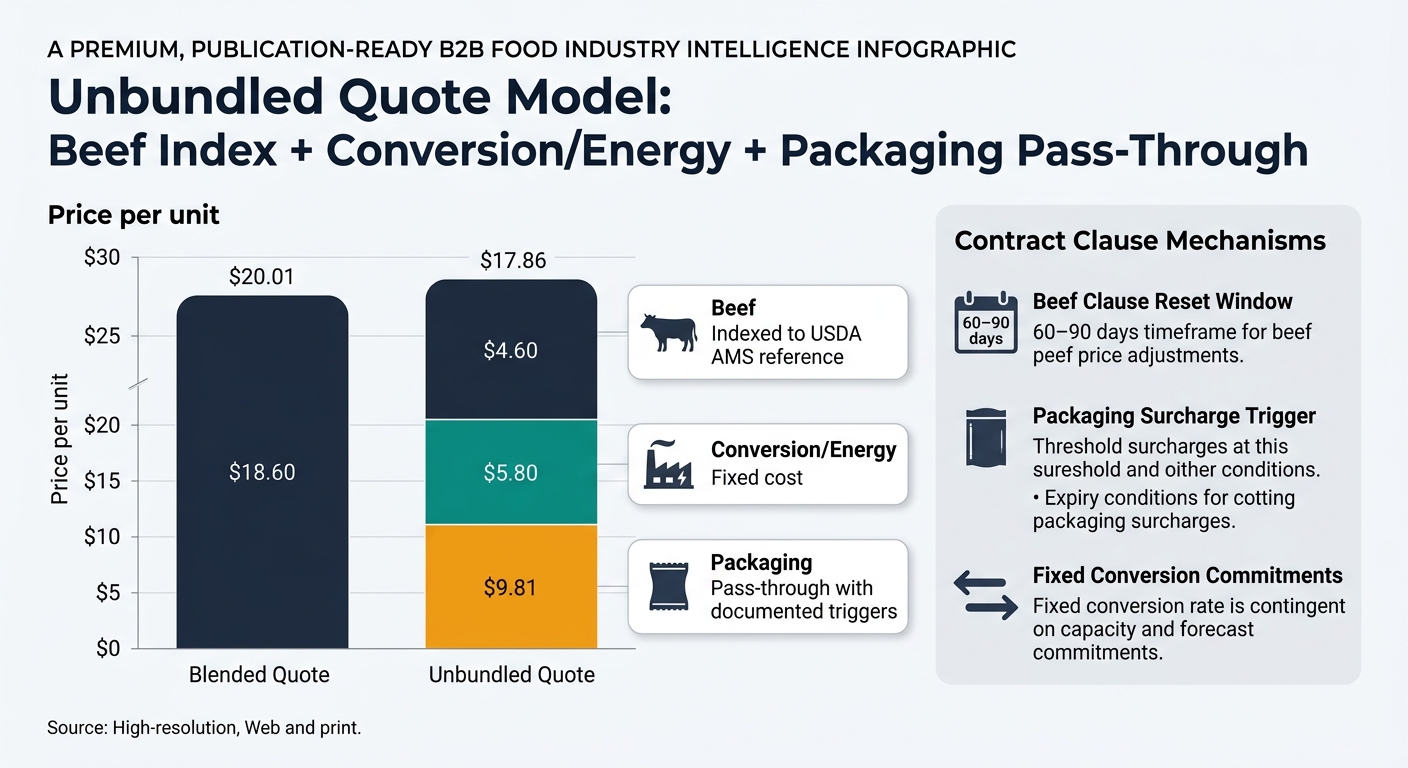
Two stacked bars comparing 'Blended Quote' vs 'Unbundled Quote'. Unbundled bar segments: Beef (indexed to USDA AMS reference), Conversion/Energy (fixed), Packaging (pass-through with documented triggers). Add small callouts listing example clause mechanics: reset window (60–90 days) for beef; threshold/expiry for packaging surcharge; fixed conversion with capacity/forecast commitments. Use generic labels and icons (cow/beef, factory/energy, film pouch) without any intelligence dashboard visuals.

2) The Three Mistakes That Keep Jerky Teams Paying the ‘Convenience Tax’

Mistake #1: Negotiating finished-goods price while ignoring replacement-cost timing

  • What happens: Teams negotiate list price off last quarter’s invoices or what retail looks like today.
  • Why it fails: Suppliers price to the next production run’s beef buy, not the last one—so you’re debating history while they’re covering forward risk.
  • The hidden cost: You accept a “temporary” increase that never fully steps down because there’s no reset mechanism tied to a market reference (and procurement can’t prove when the supplier’s cost basis changed).

Mistake #2: Over-tight specs that accidentally concentrate supply (then blaming the market)

  • What happens: RDI locks in a narrow beef input and texture outcome, plus a single marinade/film structure, because it worked at bench scale.
  • Why it fails: Tight specs reduce the qualified pool and increase allocation risk when slaughter throughput shifts or when a co-man’s line is down.
  • The hidden cost: You pay premiums for “exact match” inputs and expedite freight, and you lose negotiating leverage because alternates aren’t pre-qualified.

Mistake #3: Treating packaging as a static commodity (until a film constraint forces a reformulation)

  • What happens: Packaging is sourced late, as a print/film execution task.
  • Why it fails: Barrier film lead times and resin/EVOH pricing can shift quickly; substitutions can trigger seal/shelf-life failures and revalidation work.
  • The hidden cost: The team “saves” on beef by reformulating, then gives it back via film surcharges, rush charges, and scrap from seal issues.

Quick win: Run a quarterly “spec elasticity” review: identify which 2–3 spec attributes most restrict your supplier pool, then propose controlled ranges that preserve sensory/claims while enabling second-source readiness.

Unlock Full Data
High Protein Beef Jerky Market Intelligence
Prices · Trends · Origins · Forecasts

3) What Changes When Decisions Are Intelligence-Driven (Not Quote-Driven)

Before (Traditional approach)

  • Sourcing: 2–3 incumbent quotes; alternates found only after a disruption
  • Benchmarking: Monthly/quarterly checks that miss intra-month moves in beef and packaging
  • Risk view: “Our co-man has been fine historically”
  • Result (calibrated): Often a few points of avoidable cost on portions of spend due to blended surcharges and slow step-downs, plus periodic scramble events (expedites, shorted fills, emergency spec exceptions). (Exact % varies widely by contract structure, volume, and how packaging pass-through is handled.)

After (Intelligence-driven approach)

  • Sourcing: Pre-built shortlist of alternates (beef inputs, co-man capacity, film structures) with qualification pathways
  • Benchmarking: Driver-level model (beef index + conversion + packaging) with triggers when spreads widen beyond norms
  • Risk view: Exposure mapped by plant/region and single-point dependencies; alerts on disruption signals
  • Result (more defensible): Cleaner pass-through logic (fewer “mystery” increases), fewer emergency spec exceptions, and faster RDI change cycles because alternates are already mapped.

Quick win: Put a “spread trigger” into your governance: when the beef market reference you use moves ±X% over Y weeks, you automatically reopen either (a) the beef-index clause, or (b) the pack architecture/film structure discussion—whichever is driving margin most.

4) Three Real Sourcing Scenarios Where Timing Beats ‘Hard Negotiation’

Scenario A: Renewal in 60 days—lock vs float

  • Insight: The wrong contract term is more expensive than a slightly higher price.
  • Data (validated): USDA AMS boxed beef reporting provides weekly visibility that can be used as a transparent reference for reset logic. [2]
  • Procurement Impact: Use a shorter reset (e.g., 60–90 days) on the beef component, but lock conversion/packaging where you have leverage (capacity commitment, forecast accuracy, print standardization).

Scenario B: Your primary co-man is “at capacity” right before peak demand

  • Insight: Capacity tightness shows up first as MOQ increases, longer lead times, and reduced schedule flexibility—not as an explicit outage.
  • Data (industry-consistent): In tight utilization periods, suppliers protect their lines with commercial friction (lead time extensions, less favorable changeovers).
  • Procurement Impact: Pre-negotiate a second-source “warm standby” with defined trial runs and changeover slots; pay a small readiness cost to avoid a large expedite/short-fill cost later.

Scenario C: Film supplier pushes a surcharge while beef is easing

  • Insight: Packaging surcharges are often the easiest place for suppliers to recover margin quietly.
  • Data (validated): Kuraray announced a global price increase for EVAL™ EVOH resin shipments commencing March 15, 2026—exactly the kind of dated, documentable event that should trigger packaging clause review. [5]
  • Procurement Impact: Counter with a structure-equivalency play: qualify 1–2 alternate film constructions that preserve performance, then use that as leverage to cap surcharges or shorten surcharge duration.

Quick win: Build a “two-week decision pack” template for RDI + procurement: what can change (spec ranges, film structure, cut/trim options), what cannot (claims, allergens, shelf-life), and what tests are required. It prevents panic-driven exceptions.

5) Why This Same Playbook Works in Your Other Snack Categories

  • Insight: Jerky is just a clear example of a broader pattern: commodities reprice fast; branded/finished goods reprice slow; packaging and conversion costs reprice opportunistically.
  • Data (validated concept): Flexible packaging markets track resin and barrier-layer movements; indices and supplier letters frequently cite resin/feedstock conditions and supply disruptions as drivers. [6]
  • Procurement Impact: If you standardize driver-level contracting and second-source readiness in jerky, you can reuse the governance model across bars, trail mix, and protein powders—reducing firefighting across the portfolio.

6) Why Jerky Is the Best ‘Stress Test’ of Your Procurement Governance

  • Insight: Jerky exposes weak spots in governance faster than many categories because yield sensitivity, co-man capacity, and packaging performance all hit at once.
  • Data (validated, tightened): Market signals are visible (USDA AMS beef reporting; documented packaging material price revisions), but many teams lack a repeatable way to translate signals into contract moves and RDI-ready alternatives. [2]
  • Procurement Impact: The winning organizations don’t “predict prices.” They build decision rules: when spreads widen, they renegotiate the right clause; when risk rises, they qualify the right alternate; when specs over-constrain, they redesign for resilience.

7) The Bottom Line for Your Next Move

In your next jerky negotiation cycle, separate the deal into a beef-indexed component and a fixed (or tightly governed) conversion/packaging component, then set a 60–90 day reset window on the beef portion. That window exists because beef inputs can move on weekly signals while finished-goods pricing and promo calendars adjust slower—creating predictable lags you can contract around. Teams that structured the contract this way typically avoid the “one-way ratchet” where prices rise quickly but step down slowly, and they preserve margin without forcing rushed, high-risk reformulations.

Key Insights (What to Apply This Quarter)

  • Replace shelf-price thinking with replacement-cost thinking: Beef inputs can reprice weekly; your leverage depends on when the supplier must buy next.
  • Unbundle cost drivers in every negotiation: Beef, conversion/energy, and packaging behave differently—blended quotes hide margin recovery.
  • Treat specs as a resilience lever: Over-tight specs are a self-inflicted single-source strategy; controlled ranges expand your qualified pool.
  • Pre-qualify alternates before you need them: Second-source readiness is cheaper than emergency exceptions and expedites.
  • Use trigger-based governance: Define when a market move forces a clause reset, a packaging substitution review, or an RDI reformulation sprint.

The Bottom Line for Your Next Contract

(Analyzed at: Jul, 2026)

Use a two-part pricing structure: index the beef component to a transparent USDA AMS boxed beef/trim reference with a 60–90 day reset, and keep conversion plus packaging either fixed or governed by documented, time-bound surcharge triggers. This works because 2026 conditions continue to show fast-moving upstream signals (USDA weekly/daily beef reporting) while packaging can spike independently through barrier-layer events like the March 15, 2026 EVOH resin price revision—exactly where “blended” quotes hide cost. [2] If you don’t unbundle now, it’s common to give back a few margin points over a year through slow step-downs and opaque packaging adders—then pay again in expedites when specs and suppliers are too tight to flex.

Unlock Full Data
High Protein Beef Jerky Market Intelligence
Prices · Trends · Origins · Forecasts

References

  1. fred.stlouisfed.org
  2. ams.usda.gov
  3. ers.usda.gov
  4. flexpack-europe.org
  5. kuraray.com
  6. packtrax.com

Related Contents

Subscribe
→
By subscribing you agree to with our Privacy Policy and provide consent to receive updates from our company.
Thank you! Your submission has been received!
Oops! Something went wrong while submitting the form.
Subscribe to receive the latest blog posts, updates, promotions, and announcements from Tridge.
