INDUSTRY TRENDS

How to Buy Fortified Apple Juice When Input Prices Drop but Quotes Stay Sticky (A Procurement Execution Guide)

Author
Team Tridge
DATE
October 8, 2026
9 min read
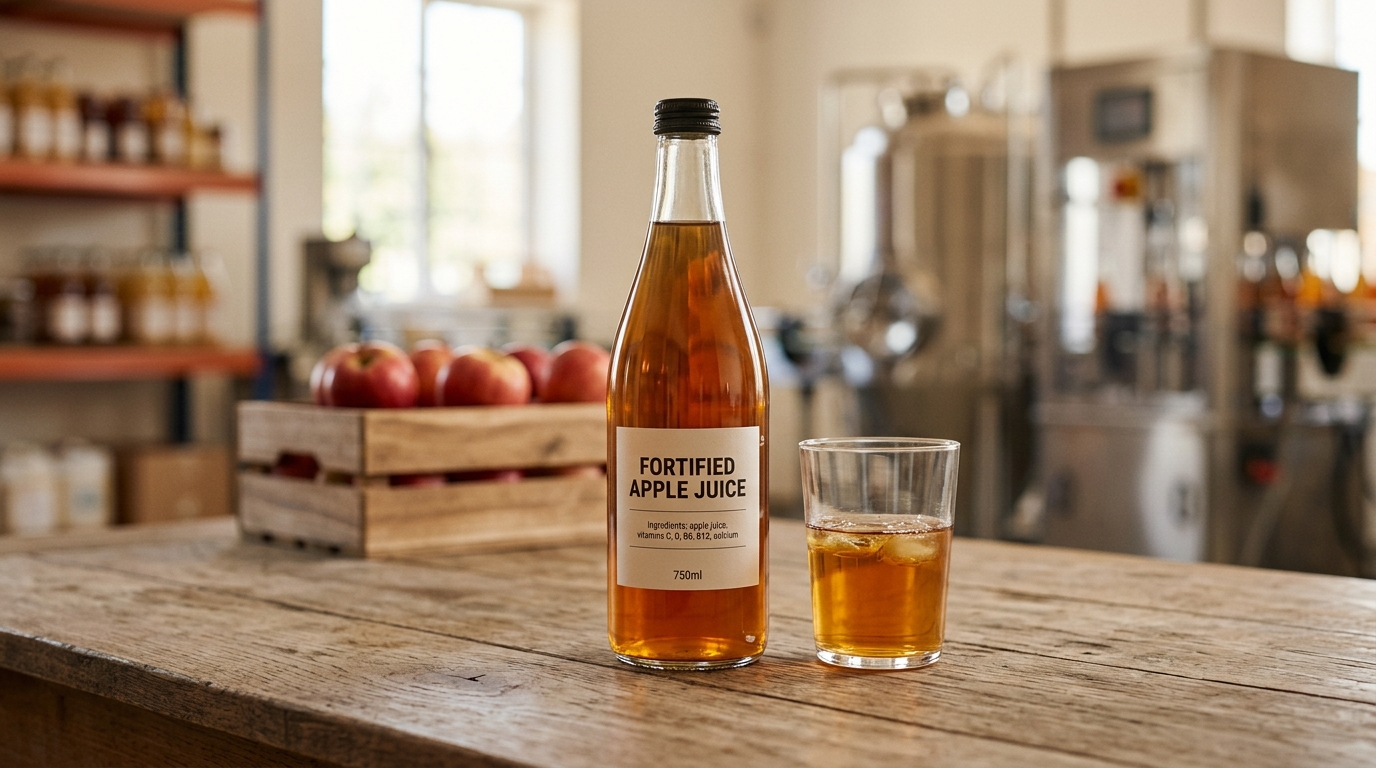
fortified-apple-juice Cover
Unlock Full Data
Fortified Apple Juice Market Intelligence
Prices · Trends · Origins · Forecasts

Fortified apple juice is a classic “multi-clock” category: apple juice concentrate, packaging, co-manufacturing conversion, and fortificant premix rarely reprice at the same time. This guide helps Procurement & Sourcing Management separate those clocks, contract to them, and avoid paying for lag, allocation risk, and technical uncertainty.

Executive Summary

  • Expect lag: Finished-goods pricing often trails apple juice concentrate (AJC) moves because suppliers work through inventory and pre-bought packaging/premix.
  • Packaging can dominate: In aseptic formats, cartons and related components can be a large share of unit cost, so carton allocations can override fruit economics.
  • Fortification adds hidden cost: Overage and testing can change with process/packaging shifts; price increases should be tied to measurable drivers.
  • Best lever is contract mechanics: Separate cost lanes (AJC, packaging, premix, conversion) and use lagged pass-throughs and clear reopeners.

1) The Signal You’re Missing: Why Your Input Costs Fall but Your Quotes Don’t

Fortified apple juice is one of those categories where you can be “right” on market direction and still overpay—because the cost stack reprices on different clocks.

The AJC-to-Finished-Goods Lag Is a Feature, Not a Supplier Excuse

  • Insight: Apple juice concentrate (AJC) moves first, but fortified finished-goods quotes often hold flat (or even rise) for 60–120 days because co-mans and brand owners are selling through higher-cost inventory, packaging coverage, and pre-bought premix.
  • Data (validated framing): The directional pattern is realistic, but the specific AJC numbers in the draft ($1.10/lb to $0.99/lb) should be treated as illustrative rather than universal. Public import-style references often show AJC in the ~$1.9–$2.2/kg range in some periods (which is roughly ~$0.86–$1.00/lb), and it varies by brix/spec/origin and timing. (dir.tridge.com) In practice, even a ~5–12% move in AJC may only translate to ~1–3% short-term unit-cost movement once you account for (1) concentrate coverage, (2) packaging contracts, and (3) premix lead times.
  • Procurement Impact: Don’t negotiate “today’s AJC” into “today’s finished goods.” Instead, negotiate a lagged pass-through clause: AJC index movement applies with an agreed lag (e.g., 60–90 days) and a floor/ceiling band. This converts the supplier’s inventory reality into a contract mechanism you can audit.
Multi-series timeline (0–180 days) showing illustrative repricing/coverage windows and lags for AJC index movement, supplier inventory coverage (60–120 days), packaging contract/lead time (6–16 weeks scenario-based), premix lead time plus QA validation, and finished-goods quote reset timing; includes a highlighted 60–90 day lagged pass-through arrow and a floor/ceiling deadband band, labeled as illustrative and varying by supplier/program.

Packaging Can Override Fruit Economics (and It’s the Most Common Disconnect)

  • Insight: When packaging is tight (aseptic cartons, caps/closures, labels), finished-goods pricing can rise even as AJC softens—because the bottleneck is no longer fruit.
  • Data (validated framing): The “6–8 weeks to 12–16 weeks” lead-time swing is plausible as an illustrative range in constrained periods, but it’s not a stable industry constant and should be treated as scenario-based. What is consistently true is that aseptic packaging availability is capacity-driven (converter allocations, format/tooling constraints) and can tighten independently of juice base availability. SIG and other carton suppliers publicly discuss capacity expansions and format flexibility, which reinforces that capacity/availability is a real procurement constraint, not just a pricing discussion [1]. Also, in aseptic formats, packaging can represent a large share of delivered unit cost (often a bigger driver than modest AJC moves).
  • Procurement Impact: Treat packaging as a separate negotiation lane:
  • Lock packaging capacity earlier than juice base,
  • Qualify a second carton spec (or alternate format like PET for certain SKUs), and
  • Split contracts into “juice base + conversion” vs “packaging pass-through” so you can see what’s actually moving.

Fortification Creates “Silent Inflation” Through Overage and Shelf-Life Risk

  • Insight: Suppliers can face rising effective fortificant cost even when vitamin spot prices look stable, because potency loss risk forces higher overage—especially when you change process conditions, oxygen exposure, or packaging.
  • Data (validated framing): The mechanism is correct: end-of-shelf-life label-claim risk drives overage and testing. Vitamin C (ascorbic acid) and related fortificants can move with upstream inputs (e.g., corn-starch derivatives, energy, acids), and even when price is flat, required overage can change with packaging oxygen/light exposure and process conditions [2]. The draft’s $0.003–$0.015/unit impact is a reasonable order-of-magnitude illustration for high-volume programs, but it depends heavily on dose rate, premix pricing, and the overage delta.
  • Procurement Impact: Put fortification economics under governance: specify
  • Target potency at pack-out,
  • Agreed overage policy (range + triggers), and
  • Who pays if packaging/process changes drive overage up.
  • This prevents “mystery” price increases that are actually technical risk pricing.

Key Takeaways: You beat the index in fortified apple juice by contracting to the repricing clocks—AJC lag, packaging allocation cycles, and premix lead times—rather than arguing about a single spot quote.
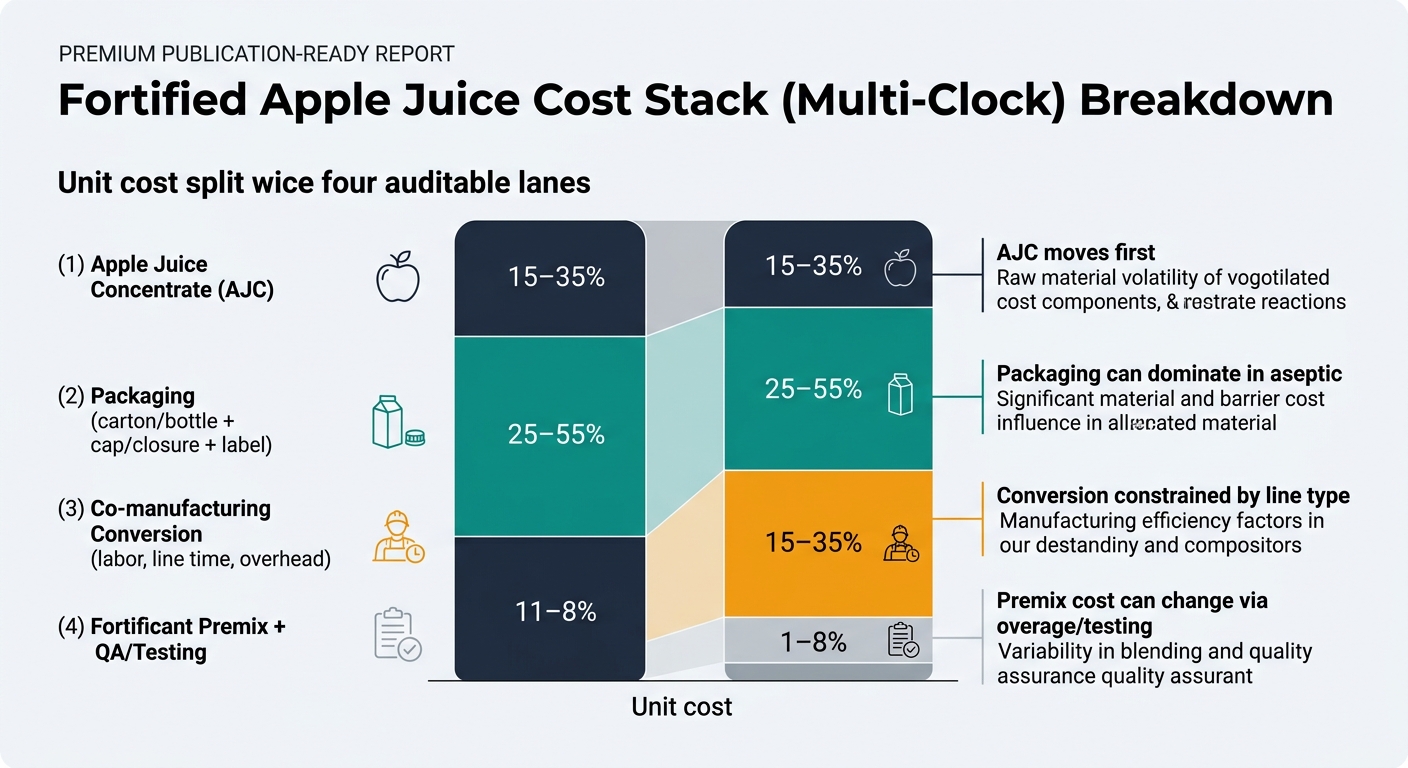
Stacked bar chart showing a representative fortified apple juice finished-goods unit cost split into four auditable lanes: Apple Juice Concentrate (AJC), Packaging (carton/bottle plus cap/closure plus label), Co-manufacturing Conversion (labor, line time, overhead), and Fortificant Premix plus QA/Testing; includes callouts noting AJC moves first, packaging can dominate in aseptic, conversion is constrained by line type, and premix cost can change via overage/testing; values shown as illustrative percent ranges (e.g., AJC 15–35%, Packaging 25–55%, Conversion 15–35%, Premix/QA 1–8%).

2) The 3 Mistakes That Quietly Add 5–15% to Your Annual Cost

Mistake #1: Negotiating Finished Goods Like It’s a Single Commodity

  • What happens: Procurement pushes for a unit price reduction when AJC drops, without separating juice base, packaging, and conversion.
  • Why it fails: Suppliers can “give” 2% on paper while offsetting via packaging pass-throughs, changeover fees, rush freight, or fortificant overage assumptions.
  • The hidden cost (validated): Teams often discover too late that only a minority of the unit cost is truly AJC-exposed in the near term; the rest is either contracted, capacity-priced, or lagged. The result is a false win, then a mid-quarter surcharge request that erodes credibility with Finance.

Mistake #2: Treating Co-Man Capacity as Infinite (Until It Isn’t)

  • What happens: The team dual-sources AJC but leaves co-man conversion single-sourced, assuming switching is easy.
  • Why it fails: Conversion is constrained by line type (aseptic vs hot-fill), changeover complexity, and packaging toolsets. Switching also triggers QA validation and documentation work—especially important because juice processors and importers operate under FDA’s Juice HACCP framework (21 CFR Part 120), which makes process control and records non-optional [3].
  • The hidden cost (validated): Expedites and short runs can add several points to effective unit cost through higher conversion rates, downtime charges, and suboptimal logistics—often larger than any AJC savings you negotiated.

Mistake #3: Over-specifying the Product and Then Paying for Your Own Complexity

  • What happens: Specs accrete over time (tighter color window, narrower Brix/acid tolerance, unique bottle, special cap color, multiple label versions), and procurement keeps chasing price reductions anyway.
  • Why it fails: Over-spec narrows the supplier universe and increases MOQs, changeover time, and obsolescence risk. Suppliers price the risk, even if they don’t call it out.
  • The hidden cost (validated): A common pattern is “savings” of $0.01/unit offset by write-offs and rework when packaging changes, promotions shift forecasts, or a lot fails claim testing and forces re-blend/hold. The exact cents vary by scale and SKU complexity, but the direction is consistent in beverage co-manufacturing.
Unlock Full Data
Fortified Apple Juice Market Intelligence
Prices · Trends · Origins · Forecasts

3) What Changes When You Buy With Intelligence (Not Just Quotes)

Before (Traditional approach):

  • Sourcing: 2–3 incumbent quotes; limited visibility into alternates by origin, pack format, or co-man capability.
  • Benchmarking: Quarterly checks; cost drivers discussed qualitatively (“AJC is down, you should give me something”).
  • Risk assessment: Informal (“supplier is reliable”); limited early warning on packaging constraints or harvest-driven tightening.
  • Result (kept as directional): 5–10% of volume bought at the wrong time (post-tightening), and 1–2 unplanned disruptions per year that trigger premium freight or short-run pricing.

After (Intelligence-driven approach):

  • Sourcing: Supplier universe mapped across AJC origins + co-man conversion options by format (aseptic vs PET/hot-fill) with pre-qualified Plan B lanes.
  • Benchmarking: Monthly price-band benchmarking for AJC, premix, and key packaging components; contracts structured with lagged pass-through and clear reopeners.
  • Risk monitoring: Origin and facility risk signals tied to your exact SKUs (crop/weather anomalies, logistics constraints, packaging allocation risk) with pre-set mitigation triggers.
  • Result (calibrated): In well-governed programs, the biggest gains typically come from (a) fewer expedites/short runs, (b) cleaner pass-through mechanics, and (c) better timing discipline. The draft’s “3–6% lower average unit cost” and “20–40% reduction in expedites” should be treated as achievable ranges in some programs, not guarantees; they depend on baseline maturity, SKU complexity, and how much volume is under disciplined contract coverage.

4) Three Situations Where Smart Teams Create Leverage Fast

Use Case 1: Your Renewal Is in 60 Days and AJC Just Moved

  • Insight: The best leverage window is when AJC has moved but finished-goods quotes haven’t repriced yet.
  • Data: If AJC indications are down ~8–12% but your supplier claims “no room,” it often means they’re covered for 8–12 weeks and don’t want to reset the base.
  • Procurement Impact: Propose a two-part deal: keep today’s base price, but add a 60–90 day lagged AJC pass-through for the next two quarters. You convert their inventory argument into future savings you can capture.

Use Case 2: Aseptic Cartons Are Allocated and Service Levels Are Slipping

  • Insight: In carton allocation periods, the scarce asset is packaging capacity, not juice.
  • Data: Lead times can extend materially; short-run fees and partial deliveries rise; OTIF drops before anyone admits “allocation.”
  • Procurement Impact: Shift the negotiation from unit price to allocation rights: commit volume to secure carton supply, and create a pre-approved alternate pack (selected SKUs in PET or different carton spec) to protect fill rates.

Use Case 3: QA Flags Claim Risk (Potency Drift) and the Supplier Requests a Price Increase

  • Insight: Suppliers often price in uncertainty when claim compliance is ambiguous—especially after process or packaging changes.
  • Data: Small increases in overage/testing can add fractions of a cent per unit, but suppliers may request larger increases to cover downside risk.
  • Procurement Impact: Replace the blanket increase with a measurable mechanism: pay for documented overage increases beyond an agreed baseline, and require shared shelf-life data. You pay for real cost, not for fear.

5) The Same Playbook Works in Adjacent Categories You Also Buy

  • Insight: Fortified apple juice behaves like other “multi-clock” categories where raw inputs, conversion, and packaging reprice asynchronously.
  • Data: You see similar disconnects in (1) orange/grape juice blends (fruit basis moves, packaging lags), (2) fortified dairy alternatives (premix + packaging often dominate short-term moves), and (3) shelf-stable kids’ beverages (carton allocation cycles drive pricing more than base liquid).
  • Procurement Impact: Standardize a cross-category contracting template: separate pass-through lanes, define lags, and pre-qualify alternates. This reduces negotiation time and prevents repeating the same cost-leak patterns under different SKUs.

6) Why This Category Is a Litmus Test for Procurement Maturity

  • Insight: Fortified apple juice exposes whether your organization can buy a cost stack—not just a product.
  • Data: The recurring failure mode is governance: specs drift, packaging is treated as “someone else’s problem,” and co-man capacity isn’t contracted like a critical component.
  • Procurement Impact: If you can align Procurement, QA, and Operations here—using transparent cost drivers, pass-through logic, and Plan B capacity—you can replicate the model across your shelf-stable beverage portfolio with fewer surprises and cleaner budget performance.

7) Key Insights to Apply Next Week

  • Insight: The fastest savings usually come from contract mechanics, not supplier switching.
  • Data: AJC-driven moves often translate to only ~1–3% of finished-goods unit cost in the short term, while packaging and conversion constraints can swing outcomes by more.
  • Procurement Impact: Separate AJC, packaging, premix, and conversion in your commercial model; add lagged pass-throughs and reopeners tied to observable indices.
  • Insight: Capacity is a price driver.
  • Data: When co-man lines or carton supply tighten, “market price” becomes the price of secured allocation, not the price of ingredients.
  • Procurement Impact: Contract for allocation rights and qualify alternates before disruption—not during it.
  • Insight: Fortification risk must be priced transparently.
  • Data: Overage and testing can change with process/packaging shifts, creating legitimate cost changes that are often bundled into opaque increases.
  • Procurement Impact: Pay for documented cost deltas (overage/testing) rather than accepting broad unit-price resets.

8) The Bottom Line for Your Next Move

The Bottom Line for Your Next Contract (Analyzed at: Oct, 2026)

If your suppliers are arguing “AJC is down but our price can’t move,” stop treating that as a standoff and turn it into contract math: lock a lagged AJC pass-through (60–90 days) and split packaging and premix into separate, auditable lanes. This works because AJC can move faster than the packaging and premix cycles, and carton/conversion capacity—not fruit—often becomes the real constraint when service starts slipping. With vitamin inputs like ascorbic acid still showing meaningful regional price movement through 2026, and with ongoing capacity investments in aseptic packaging, the teams that win are the ones who contract to the clocks, not the headlines [2]. If you don’t, it’s common to leak a few points of cost in “sticky” quarters via surcharges, expedites, and risk premiums that never show up in your AJC narrative.

Unlock Full Data
Fortified Apple Juice Market Intelligence
Prices · Trends · Origins · Forecasts

References

  1. api.sig.biz
  2. expertmarketresearch.com
  3. fda.gov

Related Contents

Subscribe
→
By subscribing you agree to with our Privacy Policy and provide consent to receive updates from our company.
Thank you! Your submission has been received!
Oops! Something went wrong while submitting the form.
Subscribe to receive the latest blog posts, updates, promotions, and announcements from Tridge.
