INDUSTRY TRENDS

How to Build a Backup Calrose Supply Plan (Before Allocation and Lead Times Force Your Hand)

Author
Team Tridge
DATE
August 3, 2026
8 min read
calrose-medium-grain-milled-rice Cover
Unlock Full Data
Calrose Medium Grain Milled Rice Market Intelligence
Prices · Trends · Origins · Forecasts

Procurement leaders buying Calrose medium-grain milled rice typically get caught in the same trap: you only find out how “real” your backup plan is when your primary mill tightens allocations or lead times jump. This guide translates common Calrose market dynamics (coverage lags, quality-year premiums, and logistics/pack constraints) into a practical, auditable playbook you can execute in weeks.

Executive Summary

  • Coverage lag is real: Mills often price milled rice off rough/paddy coverage taken weeks earlier, so quotes can stay “sticky” even when upstream values move.
  • Quality is its own market: Head rice yield (HRY) and breakage variability can widen premiums for tighter specs even if headline prices look flat.
  • Resilience is measurable: A useful KPI is “time-to-switch 30% of volume”, which drops materially when QA, packaging, and lanes are pre-cleared.
  • Current context (Aug 2026): USDA has highlighted tighter U.S. rice supply conditions tied to reduced area and shifting supply/use expectations—making supplier coverage and execution terms more valuable than small $/MT deltas.

1) The Price Signals You’re Missing: Why Calrose Offers “Stick” While Inputs Move

In Calrose medium-grain programs, the biggest negotiation edge rarely comes from “where the market is today”—it comes from spotting when rough/paddy values, mill offers, and delivered (FOB/Delivered DC) quotes are temporarily out of sync, then contracting into the lag.

Data (directionally realistic, not a universal rule): Three structural lags create repeatable disconnects:
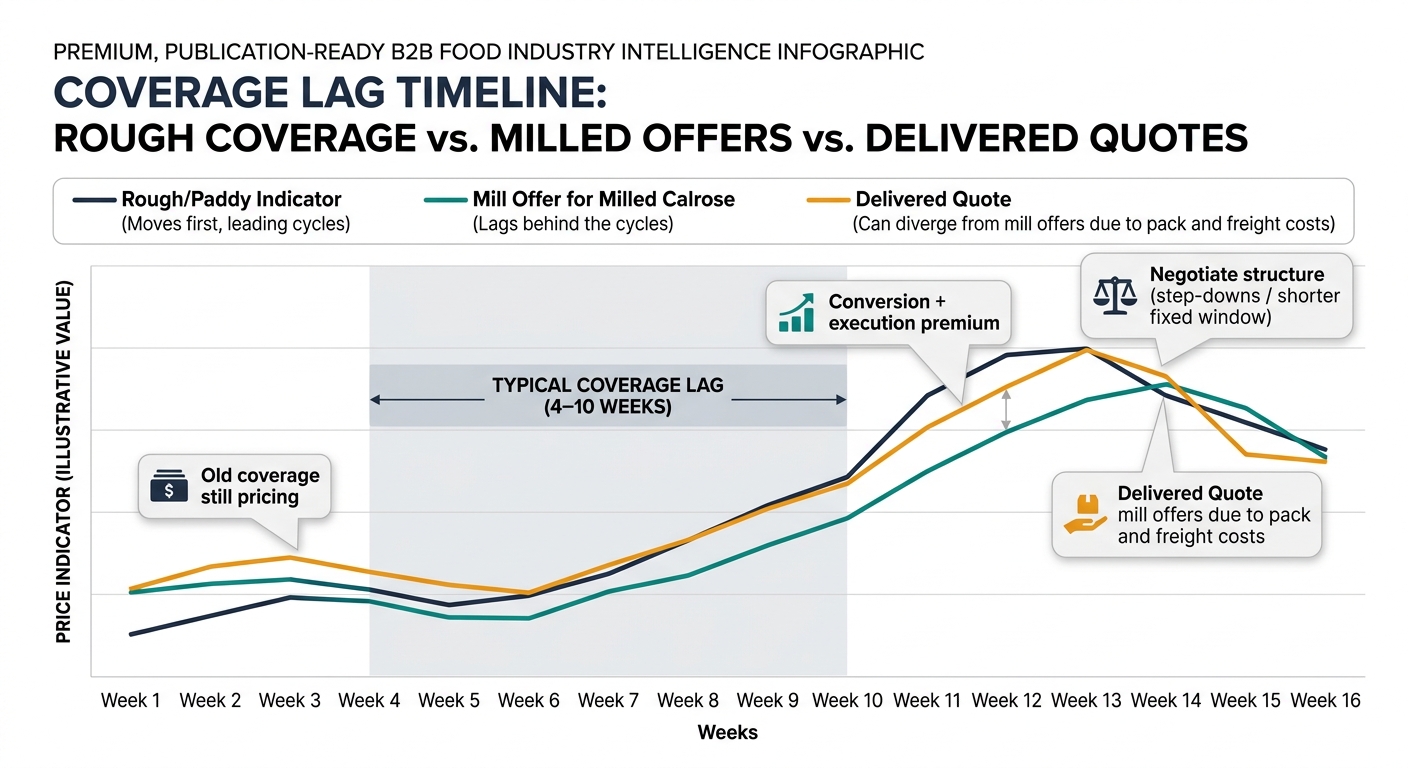
  • Inventory lag (rough-to-milled timing): Many mills are selling milled rice that reflects rough coverage taken roughly 4–10 weeks earlier (sometimes longer if they’re heavy on forward coverage). When rough prices soften after harvest pressure, milled offers often adjust more slowly until coverage rolls.
  • Quality-year lag (premium spec spreads): In a “tough quality” crop (more fissuring, chalk, or higher breakage risk), the head rice yield penalty can widen premiums for tight broken/defect specs because the mill is effectively “buying” whole kernels with yield loss. Head rice recovery is a core economic driver of rice value and pricing spreads between head rice and brokens.
  • Logistics lag (freight/pack effects): When inland truck/rail tightens or packaging slots (rebagging labor, bag supply, line time) become constrained, delivered quotes can rise even if mill-gate economics soften—especially for smaller pack formats where labor and changeovers amplify cost.
A 12–16 week timeline graphic showing three curves: (1) Rough/Paddy indicator (moves first), (2) Mill offer for milled Calrose (lags), and (3) Delivered quote (can diverge due to pack/freight). Includes a shaded band labeled “Typical coverage lag (4–10 weeks)” and callouts for “Old coverage still pricing,” “Conversion + execution premium,” and “Negotiate structure (step-downs / shorter fixed window).”

Procurement Impact: Treat the market as two curves, not one: (1) raw value direction (rough/paddy) and (2) conversion + execution premium (milling yield, packaging capacity, logistics reliability). The buying window often appears when raw values fall first but conversion premiums remain high; that’s when you negotiate structure (coverage length, allocation language, optionality) rather than chasing a headline $/MT.

Quick Win: When rough/paddy indicators fall materially (e.g., ~10% over ~6–8 weeks) but your incumbent’s offer only moves a few percent, don’t assume they’re “right”—assume you’re looking at old coverage. Ask explicitly: “What crop-year coverage is this offer based on, and what’s your current rough position?” If the answer is vague, you’ve found leverage.

2) The 3 Mistakes That Turn a Manageable Market Into an Emergency

Mistake #1: Waiting for a disruption to qualify alternates

  • What happens: A key mill signals allocation risk or pushes lead times from 4 to 8+ weeks; the team starts calling new suppliers under pressure.
  • Why it fails: Medium-grain Calrose equivalency is not just “same grain type.” You typically need QA sign-off, cook tests, packaging/artwork readiness, and logistics lane validation—which can take several weeks to a couple of months depending on your customer approvals, pack complexity, and the supplier’s responsiveness.
  • The hidden cost: The “late scramble” premium is rarely visible as price alone: expediting, partial shipments, higher breakage variability, and customer service failures can add low-single-digit percent to effective landed cost—plus reputational damage with internal stakeholders.

Mistake #2: Negotiating only price, not allocation and execution terms

  • What happens: Contracts are awarded on $/MT with minimal language on allocation, ship windows, substitution rules, or remedies.
  • Why it fails: In tight periods, suppliers protect their best customers with clear allocation frameworks (forecast lock dates, minimum call-offs, priority tiers). If your agreement is silent, you become the “optional” order.
  • The hidden cost: A 3% cheaper contract can be wiped out by one missed ship window that forces a spot replacement at high single- to low double-digit percent premiums and triggers downstream OT/line disruption.

Mistake #3: Treating “backup supplier” as a name on a slide, not a ready-to-run lane

  • What happens: Procurement lists two alternates, but no one has validated pack specs, pallet patterns, COA cadence, claim handling, or transit time variability.
  • Why it fails: The first load becomes the pilot—exactly when you can least afford surprises (label errors, enrichment declarations where applicable, inconsistent lot coding).
  • The hidden cost: First-ship failures often show up as receiving holds (days), rework (hours), and shorted usable inventory (MT). Operationally, that’s a stockout risk disguised as “supply secured.”
Unlock Full Data
Calrose Medium Grain Milled Rice Market Intelligence
Prices · Trends · Origins · Forecasts

3) What Changes When You Run This Category Like an Intelligence Program

The performance gap comes from replacing relationship-based comfort with measurable coverage and switchability—so you can act in weeks, not quarters.

Data: A realistic before/after looks like this:
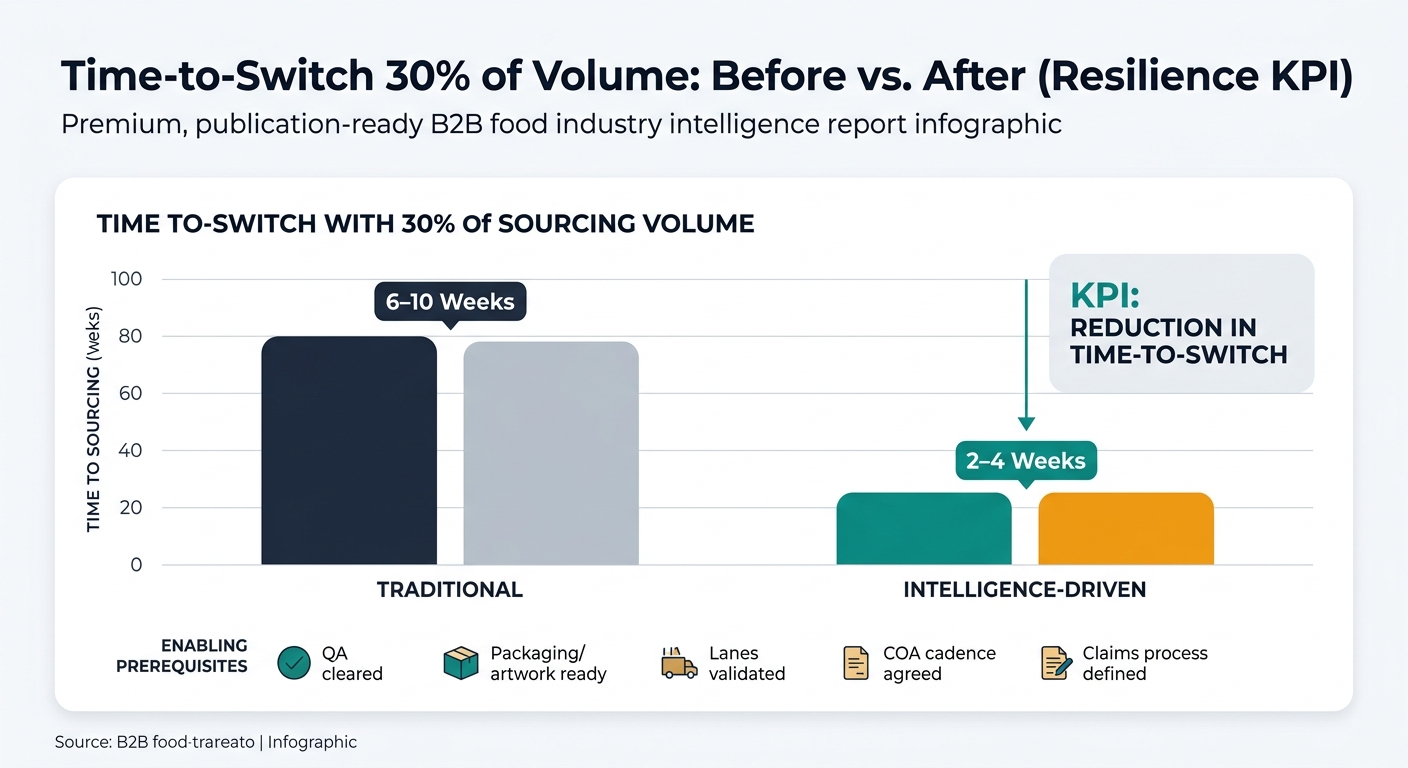
Before/after bar chart comparing “Traditional” vs “Intelligence-driven” for the KPI “Time-to-switch 30% of volume,” showing a reduction from ~6–10 weeks down to ~2–4 weeks, with icon labels for prerequisites: QA cleared, packaging/artwork ready, lanes validated, COA cadence agreed, claims process defined.
Dimension Before (traditional) After (intelligence-driven)
Supplier coverage 1 primary mill + 1 “paper backup” 1 primary + 2 qualified alternates with tested specs and lanes
Market sensing Monthly check-ins + stale benchmarks Weekly price/risk view; triggers when spreads move >3–5%
Disruption response time 6–10 weeks to switch 2–4 weeks to switch (because QA + packaging + lane are pre-cleared)
Cost outcome Spot buys 2–3x/year at +8–15% Spot buys reduced; average landed cost improves ~3–7% via timing + reduced expediting
Service level Periodic fill-rate hits during tightness Higher continuity; fewer short ships and line interruptions

Procurement Impact: You’re not trying to “predict” the market perfectly. You’re building an operating model where (a) you see the lag early, (b) you have contract structures that protect supply, and (c) you have alternates that are truly executable.

4) Three Situations Where a Ready Bench of Calrose Suppliers Pays Off Fast

Scenario A: Your incumbent signals allocation risk 30–45 days before peak demand

Insight: Early allocation signals are often the market’s first honest indicator—well before public price benchmarks move.

Data: In many programs, lead times extend first, then pack slot availability tightens, then prices re-rate. The sequence can unfold over several weeks.

Procurement Impact: Move immediately to a two-track plan: (1) secure a short extension/bridge volume with clear ship windows and allocation language, and (2) activate a pre-qualified alternate for 20–40% of volume to de-risk continuity.

Scenario B: You see a raw-value drop, but your delivered quotes aren’t following

Insight: This is the classic “coverage lag” moment—mills are selling old rough economics.

Data: If rough indicators fall high single digits but offers move <3%, the gap is usually coverage timing and conversion/pack constraints, not “supplier greed.”

Procurement Impact: Negotiate a step-down mechanism (e.g., re-openers tied to an agreed proxy) or shorten the fixed-price window to 60–90 days while you qualify alternates—so you can capture downside without betting the farm on spot.

Scenario C: QA flags rising breaks/defects and ops sees cook variability

Insight: Quality drift often precedes commercial disruption because mills re-optimize yield under pressure.

Data: When head rice yield is challenged, suppliers may push grading limits closer to spec boundaries; the result is more variability lot-to-lot.

Procurement Impact: Use a dual-sourcing posture: keep baseline volume with the incumbent under tightened COA/claim terms, and shift incremental demand to a second supplier with proven consistency—protecting customer experience without overreacting.

5) Why This Playbook Transfers to Your Other Staples

The same “lag + conversion premium” logic shows up in adjacent categories you likely buy.

Data: Examples procurement teams recognize:

  • Wheat flour: wheat futures can drop quickly, but flour prices lag due to mill coverage and regional basis.
  • Edible oils (soy/sunflower): crude oilseed moves don’t translate 1:1 into refined oil when refining capacity and packaging constraints tighten.
  • Sugar: raw sugar moves can disconnect from refined/retail pack pricing due to refining logistics and contract cycles.

Procurement Impact: Building a qualified bench and contracting into lags is not “rice-specific”—it’s a repeatable method to stabilize service levels while capturing market downside.

6) Why This Calrose Example Should Change How You Run Category Reviews

Calrose is a clean test of procurement maturity because it forces you to manage spec compliance + execution risk + timing simultaneously.

Data: Teams that only track a single price line miss the real drivers: inventory coverage timing, quality-year premiums, packaging capacity, and lane reliability.

Procurement Impact: If your QBR can’t answer two questions—“How fast can we switch 30% of volume?” and “What triggers a contract structure change?”—you don’t have a resilience plan; you have optimism.

7) The Bottom Line for Your Next Move

Insight: If you’re seeing early allocation/lead-time creep or a raw-value move that hasn’t shown up in your offers yet, your advantage is the lag window, not a last-minute price concession.

Data: That window is typically weeks, not quarters, driven by mill rough coverage and packaging/logistics constraints that reprice later than upstream indicators.

Procurement Impact: Use the lag to secure a short coverage bridge with enforceable ship windows, while activating a pre-qualified alternate for 20–40% of volume; teams that did this in prior tight cycles typically avoided +8–15% emergency buys and protected service levels without overpaying for long fixed-price commitments.

Key Takeaways

  • Price “disconnects” are structural: Rough/paddy can move first; milled Calrose offers often lag weeks due to coverage and conversion constraints.
  • Your spec is its own market: Premiums widen when quality-year factors hit head rice yield; don’t expect commodity medium-grain moves to translate cleanly.
  • Resilience is measurable: Track “time-to-switch 30% volume” and maintain 2 executable alternates, not just names.
  • Negotiate terms that protect supply: Allocation language, ship windows, COA cadence, and claim remedies often matter more than a small $/MT delta.
  • Exploit the lag with structure: When upstream drops but offers don’t, shorten fixed windows, add step-downs/re-openers, and diversify volume before the market re-rates.

The Bottom Line for Your Next Contract

(Analyzed at: Aug, 2026)

USDA’s 2026/27 outlook has emphasized tighter U.S. rice supply conditions versus recent years, and AMS weekly commentary continues to separate California medium-grain conditions from broader “all rice” narratives—so the penalty for being a single-mill buyer is higher than it looks on a spreadsheet. The high-conviction move is to contract a short bridge with your incumbent that hard-codes ship windows and allocation rules, while you pre-clear one alternate lane for 20–30% of volume (spec, pack, COA cadence, and claims). It works because it exploits the predictable coverage/execution lag: you buy time without surrendering leverage. What’s at stake is not just a missed $/MT—one late shipment can easily turn into a high single- to low double-digit percent landed-cost hit once expediting, rework, and spot replacement are in play.

Unlock Full Data
Calrose Medium Grain Milled Rice Market Intelligence
Prices · Trends · Origins · Forecasts

Related Contents

Subscribe
→
By subscribing you agree to with our Privacy Policy and provide consent to receive updates from our company.
Thank you! Your submission has been received!
Oops! Something went wrong while submitting the form.
Subscribe to receive the latest blog posts, updates, promotions, and announcements from Tridge.
