
INDUSTRY TRENDS

How to Beat the SPC “Index”: Timing, Contract Mechanics, and Supplier Leverage for High-Protein Soy Protein Concentrate

Author
Team Tridge
DATE
October 6, 2026
9 min read
high-protein-soy-protein-concentrate Cover
Unlock Full Data
High Protein Soy Protein Concentrate Market Intelligence
Prices · Trends · Origins · Forecasts

SPC procurement is usually won or lost in the gap between what upstream soy is doing and what your suppliers are willing (or able) to pass through. This guide translates that gap into specific contract mechanics, negotiation timing, and governance moves that procurement leaders can run—without assuming deep soy processing expertise.

Executive Summary

  • SPC doesn’t clear like a clean commodity: processed-inventory lag + plant utilization + qualification friction often delay pass-through versus the soy complex.
  • Your best leverage window is often after upstream breaks: negotiate repricing cadence and index resets while suppliers are still shipping higher-cost inventory.
  • Utilities and freight can dominate short-term moves: treat energy and logistics as separate levers (split-index; incoterm engineering), not “noise.” [1]
  • Resilience is a cost lever, not a nice-to-have: dual-source readiness and lead-time signals reduce expedite events and variance.

1) The Market Signals You’re Missing (and How to Trade Them)

You can do everything “right” on supplier management and still miss the biggest SPC P&L lever: SPC does not clear like a commodity. It clears like a processed ingredient with inventory lag, plant utilization constraints, and qualification friction. That’s why you’ll see weeks where soy complex moves down but your SPC offers don’t—and weeks where SPC jumps even though beans look flat.

A clean, data-driven line chart showing (1) an upstream soy indicator as a normalized index, (2) delivered SPC offer index, and (3) optional overlays for utilities and freight proxies, with a shaded “Typical pass-through lag window (30–90 days)” and callouts for “sticky down” and “fast up”; includes a legend and a note that it is illustrative and should use internal data.
  • Insight: SPC price moves are often a lagged and filtered version of upstream soy + energy + logistics, plus a supplier’s willingness to defend margin when buyers are spec-locked.
  • Data (validated as directional, not a universal constant): In many procurement cycles, upstream soy can move materially inside a quarter while delivered SPC offers adjust more slowly because SPC is costed through inventory and conversion economics (drying/evaporation/solvent recovery) rather than a same-week futures screen. Treat any “5–8% vs 1–3%” comparison as a plausible pattern, not a guaranteed spread.
  • Procurement Impact: Your “buy window” is frequently the 30–90 days after upstream breaks, when supplier finished-goods inventory is still priced high but competitors haven’t all re-opened negotiations; that’s when you can negotiate index-linked resets, shorter repricing cycles, or one-time givebacks without triggering a full re-bid.

The three most exploitable SPC disconnects

  • Insight: Inventory lag creates predictable “sticky” pricing—especially after a sharp soybean move.

    Data (logic check): SPC production commonly includes energy-intensive steps (e.g., drying and recovery) and is often scheduled in campaigns; suppliers can credibly argue that near-term shipments reflect earlier feedstock and utility inputs. This supports the “sticky down / fast up” pattern as a reasonable negotiating premise.

    Procurement Impact: Instead of demanding an instant $/mt concession (often denied), ask for a two-step mechanism:

  • near-term rebate/credit on near-term shipments,
  • formal next-quarter index reset with a cap/floor.
  • Insight: Energy-driven processing cost can overwhelm soy-driven relief—especially when plants are tight on drying/evaporation capacity.

    Data (validated): Technoeconomic work on SPC production highlights utilities—especially thermal energy/steam demand around evaporation/drying—as a material sensitivity in cost. [1]

    Procurement Impact: Your leverage improves when you separate feedstock from conversion: negotiate a split-index (soy component indexed; conversion component fixed for 90–180 days) so you don’t overpay for a utility spike that later normalizes.

  • Insight: Logistics and container availability can create regional price islands unrelated to soy.

    Data (validated for 2026 conditions): 2026 market commentary points to softer average ocean freight versus prior peaks, but still meaningful lane volatility and periodic GRIs/PSS behavior—enough to move landed cost quickly on certain routes. [2]

    Procurement Impact: When freight—not SPC ex-works—is the culprit, the win is incoterm engineering (switching FOB/CIF, alternate ports, or using a distributor buffer) rather than supplier switching.

Quick win: Track SPC offers against (a) soy complex direction over the prior 6–10 weeks, (b) regional freight, and (c) supplier lead-time quotes. When those three don’t “agree,” you’re looking at a negotiation moment—not a market mystery.
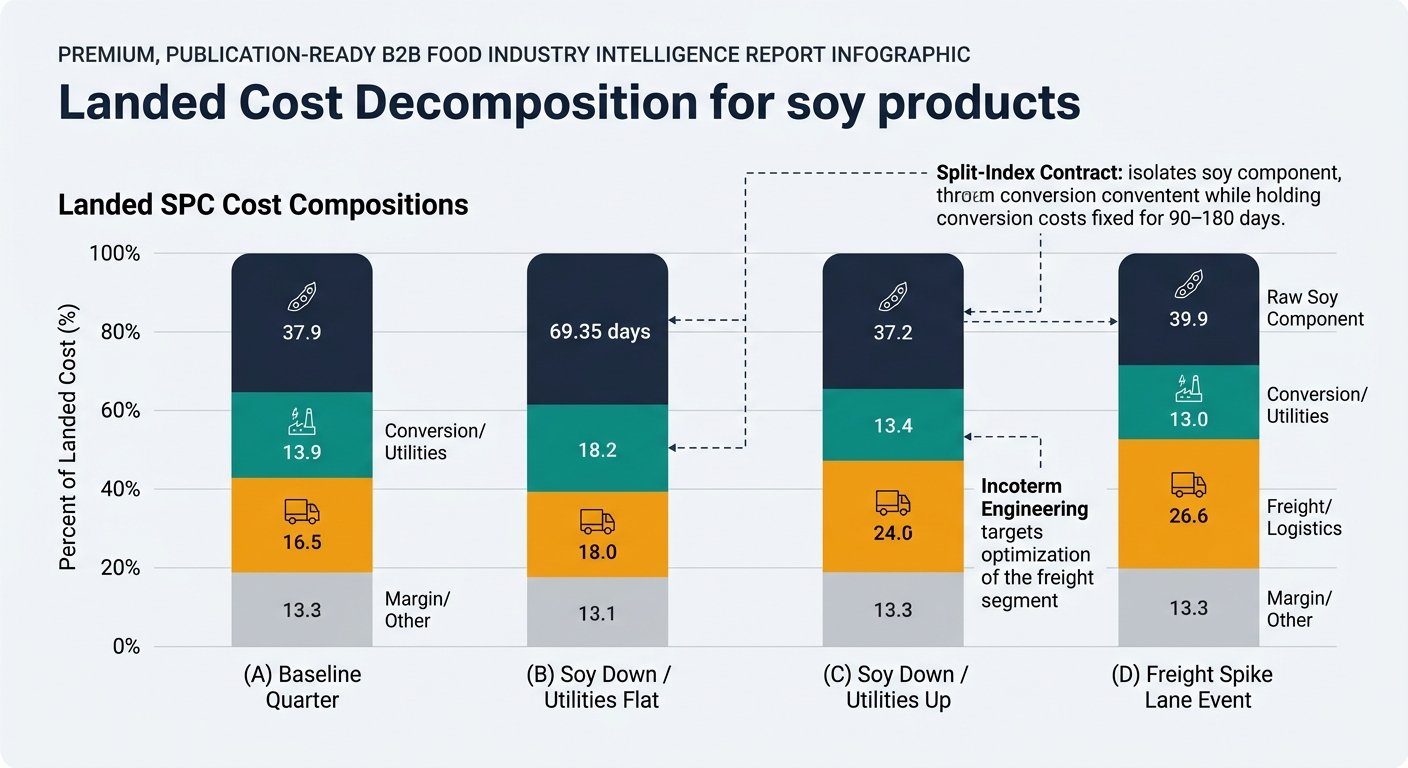
A stacked bar chart comparing 3–4 scenarios for landed SPC cost composition (baseline quarter; soy down/utilities flat; soy down/utilities up; freight spike lane event), segmented into raw/feedstock (soy), conversion (processing/utilities), freight/logistics, and margin/other, with annotations showing how a split-index contract isolates the soy component while holding conversion fixed for 90–180 days and how incoterm engineering targets the freight segment; values shown as percentages or indexed units.

2) The 3 SPC Procurement Mistakes That Quietly Inflate Your Landed Cost

Mistake #1: Treating SPC like a commodity and pushing for immediate pass-through

  • What happens: The team anchors on today’s soybean headlines and demands an instant SPC reduction.
  • Why it fails: Suppliers can credibly point to costed inventory, contracted utilities, and committed production slots; you burn goodwill and still don’t get a clean reset.
  • The hidden cost: You lose the chance to secure structural concessions (repricing cadence, index formula, service guarantees). A 2% “miss” on a $8M category is $160k—often larger than the visible rebate you argued over.

Mistake #2: Running an RFP without aligning QA/R&D on spec-flex boundaries first

  • What happens: Procurement invites 6–10 suppliers, then QA/R&D rejects half the bids late due to functional performance or documentation gaps.
  • Why it fails: SPC is interchangeable only inside a narrow “functional equivalence” band; late-stage rejection collapses competitive tension right when you need it.
  • The hidden cost: The incumbent sees the funnel collapse and holds price. Even a 6-week qualification slip can force spot buys or premium freight that wipes out 1–3% annual savings.

Mistake #3: Over-rotating on unit price and under-buying resilience

  • What happens: The team concentrates volume in one approved plant/origin because it’s $30–$60/mt cheaper.
  • Why it fails: SPC disruptions are binary (plant outage, documentation issue, logistics shock): when it hits, you can’t “buy your way out” quickly because alternates need approvals and lead time.
  • The hidden cost: Expedites, line interruptions, and reformulation firefighting typically cost multiples of the price delta. One avoided outage event can justify a second source even if it’s +1–2% on unit price.

Quick win: For every sourcing event, force a one-page pre-brief:

  1. what specs are non-negotiable,
  2. what can flex with a controlled trial,
  3. what is the maximum acceptable lead-time variance.

If you can’t answer those, you’re not ready to bid.

Sourcing Window Radar
High Protein Soy Protein Concentrate — Global Harvest Calendar
INDIA SEASON ACTIVE
🇮🇳 India
JAN — DEC
🇧🇷 Brazil
OCT — NOV
🇨🇳 China
FEB — OCT
🇩🇰 Denmark
OCT — OCT
🇺🇸 United St.
OCT — OCT
JanFebMarAprMayJunJulAugSepOctNovDec

3) What Changes When Decisions Are Intelligence-Driven (Not Quote-Driven)

Before (traditional approach):

  • Sourcing: Bid list limited to incumbents + 1 “backup” that’s never trialed.
  • Benchmarking: Quarterly check-ins with stale market talk; limited view on regional spreads.
  • Risk posture: Reactive—issues discovered when OTIF slips or QA flags a lot.
  • Result: 5–10% of volume bought “urgently” each year at peak pricing; supplier concentration remains high; negotiations focus on cents/kg instead of contract mechanics.

After (intelligence-driven approach):

  • Sourcing: Longlist built by grade fit + export readiness + documentation posture, then narrowed to 2–3 trial candidates.
  • Benchmarking: Price moves decomposed into soy vs conversion vs freight; negotiation asks become specific and defensible.
  • Risk posture: Event monitoring tied to your actual lanes and approved plants; triggers defined for safety stock and alternate activation.
  • Result (validated as plausible ranges, not promises): Typical outcomes teams can measure include cost avoidance during volatile quarters (by timing buys and repricing resets), fewer expedite events when lead-time risk is caught earlier, and concentration reduction (e.g., moving from a heavily single-sourced position toward a more balanced split over 12–18 months).

Quick win: Stop measuring “savings vs last price” only. Add two KPIs:

  1. % volume on index-linked or repricing-protected terms,
  2. % volume with a qualified alternate that can ship within your required lead time.

4) Three Situations Where Smart Teams Create Leverage Fast

Scenario A: Contract renewal in 60 days—market is turning but offers aren’t

  • Insight: You’re likely seeing inventory lag and supplier reluctance to reset.
  • Data: Upstream soy indicators can soften for 4–8 weeks before processed-ingredient offers follow.
  • Procurement Impact: Negotiate a short bridge (60–90 days) with a written reset formula for the next quarter, rather than locking a 12-month fixed price at the top of the lag.

Scenario B: Your incumbent extends lead times “temporarily”

  • Insight: Lead-time inflation is often the earliest sign of utilization tightness or allocation.
  • Data: In SPC, lead-time stretching from 4–6 weeks to 8–10 weeks frequently precedes stricter MOQs, fewer shipment slots, or reduced willingness to negotiate.
  • Procurement Impact: Trigger a dual-source activation sprint: reserve trial capacity, pre-book logistics, and negotiate a conditional volume block with an alternate even if pricing is slightly higher.

Scenario C: You’re asked to take a price increase justified by “energy and compliance”

  • Insight: Suppliers bundle multiple drivers into one narrative; some are real, some are margin defense.
  • Data (validated conceptually): Utilities are a real cost lever in SPC conversion economics, and energy prices can move independently of soy. [1]
  • Procurement Impact: Counter with a two-part structure: fixed conversion adder for 90–180 days + transparent index for soy component; add a service-level concession (OTIF, safety stock, priority slots) if price relief is limited.

Quick win: Build a standard “increase challenge pack” for SPC: last 12-month price history, upstream soy move, freight trend on your lane, and your volume/forecast stability. The goal is not to win every argument—it’s to force the conversation into verifiable drivers.

5) The Same Playbook Works on Adjacent Ingredients You Also Buy

  • Insight: Processed inputs with qualification friction behave like SPC: prices are sticky on the way down and jumpy on the way up.
  • Data: Teams see similar lag/spread dynamics in pea protein, vital wheat gluten, and textured vegetable proteins where capacity utilization, energy, and lot qualification create a “conversion margin” layer above raw ag markets.
  • Procurement Impact: If you standardize (1) driver decomposition, (2) index/term design, and (3) dual-source governance for SPC, you can reuse it across your plant-protein basket—reducing renegotiation cycle time and improving auditability.

Quick win: Create one cross-category template for “raw vs conversion vs freight” and force every supplier discussion into that structure.

6) Why This SPC Example Proves the Value of Intelligence-Led Procurement

  • Insight: The SPC buyer who wins isn’t the one who finds the lowest quote—it’s the one who understands when price should move, why it isn’t moving, and what term to trade for it.
  • Data (credibility check): The biggest leakage mechanisms in processed ingredients are typically (a) lag capture, (b) emergency buys/expedites, and (c) concentration risk—because those are where decision-making gets rushed and options are constrained.
  • Procurement Impact: Intelligence-led teams turn market complexity into governance: clearer negotiation logic, faster escalation thresholds, and fewer “surprise” disruptions that force expensive decisions under time pressure.

Quick win: If you can’t explain last quarter’s SPC variance in three lines (soy move, conversion/energy, freight/lead time), you’re negotiating blind—even if you have three quotes.

7) The Bottom Line for Your Next Move

If upstream soy has already moved down but your SPC offers are still flat, treat the next 30–90 days as a structured renegotiation window, not a waiting game. Push for a short bridge or a mid-quarter reset tied to an agreed index, and trade supplier certainty (forecast, volume bands, shipment cadence) for faster pass-through. The window exists because suppliers are still shipping higher-cost inventory while buyers haven’t fully repriced expectations. Teams that consistently capture that lag—without triggering re-qualification chaos—tend to outperform spot buyers by a few percentage points over the year, and they do it with fewer expedite events.

Key Insights

  • Insight: SPC is priced like a processed ingredient with inventory lag and conversion constraints, not like a clean commodity pass-through.

    Data (validated as directional): It’s common for upstream soy to move faster than SPC offers because conversion utilities and inventory costing slow pass-through; utilities are a recognized cost sensitivity in SPC production. [1]

    Procurement Impact: Your edge comes from contract mechanics (repricing cadence, split-index, caps/floors) and timed negotiations during lag windows.

  • Insight: Most sourcing failures are process failures: misaligned spec-flex, weak bid lists, and unmanaged concentration.

    Data: Qualification and switching friction routinely delays competitive tension until it’s too late.

    Procurement Impact: Pre-align QA/R&D boundaries, build a credible alternate bench, and measure resilience KPIs alongside price.

  • Insight: The highest ROI actions are often non-price terms.

    Data (market-practice consistency): Freight volatility and utility cost swings can be real and sudden; 2026 outlooks still emphasize rate volatility even when averages soften. [2]

    Procurement Impact: Trade forecast commitment for priority slots, safety stock, and transparent resets—then you’re buying continuity and cost control at the same time.

The Bottom Line for Your Next Contract

(Analyzed at: Oct, 2026)

Freight and utilities are still the two “silent” drivers that can erase a soybean-driven tailwind in SPC, even in a softer 2026 ocean-rate environment where lane volatility and surcharges still appear with little notice. [2] The most defensible move is to renew on a split structure: index the soy component with a clear reset cadence, but keep conversion fixed for 90–180 days and re-open it only if a defined utility benchmark moves. That structure turns the lag you’re already living with into a governed mechanism—and on an $8M annual category, avoiding even a 1–2% “sticky-down” miss is a six-figure outcome that doesn’t require switching plants or re-qualifying grades.

High Protein Soy Protein ConcentrateSupply Chain Intelligence
120 countries tracked
10
Exporters
10
Importers
$657M
Top Export Value
Top Exporters (2024)
🇺🇸
United States
$657M
🇩🇰
Denmark
$452M
🇳🇱
Netherlands
$383M
🇧🇷
Brazil
$245M
🇩🇪
Germany
$186M
+115 more
Top Buyers
🇺🇸 United States $763M🇳🇱 Netherlands $509M🇯🇵 Japan $318M🇨🇦 Canada $210M🇰🇷 South Korea $181M

References

  1. link.springer.com
  2. spglobal.com

Related Contents

Subscribe
→
By subscribing you agree to with our Privacy Policy and provide consent to receive updates from our company.
Thank you! Your submission has been received!
Oops! Something went wrong while submitting the form.
Subscribe to receive the latest blog posts, updates, promotions, and announcements from Tridge.
