

Organic apple juice concentrate (AJC) is one of those categories where “the price” is rarely the real signal. The best sourcing teams treat AJC as a lagged, capacity-constrained, compliance-sensitive ingredient—and build coverage, supplier strategy, and governance around leading indicators rather than waiting for quotes to move.
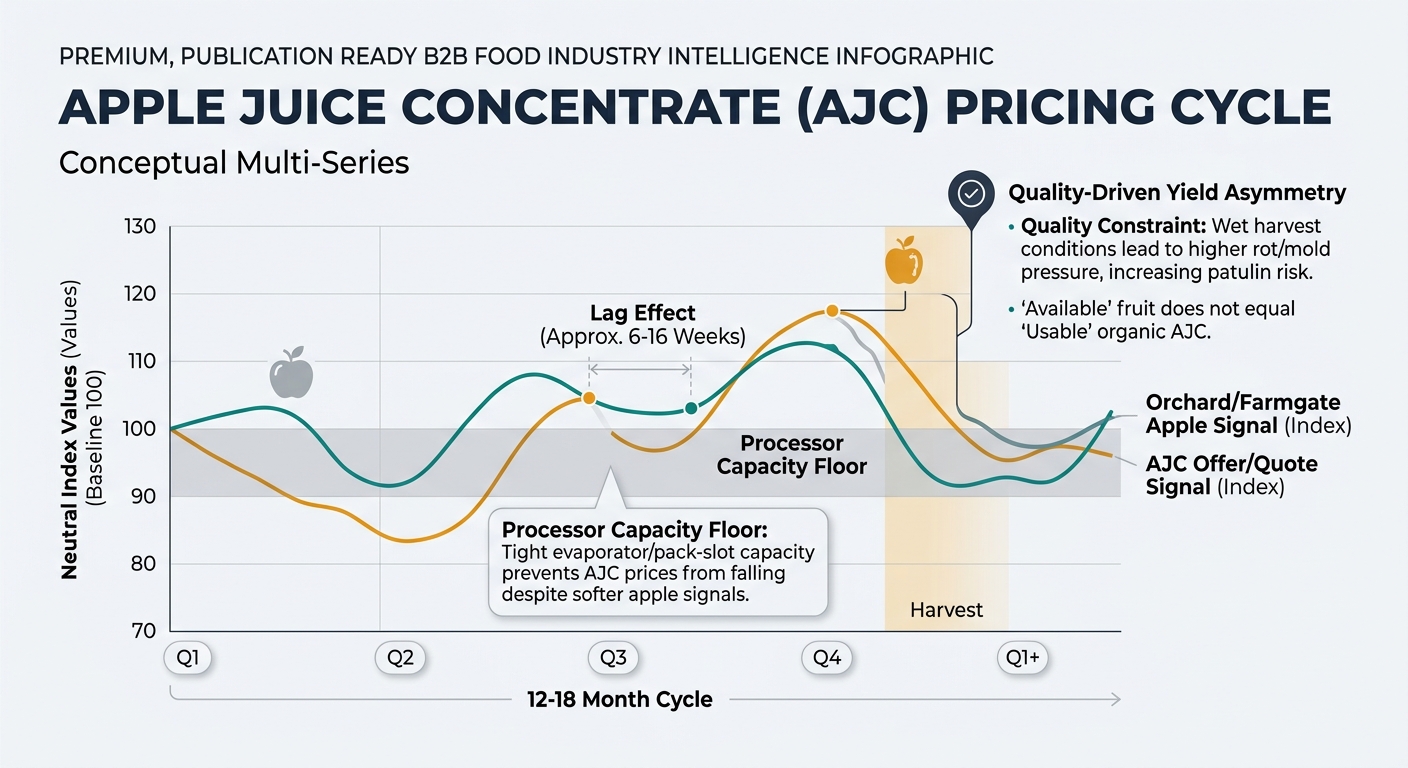
Data (validated logic): Three structural lags create the disconnect:
Data (correction to avoid false precision): The original “Scenario A/B” numbers were presented as illustrative. Keep the pattern, but don’t anchor internal decisions to those specific $/MT and $/lb-solids figures unless you have a verified market index for your exact spec/origin/pack. A more governance-safe way to express it:
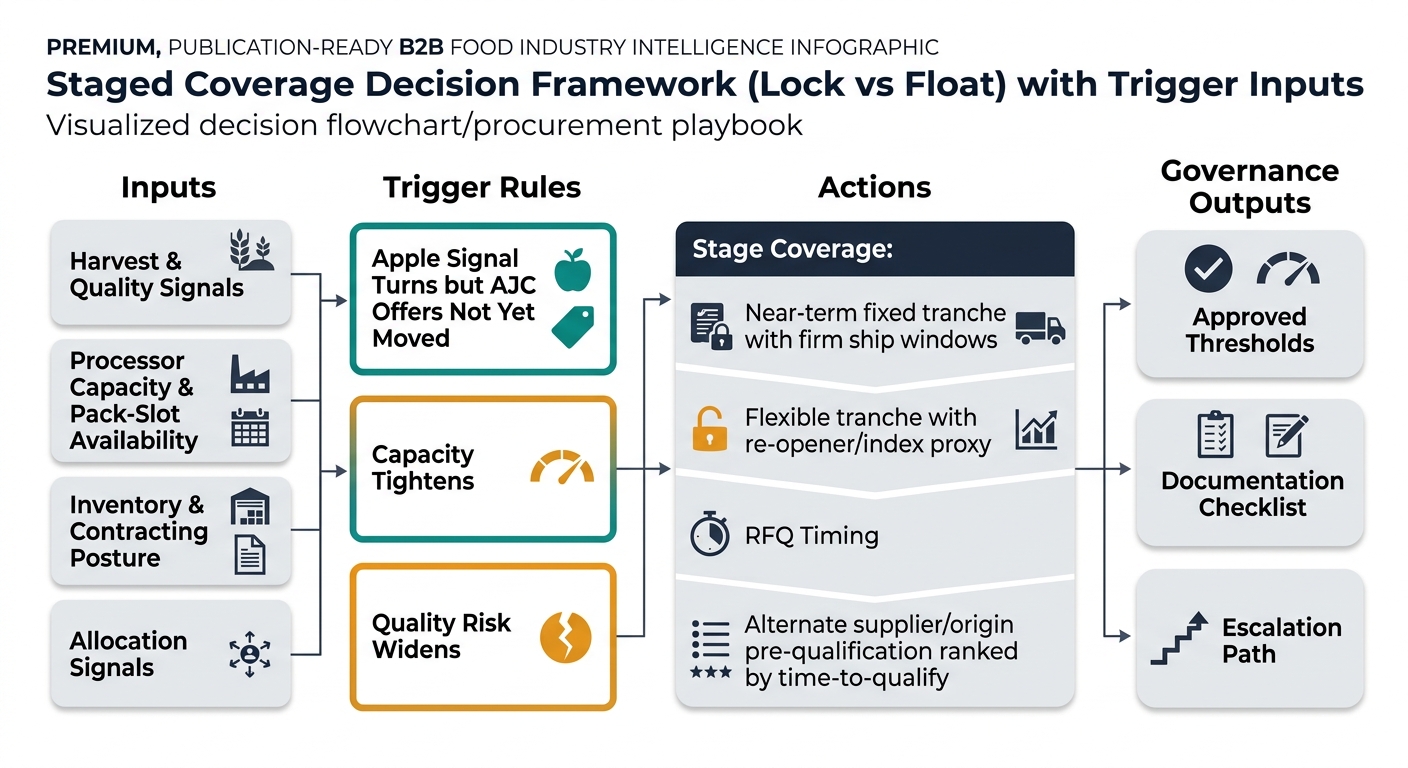
Procurement Impact: If you wait for “published AJC prices” or supplier quotes to confirm the move, you are typically buying after the market has repriced. The practical play is to run a coverage plan keyed to (1) harvest/quality risk signals and (2) processor capacity signals, then use that to time RFQs and decide whether to lock fixed, index, or stage coverage.
| Dimension | Before (quote-led) | After (intelligence-led) |
|---|---|---|
| Budget variance | Often wide swings on uncovered volume | Narrower swings with staged coverage and trigger rules |
| Spot exposure | High and accidental | Lower and intentional (spot used as a tool, not a surprise) |
| Disruption events | Recurring “scrambles” | Fewer scrambles when alternates are pre-qualified |
| Claims / rework | Recurring small issues | Fewer, earlier-detected patterns via tighter spec/doc discipline |
Procurement Impact: The win is not a heroic negotiation; it’s fewer forced buys and fewer exceptions. Leadership gets a governance-ready narrative: “We staged coverage because the apple signal turned, capacity tightened, and quality risk widened—here’s the trigger logic and the approved thresholds.”
Data: Examples procurement teams usually recognize:
Procurement Impact: Build one common playbook: leading indicators → staged coverage → supplier governance artifacts. Your team gets faster and more consistent across categories.
Right now, run your next AJC negotiation as a staged-coverage decision, not a single-price event: lock a near-term tranche while the market is still digesting orchard and processor signals, and keep a defined portion flexible for the lagged price adjustment that typically follows. This window exists because AJC offers often reflect earlier fruit economics and capacity positioning rather than today’s raw-material reality. Teams that consistently buy into that lag—rather than after it closes—tend to capture mid-single- to low-double-digit improvements versus reactive spot coverage, with fewer quality and documentation exceptions.
What you must validate internally (non-negotiable): specs and application fit (including trials), organic documentation scope/chain-of-custody, audit readiness, and legal/compliance review of claims and import requirements.
(Analyzed at: Jul, 2026)
If you’re contracting for the next 6–12 months, assume Europe-origin risk is asymmetric: late-April 2026 frosts in Poland’s main growing regions have already raised the probability of a smaller 2026/27 crop, even though near-term benchmark pricing in spring 2026 was still reported lower year-on-year—classic conditions for whipsaw behavior as the market shifts from “old-crop inventory” to “new-crop risk premium” [2]. The high-conviction move is to stage coverage now (secure a near-term tranche with firm ship windows) while pre-qualifying at least one alternate origin/supplier so you’re not forced into premium spot buys if allocation tightens. In practice, the cost of moving late is usually felt as a several-percent landed-cost step-up plus expediting and spec exceptions—exactly the avoidable part of the cycle.


