
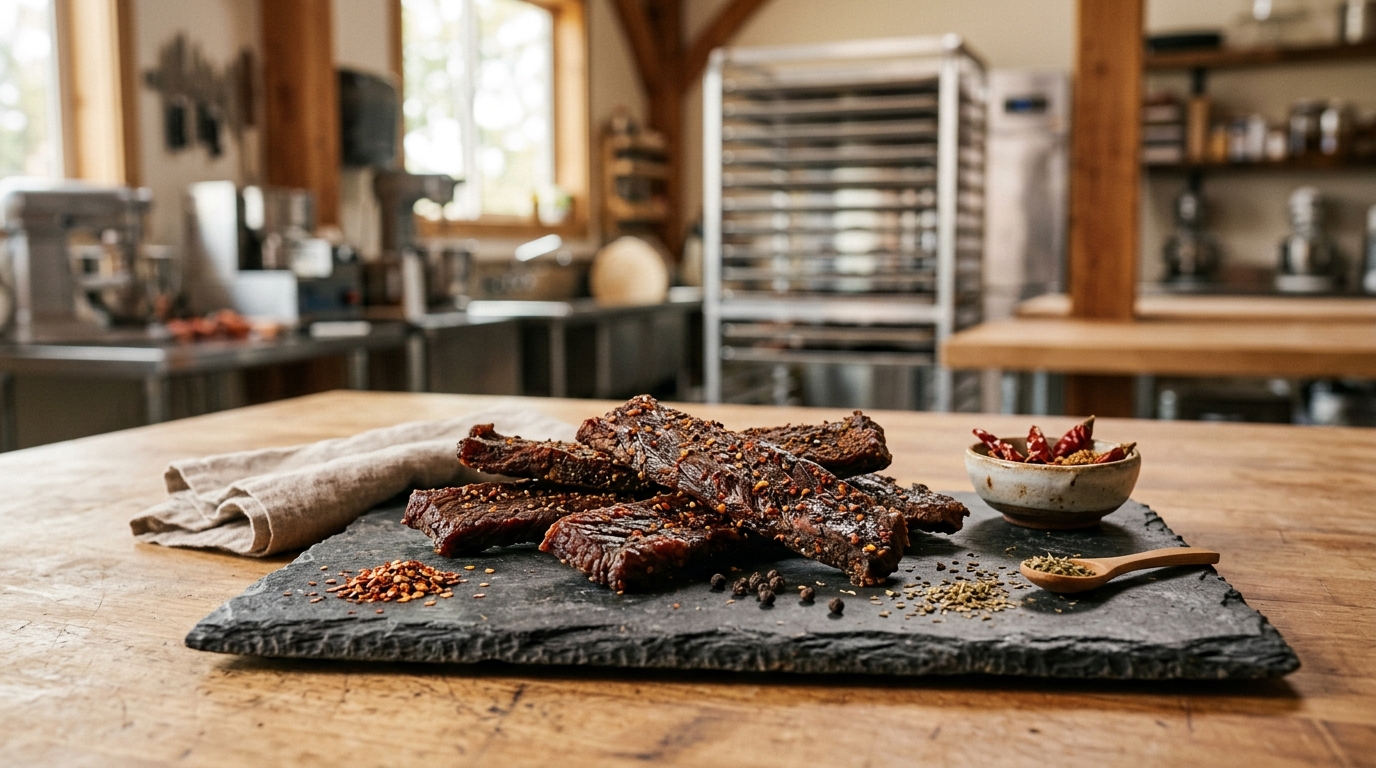
Spicy beef jerky looks like a simple shelf-stable snack, but procurement outcomes are largely determined by a few upstream “lock points”: the lean beef spec you can consistently secure, the plant’s validated lethality + drying controls (which drive yield and throughput), and the high‑barrier packaging system that protects texture and flavor in real distribution. This guide maps those nodes so Strategic Planning & Analysis teams can model margin and risk with fewer surprises.
Spicy beef jerky is a shelf-stable, ready-to-eat (RTE) meat product, but its cost and risk are “locked in” upstream—first by the beef cut/lean spec you buy, then by validated lethality + drying performance, and finally by high‑barrier packaging that protects against oxidation and moisture pickup.
Insight: The jerky supply chain is a conversion chain: you buy chilled/frozen beef (high mass), then intentionally remove water (large yield loss), then protect the dried product with barrier packaging.
Data: Finished jerky yield is structurally constrained by moisture removal; small changes in slice thickness, fat level, and target water activity (aw) / moisture-protein ratio (MPR) shift finished pounds per raw pound. (Specific endpoints vary by product/process authority and validation support.) [3]
Procurement Impact: The “physical map” you need to manage is beef spec → process capability (validated lethality + drying) → packaging barrier → distribution. Cost surprises usually come from yield and throughput, not from minor ingredients.
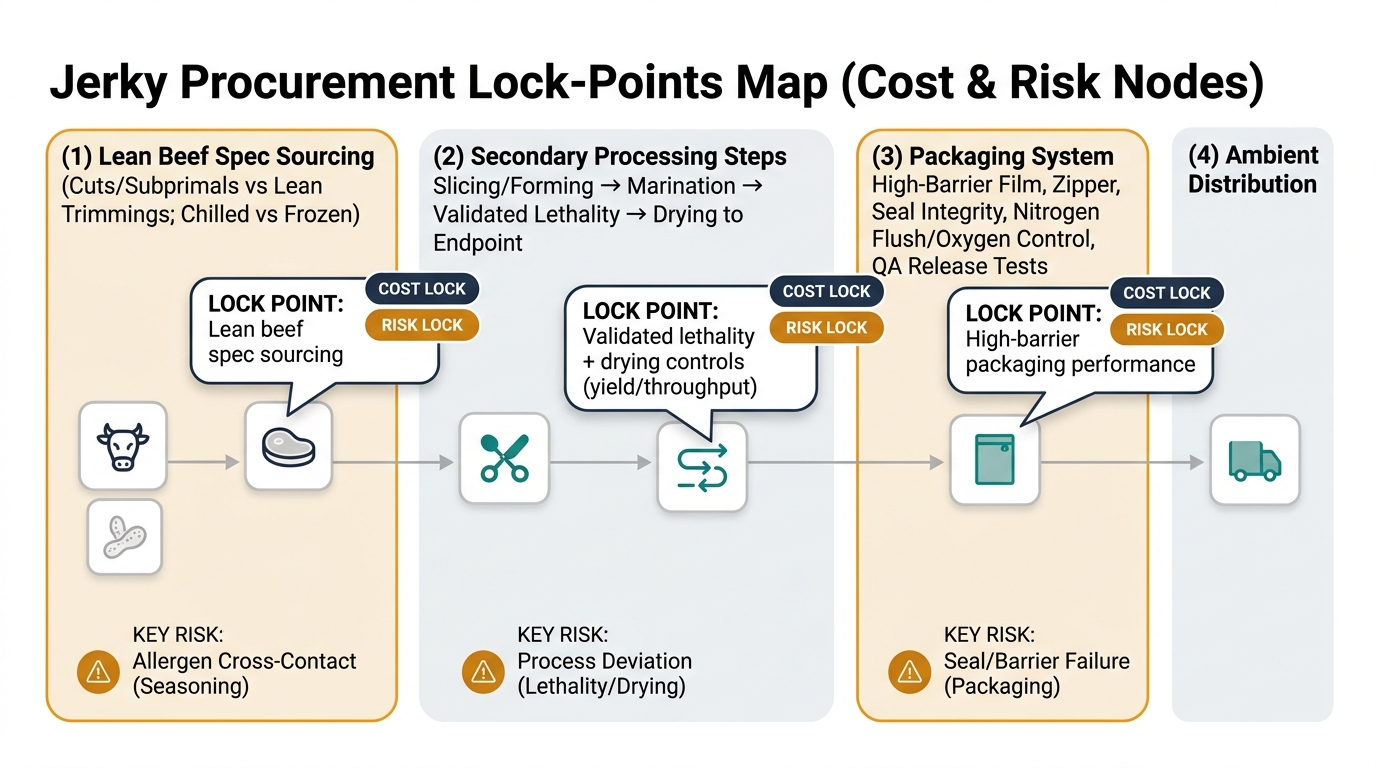
Insight: Jerky economics are dominated by three physical drivers: beef input $/lb, drying yield (moisture loss + trim), and packaging barrier performance (shelf-life protection).
Data: In most formulations, beef is the largest single cost component; drying is energy- and labor-intensive; packaging is a meaningful share because films must control oxygen and moisture to prevent rancidity and texture drift. [4]
Procurement Impact: If you want to understand why two SKUs with similar retail prices have different margins, map them by (1) beef spec, (2) yield target/endpoint controls, (3) pack format and barrier level.

| Supply Chain Node | Cost Ratio (% of Final Cost) | Notes |
|---|---|---|
| Raw Material Cost (lean cuts/subprimals) | 45% | Lean spec and cut economics dominate; chilled vs. frozen affects handling. |
| Primary Processing (fabrication/freezing) | 7% | Embedded in beef price + cold-chain conversion and portioning losses. |
| Secondary Processing (cook + dry + labor + energy) | 18% | Drying capacity, labor, and yield loss amplify cost per finished lb. |
| Seasoning & Functional Inputs | 6% | Heat consistency + allergen controls matter more than weight share. |
| Packaging & QA | 10% | High-barrier film, zippers, nitrogen flush, aw testing, detection. |
| Logistics & Distribution | 7% | Inbound cold chain + outbound ambient freight/warehousing. |
| Wholesale/Retail Margin | 7% | Channel-dependent; not a manufacturing node but affects netback. |
| Supply Chain Node | Cost Ratio (% of Final Cost) | Notes |
|---|---|---|
| Raw Material Cost (lean trimmings) | 38% | Can use specified lean trimmings; still needs fat control for stability. |
| Primary Processing (trim sorting/freezing) | 8% | Lean % sorting and frozen logistics are common. |
| Secondary Processing (grind/form + cook + dry) | 22% | Forming adds steps; drying remains the throughput constraint. |
| Seasoning & Functional Inputs | 8% | Binders/flavor systems can increase; allergen/label constraints persist. |
| Packaging & QA | 10% | Similar barrier needs; formed products can be more sensitive to moisture pickup. |
| Logistics & Distribution | 7% | Similar pattern: cold in, ambient out. |
| Wholesale/Retail Margin | 7% | Channel-dependent. |
| Supply Chain Node | Cost Ratio (% of Final Cost) | Notes |
|---|---|---|
| Raw Material Cost (higher-grade lean) | 43% | Tighter specs for texture and appearance increase usable yield requirements. |
| Primary Processing | 7% | More stringent trim/portioning expectations. |
| Secondary Processing | 17% | Tighter endpoint control (aw/texture) can reduce yield or slow throughput. |
| Seasoning & Functional Inputs | 6% | Flavor consistency and heat uniformity are brand-critical. |
| Packaging & QA | 14% | Higher barrier films, better zippers, more frequent QA verification. |
| Logistics & Distribution | 6% | Similar, but quality sensitivity to temperature abuse is higher. |
| Wholesale/Retail Margin | 7% | Channel-dependent. |
Insight: Jerky constraints are physical and regulatory, not just commercial: validated lethality, drying endpoints, and packaging barrier performance set hard boundaries on what is feasible.
Data: RTE meat processing requires documented control of critical parameters and HACCP validation; FSIS guidance for jerky highlights lethality expectations (e.g., targeting meaningful log reductions) and the need to validate the process under the plant’s actual conditions (including humidity where relevant). [6]
Procurement Impact: Supplier changes and spec changes often require re-validation, shelf-life confirmation, and label/regulatory review—so switching is slower than in many snack categories.
Critical Risk Factors: allergen cross-contact in seasoning systems, process deviation at lethality/drying steps, and packaging seal/barrier failures that trigger returns.
(Analyzed at: Jul, 2026)
Treat jerky as a capacity-and-yield constrained conversion chain, not a simple ingredient buy: lock a “process-compatible” spec bundle (lean range + form factor + approved packaging structures) with at least one qualified alternate for each of the two true bottlenecks—lean supply and drying/USDA-capable co-man throughput. This works because 2026 cattle/lean availability remains tight and lean trim pricing has been demonstrably volatile, while jerky plants can’t flex drying hours overnight without risking validated process controls and QA cadence. [2]
If you don’t standardize and pre-qualify alternates, the “cost” shows up as lost yield, premium freight, and retailer penalties; in practice, it’s easy for a mid-single-digit COGS swing to become a full margin event once service failures and chargebacks land.


