
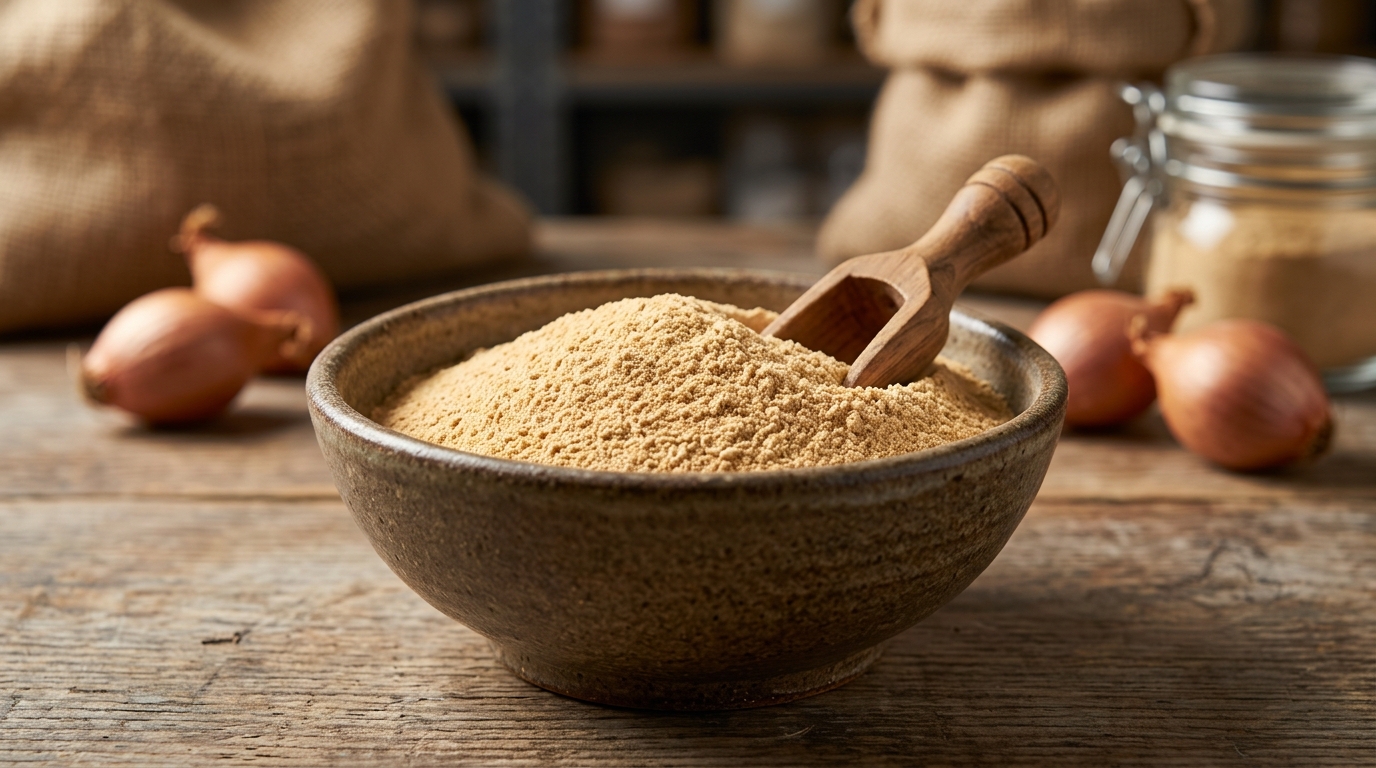
This guide maps the shallot powder supply chain the way a Purchase–Quality/Safety/Compliance buyer needs to see it: where conversion economics become “fixed,” where low‑moisture food safety controls actually bite, and which specs shrink your qualified supplier pool. Use it to pressure-test supplier claims, build a defensible qualification plan, and reduce avoidable holds/rejections driven by moisture, foreign material, and kill‑step validation gaps.
Conventional shallot powder is built on a simple physical conversion—fresh bulbs into a low-moisture, shelf-stable powder—but the cost structure is not simple. Most of the “fixed” cost pressure is created before a buyer ever sees a COA: farm yield and solids content, dehydration energy, and the kill-step/foreign-material controls needed for low-moisture safety.
Insight: The supply chain is a conversion pipeline (fresh → dehydrated pieces → milled powder) where yield loss and energy intensity dominate total cost.
Data: Fresh alliums are mostly water; typical dehydration/conversion ratios commonly fall roughly ~6:1 to 10:1 (fresh-to-dehydrated, by mass) depending on solids content, trimming, and dryer targets. (For adjacent analogs like onion powder, “~10:1 fresh equivalent” is widely cited in industry usage guidance, which is directionally consistent with this band.) [1]
Procurement Impact: Your “true” cost drivers sit upstream (bulb quality/solids) and midstream (dryer throughput + energy + validated lethality/controls). Downstream packaging and freight matter, but they rarely rescue bad conversion economics upstream.
Ground-truth flow (physical):

Insight: Shallot powder cost is the sum of (1) agricultural solids delivered, (2) energy + labor to convert to low moisture, and (3) controls to manage low-moisture food hazards and foreign material.
Data: Across dehydrated alliums, the highest cost sensitivity typically comes from raw material yield/solids and dehydration energy; secondary sensitivity comes from kill-step throughput constraints, milling losses/dust control, and packaging that prevents moisture pickup.
Procurement Impact: When you map costs by node, you can separate “structural” costs (can’t be negotiated away) from “execution” costs (losses, rework, downtime) that show up as inconsistent lots.

| Supply Chain Node | Cost Ratio (% of Final Cost) | Notes |
|---|---|---|
| Raw Material (bulbs + storage loss) | 30–45% | Solids content and grade-outs drive effective cost per kg powder. |
| Primary Processing (prep + dehydration) | 25–40% | Energy + labor + yield loss; biggest structural cost node. |
| Secondary Processing (kill-step + milling + sieving) | 10–18% | Tight mesh + lethality controls can raise losses and slow throughput. |
| Packaging & QA Release | 5–10% | Liners/barrier and testing scale with risk posture and customer specs. |
| Logistics & Distribution | 8–15% | Freight + handling; humidity/odor controls affect defect rates. |
| Supply Chain Node | Cost Ratio (% of Final Cost) | Notes |
|---|---|---|
| Raw Material (bulbs) | 35–50% | Bulb quality and storage losses dominate. |
| Primary Processing (prep + dehydration) | 30–45% | Fewer downstream losses vs. powder; still energy-heavy. |
| Packaging & QA Release | 6–12% | Lower dust loss; still moisture-sensitive. |
| Logistics & Distribution | 8–15% | Flakes are less hygroscopic than powder but still sensitive. |
| Supply Chain Node | Cost Ratio (% of Final Cost) | Notes |
|---|---|---|
| Raw Material (bulbs) | 30–45% | Similar upstream drivers to powder. |
| Primary Processing (prep + dehydration) | 25–40% | Same energy intensity; slice thickness affects dryer economics. |
| Secondary Processing (milling + sieving) | 8–14% | Lower dust loss than fine powder; easier to hit PSD. |
| Packaging & QA Release | 5–10% | Granules cake less than powder but still need liners. |
| Logistics & Distribution | 8–15% | Similar ambient shipping profile. |
Insight: Shallot powder behaves like a spice-adjacent low-moisture ingredient: safety risk is low-probability but high-impact, and physical handling (moisture/foreign matter) is a constant constraint.
Data: The category combines (1) agricultural variability, (2) energy-intensive dehydration, and (3) low-moisture food hazard expectations (pathogen control validation, environmental monitoring, and foreign-material prevention). Even when final water activity is low, pathogens can persist if introduced and not controlled; FDA and ASTA materials consistently frame Salmonella as a key hazard for spices/seasonings and emphasize validated treatment controls. [3]
Procurement Impact: The chain’s “hard constraints” are not negotiable—only managed: you can’t remove seasonality, yield loss, or the need for validated controls; you can only choose where you want redundancy and where you accept narrow supplier pools.
Insight: Shallot powder is fundamentally an energy-and-yield conversion business wrapped in low-moisture food safety controls.
Data: The largest structural cost nodes are (1) raw bulb solids delivered after storage loss and (2) dehydration energy + labor; the largest structural failure modes cluster around moisture management (caking), foreign material control, and pathogen prevention validation. Low‑moisture foods guidance and spice-industry practice consistently emphasize validated lethality and verification/monitoring because Salmonella can persist in dry products. [5]
Procurement Impact: When you evaluate suppliers or origins later, you’ll get the most signal by tracing each lot back to: bulb quality/solids, dehydration conditions, kill-step capability/throughput, and packaging moisture barriers—because those are where cost and usability are determined.
(Analyzed at: Sep, 2026) Put a lane-proof moisture control package into the contract: require a validated microbial reduction step (or a clearly defined alternative control strategy), lock liner/barrier specs and maximum moisture/aw at pack-out, and add a “container/warehouse humidity excursion” response clause (hold-and-test, rework options, disposition timelines).
This works because, in 2026, buyers are still treating shallot powder like a spice-adjacent low‑moisture ingredient where Salmonella control expectations and verification are non‑negotiable, while the most frequent day-to-day failures are moisture/odor events that happen after a perfectly acceptable COA is issued. ASTA and FDA materials reinforce the industry direction toward validated treatments and verification for these categories. [2]
If you prevent even one or two receiving holds or disposals per year on a meaningful lane, the avoided downtime, rework, and expedited replacements typically outweigh the incremental packaging and verification cost by a wide margin.


