
INDUSTRY TRENDS

How Procurement Teams Time, Negotiate, and De-Risk Cosmetic-Grade Turmeric Starch (With COA Governance That Holds Up)

Author
Team Tridge
DATE
October 2, 2026
9 min read
cosmetic-grade-turmeric-starch Cover
Unlock Full Data
Cosmetic Grade Turmeric Starch Market Intelligence
Prices · Trends · Origins · Forecasts

Procurement teams often treat turmeric-derived inputs like simple commodities—then get surprised by quality rejections, documentation gaps, and “price holds” that quietly shift risk into lead time, MOQ, or Incoterms. This guide shows how to read the raw-material signal vs. the cosmetic-pass signal, structure RFQs for true comparability, and build a resilient supplier portfolio without relaxing specs.

Executive Summary

  • Price lag is real: Raw turmeric can move faster than cosmetic-pass starch because conversion capacity, energy, inventory, and QA rejection rates dominate short-term pricing.
  • Biggest avoidable cost: Non-comparable COAs/test methods create “paper savings” that get paid back via re-testing, quarantine, and expedites.
  • Risk is not abstract: Turmeric supply chains have documented adulteration/contamination risk (e.g., lead chromate in turmeric markets), making heavy-metal controls and traceability non-negotiable. [1]
  • Governance is leverage: A COA + method matrix and change-notification commitment reduces false comparability and speeds QA/Regulatory approvals.
  • 2026 reality: Contracting should focus on landed-cost certainty and documentation completeness, not just $/kg—especially where energy/freight volatility and border scrutiny can tighten “cosmetic-pass” availability.

1) The Market Signal You’re Probably Missing: Raw Turmeric Moves First, Cosmetic Starch Moves Later (and Sometimes Not at All)

  • Insight: Cosmetic-grade turmeric starch pricing often does not track raw turmeric (rhizome/powder) in the same month—and in tight quality regimes it can even move the opposite direction. The advantage is not predicting the crop; it’s reading the conversion + QA bottleneck and buying into (or away from) the lag.
  • Data (validated as directional, not an index): In a typical downcycle, raw turmeric powder may soften ~8–15% over 6–10 weeks after harvest pressure, while cosmetic-grade starch quotes may only move ~2–6% over the same window because (1) inventory in-channel was produced from higher-cost raw material 6–12 weeks earlier, (2) wet processing + drying is capacity/energy constrained, and (3) lots that fail micro/heavy metals/pesticide screens get “downgraded,” shrinking the cosmetically-usable pool even when farmgate is cheap. (These percentages are plausible procurement heuristics; treat them as triggers to re-quote, not as market facts.)
  • Procurement Impact: If you wait for finished starch quotes to fall before you act, you often miss the only window where suppliers are willing to concede on price without asking you to relax specs or accept longer lead times.
  • Insight: The biggest price disconnects show up when processors are managing two different scarcities: cheap raw turmeric is available, but “cosmetic-pass” lots are not.
  • Data: A realistic pattern looks like this:
  • Example A (post-harvest): Raw turmeric input costs drop ~10% in February–March; starch offers drop only ~3% until April because suppliers are shipping from January-produced inventory and protecting margin to cover higher QA rejection rates.
  • Example B (quality shock): Raw turmeric prices stay flat, but cosmetic starch rises ~7–12% in 30–45 days after a spike in border holds / customer rejections tied to contaminants or documentation gaps—because re-testing, rework, and scrappage effectively reduce capacity. (Quality shocks are credible in turmeric chains given documented adulteration/contamination issues; your control is testing scope + traceability.) [1]
  • Example C (energy/freight squeeze): Raw turmeric drops ~5%, but starch increases ~4% because drying energy and packaging costs rise, and LCL consolidation delays push suppliers to quote with wider risk buffers.
  • Procurement Impact: Your negotiation leverage comes from proving you understand which scarcity is binding (raw input vs. conversion/QA vs. logistics). That changes whether you push for price, lead-time, or tighter change-control.
  • Insight: Quote structures often hide the disconnect: suppliers “hold price” but change the commercial terms.
  • Data: Common moves when input costs fall: shorter quote validity (e.g., 7 days vs. 30), higher MOQs, or shifting from DDP to FCA/FOB; when quality tightens: longer lead times, “subject to final COA,” or broader spec language.
  • Procurement Impact: Track effective landed cost and risk, not just unit price. A 3% unit-price win can be erased by one delayed lot that forces air freight or a reformulation bridge.
8% raw move in 60 days while starch <3%)." />

Quick Win

Build a simple internal indicator: if raw turmeric has moved >8% in the last 60 days and your starch quotes have moved <3%, assume you’re in a lag window—trigger an RFQ refresh and try to lock 60–90 days with fixed differentials tied to documented COA compliance.
2) The 3 Ways Teams Accidentally Overpay (or Create a Quality Incident)

Mistake #1: Negotiating only on $/kg and ignoring “spec creep” and test-method mismatch

  • What happens: Procurement compares quotes across suppliers whose COAs aren’t method-aligned (different micro methods, different heavy metal panels, inconsistent sampling plans). The cheapest offer wins.
  • Why it fails: Cosmetic-grade starch is “priced on risk.” If the supplier’s testing scope is narrower, you’re buying unknown variance. The first non-conforming arrival forces re-test, quarantine, and expedited replacement.
  • The hidden cost (validated as realistic order-of-magnitude): A $0.20/kg price delta can be wiped out by (a) one additional third-party test panel ($300–$800/lot), (b) 1–2 weeks of production rescheduling, and (c) disposal/return freight. The effective overrun commonly lands in the 4–10% range on the affected volume.
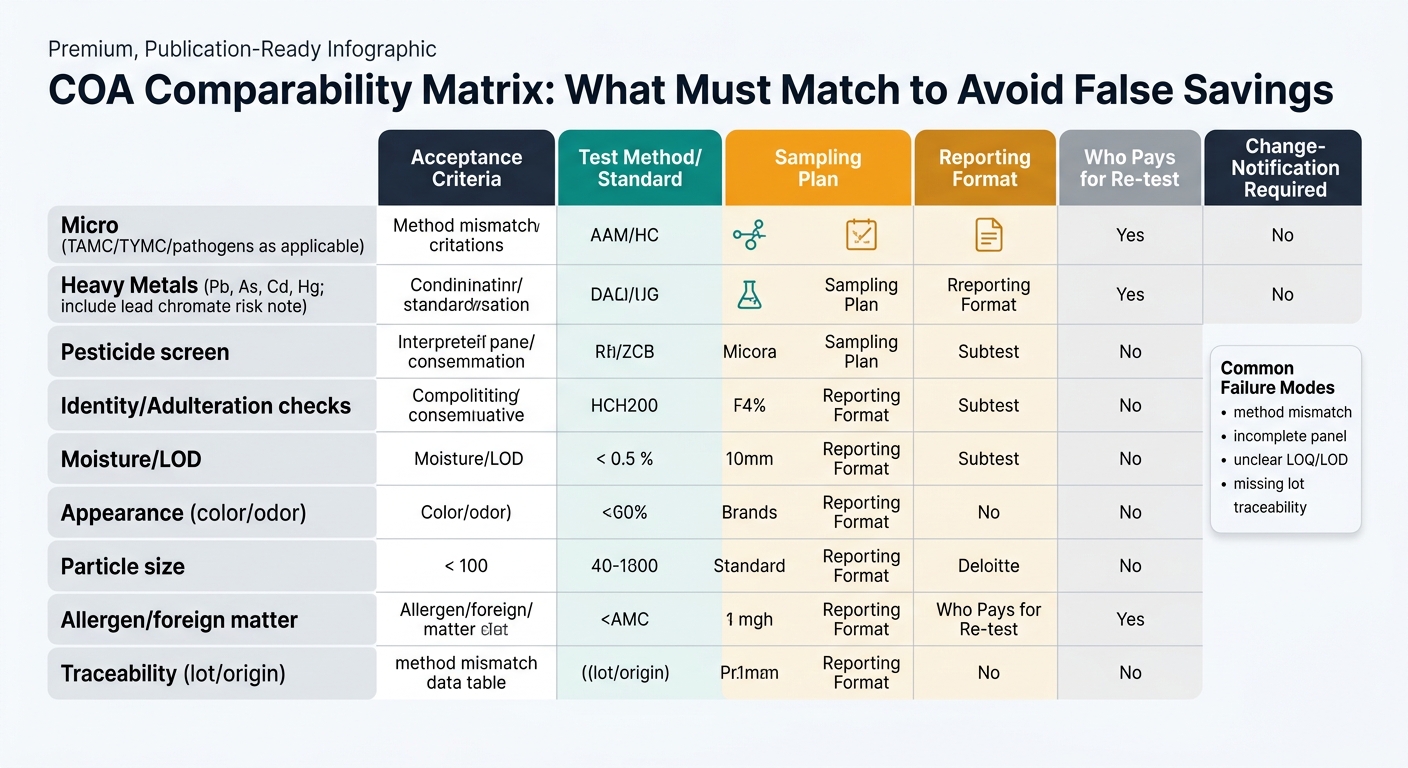
A document-like COA comparability matrix/checklist showing test categories (Micro, Heavy Metals including Pb/As/Cd/Hg with a lead chromate risk note, Pesticide screen, Identity/Adulteration checks, Moisture/LOD, Appearance, Particle size, Allergen/foreign matter, Traceability) against columns for Acceptance Criteria, Test Method/Standard, Sampling Plan, Reporting Format, Who Pays for Re-test, and Change-Notification Required, plus a side panel listing common failure modes (method mismatch, incomplete panel, unclear LOQ/LOD, missing lot traceability).

Mistake #2: Treating re-export hubs as true origin diversification

  • What happens: The team “dual-sources” by adding a trader/packer in a hub market, believing they reduced India concentration.
  • Why it fails: You may have diversified counterparty, not agricultural + processing exposure. If both channels ultimately pull from the same upstream processors, you still share the same crop/quality shock.
  • The hidden cost: In a disruption, both suppliers tighten allocation simultaneously; you discover the overlap only when lead times jump at the same time. You pay premium spot pricing and you lose the continuity benefit you thought you bought.

Mistake #3: Running RFQs without a “no-surprises” governance pack (and then paying for it later)

  • What happens: RFQs ask for a TDS and price, but not for the full documentation set and change-control expectations (site changes, sub-supplier changes, sterilization steps, packaging changes).
  • Why it fails: The award is made before QA/Regulatory has enough to approve. Procurement then renegotiates after the fact—usually from a weaker position—once gaps appear.
  • The hidden cost (validated as plausible cycle-time impact): Approval cycle time stretches from ~2–4 weeks to ~8–12 weeks, forcing either (a) extended reliance on the incumbent at unfavorable terms or (b) expensive bridging buys.

Quick Win

In your next RFQ, require a one-page “COA + method” matrix and a signed change-notification commitment (e.g., 60–90-day notice for any manufacturing site, sub-supplier, or process step changes). It’s the cheapest way to prevent false comparability.

Unlock Full Data
Cosmetic Grade Turmeric Starch Market Intelligence
Prices · Trends · Origins · Forecasts

3) What Changes When You Run Sourcing Like an Intelligence Problem (Not a Spreadsheet)

  • Insight: The performance gap comes from turning market noise into decision triggers (when to re-bid, when to lock, when to qualify alternates)—not from having more supplier names.
  • Data: A realistic before/after for a mid-sized personal care manufacturer buying 20–60 MT/year:
    Dimension Before (traditional) After (intelligence-driven)
    Sourcing set 2–3 incumbent quotes 6–10 pre-vetted suppliers segmented by capability + documentation maturity
    Benchmarking Quarterly, anecdotal Monthly: raw proxy movements + conversion cost signals + landed-cost checks
    Risk posture Single approved source + emergency broker Primary/secondary with pre-agreed specs + lead-time bands
    Outcome 6–12% price dispersion unexplained; 1–2 expedites/year 3–6% tighter price variance; fewer unplanned expedites; faster QA approvals
  • Procurement Impact: You don’t need perfect price forecasts. You need earlier visibility on when the market is offering a temporary advantage (lag windows) and when quality/continuity risk is rising (tightening cosmetic-pass supply).

Quick Win

Define three triggers that automatically start an action: (1) raw proxy down >8% in 60 days (rebid/lock), (2) lead times extend by >2 weeks (activate secondary), (3) COA failure rate or deviations >2 lots in a quarter (audit + containment + alternate qualification).

4) Three Real Sourcing Scenarios Where Intelligence Pays Back Fast

Scenario A: Your annual renewal is in 60 days and raw inputs have already moved

  • Insight: The best leverage often exists when raw turmeric has already softened but starch quotes haven’t fully repriced.
  • Data: If raw proxy indicators are down ~10% over the last 8 weeks while your supplier holds price flat, you’re likely staring at inventory + conversion-cost stickiness, not a true cost floor.
  • Procurement Impact: Negotiate a 60–90 day fixed price or a stepped reduction tied to shipment month, in exchange for volume visibility and tighter forecast commits.

Scenario B: QA flags “drift” (odor/color/consistency) but the supplier claims it’s seasonal

  • Insight: Drift can be supplier-specific (process control) or origin-wide (crop + curing variability). Treating them the same causes either overreaction or complacency.
  • Data: If drift correlates with specific lots, pack dates, or a new sub-supplier, it’s likely process governance; if multiple suppliers from the same origin show similar drift in the same period, it’s seasonal/origin-driven.
  • Procurement Impact: Decide whether to (a) tighten incoming QC and hold safety stock, (b) shift volume to a different origin/processor tier, or (c) enforce change-control and corrective actions with the incumbent.

Scenario C: A “too-good” offer appears (15–20% below your baseline)

  • Insight: Deep-discount offers in cosmetic botanicals often indicate one of three things: off-spec inventory, incomplete testing scope, or distressed selling.
  • Data: Red flags include: vague COA panels, missing pesticide/heavy metal disclosures, unusually short lead times for large volumes, or reluctance to provide traceability to lot/origin.
  • Procurement Impact: Use a gated award: small trial lot + full documentation review + defined acceptance criteria. If it passes, you’ve found a real arbitrage; if not, you avoided a hidden-cost event.

Quick Win

For any offer >10% below your rolling average, require a “price explanation” (input source, inventory age, testing scope, and lead-time assumptions) before you even sample.

5) Why This Same Playbook Works for Other Botanical Inputs You Also Buy

  • Insight: The same disconnect mechanics show up in adjacent cosmetic botanicals: upstream commodity moves quickly; downstream cosmetic-grade material moves on inventory, capacity, and QA pass rates.
  • Data: Three close analogs:
  • Botanical powders (e.g., ginger/licorice): harvest-driven raw swings vs. slower cosmetic-grade repricing due to milling/sterilization capacity.
  • Natural colorants: raw crop availability can improve while compliant lots tighten due to residue limits and higher rejection rates.
  • Starches (tapioca/rice variants used for sensorial): conversion energy and drying capacity can dominate short-term pricing even when raw feedstock softens.
  • Procurement Impact: Once your team learns to separate raw-input signals from “cosmetic-pass” supply signals, you reduce both overpaying and emergency switching across multiple categories.

6) Why This Turmeric Starch Example Is the Proof Procurement Leaders Care About

  • Insight: Cosmetic-grade turmeric starch exposes the real procurement challenge: you’re not buying a commodity—you’re buying a controlled outcome (batch consistency + documentation + continuity).
  • Data (industry-consistent documentation expectation): Cosmetic ingredient COAs are expected to report results vs acceptance criteria and support traceability; gaps in impurity/heavy-metal reporting become a governance and safety-file problem, not just a QA annoyance. [2]
  • Procurement Impact: If you can consistently time the lag window, standardize comparability, and pre-qualify alternates before a shock, you turn a fragile niche ingredient into a governed category—lower variance, faster approvals, fewer fire drills.

7) The Bottom Line for Your Next Move

If raw turmeric indicators have softened materially in the last 60 days but your cosmetic-grade starch quotes haven’t followed, treat that spread as your negotiation window: re-open the RFQ with method-aligned COA requirements and push for a 60–90 day price lock (or stepped reductions by shipment month) while suppliers are still shipping higher-cost inventory. The window exists because finished starch pricing is buffered by conversion capacity, QA pass rates, and in-channel inventory—not because suppliers’ costs are unchanged. Teams that act during the lag typically capture mid-single-digit savings and, more importantly, avoid the common trap of “saving” on price only to pay it back in re-testing, delays, and emergency freight.

Key Insights You Can Apply This Quarter

  • Insight: Price disconnects are structural; your advantage comes from acting on the lag, not waiting for finished quotes to tell you what already happened.
    Data: Raw inputs can move ~8–15% while cosmetic-grade starch moves ~2–6% in the same period due to inventory timing, conversion constraints, and QA rejection dynamics.
    Procurement Impact: Use lag windows to lock short-term pricing with strict comparability, not to relax specs.
  • Insight: Most “savings” failures start with non-comparable COAs and missing change-control.
    Data: One non-conforming lot can erase a $0.10–$0.30/kg win through re-testing, quarantine, and rescheduling.
    Procurement Impact: Standardize a COA+method matrix and documentation gate before award.
  • Insight: Dual-sourcing only reduces risk if upstream exposure truly differs.
    Data: Re-export hubs can mask shared processors and shared crop risk.
    Procurement Impact: Map origin + processor overlap and qualify a secondary that is genuinely independent.

The Bottom Line for Your Next Contract

(Analyzed at: Oct, 2026)

Given ongoing scrutiny around turmeric adulteration/contamination risk—especially lead chromate documented in turmeric markets—your next contract should make “cosmetic-pass” defensible on paper and in the lab: require method-aligned heavy-metal testing (and clear traceability to lot/origin) as a condition of price, not an afterthought. [1] If you pair that governance pack with a short, 60–90 day price mechanism during lag windows, you typically protect low-to-mid single-digit cost while avoiding the much larger downside of a single rejected lot (quarantine, re-test, and expedited replacement) that can erase a quarter’s negotiated savings in one incident.

Unlock Full Data
Cosmetic Grade Turmeric Starch Market Intelligence
Prices · Trends · Origins · Forecasts

References

  1. nature.com
  2. health.ec.europa.eu

Related Contents

Subscribe
→
By subscribing you agree to with our Privacy Policy and provide consent to receive updates from our company.
Thank you! Your submission has been received!
Oops! Something went wrong while submitting the form.
Subscribe to receive the latest blog posts, updates, promotions, and announcements from Tridge.
