INDUSTRY TRENDS

How Procurement Teams Should Time, De-risk, and Negotiate Food-Grade Turmeric Starch Buys (Without Chasing Headlines)

Author
Team Tridge
DATE
October 2, 2026
9 min read
food-grade-turmeric-starch Cover
Unlock Full Data
Food Grade Turmeric Starch Market Intelligence
Prices · Trends · Origins · Forecasts

Turmeric starch looks like a “small” ingredient until you get hit by a QA hold, an import documentation gap, or a sudden lead-time extension. This guide translates the real supply-chain mechanics (inventory lag, processing constraints, and compliance premiums) into a practical procurement operating rhythm—so you can negotiate structure, build optionality, and govern risk without overreacting to raw turmeric headlines.

Executive Summary

  • Expect lag: Raw turmeric moves can take ~6–10 weeks to show up in starch offers because sellers price off input inventory and production scheduling—not today’s mandi price.
  • Compliance drives spreads: “Clean” documentation and consistent COAs can carry a persistent premium when heavy metals/adulteration scrutiny is high (a known risk in turmeric supply chains) [1].
  • Don’t single-source by default: If you start backup qualification only during disruption, switching commonly becomes an 8–16 week problem because QA review + sampling + testing + audit scheduling are the constraint.
  • Negotiate mechanisms, not just $/kg: In softening raw markets, the best wins often come from reset clauses, rebates, and lot-month transparency rather than forcing an immediate list-price cut.

1) The Market Signals You’re Missing (and How to Trade Them)

Insight: Food-grade turmeric starch prices routinely “de-couple” from raw turmeric moves because your supplier’s offer reflects their inventory age, plant utilization, and QA release risk more than today’s farmgate headline—creating short windows where you can buy below the implied replacement cost or negotiate down while suppliers still quote “sticky” numbers.

Data: Three recurring disconnect patterns show up in this category:

  • Inventory-lag disconnect (most common): A processor selling starch produced from turmeric bought 6–10 weeks ago will defend a price even if fresh-crop turmeric softens today. Example: farmgate turmeric drops ~10% in 30 days after harvest arrivals, but starch offers fall only ~2–5% for the next 45–60 days because sellers are clearing higher-cost input inventory and don’t want to reset the market.
  • Capacity-floor disconnect (counterintuitive): When wet-processing lines are near capacity (or constrained by drying/effluent limits), finished starch holds a floor even if turmeric is easing. Example: turmeric down ~5–10% quarter-on-quarter, but starch stays flat or down ~1–3% because the plant is allocating runs to higher-margin outputs (or simply can’t increase throughput to “average down” costs).
  • Quality-risk premium disconnect (your hidden lever): In periods of higher border scrutiny or tighter internal QA (micro, residues, heavy metals), “clean documentation + consistent COA history” trades at a premium that doesn’t track raw price. Example: two offers for the same spec line item differ ~$0.20–$0.45/kg delivered, with the premium tied to audit recency, lot traceability depth, and historical COA variance—not to turmeric input cost.
A two-line time series chart over a 16–20 week timeline showing raw turmeric input price index and turmeric starch offer price index, illustrating a typical 6–10 week lag with an inventory-lag window band and callouts for harvest arrivals/mandi softening, supplier clearing higher-cost input inventory, and replacement-cost inputs flowing into production; includes legend and note that indices are illustrative, not actual prices.

Why this is credible in turmeric-linked supply chains: Turmeric is a category where authenticity and contamination risk (including heavy metals and economically motivated adulteration) is well-documented by regulators and researchers; that reality creates “assurance premiums” that behave independently of farmgate pricing [1].

Procurement Impact: You can beat the index by negotiating against the supplier’s replacement-cost narrative rather than the raw turmeric headline.

  • Quick Win: Ask every bidder to quote (a) current offer price, (b) the production month of the lots they intend to ship, and (c) the validity window of that offer. When you see “older lot month + short validity,” you have leverage: they’re clearing inventory and protecting optionality.
  • Negotiation posture: If raw turmeric is falling but starch isn’t, target concessions via rebates, delayed effective dates, or indexed reset clauses (e.g., price review after 60–90 days) instead of demanding an immediate list-price cut that suppliers resist.
  • Timing play: Use the 6–10 week lag to stage buys: cover near-term with incumbent lots, then reopen pricing once replacement-cost inputs flow into production.

2) The 3 Mistakes That Quietly Inflate Your Landed Cost

Insight: Most value leakage in turmeric starch isn’t “bad negotiating”—it’s avoidable self-inflicted friction: qualification churn, spec ambiguity, and contract terms that push volatility back onto you.

Data (directional): The following mistakes repeatedly create ~3–10% effective cost penalties through claims, expediting, and lost leverage.

Procurement Impact: Fixing these is often worth more than squeezing another 1–2% off unit price.

Mistake #1: Treating Every Quote as Comparable When QA Risk Isn’t

  • What happens: You run an RFQ and award to the lowest $/kg offer assuming the spec sheet makes suppliers interchangeable.
  • Why it fails: In turmeric-derived ingredients, the variance (COA drift lot-to-lot, documentation completeness, and release lead time) is the cost.
  • The hidden cost: A cheaper supplier that triggers holds, extra testing, or rework can add ~$0.08–$0.25/kg in internal handling and disruption costs—especially if you’re operating with tight production buffers.
  • What teams miss: The true delta often appears only after 2–3 shipments, when QA sees higher retest rates and Ops pads safety stock “just in case,” tying up working capital.

Mistake #2: Locking a 12-Month Fixed Price Without a Reset Mechanism

  • What happens: Leadership asks for budget certainty; you lock a fixed price for a year with limited review terms.
  • Why it fails: This category’s cost stack is exposed to harvest timing, FX, and freight swings. Suppliers price in a risk premium up front, and you lose the ability to capture mid-year softening.
  • The hidden cost: In down cycles, you can easily sit ~5–12% above the market for multiple months. The premium is invisible because the contract “performs,” but you pay it in opportunity cost.

Mistake #3: Waiting for a Disruption to Start Backup Qualification

  • What happens: You rely on a single approved source because volumes feel manageable and qualification seems like “extra work.”
  • Why it fails: When delays, documentation gaps, or origin scrutiny hits, the binding constraint is QA throughput (paperwork review, samples, micro/residue testing, supplier audit scheduling).
  • The hidden cost: Switching then takes ~8–16 weeks, not 2–3. You end up paying for expedites, accepting less favorable Incoterms, or buying through a trader at a markup—often ~3–7% higher landed cost—because you have no pre-approved optionality.
Unlock Full Data
Food Grade Turmeric Starch Market Intelligence
Prices · Trends · Origins · Forecasts

3) What Changes When You Run Turmeric Starch Like an Intelligence Category

Insight: The performance jump comes from turning “one-off buying” into a repeatable operating rhythm: benchmark continuously, separate price moves from risk premiums, and pre-wire switching options before you need them.

Data (target range): A realistic before/after for a mid-size manufacturer buying 150–400 MT/year:
Before (traditional approach)

  • Sourcing: 2 incumbent quotes + 1 “backup” that isn’t QA-approved
  • Benchmarking: Quarterly check-ins; limited view of alternate origins/tiers
  • Contracts: 12-month fixed price; weak clauses on documentation timeliness and lot-change notifications
  • Result:~4–9% overpayment in soft markets; ~1–2 unplanned line disruptions/year; rising safety stock (cash tie-up)

After (intelligence-driven approach)

  • Sourcing: 6–10 RFQ-ready suppliers segmented by “approved / near-approved / develop”
  • Benchmarking: Monthly landed-cost benchmarks by lane + offer validity tracking (spot vs. 90-day)
  • Governance: Lot-month visibility + COA variance tracking + supplier responsiveness SLA
  • Result:~2–6% lower landed-cost variance (not just lower price); qualification-to-switch time reduced by ~30–50%; fewer emergency buys and fewer QA surprises
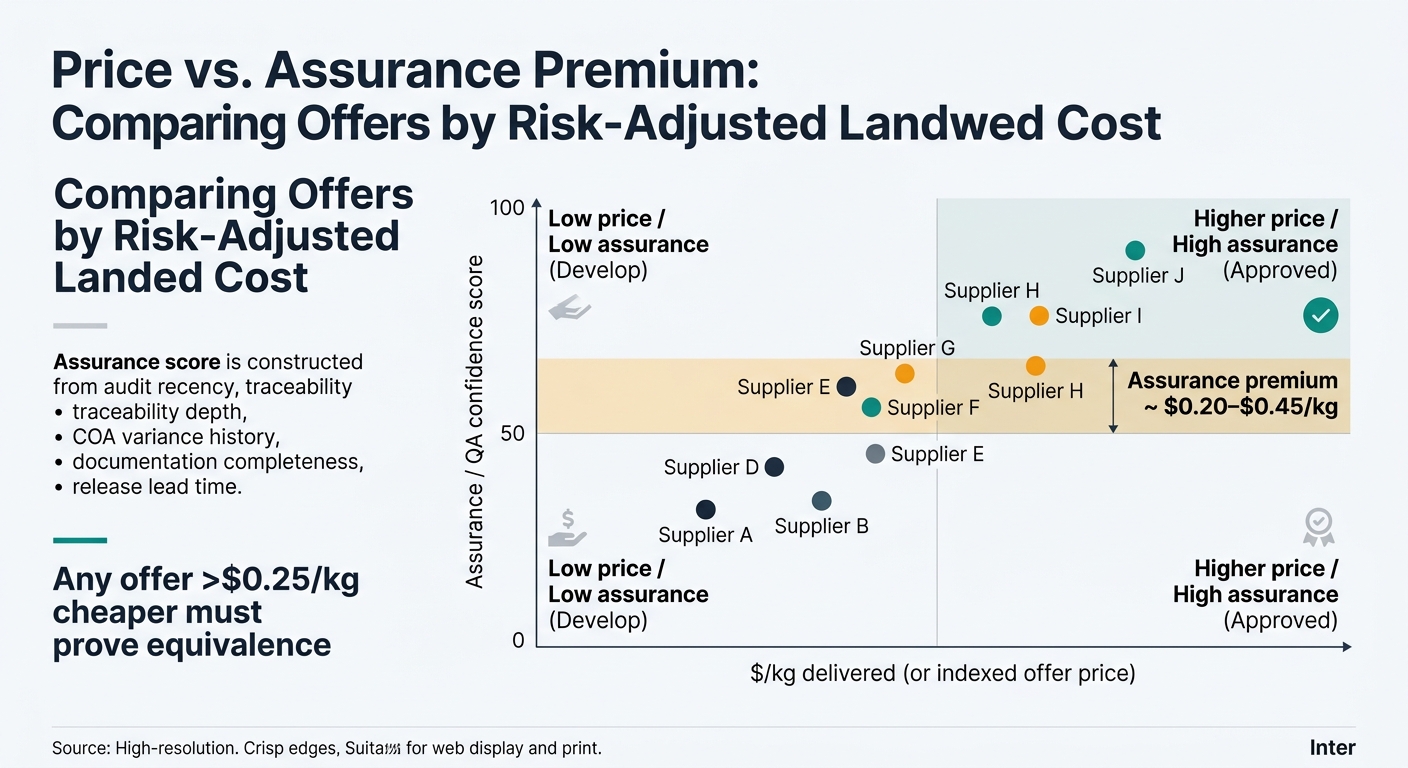
A scatter plot comparing supplier offers by $/kg delivered (x-axis) versus assurance/QA confidence score (y-axis), with 6–10 anonymized supplier points, quadrant labels (e.g., Low price/Low assurance 'Develop' and Higher price/High assurance 'Approved'), an annotation band showing the typical assurance premium range (~$0.20–$0.45/kg), and a callout noting that any offer more than $0.25/kg cheaper must prove equivalence.

Procurement Impact: You stop negotiating in the dark.

  • Quick Win: Build a simple “price vs. assurance” matrix: any offer that’s >$0.25/kg cheaper must earn it with documented equivalence (audit recency, traceability, COA stability, and release lead time), or it stays in the “develop” lane.

4) Three Situations Where Better Intelligence Pays Back Fast

Insight: Intelligence earns its keep when timing is tight and the cost of being wrong is high—renewals, disruptions, and quality drift.

Data: These are the moments where teams typically overpay or take avoidable risk.

Procurement Impact: Treat these as “trigger events” with pre-defined actions.

Use Case #1: Contract Renewal in 60 Days During a Softening Raw Market

  • Insight: If raw turmeric is easing but starch offers are sticky, you’re likely inside the inventory-lag window.
  • Data: In this window, suppliers often defend list price but will concede on structure: 60–90-day fixed, then reset; or rebate after volume thresholds.
  • Procurement Impact: Negotiate mechanism over headline: lock near-term supply, insert a review clause tied to a mutually agreed input proxy, and reopen pricing once new-cost production dominates shipments.

Use Case #2: Your Incumbent Extends Lead Times “Temporarily”

  • Insight: Lead time extensions are often an early signal of allocation, plant constraint, or documentation bottlenecks.
  • Data: A shift from 6–8 weeks to 10–12 weeks can force air/expedite decisions or stockouts if you’re running lean.
  • Procurement Impact: Immediately split volume: keep base load with incumbent, but pull ~20–30% into a pre-qualified alternate (even at a small premium) to protect service levels and regain leverage.

Use Case #3: QA Flags COA Drift (Moisture/Micro Variability) Across Lots

  • Insight: COA drift is either supplier process control deterioration or a broader seasonal/storage issue—your response differs.
  • Data: If drift correlates with specific lot months or routes, it’s likely handling/storage; if it’s supplier-specific across months, it’s process control.
  • Procurement Impact: Don’t jump straight to re-award. Tighten incoming controls for 2–3 lots, demand corrective action + evidence, and run a parallel pilot with an alternate supplier so you can switch without a production cliff.

5) The Same Playbook Works on Adjacent Ingredients You Also Buy

Insight: Turmeric starch is a textbook example of why “input down ≠ finished down”—the same lag and risk-premium mechanics appear across other food ingredients.

Data: Comparable patterns procurement teams recognize:

  • Ginger/garlic derivatives: harvest-driven input swings, but finished powders/extracts stay sticky due to inventory age and processing constraints.
  • Starches and hydrocolloids: energy and capacity floors can hold finished pricing even when agricultural inputs soften.
  • Spice powders broadly: documentation quality and border scrutiny create persistent price spreads between “cheap” and “clean” [2].

Procurement Impact: If you standardize the operating rhythm (lot-month visibility, benchmark cadence, and qualification pipeline), you reduce volatility across multiple categories—not just turmeric starch.

6) Why This Category Proves Whether Your Procurement System Is Actually Working

Insight: Turmeric starch exposes whether your team can separate three things that get blended in supplier quotes: true market movement, supplier margin behavior, and risk premium for assurance.

Data: When teams lack visibility, they default to either (a) overpaying for “reliability” without measuring it, or (b) chasing price and paying later in holds, claims, and expediting. The category’s small size often hides the leakage until a disruption forces a post-mortem.

Procurement Impact: The strongest teams treat this as a governance test: they can explain, in one page, why they paid a premium (or didn’t), what optionality they have, and how fast they can switch without compromising QA.

7) The Bottom Line for Your Next Move

If raw turmeric has softened recently but your starch offers haven’t moved, don’t waste your leverage demanding an immediate headline cut—use the lag window to negotiate a 60–90-day fixed price with a defined reset based on the next production cycle, while you parallel-qualify at least one alternate lane. That window exists because suppliers are still selling older-cost inventory and will trade structure (rebates, review clauses, lot-month transparency) to protect their list price. Teams that did this well in the last down-cycle typically captured mid-single-digit landed-cost improvement versus buyers who stayed on annual fixed pricing and only renegotiated after the market had already reset.

Key Insights You Can Apply This Week

  • Insight: Your best leverage is rarely the raw turmeric headline—it’s the mismatch between lot production month and today’s replacement cost.
    Data: Starch pricing commonly lags input moves by ~6–10 weeks, and “assurance premiums” of ~$0.20–$0.45/kg can persist independent of raw price.
    Procurement Impact: Ask for lot-month and offer validity on every quote; negotiate reset mechanisms instead of fighting list price.
  • Insight: The costliest failures come from qualification constraints, not from paying $0.03/kg too much.
    Data: Switching can take ~8–16 weeks when QA bandwidth and documentation gaps are binding.
    Procurement Impact: Maintain a live pipeline of 2–3 alternates segmented by readiness, and pre-wire a 20–30% swing plan.
  • Insight: “Cheaper” suppliers often monetize risk transfer.
    Data: Post-award leakage (holds, claims, expediting) can add ~$0.08–$0.25/kg in effective cost.
    Procurement Impact: Only accept low offers that come with measurable assurance: COA stability, audit recency, and documented release lead time.

The Bottom Line for Your Next Contract

(Analyzed at: Oct, 2026)

With Indian raw turmeric prices showing meaningful volatility through 2026 (including sharp seasonal moves around peak arrivals), you should assume your turmeric starch offers will remain “sticky” for at least one production cycle and that compliance-ready material will continue to price at a premium [3]. The highest-conviction move is to convert your next renewal into a two-lane award: lock 70–80% with your incumbent on a 60–90 day fixed plus a written reset clause tied to an agreed proxy, and qualify/allocate 20–30% to a backup now. If you wait until a QA hold or lead-time slip forces the switch, the cost of expedites and brokered supply can easily erase several points of annual savings on a category this QA-sensitive.

Unlock Full Data
Food Grade Turmeric Starch Market Intelligence
Prices · Trends · Origins · Forecasts

References

  1. nature.com
  2. food.ec.europa.eu
  3. mandibhavindia.in

Related Contents

Subscribe
→
By subscribing you agree to with our Privacy Policy and provide consent to receive updates from our company.
Thank you! Your submission has been received!
Oops! Something went wrong while submitting the form.
Subscribe to receive the latest blog posts, updates, promotions, and announcements from Tridge.
