
Herbed falafel mix looks like a simple dry commodity, but procurement outcomes are usually driven by lagged inputs, food-safety assurance costs, and co-manufacturing/packaging constraints that don’t move in sync with chickpeas. This guide shows how to convert those realities into contract mechanisms, governance rules, and qualification actions that reduce variance and disruption risk—without relying on constant supplier switching.
Herbed-falafel-mix pricing rarely tracks chickpea or spice moves cleanly. The “alpha” comes from understanding where the lag lives—and using it to time negotiations, not just accept supplier increases.
Quick Win: In your next supplier call, stop debating whether the increase is “fair.” Instead, propose a two-part mechanism: (1) chickpea/flour indexed with a lag, (2) a fixed conversion + packaging adder with a quarterly review tied to service levels (OTIF + quality holds).

Quick Win: Put a hard rule into governance: no supplier switch for <3% quoted savings unless you can show (a) validated alternates, (b) equivalent service level, and (c) a quantified switching cost estimate.
| Operating Area | Before (Traditional) | After (Intelligence-led) |
|---|---|---|
| Price governance | Accept increases with ad-hoc pushback | Index + lag rules; reopeners tied to defined drivers |
| Supplier coverage | 1 primary + “hope” | Primary + pre-qualified secondary + packaging contingency |
| Disruption response | Expedite + short ships 1–3x/year | Trigger-based actions; fewer surprises |
| Outcome (typical) | Noticeable variance vs. budget in volatile years | Lower variance; fewer emergency buys |
Quick Win: Define a category KPI that matters: “% of volume under indexed or reopener-based pricing” and target moving from ~0–20% to 50%+ over two contracting cycles.
Quick Win: For every new SKU request, require a procurement sign-off that quantifies the expected conversion and changeover impact (even a simple tiered assumption model).
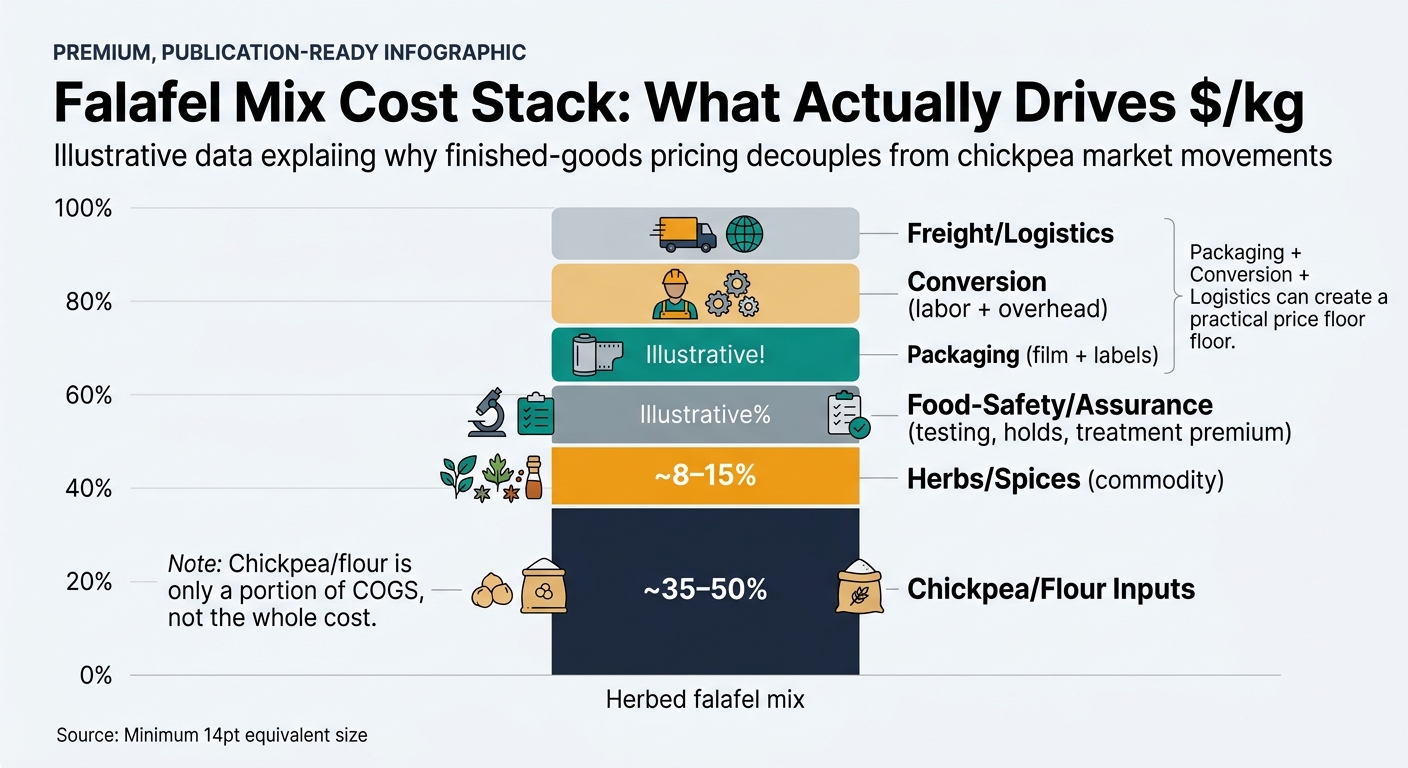
Use the current input-to-finished-goods lag to negotiate structure, not just price: lock in a contract that indexes chickpea/flour with a defined 6–10 week lag and pairs it with a fixed conversion + packaging adder that only reopens on clear triggers (service-level misses or documented packaging cost moves). That window exists because suppliers price off prior inventory and constrained production slots, so they’ll resist immediate cuts but accept forward-effective mechanisms. Teams that captured this lag in prior cycles typically avoided the “stale price” penalty that spot buyers absorb when finished mix quotes finally reset.
(Analyzed at: Oct, 2026)
With U.S. pulse acreage down in 2026 [1] and flexible packaging film costs still moving materially month to month [2], the highest-confidence move is to stop buying “all-in $/kg” and instead contract on separable drivers. Put chickpea/flour on an index with a defined 6–10 week lag, keep conversion as a fixed adder tied to OTIF/quality performance, and treat packaging as a transparent pass-through with caps and documentation. Teams that don’t separate these components typically discover too late that they’re paying for last quarter’s inputs and next quarter’s packaging—an avoidable spread that can easily show up as a few points of margin drag over a renewal cycle.


