
Procurement teams rarely lose money in turmeric and starch because they “miss the market.” They lose it because they accept blended supplier narratives (raw + conversion + compliance premium) and then lock contract shapes that don’t match how these categories actually move. This guide shows how to spot the lag, negotiate the right lever, and keep decisions defensible with QA, finance, and leadership.

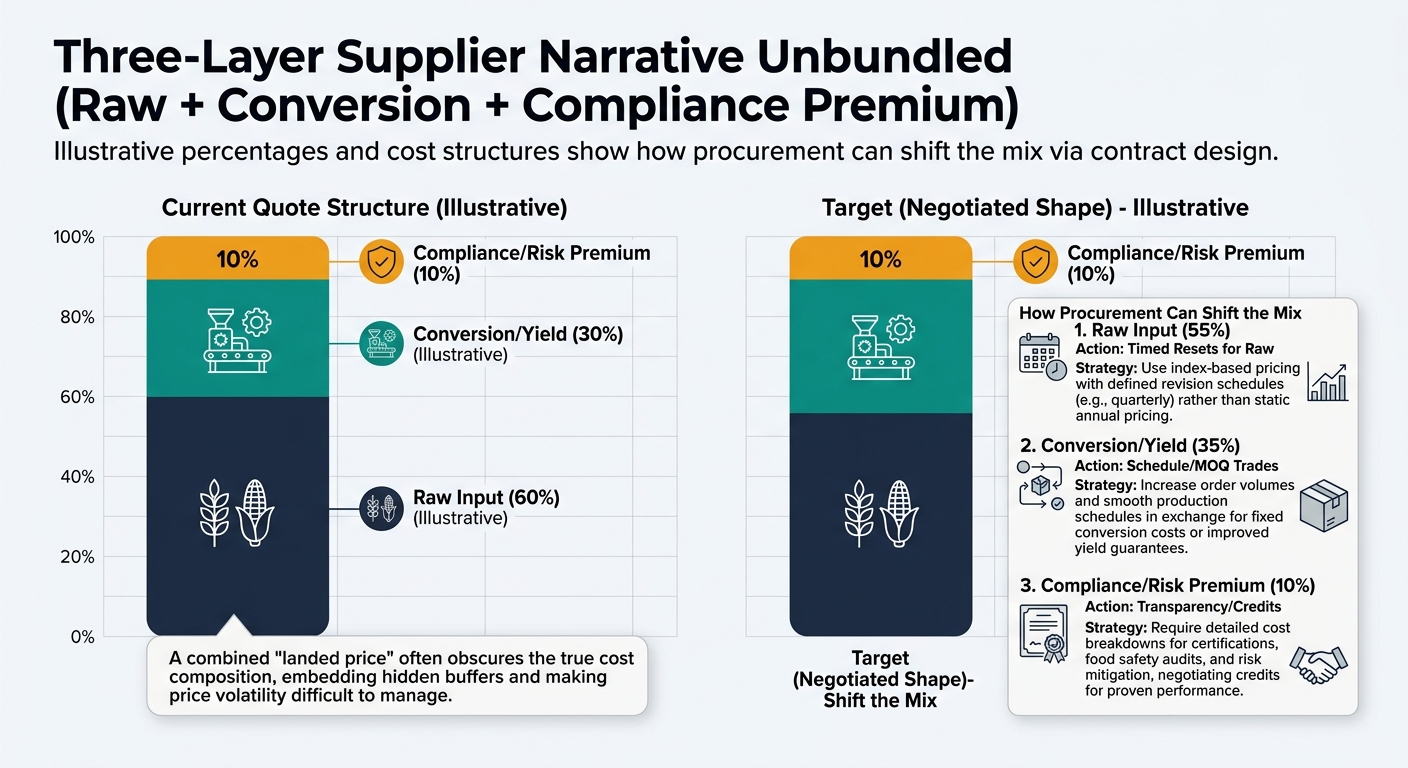
Quick Win: In your next supplier call, ask for the price split in words (not numbers): “What part of this increase is raw material, what part is conversion, and what part is compliance/risk?” If they can’t explain it clearly, you’re likely paying a blended premium you can unbundle.
Quick Win: For both categories, stop asking only “What’s your price?” and start asking “What’s your price-validity, what triggers a reset, and what’s the lead-time if I pull volume forward?” Those three answers reveal whether you’re buying into a premium phase.
| Dimension | Before (quote-led buying) | After (intelligence-led buying) |
|---|---|---|
| Price coverage | 2–3 incumbent quotes | 8–15 comparable supplier/origin references by grade/terms |
| Timing | Annual/quarterly bids | Reset triggers every 30–90 days tied to origin moves + lead-time shifts |
| Risk response | React after a failed lot or late shipment | Early actions when rejection/lead-time signals spike (sample, reserve capacity, pre-book freight) |
| Outcome (typical) | 5–12% price dispersion unexplained; 1–3 expedites/year | Lower variance over time; fewer emergency buys and fewer QA holds reaching production |
Quick Win: Track two KPIs separately: (1) price vs last quarter and (2) lead-time vs last quarter. When lead-time tightens before price rises, that’s your early warning to secure allocation or qualify alternates.
Quick Win: Treat alternates like insurance: a 1–3% “option cost” on a small volume can prevent a 10–20% premium during a squeeze.
Use the current raw-to-processed lag to negotiate a two-step reset on turmeric and a capacity-for-price trade on starch: agree near-term coverage now, but lock in a dated repricing mechanism that activates as older inventory clears and lead-times normalize. The window exists because finished offers typically reflect earlier buys and conversion constraints, not today’s origin cost signals. Teams that structure the reset instead of waiting for “the market” usually capture mid-single-digit savings while avoiding the classic downside—switching suppliers under QA pressure and paying spot premiums.
(Analyzed at: Oct, 2026)
Tapioca starch is the clearer “terms market” right now: 2026 trade/association-linked reporting shows elevated Thai export levels around the mid-$600s to ~$700/MT range in late September/early October, with tightness tied to root availability and utilization—so the fastest savings lever is not arguing feedstock, it’s buying allocation (schedule discipline, MOQ, and committed liftings) in exchange for a lower premium. [4] For turmeric, assume your supplier’s offer reflects earlier inventory and a persistent testing/compliance burden; push a written two-step reset keyed to shipment date and a transparent spec-to-price grid. If you execute both moves, it’s reasonable to protect (or recover) low-to-mid single-digit landed cost in the next 1–2 quarters—and the bigger stake is avoiding a forced spot buy when QA holds or allocation hits.


