
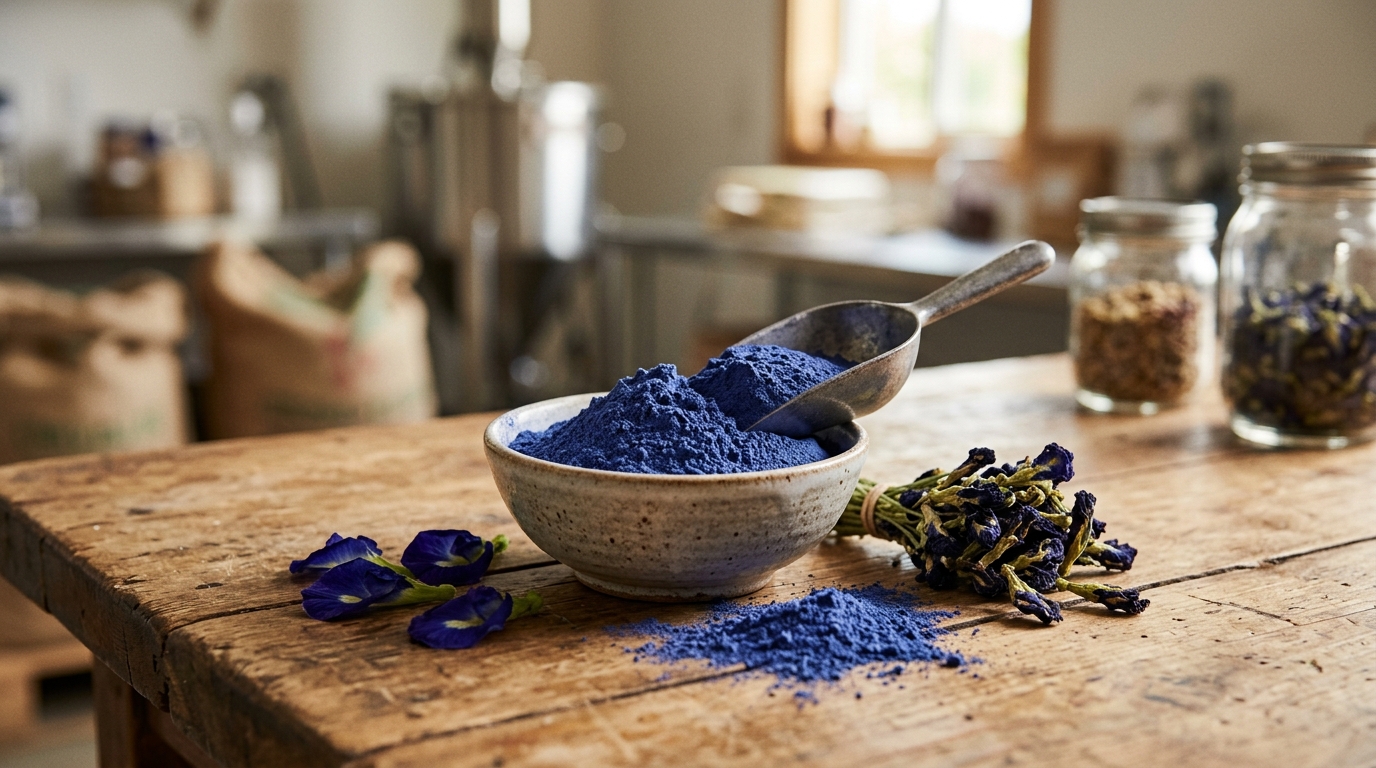
Powdered butterfly pea extract looks like a simple botanical buy, but procurement outcomes are usually decided upstream—by how flowers are dried/handled, and (more importantly) by which processor can consistently extract, ultrafilter/clarify, concentrate, and spray-dry to a spec your QA team can defend. This guide maps where cost is “locked in,” why quotes aren’t comparable without spec normalization, and where supply and compliance risks actually originate.
Powdered butterfly pea extract is not a simple “dried flower” trade—it’s an anthocyanin color system whose economics are set by three physical realities: (1) flower quality and drying discipline upstream, (2) extraction + filtration/clarification + concentration yield in the middle, and (3) spray-drying standardization (often with carriers) downstream. The supply chain is typically Southeast Asia–anchored for flowers, with a smaller set of qualified extractors/spray-dry manufacturers converting variable petals into a consistent, food-grade powder.
Insight: The chain is short on paper, but each node introduces irreversible yield loss (sorting, extraction, filtration, drying recovery) that becomes a fixed cost embedded in every kilogram of powder.
Data (validated): In the U.S., the permanently listed color additive entry at 21 CFR 73.69 defines butterfly pea flower extract as an aqueous extract with downstream processing expectations and explicit specifications (including pH and heavy metals). [1]
Procurement Impact: Expect cost to be structurally driven by yield + energy + QA holds; the “cheap” physical route (minimal sorting, weak clarification, low barrier packaging) tends to show up later as color drift, caking, or compliance rework.
Typical physical flow (industrial powder):
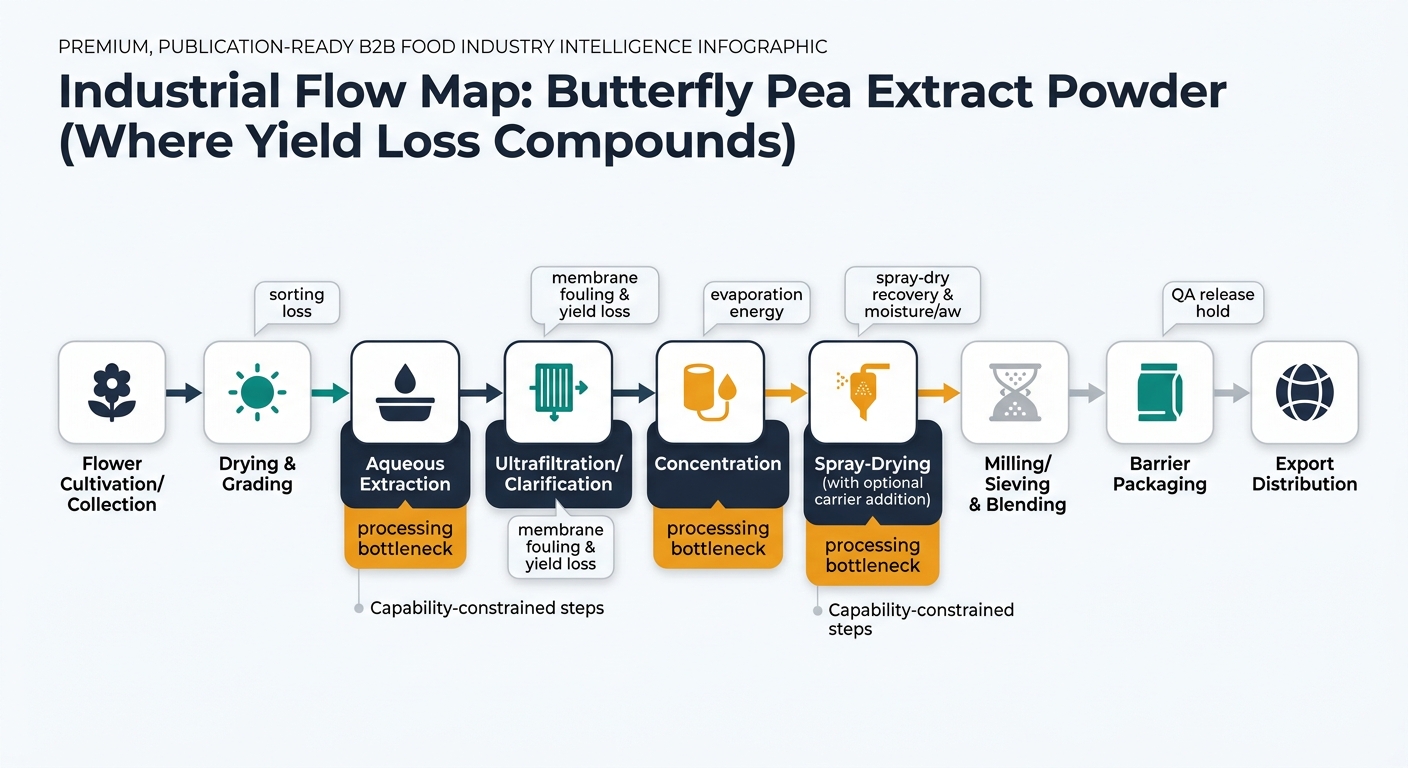
Insight: In powdered butterfly pea extract, value-add is concentrated in secondary processing (extraction + clarification/ultrafiltration + concentration + drying) because that’s where a variable flower becomes a standardized, shelf-stable ingredient.
Data (confidence check): The article’s “spray-drying moisture 3–7%” claim is directionally plausible for spray-dried powders, but the cited sources are not ideal for procurement-grade substantiation. Treat those ranges as typical engineering targets, not a guaranteed industry standard for every supplier. (Keep moisture/aw as a contractual spec item rather than a “known fact.”)
Procurement Impact: Landed cost is structurally sensitive to energy intensity, process yield, and the “time-in-hold” created by QA release testing—more than to farmgate flower price alone.
Insight: The cheapest-looking flower lots are often the most expensive once you account for unusable yield (mold risk, foreign matter, low pigment intensity) created by harvest timing and drying hygiene.
Data (validated conceptually): Butterfly pea is used for anthocyanin-driven color behavior, and anthocyanin performance is highly condition-dependent (pH and degradation pathways). [3]
Procurement Impact: This node “locks in” downstream cost through reject rates and extraction yield. Poor drying increases microbial load and can force more aggressive filtration or lot rejection, raising effective $/kg of usable extract solids.
Insight: Primary processing is a yield-protection step, not a cosmetic one: removing stems/foreign matter and standardizing particle size reduces extraction variability and filtration burden.
Data (validated by regulatory process logic): The U.S. color additive definition is explicitly an aqueous extract with downstream purification steps, so insoluble load management upstream has direct throughput implications (fouling/clarification burden). [1]
Procurement Impact: Costs here are structurally driven by labor + loss-on-sorting + basic equipment (sieves, metal detection, milling). Under-investment typically reappears as lower line efficiency in extraction and higher QA risk.
Insight: This is the economic “engine room”: small changes in pigment concentration, filtration losses, or concentration efficiency cascade into large differences in cost per standardized color unit.
Data (validated): 21 CFR 73.69 describes butterfly pea flower extract as an aqueous extract and includes downstream processing controls and specifications. [1]
Procurement Impact: Fixed cost drivers include energy for heating/evaporation, membrane/filter consumables, CIP chemicals/water, and yield loss at each separation step. This node also creates working-capital drag because lots often sit pending analytical release (heavy metals, micro) and internal disposition.
Insight: Powder economics depend on drying recovery, carrier choice/ratio, and achieving a stable moisture/aw profile—because anthocyanin systems are humidity- and light-sensitive.
Data (use with caution): Academic spray-drying studies on butterfly pea powders support the idea that inlet temperature and carrier (e.g., maltodextrin) level materially affect moisture and recovery, but procurement teams should not rely on single-study values to benchmark suppliers. Validate with supplier COAs and your own incoming data.
Procurement Impact: This node drives (a) energy cost, (b) potency dilution if carrier is used, and (c) physical performance (flowability, caking). It also determines how “standardized” the powder can be lot-to-lot—often the difference between a formulation-friendly ingredient and a variable botanical powder.
Insight: For anthocyanin-based colors, packaging is a functional unit operation: it protects against moisture ingress, oxygen, and light that degrade color and create caking.
Data (validated): U.S. specifications for the color additive include pH 3.0–4.5 and heavy metals limits including lead ≤ 1 mg/kg, plus arsenic/mercury/cadmium limits at 1 mg/kg. [1]
Procurement Impact: Structural cost drivers include foil liners/drums, desiccants where used, controlled warehousing, and the full QA panel (identity, micro, heavy metals). For U.S. food color use, documentation should be aligned to the 73.69 pathway and the allowed food categories/limitations.

| Supply Chain Node | Cost Ratio (% of Final Cost) | Notes |
|---|---|---|
| Upstream / Raw Material | 60% | Harvest + drying discipline drives usable quality and microbial risk. |
| Primary Processing | 15% | Cleaning/sorting losses + foreign matter control. |
| Packaging & QA | 10% | Barrier bags/cartons; basic micro/heavy metals screening. |
| Logistics & Distribution | 15% | Humidity protection + ocean freight sensitivity. |
| Supply Chain Node | Cost Ratio (% of Final Cost) | Notes |
|---|---|---|
| Upstream / Raw Material | 45% | Pigment variability remains “in the powder.” |
| Primary Processing | 25% | Milling/sieving + contamination controls (metal detection). |
| Packaging & QA | 10% | Moisture barrier to prevent caking; micro testing. |
| Logistics & Distribution | 20% | Bulk density and humidity control affect damage/claims. |
| Supply Chain Node | Cost Ratio (% of Final Cost) | Notes |
|---|---|---|
| Upstream / Raw Material | 20% | Flower quality affects extraction yield more than direct cost share. |
| Primary Processing | 8% | Cleaning/grading reduces clarification burden and rejects. |
| Secondary Processing | 40% | Aqueous extraction + ultrafiltration/clarification + concentration are energy/yield intensive. [1] |
| Drying & Standardization | 17% | Spray-drying energy + carrier solids + recovery variation (validate by COA and trials). |
| Packaging & QA | 8% | Barrier drums/liners; broader QA panel, release holds. |
| Logistics & Distribution | 7% | Ambient freight but moisture/light protection is critical. |
Insight: Three structural constraints shape this category regardless of market cycles: pH-driven performance limits, process-defined regulatory positioning (in the U.S.), and concentrated “capability” in the extraction/spray-drying node.
Data (validated): (1) The U.S. listing at 21 CFR 73.69 is process- and spec-defined (including pH and heavy metals). [1] (2) CBP has issued a ruling classifying a butterfly pea flower extract product under HTSUS 3203.00.8000 (duty treatment depends on product facts and origin). [2] (3) FDA’s public color additive database reflects permanent listing and use restrictions by food category. [4]
Procurement Impact: These constraints translate into (a) application-driven spec pressure (you can’t “buy around” pH behavior), (b) documentation/testing expectations tied to regulated color additive status, and (c) landed-cost sensitivity to customs classification and how the product is described/documented at import.
Insight: Color outcome is inherently conditional on formulation pH and exposure (light/oxygen/heat).
Data (validated concept): Butterfly pea’s value is anthocyanin-driven behavior, which is pH- and stability-dependent (formulation conditions matter). [3]
Procurement Impact: Specs must reflect intended use conditions (beverage vs. confectionery vs. dairy alternative), or you will see “good powder, wrong application” failures.
Insight: For U.S. food color use, the regulated identity of butterfly pea flower extract is tied to an aqueous extraction and downstream purification steps.
Data (validated): 21 CFR 73.69 defines the additive and specifications including pH 3.0–4.5 and lead ≤ 1 mg/kg. [1]
Procurement Impact: Physical process capability (aqueous extraction, clarification/ultrafiltration, pasteurization, controlled pH) becomes part of compliance readiness, not just “nice-to-have” sophistication.
Insight: Many actors can grow/dry flowers; far fewer can consistently extract, purify, and spray-dry to tight, repeatable specs with defensible QA systems.
Data (validated by process requirement): The U.S. definition includes downstream purification steps that require equipment and controls, constraining qualified capacity. [1]
Procurement Impact: Lead times and allocation risk tend to originate at the processing node (throughput, QA holds), even when flower supply looks ample.
Insight: Powdered butterfly pea extract cost is structurally built from cumulative yield loss (sorting → clarification/ultrafiltration → concentration → spray-drying recovery), not just from flower price.
Data (validated anchor): The regulated U.S. pathway is a processed aqueous extract with defined specifications, reinforcing that this is a process-controlled ingredient, not a commodity botanical. [1]
Procurement Impact: When internal stakeholders ask “why does this powder cost what it costs,” the defensible answer is: energy + yield + QA release time at the processing node.
Insight: Packaging is a stability control step for anthocyanin colors.
Data (validated concept): Anthocyanin-based systems are condition-sensitive; storage and shipping conditions can materially change performance.
Procurement Impact: Barrier packaging and moisture control are part of physical performance assurance, not an optional logistics upgrade.
Insight: U.S. compliance expectations are anchored in 21 CFR 73.69 for the color additive form.
Data (validated): FDA’s color additive database shows permanent listing and food-category restrictions/limitations for butterfly pea flower extract. [4]
Procurement Impact: Documentation and test methods must reconcile “botanical ingredient” language with “color additive” requirements where applicable.
(Analyzed at: Jul, 2026)
Write your contract around the processing bottleneck, not the flower: require a process-and-spec appendix that explicitly confirms aqueous extraction and downstream controls aligned to 21 CFR 73.69 (including pH 3.0–4.5 and heavy metals limits like lead ≤ 1 mg/kg) and make carrier type/ratio and moisture/aw part of the commercial spec. [1]
This works because most expensive failures (rework, lot holds, color drift after shipment) trace back to hidden differences in clarification, drying, and packaging discipline—things you cannot fix at receiving. If you don’t harden this appendix, the “cheaper” supplier often converts into a quiet 5–15% effective landed-cost penalty through extra testing, downgrades, and schedule disruption, especially when you’re importing under a colorant classification that can also affect duty and documentation scrutiny. [2]


