
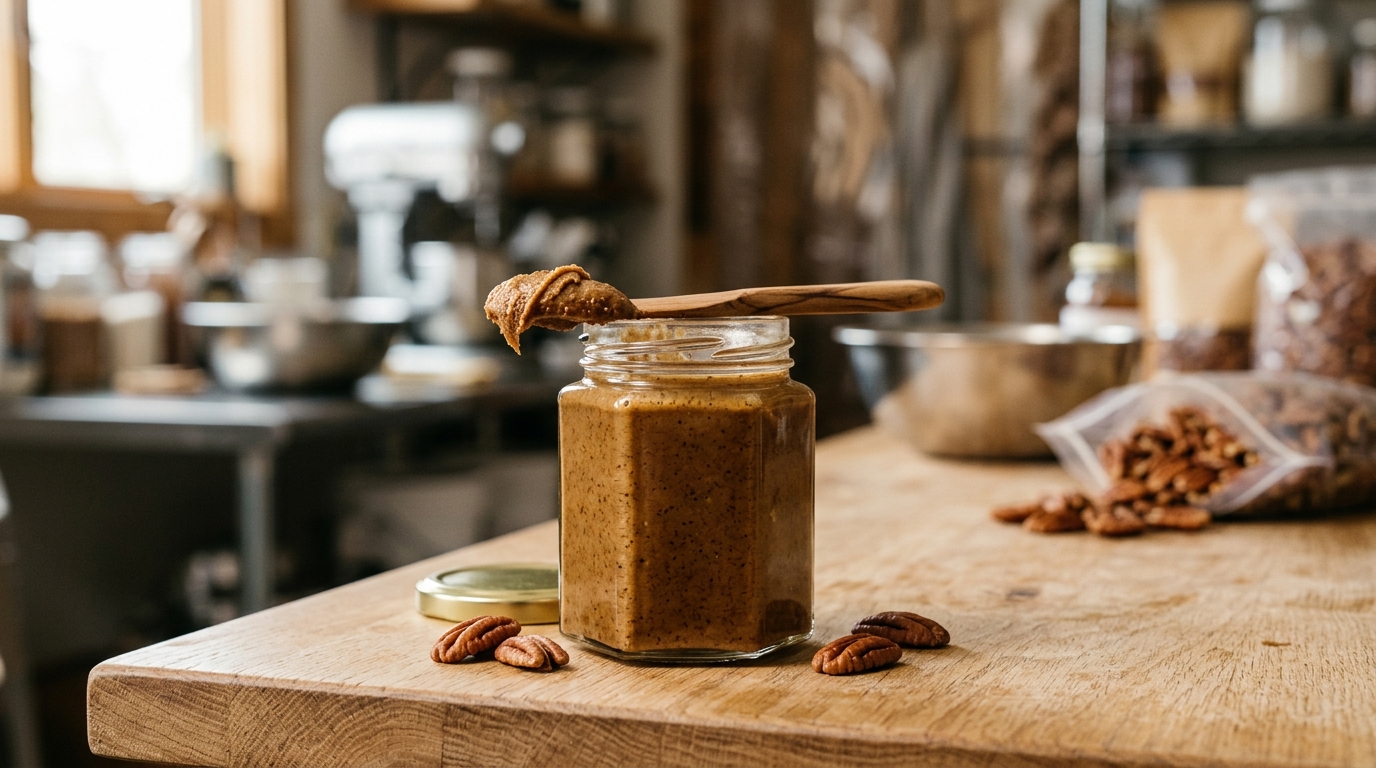
Pecan butter looks like a simple “roast + grind” product, but for procurement teams it behaves more like a controlled storage-and-conversion system: you’re turning a seasonal, oxidation-prone kernel into a stable, labeled food with repeatable sensory performance. This guide maps where costs and risks accumulate across the chain, so Quality/Safety/Compliance can write specs and contracts that reduce nonconformance, audit friction, and shelf-life surprises.
Pecan butter is physically a tree-nut storage-and-conversion business: you convert a seasonal, oxidation-prone kernel into a stable, labeled consumer (or industrial) product. The chain is short on paper, but cost accumulates fast because yield loss, cold storage, sorting, and packaging are structural—not optional.
Insight: Pecan butter’s economics are set upstream by kernel yield/grade, then downstream by oxidation control and packaging format; roasting/grinding are comparatively smaller cost nodes but high-leverage for spec compliance.
Data (validated/adjusted): U.S. pecans are harvested primarily in the fall (commonly October–December depending on region and conditions), which concentrates intake and forces storage planning. [5]
Procurement Impact: Your finished product consistency depends less on “butter making” and more on kernel condition at receipt (moisture, age, storage history) and oxygen/temperature exposure through packaging and distribution.

Insight: Pecan butter is a “high raw-material share” product: kernels dominate cost, while conversion steps add smaller but unavoidable costs tied to food safety, quality preservation, and retail readiness.
Data (validated/adjusted): USDA grade standards for pecans in the shell state moisture content shall be not more than 6% (unless otherwise specified)—a tight threshold that reflects how strongly moisture and storage drive deterioration and defects. [1]
Procurement Impact: Small upstream spec drift (moisture, defects, storage temperature) can cascade into downstream rancidity complaints, oil separation, and shortened shelf-life, which show up as nonconformance cost—not just ingredient cost.

| Supply Chain Node | Cost Ratio (% of Final Cost) | Notes |
|---|---|---|
| Raw Material Cost (kernels) | 55% | Kernel grade, yield, and storage history dominate. |
| Primary Processing | 12% | Shelling yield loss, sorting, foreign material removal. |
| Storage & Handling | 6% | Cold storage, inventory handling, pest prevention. |
| Secondary Processing | 7% | Roast (optional), grinding, blending, energy and labor. |
| Packaging & QA | 12% | Jar/closure/label, fill-line efficiency, label control, QC. |
| Logistics & Distribution | 8% | Inbound kernels + outbound finished goods; heat exposure management. |
| Supply Chain Node | Cost Ratio (% of Final Cost) | Notes |
|---|---|---|
| Raw Material Cost (kernels) | 62% | Higher share due to simpler packaging and lower channel markup. |
| Primary Processing | 13% | Sorting/defect removal still critical to customer specs. |
| Storage & Handling | 7% | Longer holding times are common; oxidation control is central. |
| Secondary Processing | 9% | Grinding throughput, temperature control, metal detection/X-ray. |
| Packaging & QA | 5% | Pails/drums + liners; COA and lot traceability burden remains. |
| Logistics & Distribution | 4% | Typically palletized bulk lanes; fewer retail handling steps. |
| Supply Chain Node | Cost Ratio (% of Final Cost) | Notes |
|---|---|---|
| Raw Material Cost (kernels) | 48% | Kernel share drops as other ingredients contribute cost. |
| Primary Processing | 11% | Same kernel prep requirements. |
| Storage & Handling | 5% | Still needed to protect kernel quality. |
| Secondary Processing | 12% | Additional batching, ingredient handling, allergen changeovers. |
| Packaging & QA | 16% | More complex labels/claims and potential additional QC checks. |
| Logistics & Distribution | 8% | Similar outbound needs; heat still impacts quality. |
Insight: Pecan butter supply chains have a few non-negotiable physical constraints that shape availability, quality consistency, and compliance workload regardless of supplier.
Data (validated/adjusted): Harvest is seasonally concentrated (fall), moisture limits in standards are tight (e.g., ≤6% in the in-shell standard), and FDA explicitly treats tree nuts (including pecans) as relevant to Salmonella risk assessment work. [1]
Procurement Impact: These realities explain why two suppliers can meet the same paper spec yet perform differently on shelf-life, sensory, and complaint rates.
Key Takeaways: Pecan butter is structurally sensitive to (1) post-harvest handling, (2) shelling/sorting effectiveness, and (3) oxygen/heat exposure after grinding. Most downstream issues labeled as “manufacturing variability” are physically rooted upstream.
(Analyzed at: Aug, 2026)
Given ongoing margin pressure and volatile conditions across fruit/tree nut markets in 2026, the highest-return contract move is to treat “kernel storage history” as a priced, auditable deliverable—not a handshake assumption. USDA’s moisture limits (≤6% in-shell, unless otherwise specified) and the industry’s reliance on cold holding (commonly 32–34°F for long storage) make this practical to specify and verify, and it directly targets the root causes of rancidity-driven complaints and shelf-life write-offs. [1]
If you’re moving meaningful volume, even a small reduction in sensory rejects/returns can quietly outweigh a 1–3% unit-cost premium—because the real spend is in expedited replacements, holds, and customer confidence when “in-spec” product still fails in market.


