
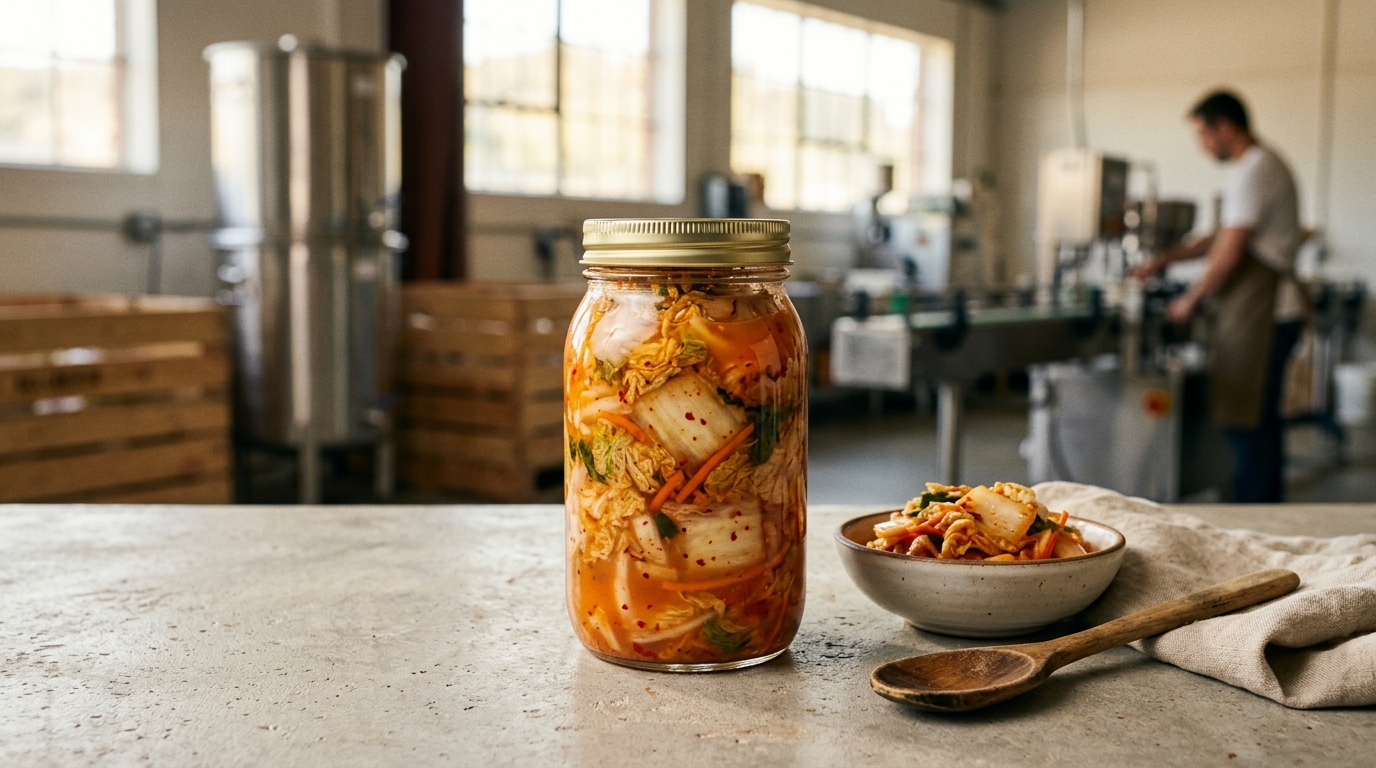
Mild cabbage kimchi looks like a simple refrigerated SKU, but it behaves like a managed biological process with a cold-chain dependency. For procurement leaders, the practical value is knowing where cost gets “locked in” (yield, fermentation capacity, packaging performance, and temperature discipline) so contracts and supplier governance protect margin and service levels.
Most mild cabbage kimchi supply chains are physically built around three immovable constraints: fresh produce perishability, fermentation time/temperature control, and refrigerated distribution. Once cabbage is harvested, value is created (or destroyed) quickly through trimming yield, brine uptake/water loss, fermentation trajectory, and packaging integrity under CO2 pressure.
Insight: Mild kimchi is not “one product”—it’s a managed biological process packaged for retail/foodservice, and the chain’s fixed cost-drivers sit at brining/fermentation capacity and cold-chain reliability.

Data: Classic commercial fermentation references describe acceptable/“optimal” kimchi around pH 4.2–4.5 with acidity often cited around 0.4–0.8% lactic acid, while process-control guidance for traditionally fermented vegetables commonly uses ferment to pH < 4.6 as a critical safety control point (monitoring frequency varies by temperature) [1].
Procurement Impact: The physical map tells you where failures become expensive: cabbage quality and trim yield upstream; pH/salinity control midstream; and leakage/swelling/over-fermentation downstream if temperature control or pack design is weak.
Insight: Kimchi economics are dominated by (1) high-water raw inputs with meaningful shrink, (2) labor + sanitation during handling/mixing, (3) refrigeration energy and dwell time during fermentation/storage, and (4) packaging performance that prevents claims.
Data: Food-safety and extension-type guidance commonly treats ≤41°F / 5°C as the refrigerated control temperature for TCS foods in distribution/handling, and fermented-vegetable process guidance emphasizes refrigeration to slow continued fermentation post-pack [3].
Procurement Impact: Cost ratios below are structural (what the chain must do physically). They explain why two suppliers with similar ingredient costs can still land at very different total costs due to yield, cold-chain, and packaging loss rates.
Insight: The biggest “silent” cost driver is usable yield, not just farmgate price—napa cabbage varies by head size, core density, leaf damage, and dehydration, which changes trim loss and brine uptake.
Data: Published references report unfermented/fresh kimchi pH commonly around ~5.0–5.5 (and other guidance cites initial pH near ~5.8), dropping as fermentation progresses toward/through the 4’s [4].
Procurement Impact: Physical specs that matter here are head weight band, leaf integrity, defect tolerance, and delivery temperature (warmer inbound cabbage accelerates softening and increases trim/waste).
Insight: This node converts fresh cabbage into a fermentation-ready substrate by controlling salt penetration and water loss; it is also where wastewater and sanitation costs become non-trivial.
Data: Many fermentation references describe vegetable ferments operating effectively in a ~2–3% salt-by-weight band (method-dependent), and some extension materials cite higher brine/salt ranges depending on the specific process and measurement basis. Treat “salt %” as a spec that must be defined by method (by weight of vegetables vs brine concentration) to avoid mismatches [5].
Procurement Impact: Brining capacity (tanks, labor, water) is a fixed throughput limiter. Variability here shows up downstream as drain-weight variance, texture inconsistency, and inconsistent fermentation speed (too salty slows; too low increases spoilage/pathogen risk).
Insight: Mild kimchi is less “heat-masked,” so the chain must manage fermentation more tightly to avoid harsh acidity and texture collapse.
Data: “Ripe” kimchi is often discussed around pH ~4.0 (with quality windows frequently in the low-to-mid 4’s), while safety-oriented controls frequently reference pH ≤4.6 as a key threshold concept for preventing growth/toxin production of C. botulinum in low-acid foods [6].
Procurement Impact: The physical cost is time + temperature control: fermentation dwell time ties up tanks/space, and refrigeration energy becomes a structural cost. This is also where allergen-relevant ingredients (e.g., fish-based seasoning) create segregation and cleaning burdens.
Insight: Kimchi packaging is functional engineering, not just branding: it must hold brine, tolerate CO2 generation, resist odor transfer, and maintain seals under cold-chain handling.
Data: Reference overviews of kimchi fermentation describe ripening stages tied to pH/acidity and continued fermentation over time; if temperature rises, gas generation and quality drift increase, raising swelling/leak risk [4].
Procurement Impact: Packaging failure costs are disproportionately large because they trigger returns, chargebacks, and brand damage. QA costs are structurally higher than for many fresh deli items due to routine pH/salinity checks, sanitation verification, and traceable lot coding.
Insight: Cold chain is not optional for most kimchi formats because fermentation continues after packing; temperature abuse converts shelf life into claims.
Data: Process guidance for traditionally fermented vegetables includes refrigeration-based fermentation/holding variants and emphasizes monitoring until pH < 4.6; broader US food code framing uses 41°F / 5°C as a core cold-holding control point for TCS foods [7].
Procurement Impact: The physical cost drivers are reefer transport availability, cold storage dwell time, and last-mile temperature discipline. Even small excursions can accelerate acidification (taste drift) and increase swelling/leak risk.
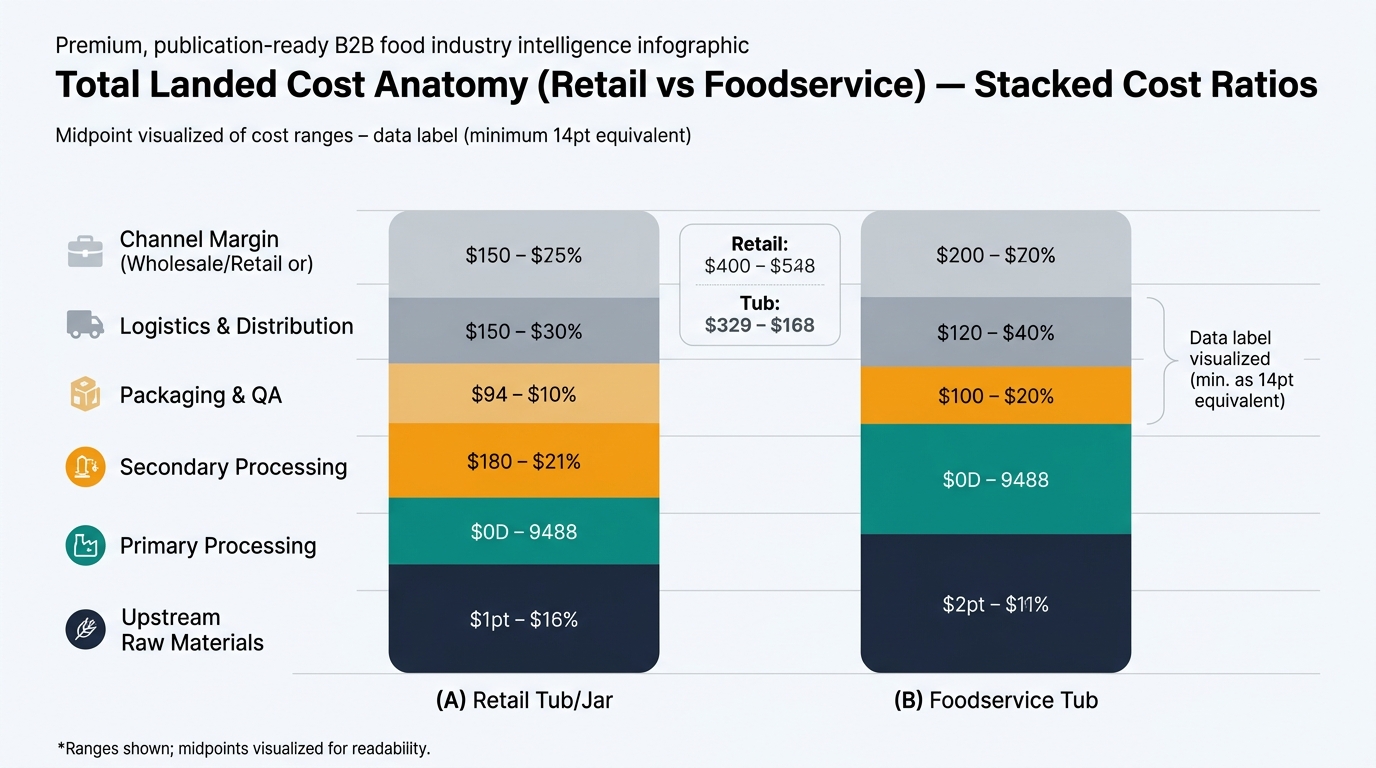
| Supply Chain Node | Cost Ratio (% of Final Cost) | Notes |
|---|---|---|
| Upstream Raw Materials | 30–40% | Cabbage + aromatics + seasoning inputs; yield/trim loss is the hidden driver. |
| Primary Processing | 12–18% | Labor + water + brine/salt handling + sanitation + wastewater. |
| Secondary Processing | 12–18% | Mixing labor + fermentation space/time + refrigeration energy. |
| Packaging & QA | 12–20% | High-performance seals/barriers; pH/salinity checks; lot coding; leak prevention. |
| Logistics & Distribution | 10–15% | Chilled storage + reefer transport + handling loss. |
| Wholesale/Retail Margin | 10–18% | Channel-dependent; shrink risk influences margin expectations. |
| Supply Chain Node | Cost Ratio (% of Final Cost) | Notes |
|---|---|---|
| Upstream Raw Materials | 32–42% | Similar ingredients; spec often emphasizes cut size and drain weight consistency. |
| Primary Processing | 12–18% | Throughput-driven; sanitation and brine management remain fixed costs. |
| Secondary Processing | 12–18% | Fermentation control still required; flavor drift is more visible in bulk use. |
| Packaging & QA | 8–14% | Lower unit packaging cost vs retail, but seal integrity still critical. |
| Logistics & Distribution | 10–16% | Foodservice distribution networks add handling steps and temperature exposure points. |
| Distributor Margin | 10–16% | Service level + returns policies shape margin. |
| Supply Chain Node | Cost Ratio (% of Final Cost) | Notes |
|---|---|---|
| Upstream Raw Materials | 30–40% | Similar inputs; cabbage quality impacts crispness more in “young” profiles. |
| Fermentation/Cold-Hold Time | 10–20% | Longer controlled time increases refrigeration + working-capital burden. |
| Packaging & QA | 12–20% | More gas management risk as acidity rises; higher need to control swelling/leaks. |
| Logistics & Distribution | 10–15% | Temperature stability determines whether product stays in target pH window. |
| Channel Margin | 10–18% | Returns/shrink expectations increase when quality drift is frequent. |
Insight: Mild cabbage kimchi behaves like a refrigerated, living product—its quality is a trajectory, not a static spec.
Data: Food science and industry references commonly describe kimchi ripening by acidity stages; “acceptable/optimal” windows are often tied to pH/acidity ranges, and continued fermentation pushes acidity higher over time—especially if temperature control weakens [1].
Procurement Impact: Finished-goods specs must include target pH window at ship, expected pH drift over shelf life, and temperature requirements—otherwise two “compliant” lots can eat very differently.
(Analyzed at: Jul, 2026)
Write your next mild-kimchi contract like you’re buying a cold-chain fermentation outcome, not a static deli item: require a ship-window pH range with a defined test method, a temperature-control clause aligned to ≤41°F/5°C cold-hold expectations, and objective pack-integrity acceptance (leakers/swells and drain-weight tolerance). This works because the biggest downstream losses originate at the fermentation/packaging/cold-chain nodes where small deviations become returns and chargebacks, and refrigerated freight in 2026 still carries a real premium and claim liability [3]. In practice, tightening these controls is often the difference between “stable” cost-to-serve and a quiet 1–3% margin leak from shrink, credits, and expedited replacements.


