
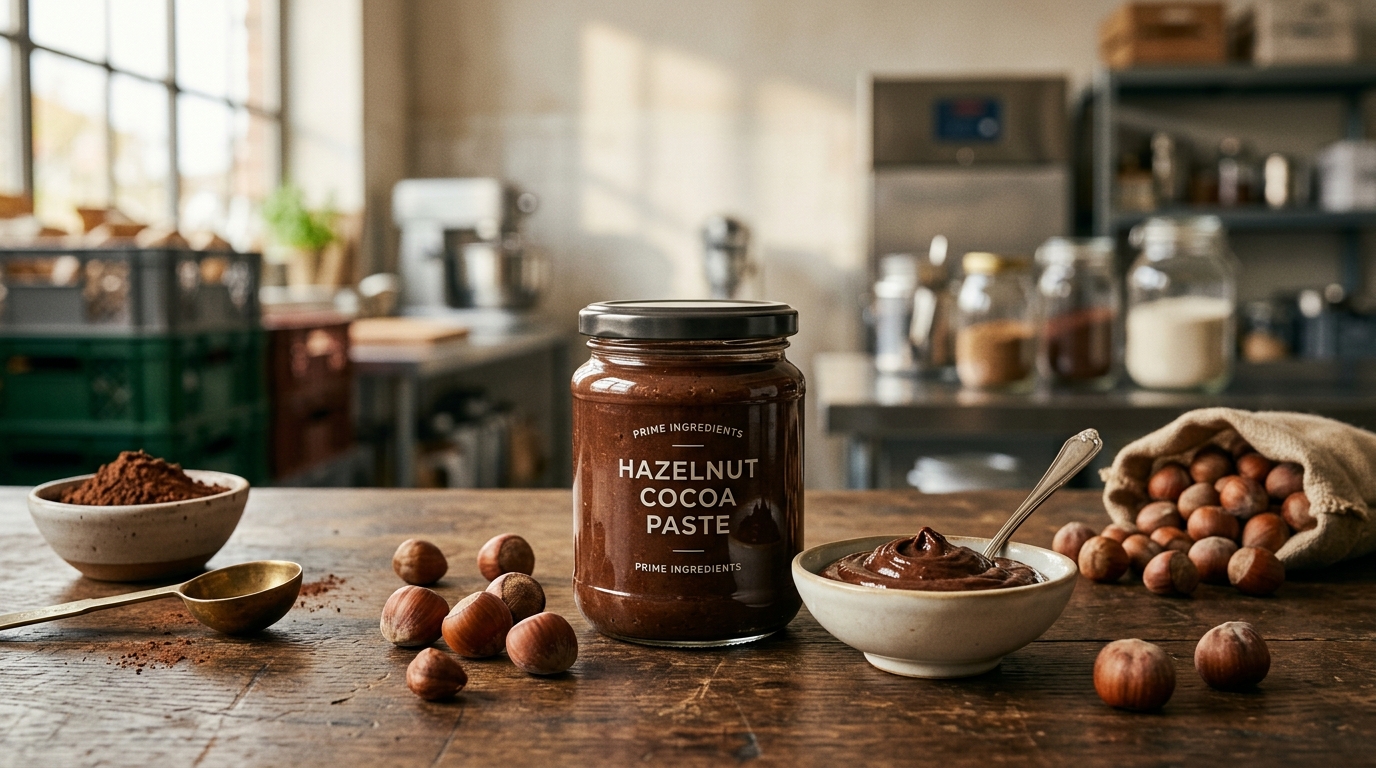
Hazelnut–cocoa paste looks like a simple semi-finished ingredient, but for Quality/Safety/Compliance buyers the “real” leverage sits upstream—in yield loss, validated low‑moisture Salmonella controls, and documentation discipline at the roasting/blending nodes. This guide maps the physical flow and shows where cost and risk become hard to change once product is in bulk.
Hazelnut paste with cocoa is not a single commodity—it’s a low-moisture, high-fat, formulation-driven semi-finished ingredient. Most of the “irreversible” cost is locked in early through (1) hazelnut kernel yield and defect removal, and (2) thermal processing choices (roast, kill-step approach, refining) that determine flavor, viscosity, and shelf stability.
Insight: The chain is structurally a two-stream system—hazelnut kernels/paste and cocoa derivatives—that converge at a blending/refining node, then become expensive to correct once packed into bulk formats.
Data: Türkiye typically accounts for roughly 60–70% of global hazelnut supply in many years, concentrating upstream kernel availability and quality variability into one origin system. [1]
Procurement Impact: Your spec outcomes (sensory + viscosity + microbiological risk posture) are largely determined before the final blender: sorting losses, roast curves, and low-moisture Salmonella controls set the baseline that downstream QA can only verify—not “fix.” [2]
Typical physical flow (simplified):
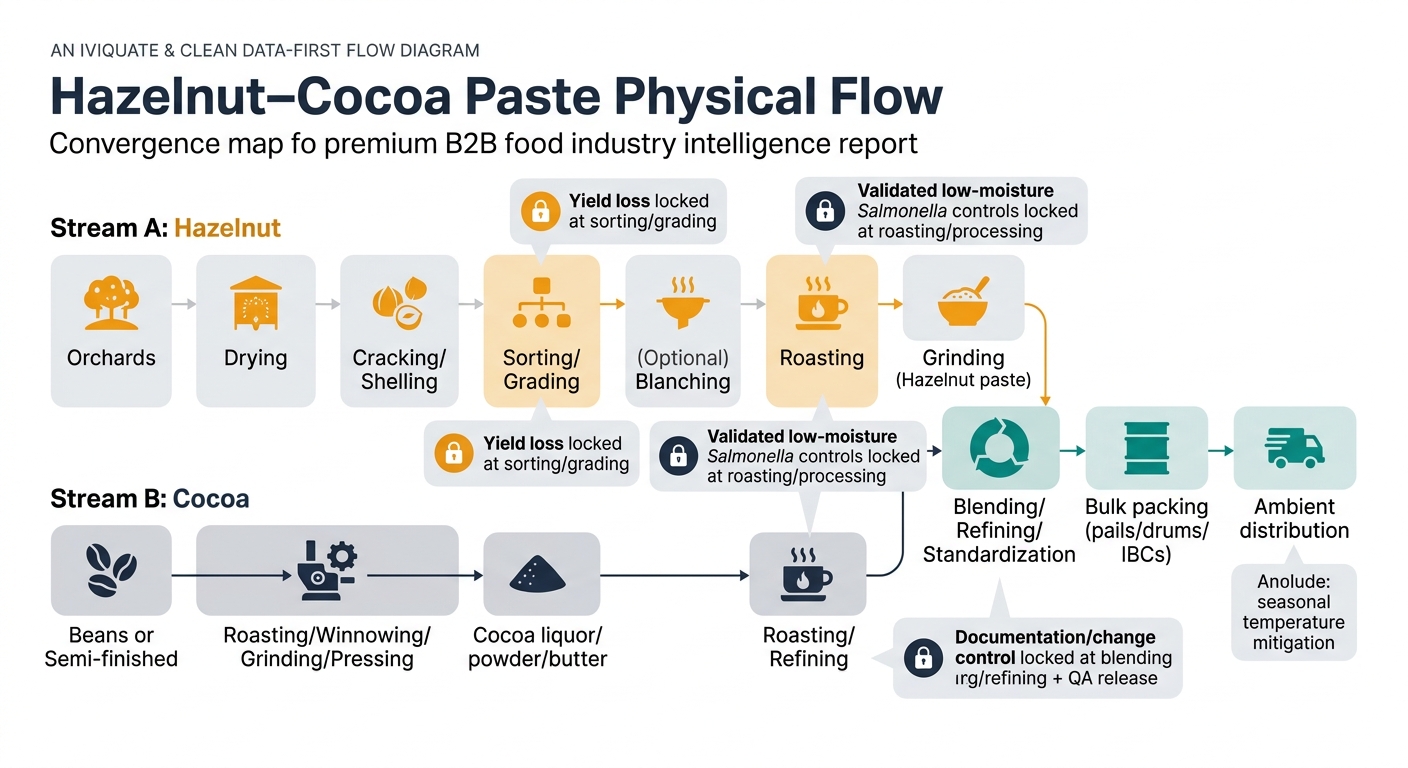
Insight: Hazelnut–cocoa paste costs are dominated by agri raw material value + yield losses, then by energy/time in thermal and refining steps, and finally by working-capital and handling (bulk packing, QA release holds, temperature control in warm seasons).
Data: Low-moisture foods (nuts, chocolate/cocoa-based) are a recognized category where Salmonella can survive for long periods and outbreaks have occurred; guidance emphasizes prevention, validated processes, and hygienic design. [2]
Procurement Impact: The “cost of being safe” is not a line item—it’s embedded in process design, environmental monitoring, segregation, rework risk, and release time, which show up as lead-time, MOQ constraints, and sometimes tighter change-control requirements.
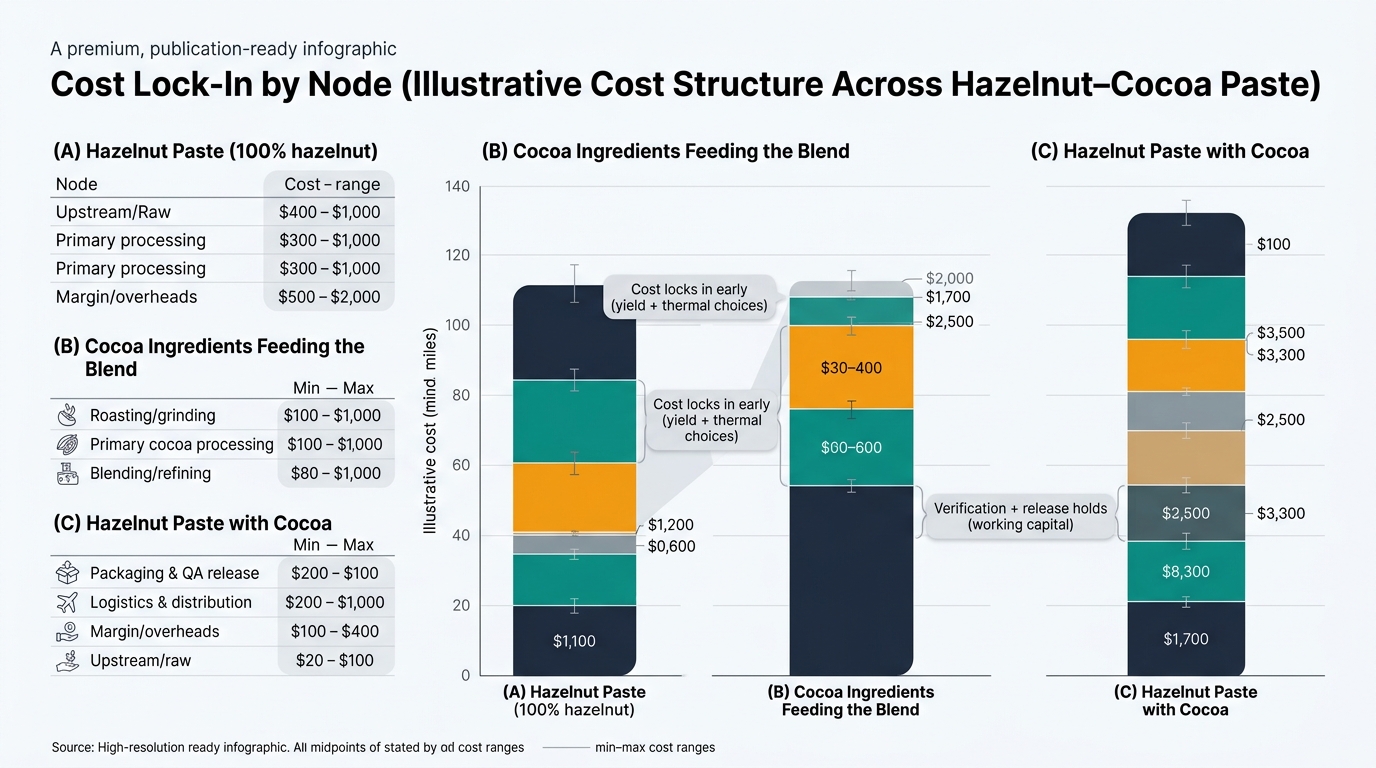
| Supply Chain Node | Cost Ratio (% of Final Cost) | Notes |
|---|---|---|
| Upstream hazelnuts (farm + drying) | 35–45% | Harvest + drying discipline sets baseline quality trajectory. |
| Cracking/shelling + sorting/grading | 15–25% | Yield losses + defect removal are the economic engine. |
| Roasting + grinding | 10–15% | Energy + throughput + validation burden in low-moisture context. |
| Packaging & QA release | 5–10% | Liners, labeling/traceability, hold time. |
| Logistics & distribution | 5–10% | Ambient freight; seasonal heat mitigation may add cost. |
| Processor margin/overheads | 8–15% | Depends on integration, utilization, and QA intensity. |
| Supply Chain Node | Cost Ratio (% of Final Cost) | Notes |
|---|---|---|
| Cocoa raw/semi-finished sourcing | 40–60% | Bean/semi-finished cost dominates; origin-linked compliance may constrain choices. [5] |
| Primary cocoa processing (if beans) | 10–20% | Roasting/winnowing/grinding/pressing; energy + yield. |
| QA & compliance documentation | 5–10% | Heavy metals/contaminants statements, traceability, testing. [5] |
| Packaging & logistics | 8–15% | Powder dust control, fat-based ingredient handling, storage. |
| Processor margin/overheads | 8–15% | Scale and utilization effects. |
| Supply Chain Node | Cost Ratio (% of Final Cost) | Notes |
|---|---|---|
| Hazelnut kernel/paste input (as used) | 30–45% | Driven by kernel yield + roast profile constraints. [1] |
| Cocoa ingredients input | 10–25% | Compliance-sensitive input (e.g., cadmium limits for some markets). [5] |
| Blending/refining/standardization | 10–18% | Particle size, viscosity targets, segregation and hygienic zoning. [2] |
| Packaging & QA release | 6–12% | Bulk liners, coding, release holds, sampling. |
| Logistics & distribution | 6–12% | Temperature excursions drive separation/texture claims. |
| Manufacturer margin/overheads | 8–15% | Depends on complexity (multi-allergen site, validation). |
Insight: Three constants shape this category regardless of supplier: origin concentration upstream, low-moisture pathogen control complexity, and compliance constraints that originate in the cocoa stream.
Data: (1) Türkiye’s hazelnut scale is repeatedly cited around 60–70% in many years; (2) low-moisture foods have documented Salmonella control guidance because the organism can persist and outbreaks have occurred in nut/chocolate-adjacent products; (3) the EU has defined maximum cadmium levels for cocoa/chocolate product categories. [1]
Procurement Impact: These constants translate into predictable operational realities:
(Analyzed at: Aug, 2026)
Given continued structural dependence on Türkiye for hazelnuts (often ~60–70% share) and the persistent low‑moisture Salmonella control burden in nut pastes, the highest-return move is to contractually lock process control + change control at the “point of no return” (sorting/grading and roasting, plus the blending/refining node). Require a version-controlled process description, validated lethality/verification approach aligned to low‑moisture guidance, and explicit triggers for re-approval when roast curves, line sharing/allergen profile, or ingredient origins change. This works because most downstream failures (sensory drift, viscosity instability, and safety posture gaps) are created upstream and only detected—not corrected—at receiving. In practice, preventing a single extended hold/rework cycle or customer complaint wave can easily outweigh a few percentage points of unit price on an annual contract.


