INDUSTRY TRENDS

How Grapefruit Juice Concentrate Really Moves (and Where the Cost Actually Builds): A Procurement Structural Guide

Author
Team Tridge
DATE
April 28, 2026
7 min read
grapefruit-juice-concentrate Cover
Unlock Full Data
Grapefruit Juice Concentrate Market Intelligence
Prices · Trends · Origins · Forecasts

Grapefruit-juice-concentrate (GJC) looks like a simple ingredient line item until you try to compare two quotes and realize you’re really buying a bundle of yield, thermal handling, aroma management, and preservation discipline. This guide maps the real physical flow and pinpoints where cost and risk “lock in,” so procurement teams can negotiate and contract on comparable, auditable terms.

Executive Summary

  • Specs drive comparability: Industrial GJC is commonly bought around ~58–65° Brix (clarified or pulp-bearing), but Brix alone doesn’t predict finished flavor or bitterness balance [1].
  • Cold-chain is not optional for frozen: Frozen concentrate programs commonly target 0°F / -18°C (or colder) to limit quality drift and claims exposure [2].
  • Aroma is a hidden cost driver: Evaporation strips volatiles; suppliers with better aroma recovery/recombination tend to deliver more consistent sensory outcomes at the same solids [3].
  • Packaging is a capability signal: Most fruit concentrates move in 55–60 gallon (208–227 L) drums, including aseptic bag-in-drum formats; failure modes differ by frozen vs aseptic [4].
  • 2026 sourcing reality: U.S. citrus (including grapefruit) remains structurally constrained by disease/weather impacts, increasing the value of dual-sourcing and tighter spec governance [5].

1) The Physical Map: Where Grapefruit Juice Concentrate Is Actually “Made”

Grapefruit-juice-concentrate (GJC) is not a single-step commodity; it is a chain of short-lived fruit, energy-intensive concentration, and cold/sterile handling that locks in cost early and then protects value through storage and logistics. The “fixed” cost-drivers are structural: harvest timing, extraction yield, evaporation energy, packaging sterility, and cold-chain discipline.

Insight: The product’s economic value is created by removing water (concentration) and preserving flavor/aroma while keeping microbiology under control.

Data (validated): Industrial grapefruit concentrate is commonly sold in a high-solids range (often ~58–65° Brix, depending on grade/spec and clarified vs pulp-bearing). Frozen programs commonly specify storage/transport around 0°F / -18°C (or colder) to protect quality [1][2].

Procurement Impact: Your cost base is physically anchored at three choke points—fruit solids yield, evaporation/aroma recovery, and pack + cold/aseptic integrity—so any comparison of suppliers or quotes only makes sense once these nodes are understood.
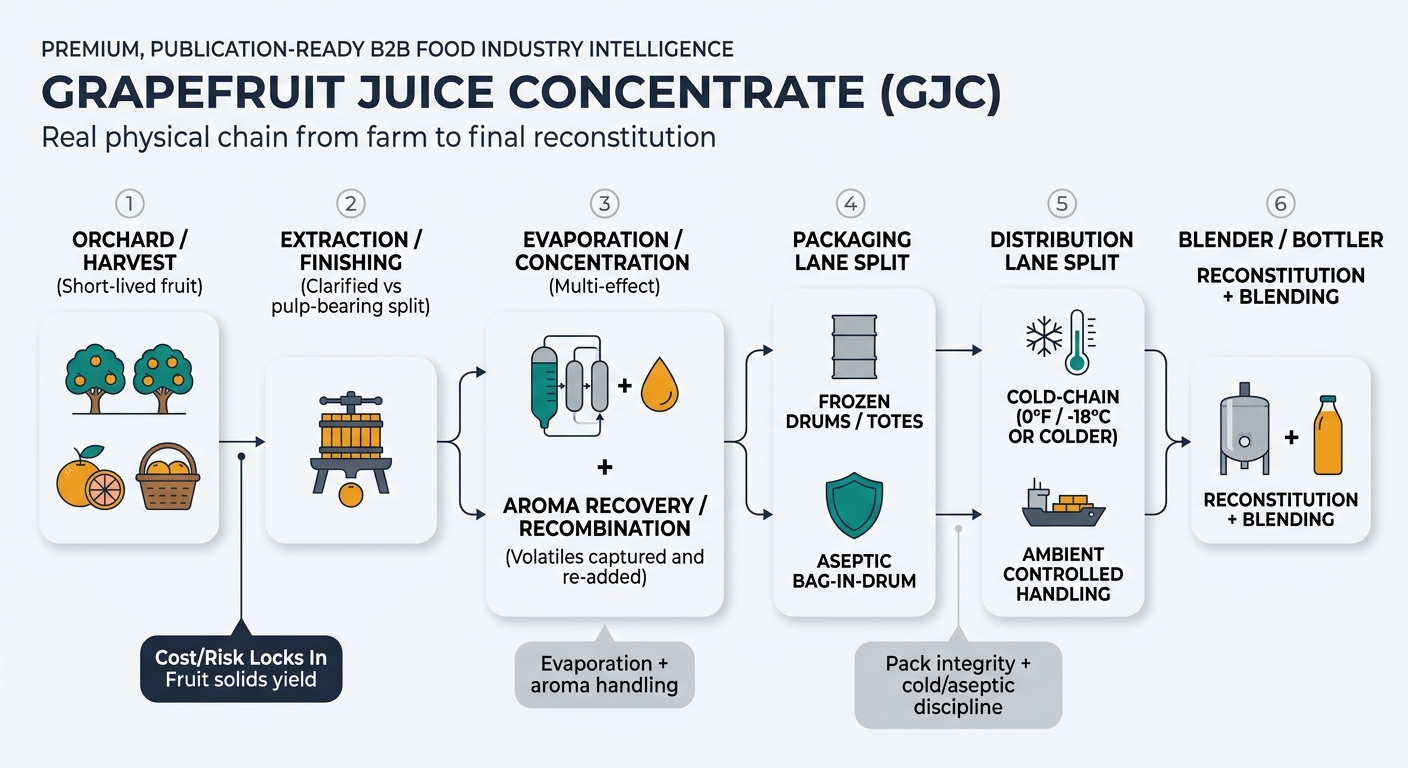
  • Typical flow. Orchard/harvest → extraction/finishing → evaporation + aroma management → packaging (frozen drums/totes or aseptic bag-in-drum) → cold/ambient distribution → blending/reconstitution into finished beverages.
  • Quick win for readers. Treat “GJC” as a family of products (clarified vs pulp-bearing; frozen vs aseptic; aroma-managed vs commodity solids), because physical handling and loss mechanisms differ by form.
A left-to-right process flow showing the physical chain of grapefruit juice concentrate from orchard/harvest through extraction/finishing, evaporation/concentration with aroma recovery, packaging split (frozen drums/totes vs aseptic bag-in-drum), distribution split (cold-chain at 0°F / -18°C or colder vs ambient controlled handling), and blender/bottler reconstitution, with callouts for the three procurement choke points where cost and risk lock in: fruit solids yield, evaporation and aroma handling, and pack integrity with cold/aseptic discipline.

2) Where Cost and Margin Accumulate (Node by Node)

Insight: Costs accumulate less from “trading” and more from physics: yield losses, heat transfer, sterility, and temperature control.

Data (validated): Multi-effect evaporation is a common industrial approach for concentrating juice; during evaporation, volatile aroma compounds can transfer to the vapor phase and typically require recovery and re-addition to avoid flavor impairment [3].

Procurement Impact: Even without discussing buying strategy, a buyer can predict where suppliers will differ structurally: (1) orchard solids, (2) plant technology/energy, (3) packaging format and cold-chain/aseptic capability.

1. Upstream / Raw Material (Grapefruit for Processing)

  • Insight: Fruit cost dominates because concentrate is essentially juice solids, and solids yield is set by variety, maturity, and growing conditions.
  • Data (tightened): Citrus maturity and processing suitability are commonly managed using measures like Brix and Brix/acid ratio, because these correlate with balance and usability for juice products [6].
  • Procurement Impact: The chain “locks in” cost here: low-solids fruit means more fruit (and more handling) per ton of concentrate, which cascades into higher processing energy and more waste.

2. Primary Processing (Extraction, Finishing, Clarification/Pulp Handling)

  • Insight: This node sets base juice quality (pulp level, cloud, bitterness management) and determines how much downstream blending is needed to hit spec.
  • Data (corrected for credibility): In citrus processing, producers can manage pulp/cloud through finishing and separation steps and can standardize lots via blending and controlled recombination of streams. (The original “pulp-washing creates lower-cost solids streams” point is directionally plausible, but it is not a universal practice and depends heavily on plant configuration and customer spec.)
  • Procurement Impact: “Same Brix” does not mean “same juice”: clarified vs pulp-bearing concentrates behave differently in reconstitution, filtration, and flavor delivery.

3. Secondary Processing (Evaporation/Concentration + Aroma Management)

  • Insight: Evaporation is the most energy- and technology-dependent step; it is also where sensory quality is most easily damaged.
  • Data (validated): Research and industry references describe that traditional evaporation can cause loss of aroma compounds to the vapor phase, and that processors often recover and add back aroma fractions to protect final flavor [3].
  • Procurement Impact: Suppliers with stronger aroma recovery and tighter thermal control can deliver more consistent finished flavor at the same solids—reducing downstream flavor correction and batch-to-batch variability.

4. Packaging & QA (Frozen Drums/Totes vs Aseptic Bag-in-Drum)

  • Insight: Packaging is not “just a container”—it is a preservation system (temperature or sterility) that determines shelf-life, contamination risk, and handling losses.
  • Data (corrected): A common industrial format for fruit juice concentrates is 55–60 U.S. gallon metal drums (about 208–227 L). Aseptic concentrates frequently use aseptic barrier bags inside these drums, and 200/220 L is a common bag size class. (Fill weight varies with density and headspace.) [4]
  • Procurement Impact: Packaging choice changes your risk profile: frozen packs stress cold-chain capacity; aseptic packs stress sterile integrity and careful decanting to avoid post-opening contamination.

5. Logistics & Distribution (Cold Chain, Ports, Storage, Handling)

  • Insight: Logistics is a “value protection” node: most losses are not from distance, but from temperature excursions, delays, and handling damage.
  • Data (validated): Cold storage guidance for citrus juice concentrates commonly references 0°F / -18°C as a benchmark to minimize quality loss over time [2].
  • Procurement Impact: Freight and storage are not linear add-ons—if cold storage is constrained or transit is variable, the effective cost includes higher safety stock, higher risk of quality claims, and more frequent lot testing.

Product-Level Cost Breakdown (Indicative Structures)

Two 100% stacked bars comparing indicative cost build-up for frozen grapefruit juice concentrate versus aseptic bag-in-drum concentrate, using the article’s percentages: raw material 45%, primary processing 10%, secondary processing (18% frozen vs 16% aseptic), packaging and QA (7% frozen vs 10% aseptic), logistics and distribution (12% frozen vs 11% aseptic), and processor/distributor margin 8%, with annotations noting aseptic’s higher packaging/QA and frozen’s higher secondary processing and cold-chain burden.

A) Frozen Grapefruit Juice Concentrate (FCGJ, industrial drums/totes)

Supply Chain Node Cost Ratio (% of Final Cost) Notes
Raw Material Cost (fruit) 45% Driven by fruit price and juice-solids yield; highest structural lever.
Primary Processing 10% Extraction/finishing, filtration aids (as applicable), waste handling.
Secondary Processing 18% Evaporation energy + aroma recovery/recombination capability.
Packaging & QA 7% Frozen drums/totes, sampling, micro/chem testing, documentation.
Logistics & Distribution 12% Reefer transport + cold storage + port handling; sensitive to delays.
Processor/Distributor Margin 8% Varies by integration level and services (blending, documentation).

B) Aseptic Grapefruit Juice Concentrate (bag-in-drum)

Supply Chain Node Cost Ratio (% of Final Cost) Notes
Raw Material Cost (fruit) 45% Similar fruit economics; may differ by target spec and solids.
Primary Processing 10% Clarification/pulp management choices affect downstream usability.
Secondary Processing 16% Concentration + aroma management; thermal damage avoidance matters.
Packaging & QA 10% Sterile barrier bags/drums, aseptic filling controls, higher barrier materials [4].
Logistics & Distribution 11% Less cold-chain burden than frozen, but still needs controlled handling.
Processor/Distributor Margin 8% Often includes documentation, traceability, and lot management.

C) Reconstituted Grapefruit Juice Base (made at blender/bottler from concentrate)

Supply Chain Node Cost Ratio (% of Final Cost) Notes
Concentrate Input (as purchased) 55% Concentrate dominates; performance depends on reconstitution yield/targets.
Reconstitution & Blending 12% Water treatment, mixing, filtration, flavor adjustment, in-plant losses.
Packaging & QA 10% Finished-pack packaging (varies widely by channel).
Logistics & Distribution 13% Ambient vs chilled distribution economics dominate here.
Brand/Channel Margin 10% Varies by route-to-market; not a processing physics driver.
Sourcing Window Radar
Grapefruit Juice Concentrate — Global Harvest Calendar
MEXICO SEASON ACTIVE
🇲🇽 Mexico
APR — OCT
🇮🇱 Israel
APR — OCT
🇹🇼 Taiwan
APR — OCT
🇻🇳 Vietnam
JUN — OCT
🇦🇷 Argentina
APR — OCT
JanFebMarAprMayJunJulAugSepOctNovDec

3) Structural Facts That Don’t Change (Even When the Market Does)

Insight: The biggest “surprises” in GJC are usually not price moves—they are physical constraints that show up as quality failures, delays, or spec disputes.

Data (validated): USDA standards and specifications operationalize quality beyond solids (e.g., Brix/acid ratio and defect/sensory frameworks), reinforcing that acceptance is multi-parameter, not just °Brix [6].

Procurement Impact: If you don’t align internal stakeholders on which physical parameters are critical-to-quality, you will see avoidable rejects, rework, and inconsistent finished flavor.

  • Seasonality forces inventory carry. Grapefruit processing is tied to harvest windows; year-round supply is achieved by concentrating and storing lots, which makes storage conditions (frozen/aseptic) a built-in cost and risk.
  • “Brix is necessary, not sufficient.” Brix tells you solids concentration, but not bitterness balance, aroma retention, pulp behavior, or oxidation state—yet these drive acceptance in beverage applications.
  • Packaging format is a capability statement. A supplier that can reliably run aseptic bag-in-drum in common drum sizes (55–60 gallon / 208–227 L; often 200/220 L bag class) is signaling different plant controls than a frozen-only operator; both can be “good,” but failure modes differ [4].

Key Insights (What to Remember When You Look at Any Spec Sheet)

Insight: Grapefruit juice concentrate is a solids + aroma + preservation system, not a generic liquid ingredient.

Data (validated): Concentration inherently risks aroma stripping; sources describe aroma recovery and recombination as common approaches to protect sensory quality, while industrial packaging frequently relies on either frozen storage expectations or aseptic barrier systems [3][4].

Procurement Impact: When internal teams see variability, the root cause usually traces to one of three physical levers: (1) fruit solids/yield, (2) evaporation/aroma handling, or (3) temperature/sterility discipline from pack-out to receiving.

Key Takeaways: Raw fruit economics dominate the cost base; evaporation/aroma systems differentiate sensory performance; packaging and logistics protect (or destroy) the value you already paid for.

4) The Bottom Line for Your Next Contract

(Analyzed at: Apr, 2026)

Lock your next GJC award around a two-lane spec and governance structure: one lane for frozen at 0°F / -18°C (or colder) with explicit ship/receive temperature evidence, and one lane for aseptic bag-in-drum with defined drum/bag format and post-opening handling rules—then require lot-level COAs that include °Brix and Brix/acid ratio plus a defined sensory reference.

This works because the biggest avoidable cost isn’t the headline $/kg; it’s the downstream spend from aroma drift, bitterness imbalance, and cold-chain/aseptic failures that show up as reblends, holds, and claims. In a 2026 environment where citrus supply remains structurally pressured by disease and weather impacts, teams that pre-qualify an alternate lane (even for 20–30% of volume) typically buy down the risk of emergency spot buys and line disruptions that can easily cost low-to-mid single-digit percentages of annual ingredient spend [2].

Grapefruit Juice ConcentrateSupply Chain Intelligence
127 countries tracked
10
Exporters
10
Importers
$45M
Top Export Value
Top Exporters (2024)
🇮🇱
Israel
$45M
🇿🇦
South Africa
$39M
🇳🇱
Netherlands
$35M
🇺🇸
United States
$9M
🇵🇾
Paraguay
$3M
+122 more
Top Buyers
🇯🇵 Japan $37M🇳🇱 Netherlands $19M🇺🇸 United States $14M🇰🇷 South Korea $12M🇩🇪 Germany $7M

References

  1. venturacoastal.com
  2. gcca.org (Commodity Storage Manual: Citrus Juices)
  3. sciencedirect.com
  4. gcca.org (Fruit Juice Packaging Materials 2024)
  5. edis.ifas.ufl.edu
  6. handbook.ashrae.org
Subscribe
By subscribing you agree to with our Privacy Policy and provide consent to receive updates from our company.
Thank you! Your submission has been received!
Oops! Something went wrong while submitting the form.
Subscribe to receive the latest blog posts, updates, promotions, and announcements from Tridge.