

Kelp powder sourcing looks simple on paper (“dried seaweed, milled”), but most QSC problems originate in a few physical control points: how wet biomass is dried, how powder is standardized, and how lots are protected from moisture and recontamination through packing and transit. This guide maps the real sequence and highlights what to specify, verify, and monitor so supplier approvals are faster and more defensible.
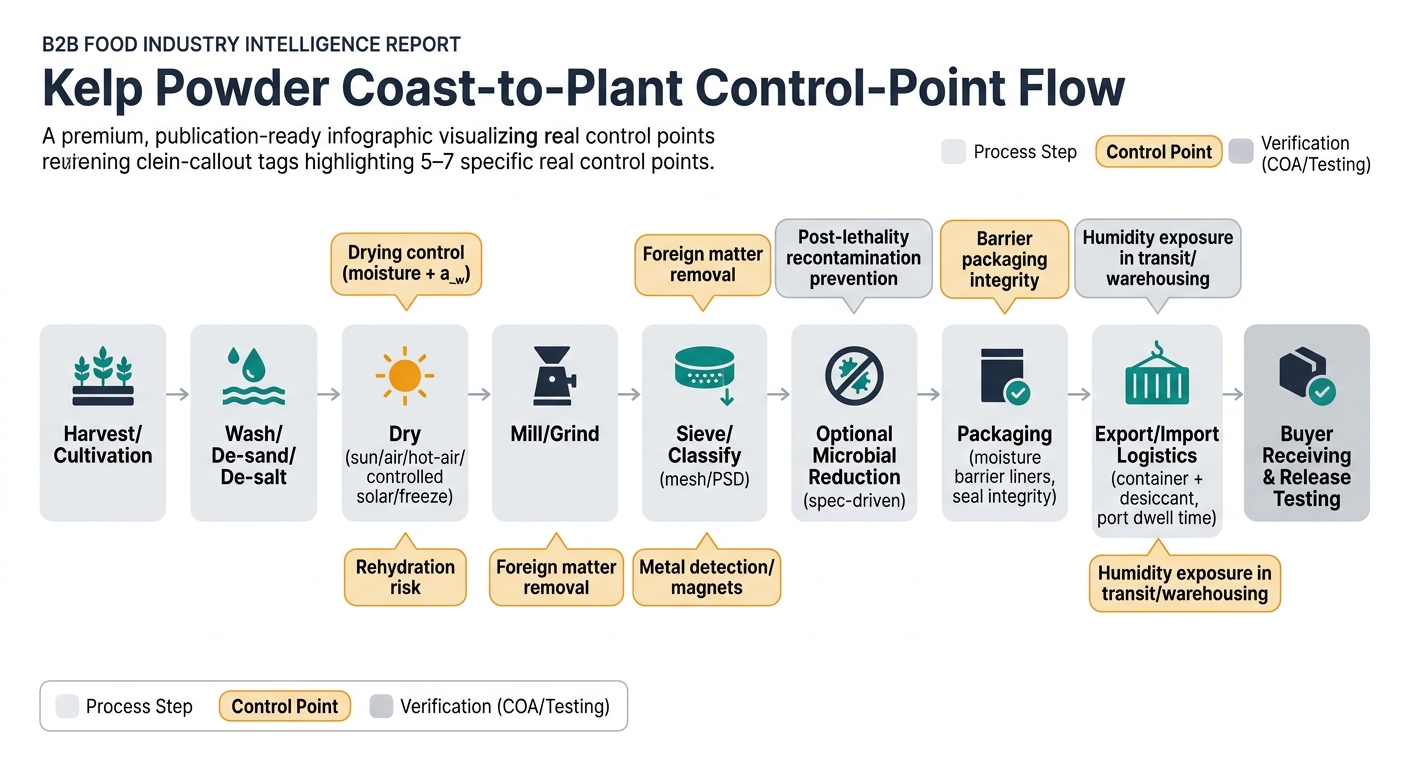
Food-grade kelp powder is not a single industry—it’s a physical sequence of wet biomass handling, dehydration, particle-size standardization, and compliance gating. The chain is built around one immovable fact: kelp is harvested/cultivated with very high water content, and the first economically decisive step is drying (because yield collapses from wet-to-dry, and moisture control determines shelf stability).
Insight: The supply chain is a “dehydration-and-standardization” business: drying creates the shippable commodity; milling, sieving, and optional microbial reduction create the food-grade powder.
Data: Drying is fundamentally about lowering water activity (aw) to inhibit microbial growth; seaweed food-safety guidance notes that water activity cannot be accurately estimated from total moisture alone, so moisture should not be used as the sole indicator of safety from microbial growth. [1]
Procurement Impact: The fixed cost-drivers and quality outcomes concentrate at (1) drying method/capacity and (2) secondary processing controls (foreign matter removal, metal controls, and any validated kill-step). Everything downstream—COA consistency, lot integrity, and shipment stability—depends on how these two nodes are run.
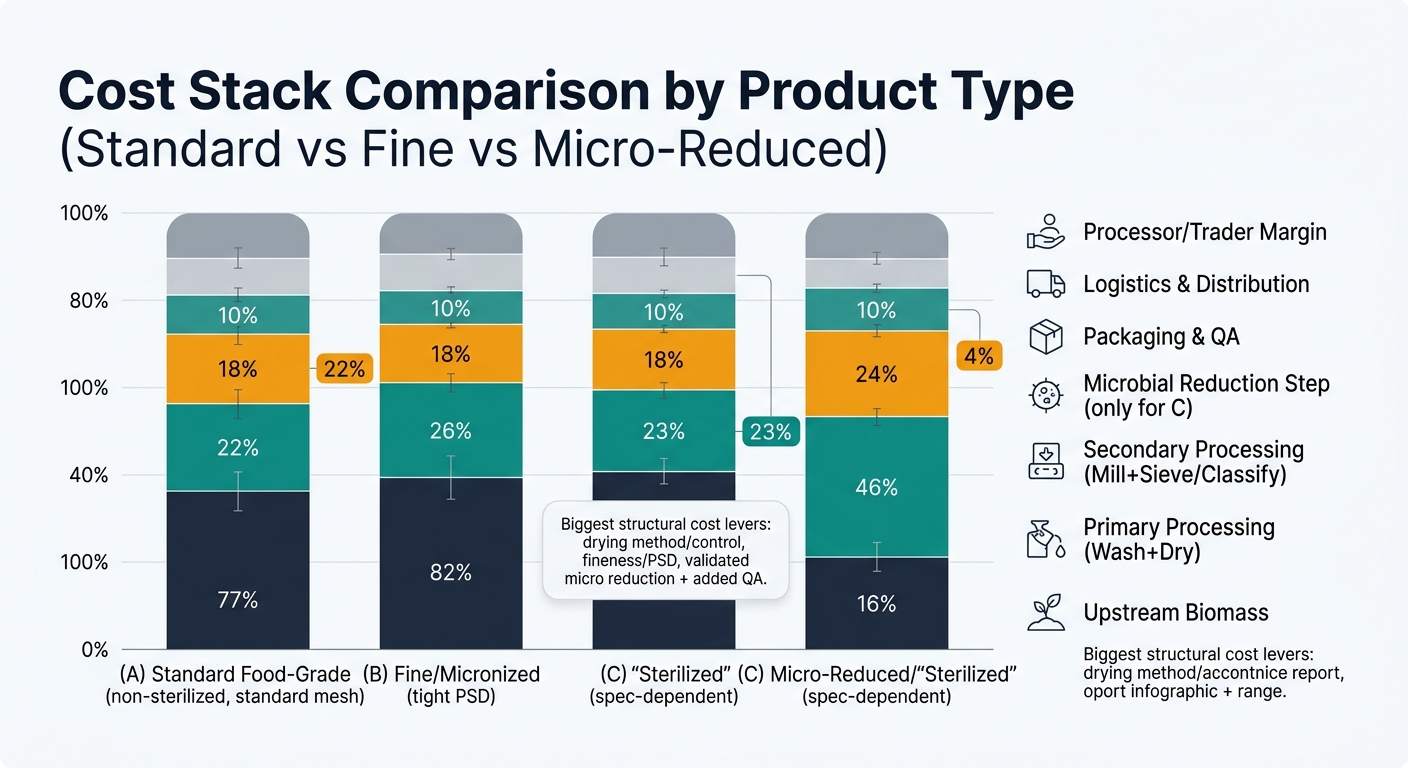
Insight: Kelp powder cost is “locked in” by yield loss and energy/time at drying, then re-priced by how much QA control is added during milling/finishing.
Data: Seaweeds are hygroscopic and can reabsorb moisture under fluctuating humidity; practically, this increases the need for controlled drying, barrier packaging, and disciplined warehousing/handling to prevent caking and quality drift. (This hygroscopicity point is widely recognized in seaweed preservation literature; treat it as a design constraint even when supplier docs don’t emphasize it.)
Procurement Impact: The same label (“kelp powder”) can sit on very different cost stacks depending on drying method, contamination controls, and documentation/testing burden.
Fixed cost-drivers you can’t “optimize away”: Coastal labor availability, boat/gear, site access, and raw biomass handling speed (spoilage risk if delays occur).
Fixed cost-drivers: Drying energy (or weather risk if sun-dried), drying yard/plant throughput, rework from rehydration events, and water usage for washing/de-sanding.
Fixed cost-drivers: Grinding energy, screen changes, dust control, magnets/metal detection, and yield loss from oversize/undersize fractions.
Fixed cost-drivers: Energy/time, validation and monitoring, post-step handling segregation, and potential sensory changes (odor/color) depending on conditions.
Fixed cost-drivers: Food-grade liners, sealing integrity, pallet protection, lab testing cadence, and document control.
Fixed cost-drivers: Inland drayage from coastal processors, ocean freight, insurance, demurrage risk, and destination warehousing humidity control.
Insight: “Food-grade kelp powder” spans multiple cost stacks; the biggest structural differences are (1) drying method/control, (2) fineness/standardization, and (3) whether microbial reduction and expanded contaminant testing are built in.
Data: Global seaweed trade/production concentration is structural (not a one-off cycle), which tends to amplify the effect of regional shocks and logistics volatility on delivered cost. [7]
Procurement Impact: When comparing suppliers, separate “conversion intensity” (drying + milling + micro step) from “paper intensity” (QA/testing/documentation). They often move together, but not always.
| Supply Chain Node | Cost Ratio (% of Final Cost) | Notes |
|---|---|---|
| Upstream biomass | 25–35% | Labor + access + harvest handling; origin drives variability. |
| Primary processing (wash + dry) | 20–30% | Energy or weather risk; yield loss is structural. |
| Secondary processing (mill + sieve) | 10–18% | Mesh standardization, metal/foreign matter controls. |
| Packaging & QA | 8–12% | Barrier liners, baseline micro + metals testing, COA. |
| Logistics & distribution | 10–18% | Moisture protection + port/warehouse time. |
| Processor/trader margin | 8–15% | Varies with services, credit, and inventory carry. |
| Supply Chain Node | Cost Ratio (% of Final Cost) | Notes |
|---|---|---|
| Upstream biomass | 20–30% | Same raw material, but higher downstream conversion dominates. |
| Primary processing (wash + dry) | 18–28% | More emphasis on consistent dryness to support milling. |
| Secondary processing (mill + classify) | 18–28% | Higher energy, wear parts, tighter sieving/classification. |
| Packaging & QA | 10–14% | Greater moisture sensitivity; tighter PSD + added checks. |
| Logistics & distribution | 8–15% | Higher risk of caking if humidity control is weak. |
| Processor margin | 8–15% | Premium for tighter spec execution. |
| Supply Chain Node | Cost Ratio (% of Final Cost) | Notes |
|---|---|---|
| Upstream biomass | 18–28% | Often sourced with tighter harvest-area discipline. |
| Primary processing (wash + dry) | 18–28% | Stability focus; rehydration control becomes critical. |
| Secondary processing (mill + sieve) | 12–20% | Must protect against recontamination. |
| Microbial reduction step | 6–15% | Energy/time + validation/monitoring + segregation costs. |
| Packaging & QA | 10–16% | More frequent micro verification + stronger lot controls. |
| Logistics & distribution | 8–14% | Must maintain package integrity to preserve micro status. |
| Processor margin | 8–15% | Premium for compliance execution and documentation. |
Insight: The chain’s physical economics hinge on dehydration throughput and control; poor drying creates downstream instability that no COA can fully “paper over.”
Data: Seaweed safety guidance frames drying as a process aimed at reducing water activity or moisture content, and emphasizes that aw cannot be inferred reliably from moisture alone—so the control objective must be explicit. [1]
Procurement Impact: Supplier capability is often best inferred by drying controls (method, humidity management, rehydration prevention) because it predicts both quality variance and downstream rework/testing burden.
Insight: Two lots with similar moisture can behave differently in storage if aw differs; stability is a systems outcome (drying + packaging + storage), not a single number.
Data: Seaweed food-safety guidance explicitly notes that water activity cannot be accurately estimated from moisture alone, so moisture should not be used as the sole indicator of safety from microbial growth. [1]
Procurement Impact: Receiving specs that only state moisture (without aw or equivalent stability evidence) can under-control shelf stability, especially for fine powders that reabsorb moisture readily.
Insight: Many seaweeds bioaccumulate elements from their environment; compliance risk is partly determined by harvest area and species, then managed by testing and lot segregation.
Data: EU-facing contaminant summaries for algae highlight the importance of arsenic speciation (inorganic vs total) and reference the broader EU contaminant regulation framework (e.g., Regulation (EU) 2023/915 context). In the U.S., FDA notes seaweed as a food of interest for arsenic and cadmium exposure (and to a lesser extent lead/mercury), reinforcing why buyers must treat metals as a recurring verification topic, not a one-time qualification test. [2]
Procurement Impact: Even with strong processing, a supply chain that cannot demonstrate harvest-area mapping and consistent contaminant testing will face recurring release uncertainty.
(Analyzed at: Sep, 2026)
Write your next kelp powder contract as if ocean variability and humidity exposure are a given: require an aw-based stability control (or equivalent validated stability evidence), mandate barrier packaging with defined liner/seal requirements, and tie “micro-reduced” claims to post-step handling/packing controls that prevent recontamination. This works because the category’s most expensive failure mode is not “bad kelp,” it’s rehydration and handling drift after drying—showing up as caking, extended QC holds, and rework/disposal even when metals are fine. In 2026, when schedule variability and port dwell time remain real, that extra packaging and verification discipline is often the difference between routine release and a multi-week disruption that quietly costs more than the ingredient premium. [4]


