

Encapsulated Antarctic krill oil behaves less like a scalable commodity and more like a managed biological resource plus a capacity-constrained dosage-form manufacturing network. For procurement leaders, the point of this map is simple: most “surprises” in cost, service level, and quality are created early (at sea and in bulk handling) and then amplified later (at encapsulation and packaging).
Encapsulated Antarctic krill oil is not a single commodity—it’s a tightly sequenced chain where quality and cost are “locked in” early. The upstream fishery runs in the Southern Ocean under CCAMLR management, with Area 48 governed by a precautionary limit and an interim “trigger level” concept that constrains total removals unless further spatial allocation rules are applied. [1] The practical implication is that supply starts with a regulated, remote harvest and only then becomes an industrial nutraceutical input.
Insight: The chain is physically constructed around speed-to-stabilization (at sea), then controlled refining, then oxygen/temperature-managed encapsulation and packing.
Data: In Area 48, CCAMLR’s long-standing trigger level is 620,000 tonnes/year across Subareas 48.1–48.4 (interim constraint), reflecting management designed to prevent localized ecosystem impacts and to force finer-scale management if catches rise. [1]
Procurement Impact: Your biggest “fixed” cost drivers are not negotiable operational choices—they’re structural: Antarctic vessel economics, rapid stabilization, downstream oxidation control, and the two-tier manufacturing model (oil + softgel/pack).
Supply chain flow (physical):

Insight: Costs stack in layers: (1) regulated harvesting + at-sea processing, (2) yield-driven extraction/refining, (3) oxidation-managed storage/logistics, (4) encapsulation conversion, (5) packaging + QA release.
Data: Oxidation measurement and control is an industry constant: PV, p-anisidine, and TOTOX are widely used metrics across marine oils, with TOTOX calculated as 2×PV + p-AV. [3]
Procurement Impact: Even without discussing “how to buy,” you can predict where suppliers will defend margin: nodes with high yield loss (extraction/refining) and nodes with capacity bottlenecks (softgel lines + packaging).
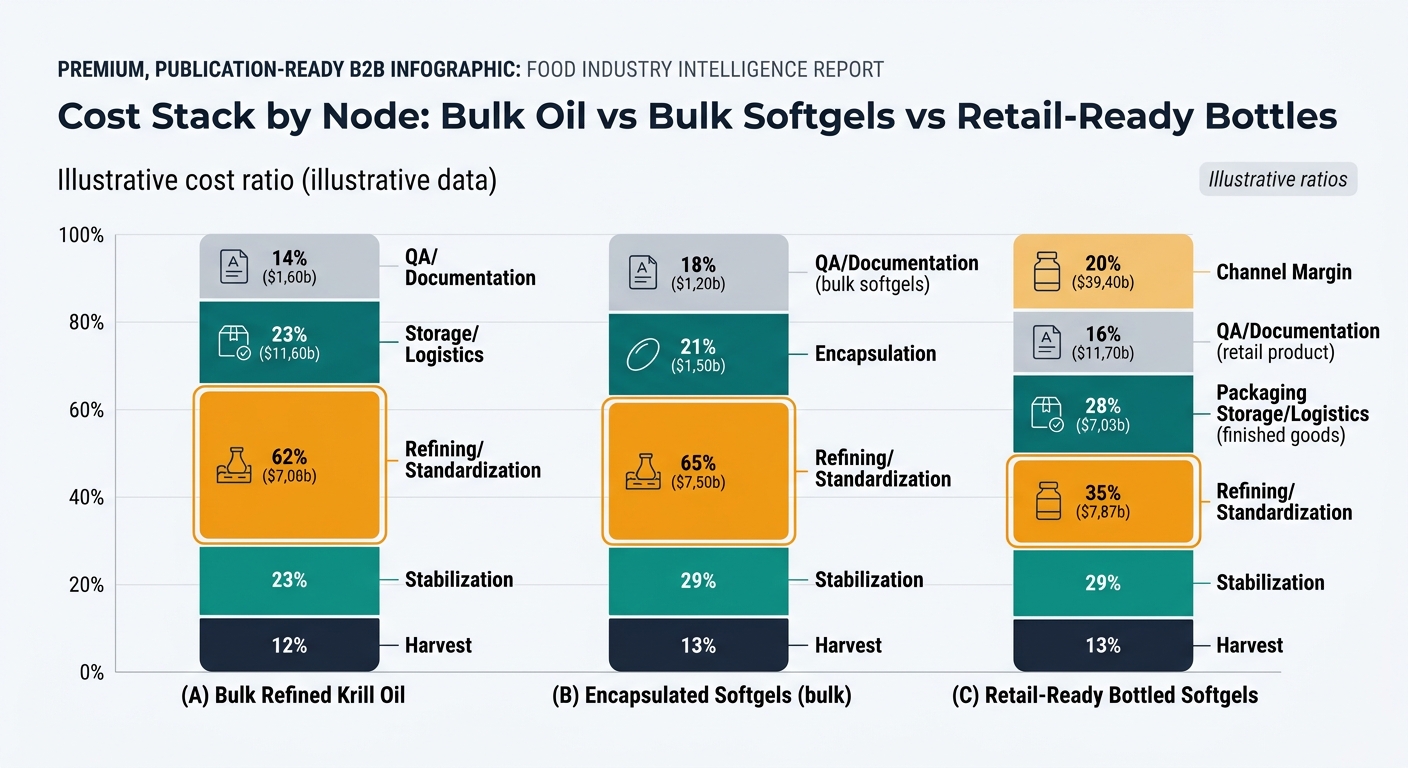
| Supply Chain Node | Cost Ratio (% of Final Cost) | Notes |
|---|---|---|
| Upstream harvest (vessel + compliance) | 45% | Regulated, fuel- and day-rate-driven economics; structurally constrained by CCAMLR management. [1] |
| At-sea stabilization/first processing | 10% | Freezing/handling to prevent rapid degradation; affects downstream yield and spec attainment. |
| Extraction/refining/standardization | 25% | Yield loss + QA testing + process inputs; value-add is consistent spec. [2] |
| Bulk storage & international logistics | 10% | Preservation (temperature/oxygen control) + freight + insurance. |
| Processor margin/overhead | 10% | Covers working capital and operational risk across long lead times. |
| Supply Chain Node | Cost Ratio (% of Final Cost) | Notes |
|---|---|---|
| Bulk refined krill oil input | 40% | Oil cost embeds upstream + refining stack. |
| Encapsulation conversion (softgel) | 25% | Shell materials + line time + yield loss (leakers/defects). [6] |
| Packaging components (bulk bags/drums, desiccants) | 5% | Lower than retail packs, but still quality-critical. |
| QA release testing & documentation | 10% | Oxidation testing and CoA package are recurring costs (methods/specs typically aligned to customer and voluntary frameworks). [2] |
| Logistics & distribution | 8% | Temperature/time sensitivity persists post-encapsulation. |
| CMO margin/overhead | 12% | Covers compliance systems, batch records, and capacity management. |
| Supply Chain Node | Cost Ratio (% of Final Cost) | Notes |
|---|---|---|
| Bulk refined krill oil input | 25% | Oil becomes a smaller share as packaging and channel costs rise. |
| Encapsulation conversion (softgel) | 18% | Same physical process; additional handling for retail specs. [6] |
| Bottling/blister + labeling + cartons | 20% | SKU complexity and compliance labeling drive labor and component cost. |
| QA release, stability, documentation | 10% | Oxidation metrics and shelf-life substantiation add cost. [5] |
| Finished goods warehousing & distribution | 12% | Pick/pack, retailer/e-comm requirements, temperature management. |
| Wholesale/retail margin (channel) | 15% | Channel structure, not manufacturing, often dominates the last step. |
Insight: Three structural realities shape availability, cost build, and quality outcomes regardless of supplier.
Data: The Area 48 krill fishery operates under CCAMLR management with an interim trigger level (620,000 tonnes/year) and spatial subareas; this is a designed constraint, not a market preference. [1]
Procurement Impact: These constraints explain why the chain behaves more like a managed resource + specialty manufacturing network than a scalable commodity.
Insight: The fishery is management-constrained, not acreage-scalable.
Data: Area 48’s trigger level framework (620,000 tonnes) is a long-standing control point in CCAMLR management, intended to limit catch until finer-scale management is implemented. [4]
Procurement Impact: Supply growth is structurally bounded; “more demand” does not automatically create “more supply.”
Insight: Oxidation control is a cross-node requirement, not a single QC test at the end.
Data: PV, p-AV, and TOTOX are widely referenced oxidation measures; TOTOX = 2×PV + p-AV is a standard calculation used in marine oil quality contexts, and GOED’s voluntary monograph specifies commonly referenced maximums (PV 5, p-AV 20, TOTOX 26). [2]
Procurement Impact: Quality failures often originate earlier (stabilization, storage, dwell time) and only become visible at finished-goods release.
Insight: Encapsulated krill oil is inherently a two-industry product: marine oil processing + pharmaceutical-like dosage-form conversion.
Data: Softgels rely on a defined shell system and specialized forming/filling equipment; the process is sensitive to material and environmental controls. [6]
Procurement Impact: Supplier qualification must cover both the oil spec and the dosage-form process capability; one without the other does not deliver shelf-stable capsules.
Insight: The “hard costs” in encapsulated Antarctic krill oil are created by regulated access, rapid stabilization, yield-dependent refining, and oxidation-managed conversion into softgels.
Data: CCAMLR’s Area 48 trigger level (620,000 tonnes) illustrates the structural cap upstream, while oxidation frameworks rely on PV/p-AV/TOTOX (TOTOX = 2×PV + p-AV) to assess degradation risk downstream. [1]
Procurement Impact: When cost or quality moves unexpectedly, the root cause is usually physical (time/temperature/oxygen exposure, yield loss, capacity constraints), not paperwork.
(Analyzed at: Jul, 2026)
Write your krill program contract as a two-risk agreement: (1) managed-resource supply (CCAMLR-trigger-level constrained) and (2) capacity-and-oxidation-controlled manufacturing. CCAMLR’s Area 48 trigger level remains a hard structural constraint, so the procurement lever you actually control is downstream: reserve softgel/pack slots and hard-code measurable time/temperature/oxygen exposure controls from bulk oil receipt through finished-goods dispatch, tied to PV/p-AV/TOTOX release specs aligned to GOED-style limits. [7] This works because most repeat losses show up as QA holds, rework, and shelf-life erosion after refining—often turning what looks like a small unit-price win into a mid-single-digit (and sometimes low-double-digit) total program cost penalty when lots miss release or require expedited replacement.


