INDUSTRY TRENDS

How Cured Chorizo Really Moves: The Physical Bottlenecks, the Cost Stack, and the QA/Compliance Levers

Author
Team Tridge
DATE
July 27, 2026
7 min read
cured-chorizo Cover
Cured ChorizoHS 160100
Powered by Tridge Eye
🇺🇦 Ukraine↓ 9.2%
$5.20/kg
Wholesale reference prices across 133 markets

Cured chorizo sourcing looks like “buy pork + spices,” but the real cost and risk sit in time-in-process (curing/drying), verification discipline, and post-cure handling choices (especially slicing). This guide maps the physical flow to the cost stack so Purchase—Quality, Safety, and Compliance teams can write tighter specs, qualify suppliers faster, and reduce avoidable holds, downgrades, and complaint credits.

Executive Summary

  • The true bottleneck is curing/drying capacity (space + airflow + dehumidification), not grinding or stuffing—this drives lead time, continuity risk, and cost floor.
  • Shrink is unavoidable because finished weight is created by removing water; yield and cycle time vary materially by formulation, diameter, and drying control.
  • Sliced formats shift cost and risk downstream into packaging barrier performance, oxidation control, and cold-chain discipline.
  • Shelf-stability is not a vibe: it is demonstrated/validated using measurable hurdles (e.g., pH, water activity, moisture/protein ratio) and lot-by-lot release evidence.
  • 2026 context: pork supply and price remain exposed to animal-disease disruption risk (e.g., ASF activity in Europe) while energy remains a meaningful structural cost for drying operations.

1) The Physical Map: How Cured Chorizo Is Built (and Where Fixed Costs Sit)

Cured chorizo is not a “simple pork product”—it is a time-in-process, controlled-dehydration system. The chain is physically defined by (1) pork lean/fat inputs, (2) curing-room throughput (space + HVAC/dehumidification), and (3) verification and packaging choices that protect a ready-to-eat product.

Insight: The supply chain’s most important “asset” is not the meat grinder—it’s controlled drying capacity and the ability to hit target pH/water activity (aw) consistently.

Data: Moisture loss (shrink) during drying is inherent; longer or tighter drying profiles increase working capital lock-up and utilities while reducing sellable weight.

Procurement Impact: Your continuity and cost base are structurally tied to curing-room capacity, energy intensity, and yield loss—factors that do not disappear even when raw pork prices soften.

Physical flow (typical): Pork (lean + fatback/trim) + spices + salt + casings → grind/blend → stuff → optional fermentation (style-dependent) → curing/drying (multi-week, controlled RH/temperature/airflow) → optional smoking → whole vs. sliced/diced packing → QA release (micro + label/spec conformance) → chilled or ambient distribution (many “shelf-stable” products still ship chilled for quality).
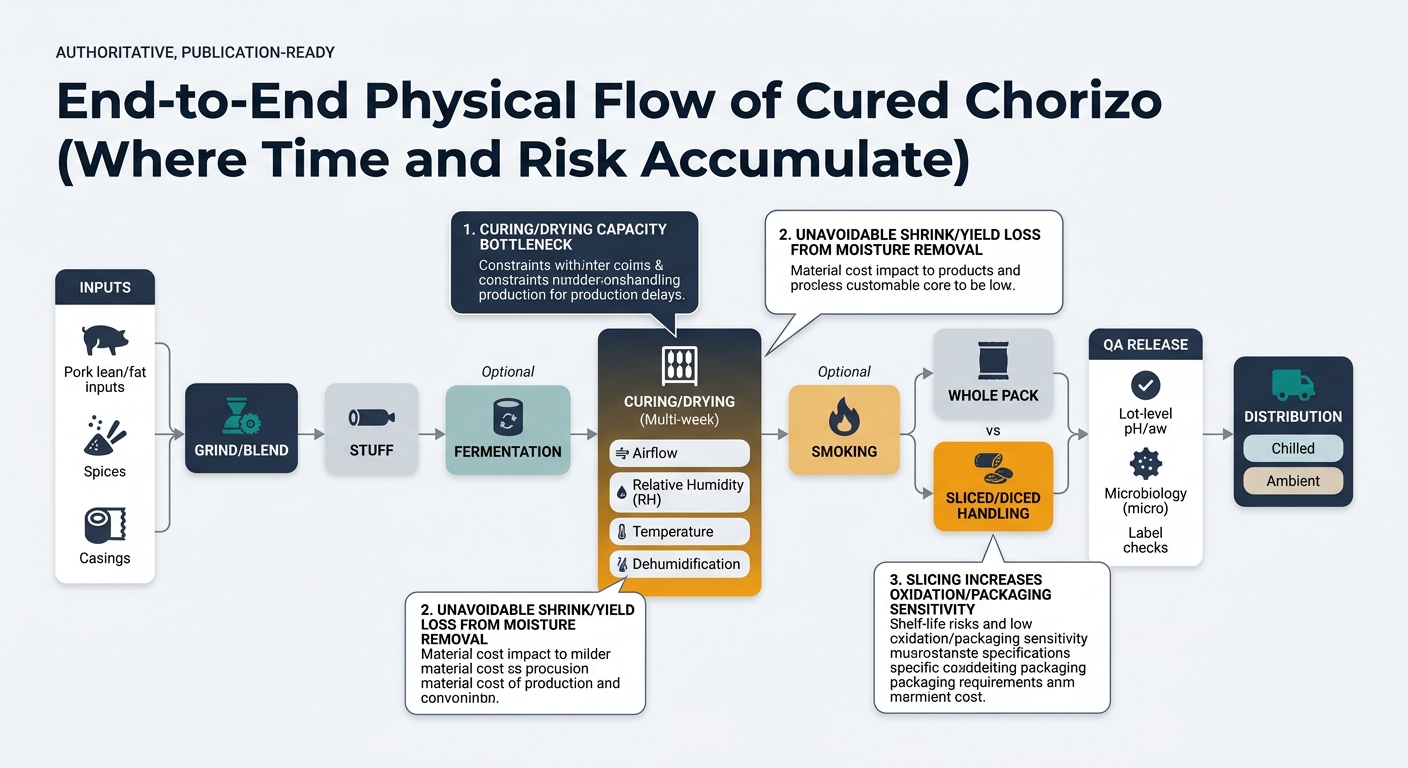
A left-to-right process flow showing: Pork lean/fat inputs + spices/casings → grind/blend → stuff → (optional) fermentation → curing/drying (multi-week; callouts for airflow, RH, temperature, dehumidification) → (optional) smoking → whole pack vs sliced/diced handling → QA release (lot-level pH/aw + micro + label checks) → distribution (chilled vs ambient). Add 3 callout badges over the most important risk/cost pinch points: (1) curing/drying capacity bottleneck, (2) unavoidable shrink/yield loss from moisture removal, (3) slicing increases oxidation/packaging sensitivity. Keep it product/operations-focused (no dashboard UI).

2) Where the Money Stacks Up: Cost & Margin by Node (Physical + Financial)

Insight: Cured chorizo costs accumulate through irreversible steps: once meat is seasoned/stuffed and enters curing, time, shrink, and QA holds become embedded costs.

Data: The dominant cost drivers shift by node: pork input cost dominates upstream; utilities + shrink dominate curing; packaging materials and line efficiency dominate slicing/packing.

Procurement Impact: Understanding node economics clarifies what is “structural” (shrink, energy, compliance overhead) versus what is “variable” (pork trim, spice lots, freight).
1. Upstream Inputs (Pork, Fat, Spices, Casings)

  • Insight: The product’s performance is determined before processing starts—fat firmness, lean-to-fat ratio, and spice quality dictate drying behavior, sliceability, and oxidation stability.
  • Data: Pork trim and fatback are the mass drivers; paprika/garlic are small by weight but high leverage for color and flavor, while natural casings add variability (diameter uniformity, breakage, and permeability).
  • Procurement Impact: Input variability shows up downstream as yield loss, texture defects (smear/fat separation), and inconsistent aw/pH achievement—raising rework, hold, or downgrade risk.

2. Primary Processing (Cutting, Chilling, Trim Sorting)

  • Insight: Hygiene and temperature control at this node set the microbiological baseline for a ready-to-eat environment later.
  • Data: Cost is driven by labor, chilling energy, and yield management (lean/fat segregation, trim spec tightness). Poor trim control forces formulation corrections that can destabilize drying curves.
  • Procurement Impact: If trim specs drift (fat % swings, soft fat), the plant pays twice: first in formulation adjustments, then in curing instability (longer dry times, higher shrink, or texture complaints).

3. Secondary Processing (Grinding, Mixing, Stuffing, Fermentation/Curing)

  • Insight: This is the “physics and microbiology” node: particle definition, salt distribution, and controlled acidification (if fermented) determine pathogen control margin and final texture.
  • Data: Key fixed costs are skilled labor, sanitation, and utilities; key structural losses are shrink (moisture evaporation) and time-in-process (inventory financing). Curing-room throughput is constrained by square meters/airflow rather than mixer capacity.
  • Procurement Impact: This node creates the longest recovery time after disruption because you cannot compress curing time without risking aw/pH targets, sensory profile, or shelf-life validation.

4. Packaging, QA Release, and Shelf-Life Protection (Whole vs. Sliced)

  • Insight: Packaging is not just a “wrap”—it is an oxygen and handling control system that protects color, aroma, and slice integrity.
  • Data: Sliced SKUs add material cost (films/trays), labor, line downtime, and oxidation exposure; MAP/vacuum choices affect rancidity risk and color stability. QA costs include micro verification, metal detection/X-ray, label checks, and hold time.
  • Procurement Impact: Moving from whole to sliced shifts cost from curing to packaging/line efficiency and increases sensitivity to oxidation, breakage, and giveaway—often raising total cost even at similar raw material inputs.

5. Logistics & Distribution (Chilled vs. Ambient Handling)

  • Insight: Even when aw supports shelf-stability, many supply chains default to chilled distribution to preserve sensory quality and reduce rancidity/grease-out risk.
  • Data: Costs concentrate in refrigerated transport, cold storage, and inventory rotation (best-before management). Export lanes add inspection holds, documentation handling, and temperature compliance overhead.
  • Procurement Impact: Logistics cost is structurally higher for sliced and premium sensory specs because temperature abuse and time-at-oxygen exposure translate quickly into complaints and returns.
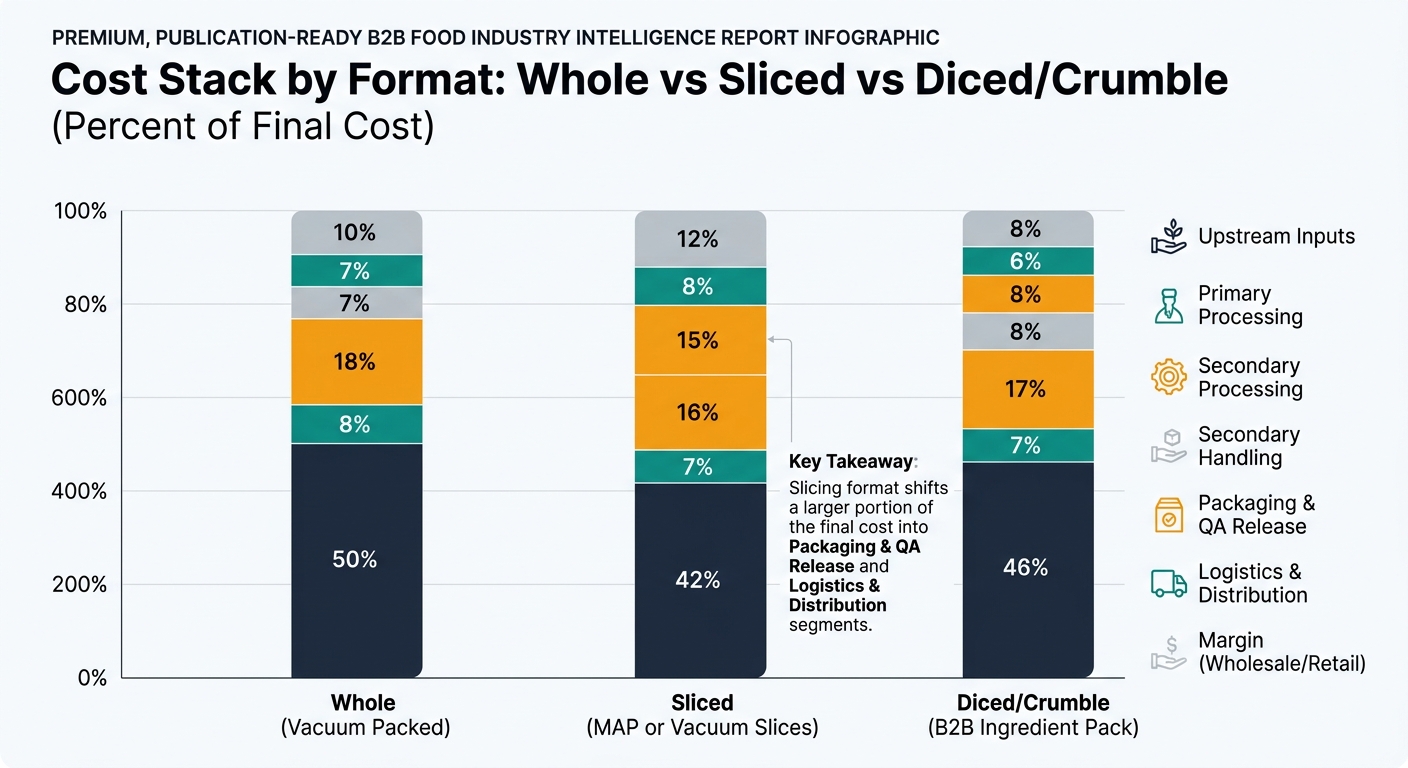
Three 100% stacked bars labeled Whole (Vacuum Packed), Sliced (MAP or Vacuum Slices), and Diced/Crumble (B2B Ingredient Pack), segmented by Upstream Inputs, Primary Processing, Secondary Processing, Packaging & QA Release, Logistics & Distribution, and Margin using the article’s cost ratios. Includes an annotation highlighting that slicing shifts cost into Packaging & QA and Logistics.

Product-Level Cost Breakdown

A) Whole Cured Chorizo (Vacuum Packed)

Supply Chain Node Cost Ratio (% of Final Cost) Notes
Upstream Inputs (pork, spices, casings) 50% Pork lean/fat dominates; spices are leverage inputs for color/flavor.
Primary Processing (cut/chill/trim sort) 8% Labor + chilling energy; trim control affects downstream yield.
Secondary Processing (mix/stuff/ferment/cure) 18% Utilities + shrink + time-in-process; curing-room throughput is the bottleneck.
Packaging & QA Release 7% Vacuum bags, labels, micro verification, metal detection.
Logistics & Distribution 7% Often shipped chilled for quality even if technically shelf-stable.
Wholesale/Retail Margin 10% Channel margin varies by brand/private label and service level.

B) Sliced Cured Chorizo (MAP or Vacuum Slices)

Supply Chain Node Cost Ratio (% of Final Cost) Notes
Upstream Inputs (pork, spices, casings) 42% Same inputs, but downstream costs rise sharply.
Primary Processing (cut/chill/trim sort) 7% Similar baseline, but tighter texture targets matter for slicing.
Secondary Processing (mix/stuff/ferment/cure) 16% Still material, but not the main differentiator vs. whole.
Packaging & QA Release 15% Higher material usage + labor + oxidation management + line losses.
Logistics & Distribution 8% Higher sensitivity to temperature and time-at-oxygen.
Wholesale/Retail Margin 12% More handling/service expectations in retail-ready formats.

C) Diced/Crumble Chorizo (B2B Ingredient Pack)

Supply Chain Node Cost Ratio (% of Final Cost) Notes
Upstream Inputs (pork, spices, casings/alternatives) 46% Formulation may tolerate different particle specs; still pork-driven.
Primary Processing (cut/chill/trim sort) 7% Similar baseline.
Secondary Processing (mix/stuff/ferment/cure) 17% Shrink + utilities remain structural.
Secondary Handling (dice/crumb, rework control) 8% Adds yield loss, foreign-body control burden, and sanitation time.
Packaging & QA Release 8% Bulk vacuum, labels, verification; allergen/cross-contact controls matter.
Logistics & Distribution 6% Often chilled or frozen depending on customer process.
Wholesale Margin 8% Typically lower than retail but volume-driven.
Sourcing Window Radar
Cured Chorizo — Global Harvest Calendar
MEXICO SEASON ACTIVE
🇪🇸 Spain
AUG — OCT
🇲🇽 Mexico
JUL — NOV
🇫🇷 France
SEP — DEC
🇨🇷 Costa Rica
OCT — OCT
🇬🇷 Greece
OCT — OCT
JanFebMarAprMayJunJulAugSepOctNovDec

3) Structural Facts You Can’t Negotiate Away (Industry Constants)

Reality 1: Curing Capacity Is the Hard Bottleneck

Insight: Drying rooms (space + airflow + dehumidification) cap output more than grinders or stuffers.

Data: Multi-week curing ties up racks and WIP; high humidity periods increase dehumidification load and can slow drying, raising energy use and cycle time.

Procurement Impact: Service level risk is structurally linked to a supplier’s curing footprint and utilities resilience (HVAC redundancy, maintenance discipline), not just “annual tonnage claims.”

Reality 2: Shrink (Moisture Loss) Is a Built-In Yield Tax

Insight: Finished weight is created by removing water; shrink is unavoidable and highly sensitive to formulation and casing diameter.

Data: Lean/fat ratio, particle definition, and drying profile shift shrink and texture; tighter aw targets generally require more time/energy and can increase loss.

Procurement Impact: Two suppliers can buy identical pork and still land at different costs because shrink and cycle time differ—especially for thicker diameters or premium texture specs.

Reality 3: Slicing Converts “Cured Meat” into a Packaging-and-Oxidation Problem

Insight: Once sliced, surface area and oxygen exposure jump, accelerating aroma loss and rancidity risk.

Data: MAP/vacuum choice, film barrier properties, and line temperature control influence color stability and grease-out; slicing also increases giveaway and breakage losses.

Procurement Impact: If your business spec requires consistent slice integrity and color, your cost base will structurally tilt toward packaging materials, line efficiency, and tighter cold-chain discipline.

Key Insights (What to Remember When You Read Any Spec or Factory Profile)

  • Insight: Cured chorizo economics are dominated by three physical levers: pork composition, curing-room throughput, and post-cure handling (whole vs. sliced).
  • Data: Upstream pork is typically the largest cost block, but curing adds structural shrink + utilities + time-in-process, while slicing shifts cost into packaging materials, oxidation control, and line losses.
  • Procurement Impact: When you compare suppliers or SKUs, separate “input cost” from “process physics”: the same recipe can land at different total cost and complaint exposure depending on drying control, QA release discipline, and packaging format.

The Bottom Line for Your Next Contract

(Analyzed at: Jul, 2026)

Write the contract so the supplier is paid for demonstrated process outcomes, not just a recipe: require lot-level evidence of pH/aw (and where applicable moisture/protein ratio) tied to the supplier’s validated process and release program, because that is what actually governs shelf-stability and RTE safety margin under FSIS expectations. In 2026, the two structural shocks you can’t wish away are (1) ongoing animal-disease disruption risk in key pork origins (ASF activity has been increasing in parts of the EU) and (2) energy sensitivity in long-cycle drying operations—both of which show up first as “quiet” spec drift, extended lead times, and extra holds. Teams that hard-wire outcome-based release evidence plus change-control triggers (casing diameter, formulation, drying profile, packaging barrier) typically avoid the expensive failure mode: a late-stage hold/downgrade on sliced product that can easily erase 2–5% of annual category value through credits, write-offs, and expedited freight.

Cured ChorizoSupply Chain Intelligence
133 countries tracked
10
Exporters
10
Importers
$962M
Top Export Value
Top Exporters (2024)
🇮🇹
Italy
$962M
🇺🇸
United States
$866M
🇪🇸
Spain
$729M
🇵🇱
Poland
$678M
🇩🇪
Germany
$676M
+128 more
Top Buyers
🇬🇧 United Kingdom $1.00B🇩🇪 Germany $619M🇧🇪 Belgium $372M🇨🇦 Canada $322M🇳🇱 Netherlands $315M

Related Contents

Subscribe
→
By subscribing you agree to with our Privacy Policy and provide consent to receive updates from our company.
Thank you! Your submission has been received!
Oops! Something went wrong while submitting the form.
Subscribe to receive the latest blog posts, updates, promotions, and announcements from Tridge.
