INDUSTRY TRENDS

How Cubed Radish Kimchi Really Moves (and Where Total Landed Cost Locks In)

Author
Team Tridge
DATE
July 9, 2026
7 min read
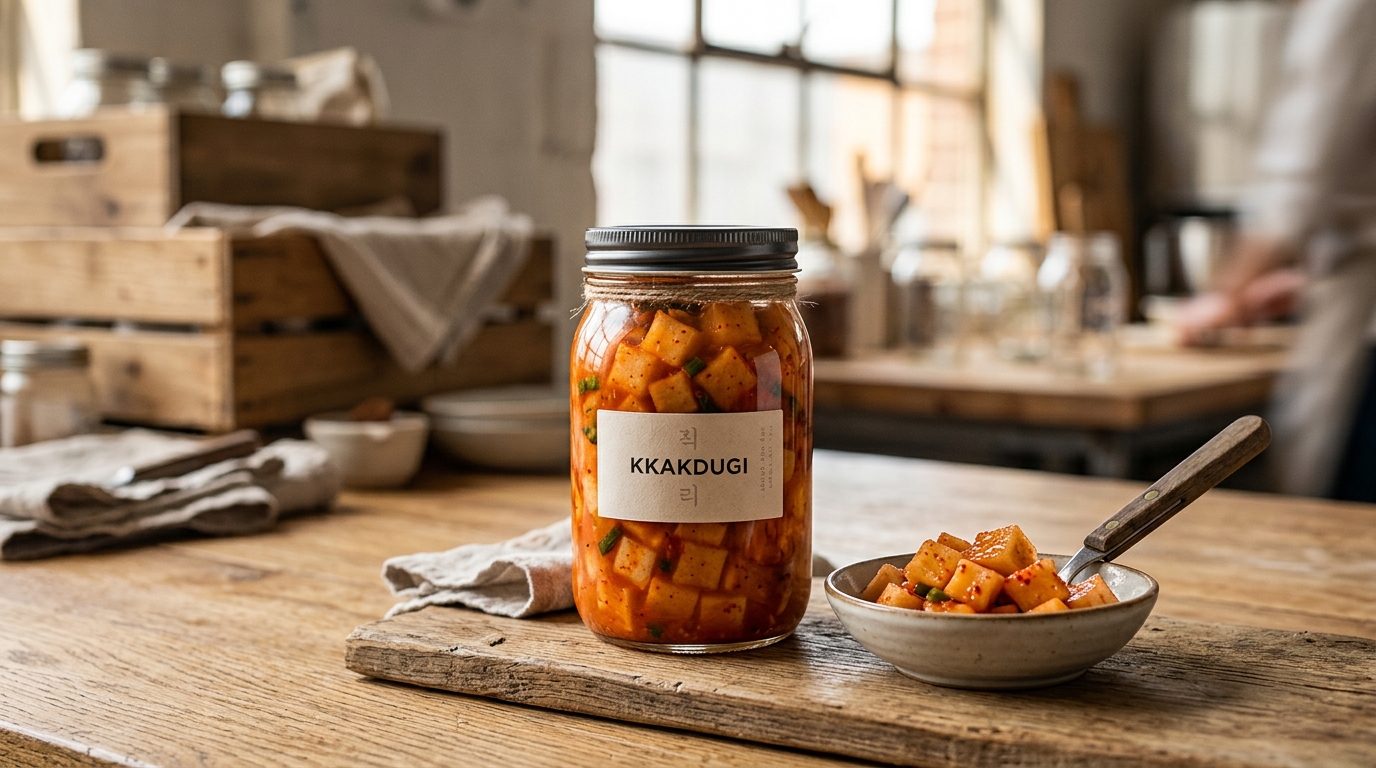
cubed-radish-kimchi Cover
Unlock Full Data
Cubed Radish Kimchi Market Intelligence
Prices · Trends · Origins · Forecasts

Cubed radish kimchi (kkakdugi-style) is one of those categories where procurement outcomes are determined less by “ingredient price” and more by physics and process control: radish yield at intake, water draw during salting, CO₂ management in packaging, and temperature discipline across the lane. This guide maps the chain in buyer language so you can negotiate, dual-source, and govern the right variables.

Executive Summary

  • Cost locks in early: Intake grade → salting/draining yield → packaging gas-management are the three biggest irreversible levers.
  • Cold chain is a quality governor: Fermentation (and CO₂ generation) continues slowly under refrigeration, so warm dwell shows up as swelling/leaks and over-souring. [1]
  • Packaging is functional, not cosmetic: Commercial kimchi often uses degassing valves/CO₂ management to prevent pouch swelling/bursting. [2]
  • Governance matters in 2026: Lane volatility (reefer capacity and ocean-rate swings) is still a material driver of total landed cost and claims risk. [3]

1) The Physical Reality: A Chilled Fermentation Chain Where Costs “Set” Early

Cubed radish kimchi (kkakdugi-style) is physically constructed around three immovable constraints: (1) bulky, water-heavy radish that is expensive to move relative to value, (2) fermentation that changes the product every day, and (3) chilled handling that slows—but does not stop—CO₂ generation, acid development, and texture drift. The supply chain is therefore less like a stable packaged-food pipeline and more like a controlled biological process wrapped in cold-chain logistics. [4]

Insight: The chain’s fixed cost-drivers are front-loaded at raw radish intake (grade/yield), then “locked in” again at salting/draining (mass loss + salinity targets), and finally constrained by packaging physics (gas management) and temperature control.

Data: Typical operations see measurable mass loss from trimming plus water draw during salting/draining; small shifts in radish moisture, cube size, or brine time change yield and downstream pack performance (bloating/leakage). (Practical validation: require supplier to report pre-/post-salt weights and target salt uptake by lot.)

Procurement Impact: Even before any commercial discussion, the physical map tells you where variability becomes irreversible: radish grade at intake, salting/draining controls, and pack format + cold chain integrity.

Ground-truth flow (simplified)

  • Upstream: Radish cultivation → harvest → field sorting → inbound transport
  • Primary processing: Wash/trim → cube → salt/brine → drain/rinse → dewater/hold
  • Secondary manufacturing: Seasoning paste blend → mix → controlled fermentation → chilled stabilization
  • Pack & release: Fill/seal (venting/high-barrier decisions) → metal detection/X-ray → pH/salt/sensory checks → micro/chem checks as required by your risk plan → cold storage
  • Distribution: Reefer transport/warehouse → retail/foodservice cold chain
A left-to-right (or top-to-bottom) supply chain flow showing: Radish cultivation/harvest → field sorting → inbound transport → wash/trim → cube → salt/brine → drain/rinse → dewater/hold → seasoning blend → mix → controlled fermentation → chilled stabilization → fill/seal (CO₂ management) → QA gates (pH/salt/sensory; micro/chem as required) → cold storage → reefer transport/warehouse → retail/foodservice. Visually emphasize three ‘irreversible levers’ with callouts or highlighted nodes: (1) Intake grade/usable yield, (2) Salting/draining yield + salinity targets, (3) Packaging gas-management performance. Add a subtle overlay showing that fermentation continues under refrigeration (slow CO₂ generation) and that temperature excursions increase swelling/leaks and souring risk.

2) Where Money Accumulates: Cost & Margin Structure by Node

Insight: In cubed radish kimchi, “cost” is not only inputs and labor; it is also yield loss, time-in-process (working capital tied up during fermentation), and shrink risk from temperature abuse.

Data: The product’s high water content increases freight cost per edible unit; fermentation time creates inventory dwell; and packaging must tolerate internal pressure from CO₂ produced by lactic fermentation (even during cold storage/transport). [5]

Procurement Impact: You can’t interpret a finished-goods price without knowing which node is carrying yield loss, cold storage time, and packaging performance requirements.

1. Upstream / Raw Material (Radish Farming + Intake Grade)

  • Insight: Radish grade at intake is the earliest “cost lock,” because size distribution, firmness, and defect rate directly determine trim loss, cube uniformity, and texture retention after salting.
  • Data: Radish is seasonal and water-heavy; inbound logistics is high weight/low value. Field variability (hollowing, cracking, pest damage) increases rejects and slows line speed at trimming/cubing.
  • Procurement Impact: The physical driver is not just farmgate price—it’s usable yield and line throughput. Higher defect loads translate into higher unit cost even if the invoice price per kg looks unchanged.

2. Primary Processing (Wash/Trim/Cube + Salting/Draining)

  • Insight: Salting and draining are the chain’s biggest hidden cost mechanics: they intentionally remove water to set texture and salinity, but they also reduce sellable mass and create wastewater handling costs.
  • Data: Costs stack from labor (trim/cut), water and sanitation chemicals, salt/brine, and yield loss (trim + dehydration). Cube-size spec affects surface area, salt uptake rate, and crunch retention; radish cubes visibly shrink during salting/fermentation (a proxy for water draw). [6]
  • Procurement Impact: A “tight” cube-size tolerance or crunch spec is physically paid for here via slower cutting, more sorting, and tighter brine-time control—raising unit conversion cost and sometimes lowering yield.

3. Secondary Manufacturing (Seasoning Blend + Fermentation Control)

  • Insight: This node converts vegetables into a managed fermentation product; the differentiator is process control (time/temperature) rather than heavy capital equipment.
  • Data: Major variable inputs include gochugaru, garlic/ginger, sweeteners/substrates, and optional fish sauce/jeotgal (adds allergen and labeling complexity). Fermentation requires chilled space and time; energy and working capital rise with longer stabilization. Fermented foods can still carry food-safety risk if process controls are weak (pH/salt/time/temperature are hurdles, not magic). [7]
  • Procurement Impact: “Ripeness” targets (pH/acidity band at ship) are physically constrained by fermentation kinetics and temperature history—affecting remaining shelf life and return risk downstream.

4. Packaging & QA Release (Gas Management + Food Safety Gate)

  • Insight: Packaging is not decorative—it is a pressure-management system. If the pack can’t handle CO₂, the chain pays later in leakage, swelling, odor complaints, and returns.
  • Data: Common formats include tubs, jars, and pouches; commercial kimchi commonly uses CO₂ management approaches such as one-way degassing valves, CO₂ absorbents, or gas-permeable films to reduce swelling/burst risk during cold-chain storage/transport. [8]
  • Procurement Impact: Pack format and film choice can materially change total cost via material price, line speed, seal integrity, and shrink/claims. QA intensity and hold times also affect release timing and inventory dwell.

5. Cold Chain Logistics & Distribution (Reefer Reality)

  • Insight: Temperature control is the last physical “governor” on fermentation speed; the chain’s economics can be erased by a single warm leg that accelerates souring and gas.
  • Data: Costs include reefer trucking, chilled warehousing, potential export reefer ocean/air, and shrink from temperature excursions. Longer, less stable lanes increase risk of bloating/leaks and shortened remaining shelf life at receipt.
  • Procurement Impact: Logistics cost is not linear with distance—lane reliability and dwell time matter as much as miles. A cheaper lane that introduces temperature abuse can create higher net cost through credits, returns, and wasted inventory.
A data-driven visualization using the article’s cost ratios. Include two side-by-side views: (A) Retail chilled tubs/jars and (B) Foodservice bulk bags/buckets. Categories: Raw Material, Primary Processing, Secondary Manufacturing, Packaging & QA, Cold Chain Logistics & Distribution, Margin. Plot the exact percentages shown in the tables (Retail: 22/18/16/17/12/15; Foodservice: 24/19/15/10/17/15). Add a note/callout that the most controllable/negotiable drivers are yield (intake + salting/draining), packaging performance, and lane stability (cold chain).

Product-Level Cost Breakdown

A) Retail Chilled Cubed Radish Kimchi (Tubs/Jars)

Supply Chain Node Cost Ratio (% of Final Cost) Notes
Raw Material Cost (radish + minor inputs) 22% Usable yield depends on grade/defects; bulky inbound freight often embedded here.
Primary Processing 18% Labor + sanitation + salt/brine + yield loss + wastewater.
Secondary Manufacturing 16% Seasoning inputs (gochugaru/garlic/ginger) + fermentation control + chilled time.
Packaging & QA 17% Packs must manage CO₂; QA holds and testing add time and cost.
Cold Chain Logistics & Distribution 12% Reefer transport/warehouse; lane stability affects shrink.
Wholesale/Retail Margin 15% Margin expands with brand/private-label positioning and promo structure.

B) Foodservice Cubed Radish Kimchi (Bulk Bags/Buckets)

Supply Chain Node Cost Ratio (% of Final Cost) Notes
Raw Material Cost 24% Higher volume sensitivity to radish grade and conversion yield.
Primary Processing 19% Similar conversion steps; throughput and labor efficiency dominate.
Secondary Manufacturing 15% Seasoning intensity can be lower/higher by operator spec.
Packaging & QA 10% Bulk packaging lowers unit pack cost but raises handling/spill considerations.
Cold Chain Logistics & Distribution 17% Heavier packs; pallet efficiency helps but reefer still required.
Distributor/Foodservice Margin 15% Distributor handling and cold storage often embedded in margin.

C) “Fresh-Ripened” vs “Stabilized” Chilled Cubed Radish Kimchi (Same SKU Family)

Cost Driver Fresh-Ripened (Ship earlier in fermentation) Stabilized (Hold longer under control)
Fermentation time & working capital Lower Higher
Cold storage energy Lower Higher
Remaining shelf life at receipt More variable (lane-sensitive) More predictable
Packaging pressure risk Higher (more CO₂ generation ahead) Lower (if fermentation slowed before ship)
Shrink/returns sensitivity Higher Lower
Sourcing Window Radar
Cubed Radish Kimchi — Global Harvest Calendar
CHINA SEASON ACTIVE
🇨🇳 China
JAN — DEC
🇰🇷 South Kor.
NOV — NOV
JanFebMarAprMayJunJulAugSepOctNovDec

3) Structural Facts That Don’t Change (and Why They Matter)

Reality 1: Yield Loss Is Designed In—and It’s Spec-Dependent

Insight: The chain intentionally removes mass (trim + water draw) to achieve texture and salinity, so “conversion yield” is a structural cost driver, not an operational mistake.

Data: Cube size, brine concentration, brine time, and drain/dewater targets shift mass loss and salt uptake; tighter crunch specs often require tighter control and sometimes higher rejects.

Procurement Impact: Two suppliers can use the same farmgate radish price yet deliver different unit economics because their conversion yield and process controls differ.

Reality 2: Packaging Is a Fermentation Control Surface, Not a Commodity Input

Insight: CO₂ generation continues in chilled distribution; packaging must balance seal integrity, odor barrier, and pressure relief.

Data: Commercial approaches include one-way degassing valves and gas-permeable films to reduce swelling/bursting risk under cold-chain conditions. [9]

Procurement Impact: Pack-format changes can shift costs across materials, line speed, and claims—often more than ingredient tweaks.

Reality 3: Cold Chain Integrity Determines “Remaining Shelf Life,” Not Just Safety

Insight: Temperature abuse primarily shows up as quality drift (over-souring, softening) and pack failures (bloating/leaks) before it shows up as obvious spoilage.

Data: Warm dwell accelerates fermentation kinetics; the same batch can present differently across lanes.

Procurement Impact: Shelf-life complaints are frequently logistics-physics problems, not recipe problems—meaning the supply chain map must include lane stability, dwell points, and receiving temperature discipline.

Key Insights You Can Reuse in Your Next Internal Brief

  • Insight: The highest-leverage physical variables are radish intake grade (usable yield), salting/draining controls (mass loss + salinity), and packaging gas management (CO₂ handling).
  • Data: Costs are driven by labor-intensive conversion (wash/trim/cube), sanitation and wastewater, seasoning inputs (often led by chili/garlic/ginger), chilled storage time, and reefer distribution stability.
  • Procurement Impact: When stakeholders debate “why this SKU costs more,” the answer is usually in (1) yield and throughput at conversion, (2) time-in-process under cold control, and (3) packaging engineered for fermentation—not in a single ingredient line item.

4) The Bottom Line for Your Next Contract

(Analyzed at: Jul, 2026)

Write your next agreement so the supplier is commercially accountable for the three “irreversible” levers: conversion yield, pack gas-management performance, and temperature history. This is especially worth tightening now because 2026 cold-chain and ocean markets are still volatile—industry outlooks point to continued freight variability, and reefer capacity/rate pressure remains a real budget risk. [10]

Make the supplier report lot-level pre-/post-salt yields and provide evidence that the pack format can tolerate defined temperature profiles (so swelling/leakage doesn’t become your credit memo problem). If you don’t, it’s common for the “cheap” award to come back as a mid-single-digit to low-double-digit equivalent cost swing through shrink, extra cold storage, and claims—cost that never shows up in the ingredient bill but hits total landed cost all the same.

Cubed Radish KimchiSupply Chain Intelligence
132 countries tracked
10
Exporters
10
Importers
$365M
Top Export Value
Top Exporters (2024)
🇳🇱
Netherlands
$365M
🇮🇹
Italy
$278M
🇪🇸
Spain
$232M
🇰🇷
South Korea
$178M
🇹🇷
Turkey
$156M
+127 more
Top Buyers
🇺🇸 United States $753M🇩🇪 Germany $471M🇯🇵 Japan $358M🇰🇷 South Korea $304M🇬🇧 United Kingdom $228M

References

  1. pmc.ncbi.nlm.nih.gov
  2. pmc.ncbi.nlm.nih.gov
  3. spglobal.com
  4. ift.org
  5. pmc.ncbi.nlm.nih.gov
  6. koreanbapsang.com
  7. ift.org
  8. pmc.ncbi.nlm.nih.gov
  9. pmc.ncbi.nlm.nih.gov
  10. spglobal.com

Related Contents

Subscribe
→
By subscribing you agree to with our Privacy Policy and provide consent to receive updates from our company.
Thank you! Your submission has been received!
Oops! Something went wrong while submitting the form.
Subscribe to receive the latest blog posts, updates, promotions, and announcements from Tridge.
