

Butterfly pea extract can look like a simple “natural blue” line item, but for procurement the real work is separating farm-driven variability from processor-driven consistency—and then contracting for the physical controls that keep color and microbiology stable through transit and storage. This guide maps the real flow, the cost stack, and the non-obvious bottlenecks that determine whether your next lot is routine—or a deviation.
Butterfly pea extract (INCI commonly listed as Clitoria Ternatea Flower Extract) looks like a simple botanical, but the supply chain’s economics are set by two physical bottlenecks: post-harvest drying (to protect anthocyanin color bodies) and standardized extraction/finishing capacity (to hit repeatable color strength and contaminant limits). The farming footprint can be broad, but exportable cosmetic-grade lots tend to concentrate around processors that can control moisture, microbiology, and documentation.
Insight: The “value creation” point is not the flower—it’s the conversion of a humidity-sensitive flower into a stable, standardized pigment-rich extract that survives storage, shipping, and formulation.
Data: Butterfly pea anthocyanins (ternatins) are pH-responsive and their stability is influenced by pH, temperature, light, and oxygen exposure; studies show visible color/spectral shifts across pH and faster degradation as temperature rises, making drying discipline and protective storage/packaging structurally important. [1]
Procurement Impact: If the chain fails at drying or finishing, the downstream symptom is not just weaker color—it’s batch-to-batch variability, higher micro counts, and more “mystery” deviations that look like supplier inconsistency but are often physical handling variance.
Typical physical flow (simplified):
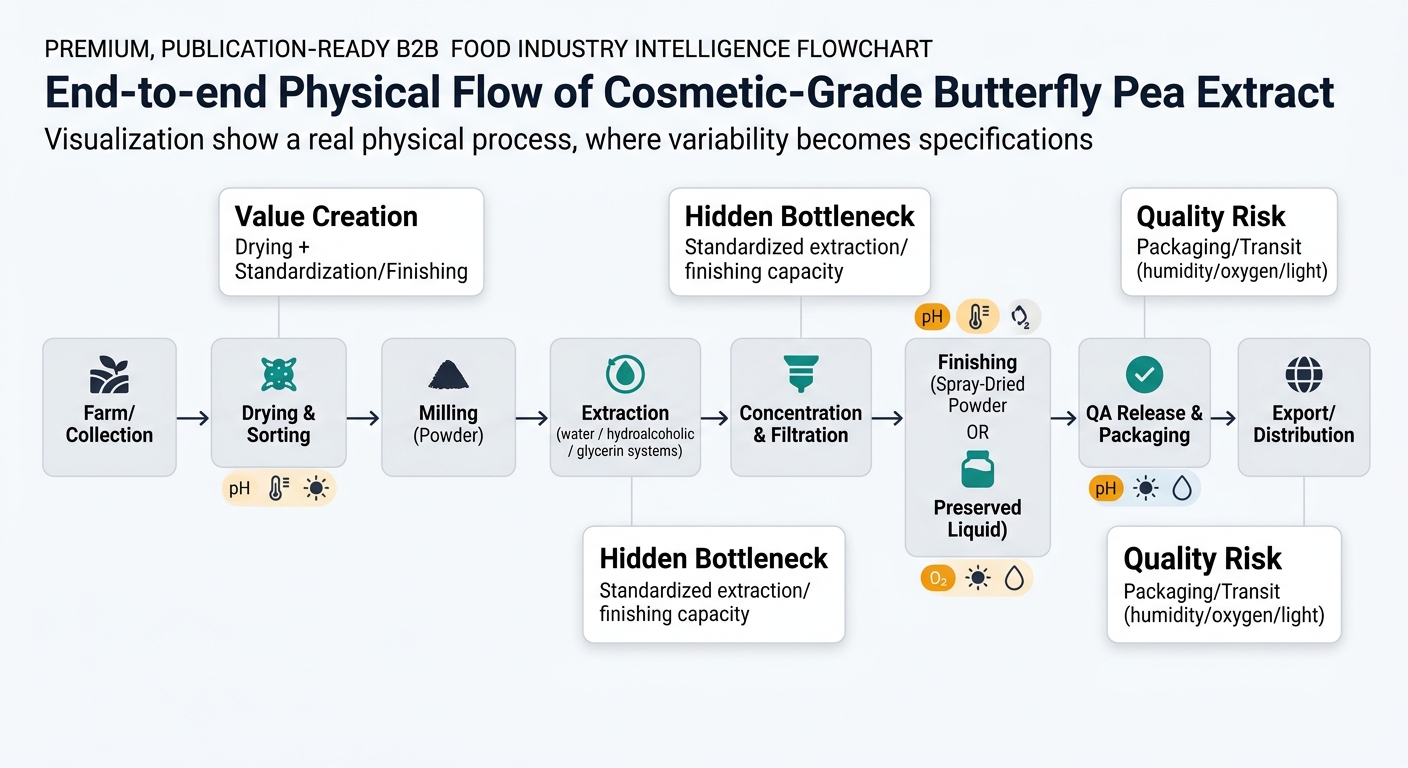
Insight: Costs stack in predictable places: (1) labor-heavy harvesting/sorting, (2) energy-heavy drying and spray drying, and (3) lab/testing plus yield loss from rejecting non-compliant lots.
Data: Anthocyanin systems from Clitoria ternatea are sensitive to pH and processing/storage conditions; that sensitivity is why processors invest in controlled drying/finishing and protective packaging rather than treating the material like a commodity herb. [1]
Procurement Impact: Even if market prices move, the structural cost floor is set by labor + utilities + QA + yield loss. Understanding these nodes helps you interpret why two “butterfly pea extracts” can have radically different economics.
Insight: The first drying step is the chain’s “make-or-break” control point because flowers are high-moisture and degrade quickly in humid conditions.
Data: Anthocyanin stability is influenced by oxygen/light/temperature and pH; poor early handling increases oxidation and microbial risk and can reduce pigment integrity before extraction even starts. [1]
Procurement Impact: This node drives downstream rejection risk: mold risk, elevated total plate count/yeast & mold, and weaker color strength that cannot be fully “fixed” later without heavy standardization (which adds cost).
Cost drivers (structural):
Insight: Primary processing converts a variable agricultural input into a “processable” intermediate—either consistent powder (mesh-defined) or crude extract.
Data: Milling and sieving create a more uniform feedstock for extraction; however, finer powders increase handling hygiene and dust-control requirements.
Procurement Impact: This is where documentation begins to diverge: suppliers who can consistently report moisture, mesh, and basic micro screens tend to reduce variability later, because extraction yield and filtration load depend on feedstock cleanliness.
Cost drivers (structural):
Insight: “Cosmetic-grade” is operationally created here: extraction parameters, carrier system, microbial reduction approach, and standardization rules define consistency.
Data: Butterfly pea anthocyanins are pH-responsive and can shift color visibly; processors use controlled extraction (commonly water and/or hydroalcoholic systems; cosmetic liquids often use glycerin/water carriers), plus filtration and concentration to manage performance and stability. [1]
Procurement Impact: This node explains quote dispersion: two suppliers may both sell “Clitoria Ternatea Flower Extract,” but one is a lightly processed macerate while another is a standardized, spray-dried, carrier-based extract with tighter micro and contaminant controls.
Cost drivers (structural):
Insight: Packaging is a functional input, not a commodity choice, because moisture/oxygen/light exposure can degrade color and raise complaint rates.
Data: Anthocyanin stability is affected by light, oxygen, temperature, and pH; tighter control during storage/transit reduces degradation risk and “arrived different” performance. [1]
Procurement Impact: The same batch can perform differently depending on pack-out: lined drums, barrier bags, desiccants, and headspace control reduce the probability of “arrived out-of-spec” color strength or clumping.
Cost drivers (structural):
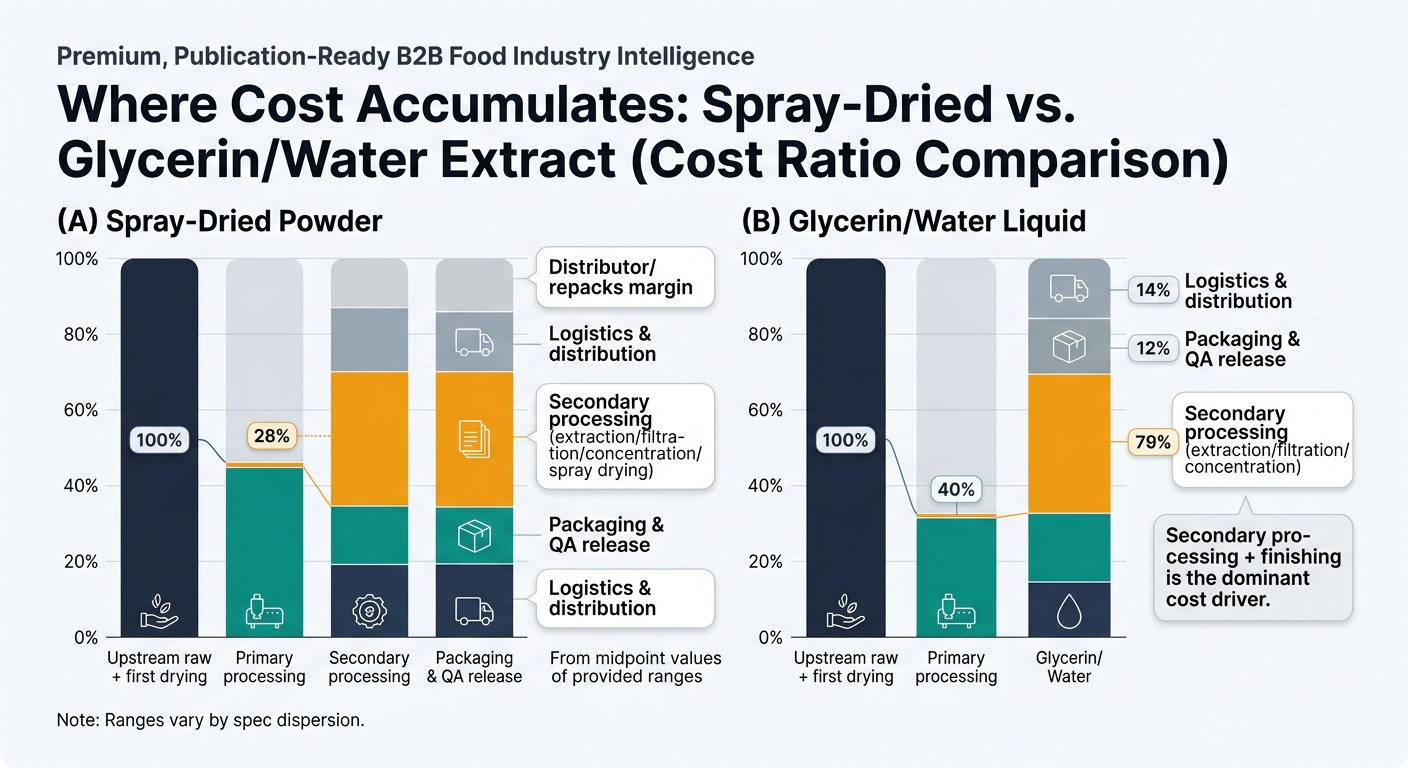
| Supply Chain Node | Cost Ratio (% of Final Cost) | Notes |
|---|---|---|
| Upstream raw flowers + first drying | 20–30% | Labor + drying utilities; sets baseline pigment potential. |
| Primary processing (clean/mill/sieve) | 8–12% | Foreign matter control + mesh standardization; adds yield loss. |
| Secondary processing (extraction + concentration + spray drying + carriers) | 30–45% | Energy + carriers + yield + microbial/filtration burden dominate. |
| Packaging & QA release | 10–15% | Barrier packaging + lab testing + documentation pack. |
| Logistics & distribution | 10–18% | Ocean/air, inland freight, insurance; humidity protection matters. |
| Distributor/repacks margin | 5–12% | Varies by region and lot size; includes working capital. |
| Supply Chain Node | Cost Ratio (% of Final Cost) | Notes |
|---|---|---|
| Upstream raw flowers + first drying | 15–25% | Similar farming economics; quality loss here is hard to correct. |
| Primary processing (crude extraction prep) | 6–10% | Cleaning/milling; may move faster to extraction to reduce risk. |
| Secondary processing (extraction + filtration + standardization) | 25–40% | Less spray-drying energy, but higher filtration/bioburden management. |
| Carrier + preservation system | 8–15% | Glycerin cost + preservative system (where used/allowed) + validation. |
| Packaging & QA release | 12–18% | Higher sensitivity to microbial specs; container compatibility checks. |
| Logistics & distribution | 12–20% | Higher weight/volume; stability window and temperature exposure matter. |
| Supply Chain Node | Cost Ratio (% of Final Cost) | Notes |
|---|---|---|
| Farming + harvest labor | 35–50% | Manual picking/sorting is dominant. |
| Drying & grading | 20–35% | Moisture control, mold prevention, defect sorting. |
| Packaging | 5–10% | Moisture barrier sacks/liners; desiccants for export lots. |
| Logistics & distribution | 10–20% | Bulky product; humidity exposure risk in transit/storage. |
| Trader/exporter margin | 8–15% | Aggregation, working capital, and quality risk coverage. |
Insight: The chain’s real constraint is not acreage—it’s the ability to dry fast and consistently without mold, color loss, or high microbial load.
Data: Anthocyanin systems are sensitive to storage/processing conditions; once degradation occurs early, later standardization often means more processing steps, more carrier, or higher rejection—each adding fixed cost. [1]
Procurement Impact: When supply tightens, the “available” volume may still exist physically, but the volume that can pass cosmetic contaminant/micro expectations shrinks first (especially for tighter internal specs aligned to ISO-style microbiological limits). [3]
Insight: Many farms can grow butterfly pea, but fewer sites can run repeatable extraction, filtration, microbial control, and documentation at export standards.
Data: Standardization requires controlled extraction parameters, lab capability, and often energy-intensive finishing (e.g., spray drying for powders), which tends to cluster in specialized processors.
Procurement Impact: You can see apparent supplier diversity (many traders) while still being exposed to a smaller set of underlying processors.
Insight: Butterfly pea’s signature value (blue/purple hue) is inherently pH-responsive, so performance is not a single number you can lock forever.
Data: Published work shows visible color shifts across pH ranges and sensitivity to temperature/light/oxygen; your formulation pH and thermal history can change perceived shade and stability even when the extract meets its COA. [4]
Procurement Impact: A supplier can meet an extract COA yet still underperform in your finished product if your formulation pH, heat exposure, or packaging differs from the conditions under which the extract was characterized.
(Analyzed at: Jul, 2026) Contract for redundancy plus pack-out, not just unit price: award a qualified secondary source (even at a small premium) and hard-specify moisture/oxygen/light protection in delivery (liner type, desiccant use where appropriate, max transit/storage temperature, and “ship in dry season / avoid port dwell” handling clauses). This works because the fragile node is still drying + finishing, and 2026 weather signals in South/Southeast Asia plus persistent ocean-freight disruption risk make lead-time and “arrived different” quality variance more likely than a clean, linear supply plan suggests. [2]
What’s at stake is rarely just shade drift—teams typically feel it as batch holds, extra QC testing, and reformulation/stability rework that can easily turn a low-cost award into a mid-single- to low-double-digit increase in effective cost of usable material once delays and rejects are included.


