
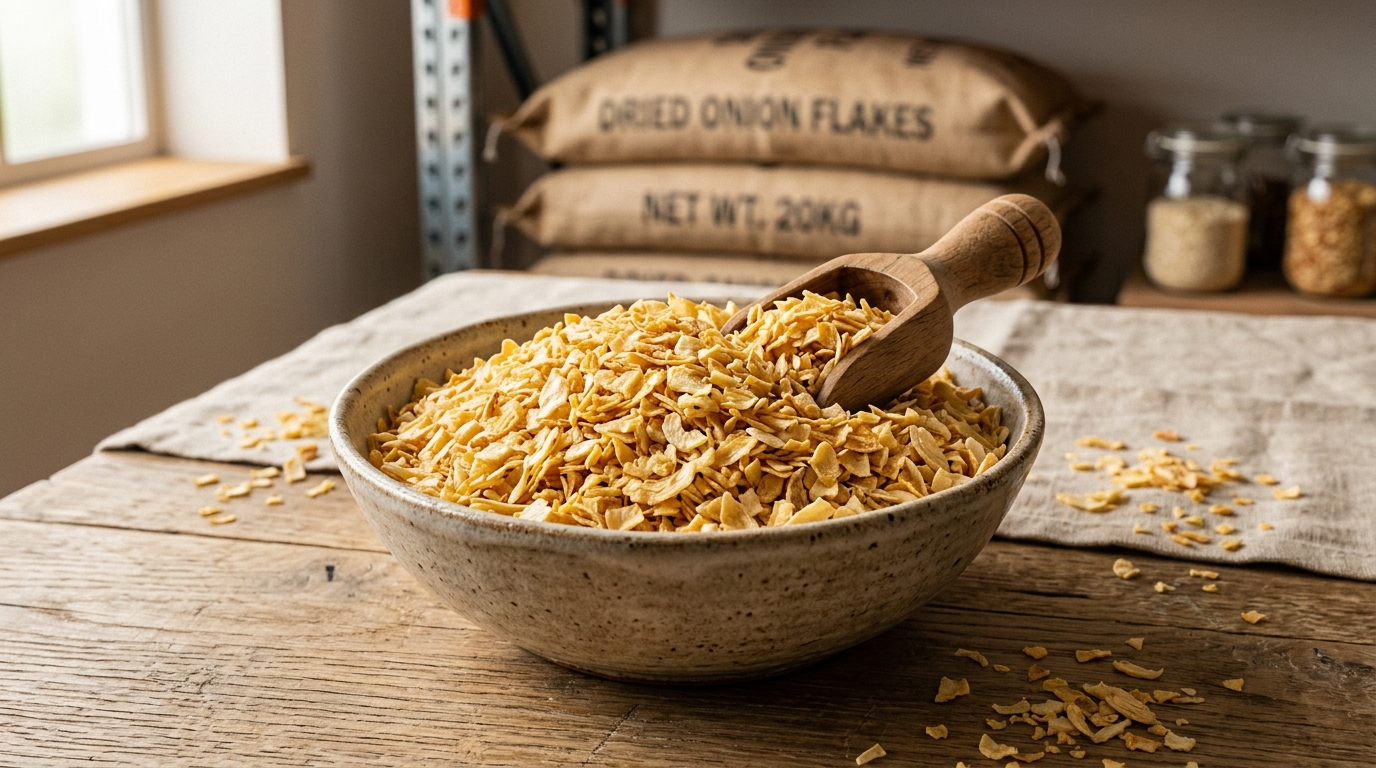
Dried onion flakes look like a simple shelf-stable ingredient, but for Purchase–QA the category behaves like a conversion-and-protection system: you pay to remove ~85–90% water, then you spend the rest of the chain preventing moisture re-absorption, foreign material, and traceability loss. This guide maps the real supply chain sequence and highlights the control points that most influence landed cost, audit readiness, and the probability of holds/rejections.
Dried onion flakes look like a simple shelf-stable ingredient, but the supply chain is a conversion business: you are paying to remove water, then protect the product from re-absorbing it. The biggest fixed cost-drivers are (1) raw onion dry-matter/yield, (2) dehydration energy and throughput, and (3) post-dry handling and packaging integrity that prevents moisture pickup and foreign material.
Insight: The chain is structurally anchored by dehydration clusters and energy-intensive drying; once onions are sliced and dried, most cost is already embedded.
Data: Fresh onions are typically ~85–90% water, so dehydration concentrates solids and creates a large mass-loss conversion; dryers operate as high-energy, capacity-constrained assets where utilization strongly affects unit cost.
Procurement Impact: Your downstream “flake” price mostly reflects upstream yield + dryer economics + packaging/moisture protection—not just labor or freight.

Insight: In dried onion flakes, cost does not accumulate evenly—two nodes dominate: raw onion solids (yield) and dehydration (energy + capacity). Everything else is largely about protecting that value from loss (moisture pickup, contamination, foreign material, and spec drift).
Data: Dehydration is typically the largest variable processing cost due to fuel/power; conversion losses mean small changes in dry-matter, storage shrink, or dryer efficiency materially change cost per kg of finished flakes.
Procurement Impact: The “physics” of the chain explains why the same flake spec can show persistent cost differences by origin: agronomy + energy + plant utilization + post-dry controls.

| Supply Chain Node | Cost Ratio (% of Final Cost) | Notes |
|---|---|---|
| Upstream / Raw Material | 30% | Dominated by dry-matter yield, shrink, and usable solids after defect removal. |
| Primary Processing (Dehydration) | 35% | Energy + dryer utilization + peel/slice losses are the main cost engine. |
| Secondary Processing | 10% | PSD targeting creates fines/off-spec fractions; optional kill-step adds energy. |
| Packaging & QA | 8% | Lined bags/drums + micro/moisture/defect controls; high impact on claims. |
| Logistics & Distribution | 12% | Ocean freight + inland + warehousing; moisture protection is the real value driver. |
| Importer/Distributor Margin | 5% | Service margin for consolidation, credit, re-pack (if applicable). |
| Supply Chain Node | Cost Ratio (% of Final Cost) | Notes |
|---|---|---|
| Upstream / Raw Material | 28% | Slightly lower share as downstream processing/QA intensity rises. |
| Primary Processing (Dehydration) | 33% | More stringent end-point control to avoid under/over-drying. |
| Secondary Processing | 14% | More sieving passes, higher off-spec fraction, more rework handling. |
| Packaging & QA | 12% | Higher verification intensity; packaging integrity becomes more critical. |
| Logistics & Distribution | 10% | Similar freight, but higher sensitivity to container humidity excursions. |
| Importer/Distributor Margin | 3% | Margin may compress if shipped direct to reduce handling steps. |
| Supply Chain Node | Cost Ratio (% of Final Cost) | Notes |
|---|---|---|
| Upstream / Raw Material | 18% | Raw content becomes a smaller share as pack/handling dominate. |
| Primary Processing (Dehydration) | 22% | Same physics, but diluted by packaging and channel costs. |
| Secondary Processing | 8% | Cut/sieve and blending for appearance consistency. |
| Packaging & QA | 22% | Small-pack materials, labeling, tamper evidence, and higher QA overhead. |
| Logistics & Distribution | 13% | More touchpoints and warehousing; higher damage/returns handling. |
| Wholesale/Retail Margin | 17% | Channel markup becomes a major cost share. |
Insight: Even with stable onion supply, dryer throughput and energy availability set a hard floor under cost and a ceiling on supply.
Data: Dehydration requires sustained thermal energy and controlled airflow; plants are constrained by dryer hours, maintenance downtime, and fuel/power reliability.
Procurement Impact: Structural tightness can persist even when fresh onions are plentiful, because dehydration capacity—not just acreage—limits output.
Insight: Small upstream changes in dry-matter, storage shrink, or defect rate cascade into finished cost because you are concentrating solids.
Data: Because most of the fresh onion mass is water, usable solids after curing/storage and trimming determine how many kg of flakes a plant can produce per ton inbound.
Procurement Impact: Two suppliers with the same “flake spec” can have structurally different economics if their inbound onion solids and defect removal rates differ.
Insight: For dried onion flakes, moisture control is a continuous requirement from post-dry cooling through destination warehousing.
Data: Humidity ingress drives caking, potential microbiological growth conditions if moisture/aw rises, and odor changes; container condensation events can occur even in “dry cargo” lanes.
Procurement Impact: Packaging design, liner integrity, and container moisture-control practices are structural safeguards; failures here can erase all upstream value in a single shipment.
(Analyzed at: Aug, 2026)
Write moisture protection into the commercial terms, not just the spec: require high-barrier liners with documented seal integrity, mandate container moisture-control (e.g., approved desiccant/installation practice) and define objective receiving criteria (moisture plus sensory/condition checks tied to hold-and-notify rules). This works because 2026 logistics is still volatile—rates may soften on average, but disruption-driven spikes and longer dwell times increase “container rain” exposure, and dried onion will pick up humidity fast once the barrier system is compromised. What’s at stake is rarely a small claim credit; one wet container can trigger a full-lot hold/rejection and replacement freight, which can easily consume a double-digit share of the landed value of that shipment.


