
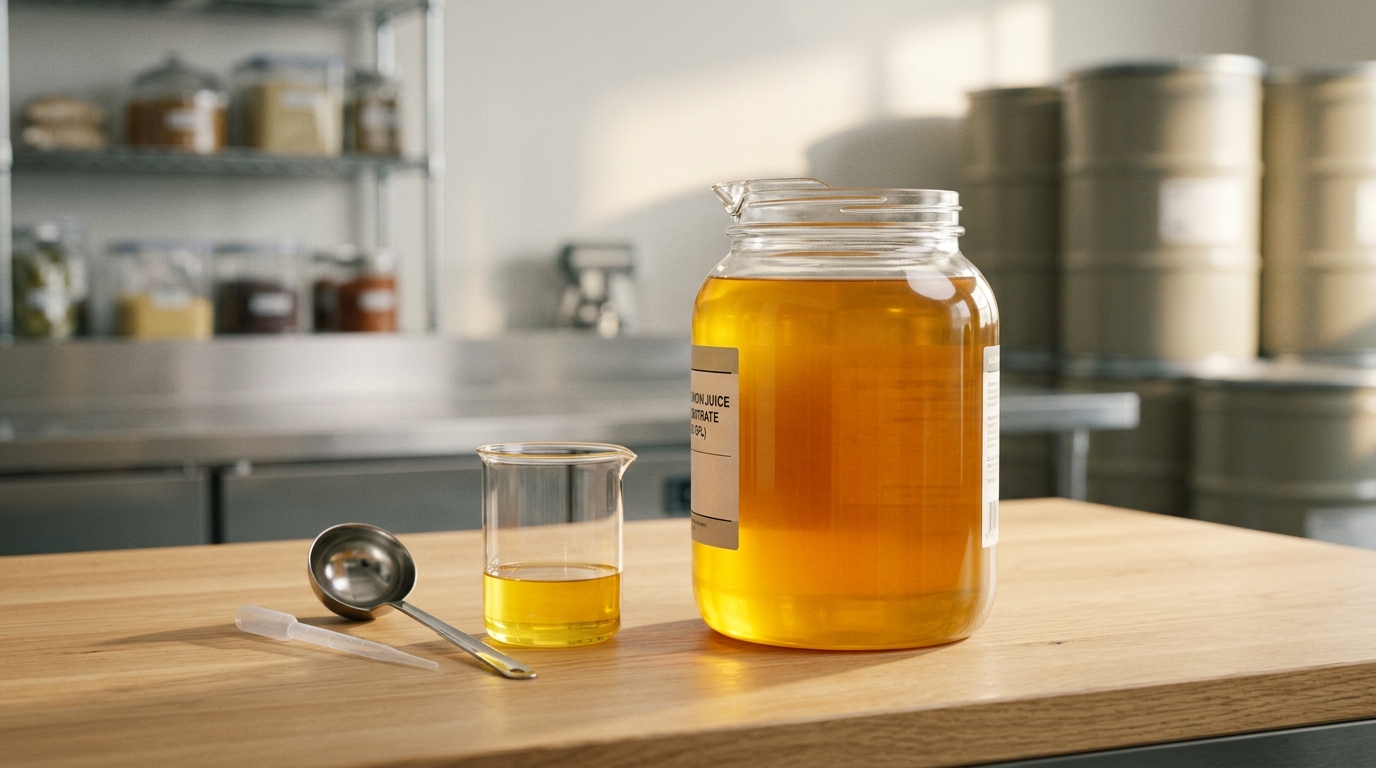
You’re not just buying “lemon juice, but stronger.” You’re buying into a specific industrial chain where small process choices (clarification intensity, evaporator control, aseptic discipline, and logistics temperature/time) drive whether a “400 GPL clarified” concentrate behaves predictably in clear beverages and passes receiving QA without holds.
Clarified lemon juice concentrate (CLJC) at 400 g/L (400 GPL) is not “just juice made stronger”—it’s an industrial liquid ingredient built through a tightly sequenced chain: fruit selection → extraction → clarification → vacuum concentration → aseptic packing → containerized export → controlled storage → reconstitution/use. The fixed cost-drivers are locked in early (fruit yield and byproduct economics) and midstream (energy-intensive evaporation and filtration), while the most failure-prone interfaces are packaging integrity and temperature/time abuse in transit.
In USDA’s manufacturing standard, the “anhydrous citric acid in concentrate” is expressed in grams per liter, which is the basis buyers typically reference as “GPL.” [1] Typical 400 GPL commercial offerings commonly pair that acidity with ~42–50 °Brix (often reported as acid-corrected Brix for citrus concentrates). [2] Concentration is typically achieved by vacuum evaporation; multi-effect systems reuse vapor heat and can achieve very low specific steam consumption (often cited as ~1 kg steam to evaporate ~6 kg water in high-effect systems). [3]
If you don’t map where clarification, evaporation, and aseptic filling occur (and under what controls), you miss the physical reasons why two “400 GPL clarified” offerings can behave differently in clear beverages: turbidity drift, oil carryover, oxidative notes, and micro risk are created by process choices—not by paperwork.

In CLJC 400 GPL, cost is structurally concentrated in (1) fruit and yield, (2) clarification losses + consumables, (3) evaporation energy and throughput, and (4) aseptic packaging materials and hygiene discipline. Margins tend to be “earned” at nodes that reduce variability (standardization/blending, QA release discipline, and reliable export execution).
Commercial 400 GPL specs commonly cite acidity windows around 390–410 g/L and Brix ranges that vary by supplier and measurement method (acid-corrected vs. not). [2] Vacuum evaporation economics are driven by energy and steam economy in multi-effect designs (often cited: ~1 kg steam evaporates ~6 kg water). [3] Aseptic bag-in-drum is a common industrial pack format for juices/concentrates, commonly in the ~200–220 L drum/bag size family. [5]
When you evaluate physical equivalence, the “cost story” tells you where suppliers are most likely to cut corners: filtration media change-outs, evaporator operating conditions, and aseptic consumables/controls. Those are the nodes most correlated with downstream nonconformance (clarity, flavor stability, micro holds).
Fruit cost is not just “per ton of lemons”—it’s per kg of recoverable juice acids and soluble solids, and that depends on orchard water availability, fruit size, and diversion between fresh and processing channels.
In practice, industrial processors rely on incoming fruit sorting/fitness controls because defect load and extraneous matter become downstream fouling and filtration loss (even if final acidity is standardized). (Industry practice; validate in supplier audits/specs.)
Expect the largest embedded variability to enter here: if fruit quality shifts, you’ll see it later as higher clarification load (more fouling), more filtration loss, and more variability in color/oxidative notes—regardless of the final 400 GPL target.
Extraction is a yield-and-contamination-control operation: you’re maximizing juice recovery while minimizing peel oil carryover and insolubles that later threaten clarity.
Citrus juice processing flows typically include extraction followed by separation/screening prior to concentration; clarified pathways are more sensitive to insolubles because they must support transparent applications. (General processing reality; confirm via supplier process descriptions during qualification.)
The physical lever here is not “more pressing,” it’s controlled extraction/screening that reduces downstream filtration burden. Poor control increases filtration media cost and raises the probability of turbidity drift in finished concentrate.
Clarification is where suppliers pay (or avoid paying) for consistency: removing pulp/insolubles and haze precursors protects clear beverages, but it introduces product loss and recurring consumable costs.
Fraud/adulteration literature for lemon juice repeatedly cites vectors such as undeclared sugar/water, peel and/or pulpwash, and organic acid additions—meaning “clarified” status and authenticity controls remain structurally relevant, not academic. [6]
This is the node most associated with “looks fine on CoA, fails in your line” outcomes (haze, ring formation, filter plugging). Physical clarification capability and discipline matter more than nominal GPL.
Concentration is an energy-and-quality balancing act: the economics are dominated by water removal, while quality risk is dominated by heat/time/oxygen exposure and evaporator control.
Technical references describe vacuum evaporation as the practical commercial method for fruit juice concentrates; multi-effect systems improve steam economy (commonly cited: ~1 kg steam to evaporate ~6 kg water). [3]
Suppliers with constrained evaporation capacity will prioritize throughput; that physical constraint often shows up as broader Brix ranges and greater lot-to-lot sensory drift. Even with the same 400 GPL target, evaporator operating discipline is a primary determinant of stability in clear systems.
400 GPL product is frequently standardized (blended) to hit acidity targets and maintain functional consistency; this is where “industrial grade” repeatability is created.
Market specs for “clear 400 GPL” commonly present standardized targets and tight acidity windows (e.g., 390–410 g/L) with minimum Brix thresholds. [7]
This node determines how predictable your dosing and finished-product pH/TA will be. The physical reality: tighter release criteria increase rework/blending effort and hold time, which must be managed to avoid oxidative quality drift.
Packaging is a high-leverage cost node because it combines material cost (aseptic bags, drums) with the operational discipline required to keep micro near-zero and prevent oxygen ingress.
Aseptic bulk packaging for juice concentrates commonly uses bag-in-drum formats around 200–220 L, and packaging guidance highlights handling/stacking and material considerations for juice concentrates. [8]
Most “mystery” micro positives and shelf-life complaints trace back to this interface (bag integrity, aseptic zone control, seal quality). Packaging choices also hard-set your warehouse handling constraints and damage risk profile.
CLJC is typically exported in containerized shipments; the biggest physical risks are delay, heat exposure, and handling damage (drum deformation, bag puncture), not just freight cost.
Industry packaging/handling guidance for fruit juice concentrates emphasizes that packaging choice and handling conditions affect storage/transport outcomes (including damage risks and suitability for refrigerated vs. aseptic classifications). [8]
The logistics node is where “spec-compliant at release” can become “nonconforming at receipt” through physical abuse. Your receiving QA outcomes (clarity, sensory, micro) are partially a logistics performance artifact.

| Supply Chain Node | Cost Ratio (% of Final Cost) | Notes |
|---|---|---|
| Upstream raw lemons | 30% | Driven by yield and fruit quality; sets downstream filtration load. |
| Extraction & screening | 8% | Yield optimization + basic solids removal. |
| Clarification/filtration | 12% | Consumables + product loss; key for clear applications. |
| Vacuum evaporation concentration | 18% | Energy + throughput; quality depends on control. |
| Standardization + QA release | 7% | Blending/holds/testing to hit 400 GPL repeatedly. |
| Aseptic packaging | 10% | Aseptic bags + drums + hygienic controls. |
| Ocean/inland logistics + warehousing | 15% | Containerization, handling damage risk, storage time. |
| Supply Chain Node | Cost Ratio (% of Final Cost) | Notes |
|---|---|---|
| Upstream raw lemons | 32% | Similar fruit economics; sometimes tolerates higher defect load. |
| Extraction & screening | 10% | Less aggressive clarification expectations vs. clear. |
| Clarification/filtration | 5% | Lower filtration intensity; more insolubles tolerated. |
| Vacuum evaporation concentration | 18% | Still energy-intensive water removal. |
| Standardization + QA release | 7% | Targeting acidity/Brix ranges; less clarity-driven rework. |
| Packaging & QA | 10% | Drum formats similar; micro control still critical. |
| Logistics + warehousing | 18% | Similar physical handling; sometimes different temp requirements by customer. |
| Supply Chain Node | Cost Ratio (% of Final Cost) | Notes |
|---|---|---|
| Concentrate input (400 GPL) | 55% | Dominant cost component; drives acid load and flavor base. |
| Water treatment + blending | 10% | Water quality and mixing control affect clarity and taste. |
| In-plant QA (pH/TA/clarity/micro) | 8% | Verification and release at use site. |
| Packaging (finished product) | 17% | Retail/foodservice pack materials often dominate. |
| Internal logistics + storage | 10% | Tank/drum handling, shelf-life management. |
CLJC 400 GPL behaves like a “precision liquid ingredient” because clarified specs narrow substitutability, and the chain’s bottlenecks are physical (campaign processing capacity, evaporation energy, and aseptic discipline), not administrative.
USDA’s manufacturing standard expresses concentrated lemon juice grading using anhydrous citric acid in grams per liter—so suppliers can meet the number while still differing on Brix ranges, clarification intensity, and minor components that affect clarity/sensory. [1] Adulteration literature for lemon juice repeatedly cites vectors like sugar/water addition, pulpwash/peel, and organic acid additions, which is why authenticity controls are structurally relevant in juice concentrates. [6]
Three constants shape your operational outcomes:
If you only track “400 GPL clarified” as a label, you miss the physical determinants of performance: clarification load, evaporator control, and aseptic integrity.
Market-facing specs show wide real-world ranges for Brix and acidity targets around 400 GPL, and technical references emphasize vacuum evaporation’s energy-driven economics and aseptic drum prevalence. [2]
Quick Win: Treat your internal material definition as a process-backed ingredient, not a single number—document (a) clarified/insolubles expectations, (b) acidity basis (GPL definition), (c) Brix method (acid-corrected vs. not), and (d) packaging format/aseptic expectations. That single alignment step reduces downstream confusion during QA release and plant troubleshooting.
(Analyzed at: Jul, 2026)
The highest-conviction move is to contractually lock process-backed equivalence—not just “400 GPL”—by requiring (1) acid-corrected Brix reporting, (2) explicit clarified/insolubles limits tied to your clear-beverage use case, and (3) aseptic pack integrity/handling requirements with defined hold-and-release evidence. This works because the market can meet the GPL number while still varying on the exact levers that create haze, oxidative drift, and micro risk, and because 2025/26 supply commentary continues to flag structural concentration and volatility in global lemon processing capacity. [4] In practice, teams that formalize these controls typically cut receiving holds and re-testing enough to protect a low-single-digit percent of annual ingredient spend—while avoiding the much larger, harder-to-budget cost of a mid-season emergency switch.


