INDUSTRY TRENDS

How Canned Shredded Beef Really Moves, Costs, and Fails (and What QA/Compliance Buyers Should Lock Down)

Author
Team Tridge
DATE
August 25, 2026
8 min read
canned-shredded-beef Cover
Unlock Full Data
Canned Shredded Beef Market Intelligence
Prices · Trends · Origins · Forecasts

Canned shredded beef looks like a simple shelf-stable protein SKU, but the real procurement leverage sits in a few technical “gates”: raw beef composition (yield), cook/shred control (drained weight), and the retort + container-closure system (commercial sterility). This guide maps where value concentrates, where failures originate, and what a Purchase–Quality/Safety/Compliance role should require so approvals hold up in audits.

Executive Summary

  • Risk concentrates at the retort + closure node: once sealed, shelf-stable meat risk shifts from cold-chain biology to process control + container integrity (double seams/pouch seals) [1].
  • Retort conditions are not “nice-to-have” details: commercial sterilization commonly uses >212°F, typically ~240–250°F (115–121°C) in a pressure vessel; small deviations become big compliance events [2].
  • Packaging volatility is real in 2025–2026: U.S. can-related producer price indices rose materially into 2026; expect pass-through timing and availability constraints to matter as much as beef [3].
  • Cost surprises usually come from three levers: beef input price, yield/drained-weight misses, and can/ends economics—often moving independently.

1) The Physical Map: Where Value (and Risk) Concentrates in Shelf‑Stable Shredded Beef

Insight

Canned shredded beef is a “retort + container” product as much as it is a beef product: once beef is cooked, shredded, filled, and thermally processed in a hermetically sealed container, the supply chain shifts from cold-chain biology risk to process-control and container-integrity risk.

Data

Commercial sterilization for retort packaging typically occurs above 212°F, commonly around 240–250°F (115–121°C), and the container can be a metal can or retort pouch [2].

Procurement Impact

Your fixed cost-drivers are structurally “locked in” at three nodes: (1) raw beef selection (lean/fat and trim discipline), (2) cook/shred yield + formulation control (drained weight, salt/moisture), and (3) packaging + seam/seal integrity (can ends, double seams, pouch seals). If any of these nodes is under-controlled, downstream distribution scale and long shelf life amplify the consequence of a miss.
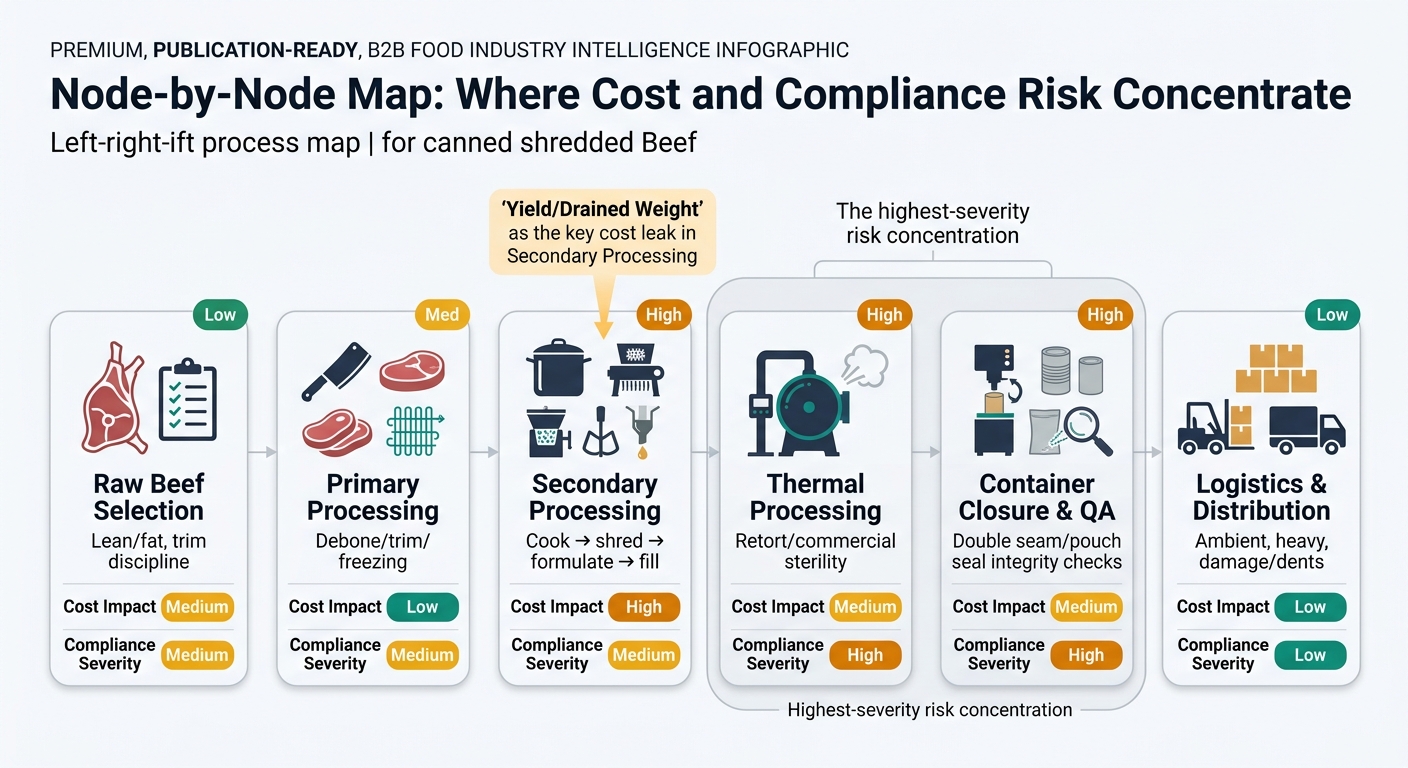
  • Quick Win: Treat packaging and thermal processing capacity as hard constraints (not “support functions”) when mapping supply continuity.
A left-to-right supply chain/process map for canned shredded beef with 6 nodes (raw beef selection; primary processing; secondary processing cook→shred→formulate→fill; thermal processing/retort; container closure & QA; logistics & distribution) overlaid with relative cost impact and compliance severity indicators, emphasizing retort + closure as highest-severity risk and highlighting yield/drained weight as the key cost leak in secondary processing.

2) Where Cost Accumulates: Node-by-Node Cost & Margin Structure (and What Drives It)

Insight

Costs build in step-changes rather than smoothly: raw beef dominates the base, but packaging and thermal processing add large, relatively fixed increments that don’t scale down well for short runs.

Data (validated + corrected framing)

Packaging cost is structurally volatile because it is tied to metal inputs (tinplate/aluminum), tariffs, and indexed pass-through mechanisms. In the U.S., producer price indices for metal can manufacturing increased notably into 2026, consistent with ongoing packaging input inflation pressure [3].

Procurement Impact

When you see unexplained cost movement in finished canned shredded beef, the “usual suspects” are (a) beef input price, (b) yield loss vs. drained-weight spec, and (c) can/ends availability and metal input cost—often independent of each other.

1. Upstream / Raw Material (Cattle → Boneless Blocks/Trimmings)

  • Insight: Raw material economics are driven by cut selection and trim discipline (lean/fat ratio) more than “beef is beef.” Shredded formats can use lower-value cuts/trimmings, but variability shows up later as texture, fat cap, and drained yield issues.
  • Data (validated, but avoid overstating the specific source): Cooking yield loss is expected due to moisture loss and fat rendering; the magnitude varies by cut, fat content, and trimming practices. (Use internal yield history + supplier trim specs as primary evidence; public nutrition tables are directionally consistent but not a yield spec.)
  • Procurement Impact: The physical reality is that you are buying an input whose composition strongly influences downstream yield and spec compliance. If the upstream spec tolerates wide lean/fat swings, you pay later in cook shrink, texture complaints, and drained-weight rework/holds.

2. Primary Processing (Deboning, Trimming, Freezing, Export Prep)

  • Insight: This node converts biological variability into tradable industrial inputs (frozen blocks, standardized trims). The cost stack is dominated by labor, freezing/energy, and yield loss from trimming.
  • Data (validated conceptually): Yield loss occurs not only from cooking but also from removal of bone, gristle, and fat before or after cooking; upstream trimming choices materially change downstream “usable meat.”
  • Procurement Impact: Physical standardization here reduces downstream variance. If this node is weak (inconsistent trim specs, poor segregation), the retort plant becomes the “sorting station,” which is the most expensive place to discover variability.

3. Secondary Processing / Manufacturing (Cook → Shred → Formulate → Fill)

  • Insight: This is the yield-and-spec node. The product’s unit economics are shaped by cook shrink, shredding losses, formulation (broth/sauce), and the ability to hit drained weight and texture targets consistently.
  • Data (validated conceptually): Cooking inherently causes moisture/fat loss; the magnitude varies by cut, fat content, and trimming practices—hence why plants rely on yield targets, in-process checks, and finished drained-weight verification (not just incoming COAs).
  • Procurement Impact: This node is where “cheap beef” can become expensive finished goods. If the formulation is tight (e.g., low tolerance on fat, salt, moisture, drained weight), the plant must buy more expensive inputs or accept higher rework/scrap—both are structural cost drivers.

4. Thermal Processing & Container Closure (Retort + Commercial Sterility)

  • Insight: Retort processing is a capability gate: it requires validated thermal schedules, trained operators, and tight control of critical factors. A small deviation can create a large compliance event because the product is designed to be shelf-stable.
  • Data: FSIS guidance for thermally processed, commercially sterile (TPCS) products treats these as “canned” products across multiple container types, and the canning regulations/controls are intended to exclude biological hazards when properly executed [1].
  • Procurement Impact: This node is a non-negotiable fixed cost: validated processes, monitoring, and deviation handling are embedded in the manufacturing footprint. Capacity is constrained by retort availability and cycle time; you cannot “overtime” your way out of a retort bottleneck without risking process drift.

5. Packaging & QA (Cans/Ends or Pouches + Seam/Seal Integrity)

  • Insight: Packaging is both a cost center and a safety system. For shelf-stable meats, closure integrity (double seam or pouch seal) is a primary barrier preventing post-process contamination.
  • Data: FDA’s container-integrity examination methods call out critical seam conditions/defects and formal seam evaluation practices; inspection guidance emphasizes documented container closure examinations and corrective actions [4].
  • Procurement Impact: Packaging availability (can bodies/ends) can stop production even when beef is available. Quality failures here are high-severity: seam/seal defects can turn into market withdrawals/recalls, and the investigation burden is heavy because you must prove container integrity lot-by-lot.

6. Logistics & Distribution (Ambient, Heavy, Cube-Inefficient)

  • Insight: Finished product is shelf-stable (no cold chain), but it is dense and heavy, making freight and handling a structurally meaningful cost—especially for long lanes and mixed loads.
  • Data: Retort packaging is shelf-stable at room temperature after commercial sterilization [2].
  • Procurement Impact: Ambient distribution reduces temperature-control complexity, but the physical weight of canned goods makes outbound freight and warehousing space persistent cost drivers. Damage handling matters: dents and seam damage can trigger holds and inspection workload.

Product-Level Cost Breakdown

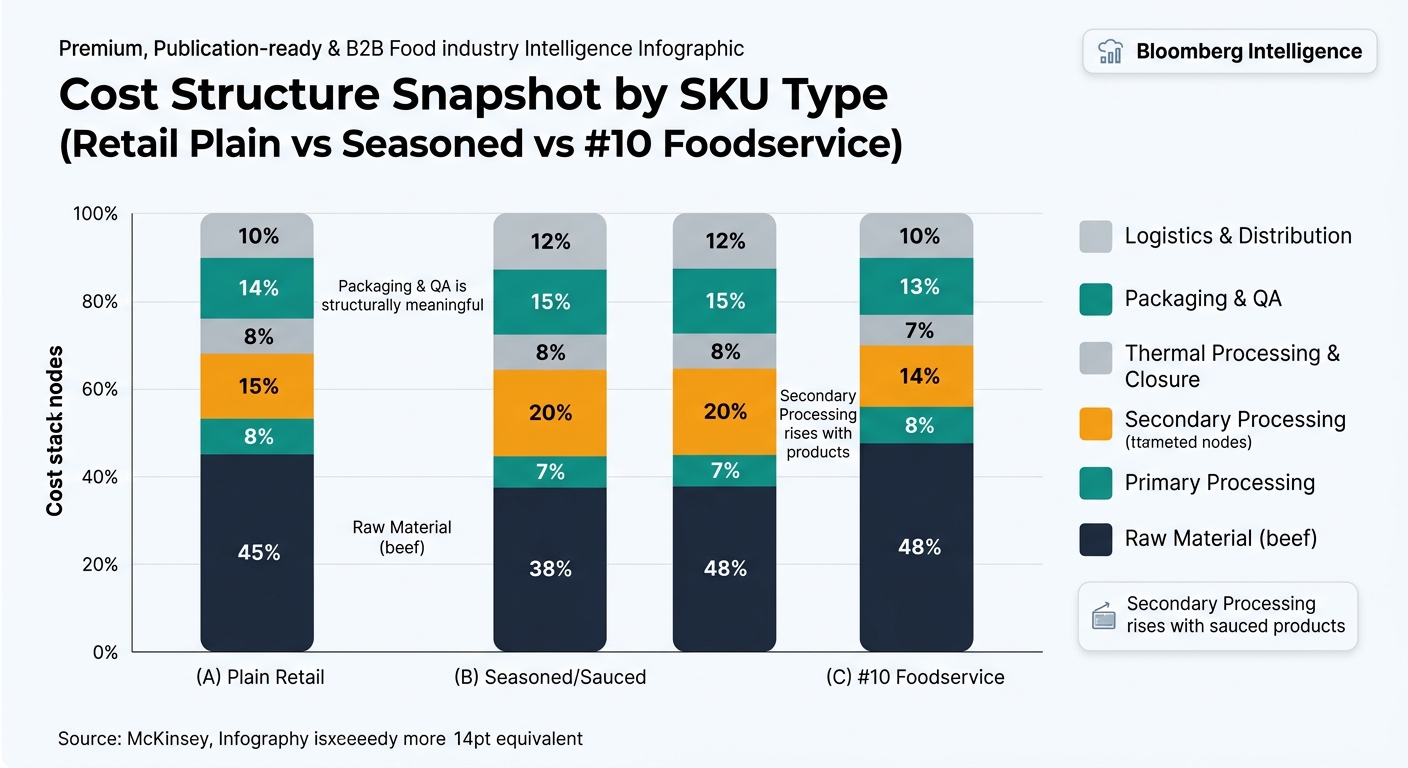
A) Plain Canned Shredded Beef in Broth (Retail 5–12 oz)

Supply Chain Node Cost Ratio (% of Final Cost) Notes
Raw Material Cost (beef) 45% Dominated by lean/fat spec and trim discipline; variability converts to yield loss later.
Primary Processing 8% Debone/trim/freezing; standardization and segregation reduce downstream variance.
Secondary Processing 15% Cook shrink + shredding + formulation; drained-weight compliance is a yield lever.
Thermal Processing & Closure 8% Retort cycle time, utilities/steam, monitoring, and deviation controls.
Packaging & QA 14% Can/ends, labels, seam checks, container integrity inspection workload.
Logistics & Distribution 10% Heavy outbound freight + warehousing; damage/hold handling adds friction.

B) Seasoned Canned Shredded Beef (Sauced / Taco-Style)

Supply Chain Node Cost Ratio (% of Final Cost) Notes
Raw Material Cost (beef) 38% Sauce can dilute meat share, but meat spec still drives texture and fat control.
Primary Processing 7% Similar to plain, plus tighter segregation if multiple inputs are used.
Secondary Processing 20% More ingredients, mixing control, viscosity management, higher rework risk if out-of-spec.
Thermal Processing & Closure 8% Same retort constraints; particulate-in-sauce products can be more schedule-sensitive.
Packaging & QA 15% Same can/ends exposure; additional label complexity increases QA checks.
Logistics & Distribution 12% Similar weight; sometimes higher damage sensitivity if larger packs.

C) Foodservice #10 Can Shredded Beef

Supply Chain Node Cost Ratio (% of Final Cost) Notes
Raw Material Cost (beef) 48% Higher meat content and tighter drained yield expectations drive beef share.
Primary Processing 8% Larger run sizes can improve efficiency, but input consistency is critical.
Secondary Processing 14% Cook/shred yield remains the key driver; texture specs are often stricter for foodservice.
Thermal Processing & Closure 7% Retort time and handling scale with can size; capacity planning is structural.
Packaging & QA 13% Larger cans/ends; seam integrity and dent handling are major hold triggers.
Logistics & Distribution 10% Pallet density helps, but weight keeps freight meaningful.
100% stacked bar chart comparing cost structure by SKU type (plain retail, seasoned/sauced, and #10 foodservice) segmented by six cost nodes using the exact table percentages, with legend and callouts that packaging & QA is structurally meaningful and secondary processing rises with sauced products.
Sourcing Window Radar
Canned Shredded Beef — Global Harvest Calendar
BRAZIL SEASON ACTIVE
🇧🇷 Brazil
JAN — DEC
🇺🇸 United St.
JAN — NOV
🇲🇽 Mexico
SEP — SEP
JanFebMarAprMayJunJulAugSepOctNovDec

3) Structural Realities You Can’t “Process-Improve” Away

Insight

Three constraints shape availability, cost, and compliance exposure regardless of supplier: retort capacity, packaging supply, and the physics of yield loss.

Data

(1) TPCS products rely on thermal processing controls intended to exclude biological hazards when properly executed; (2) container integrity evaluation is formalized through seam/seal examination methods; (3) retort packaging achieves commercial sterilization at high temperatures (commonly 240–250°F) [1].

Procurement Impact

These are “industry constants” that should be built into your specification and approval artifacts.

  • Reality 1 — Retort capacity is a hard ceiling: Retort lines are specialized assets with cycle-time physics. When demand spikes, the constraint is often retort time and validated schedule discipline—not labor.
  • Reality 2 — Packaging is a supply chain within the supply chain: Packaging costs and availability are exposed to metal input inflation and policy/tariff dynamics; in 2026, industry commentary and price indices support ongoing pressure and pass-through timing into 2026–2027 contracting cycles [3].
  • Reality 3 — Yield losses are structural, not a rounding error: Cook shrink and fat/moisture loss are inherent; upstream trim and formulation choices decide whether that loss is predictable or chaotic.
  • Quick Win: Document these three constraints explicitly in your product “technical file” (spec + process + packaging assumptions) so exceptions are visible before production slots are booked.

Key Insights (What to Remember When You Review a Spec or Plant Profile)

Insight

In canned shredded beef, the highest-leverage technical controls are the ones that tie raw input composition to finished container integrity.

Data

Regulators and reference methods emphasize (a) validated thermal processing controls for commercially sterile products and (b) formal examination of container integrity (double seams/pouch seals) [1].

Procurement Impact

A strong physical map lets you separate “cost drivers” from “failure modes” without guessing.

Key Takeaways

  • Beef spec discipline (lean/fat, trim) determines yield and texture stability.
  • Cook/shred + drained-weight control is where hidden cost accumulates.
  • Retort + closure integrity is the safety system; seam/seal defects are not cosmetic issues.
  • Packaging availability can be the binding constraint even in a well-supplied beef market.

The Bottom Line for Your Next Contract

Analyzed at: Aug, 2026

Lock in a single auditable “retort + closure + packaging” dossier per SKU (thermal process family by container, seam/seal control plan, and a can/ends supply commitment with a price-reset mechanism), then tie supplier approval to evidence that those controls are executed and recorded—not just promised. This works because regulators treat TPCS controls and container-closure examinations as foundational, and 2025–2026 packaging inflation has been measurable enough that ends/cans can swing your delivered cost even when beef is flat [1].

If you don’t contract and govern packaging and closure integrity explicitly, the “cost of a hold” (line downtime, rework, and potential market action) can easily outweigh a few cents per can—especially on long-shelf-life, wide-distribution SKUs.

Canned Shredded BeefSupply Chain Intelligence
131 countries tracked
10
Exporters
10
Importers
$667M
Top Export Value
Top Exporters (2024)
🇧🇷
Brazil
$667M
🇺🇸
United States
$277M
🇮🇪
Ireland
$253M
🇩🇪
Germany
$249M
🇵🇱
Poland
$242M
+126 more
Top Buyers
🇺🇸 United States $615M🇬🇧 United Kingdom $309M🇨🇦 Canada $234M🇩🇪 Germany $162M🇳🇱 Netherlands $107M

References

  1. fsis.usda.gov
  2. ask.fsis.usda.gov
  3. fred.stlouisfed.org
  4. fda.gov

Related Contents

Subscribe
→
By subscribing you agree to with our Privacy Policy and provide consent to receive updates from our company.
Thank you! Your submission has been received!
Oops! Something went wrong while submitting the form.
Subscribe to receive the latest blog posts, updates, promotions, and announcements from Tridge.