
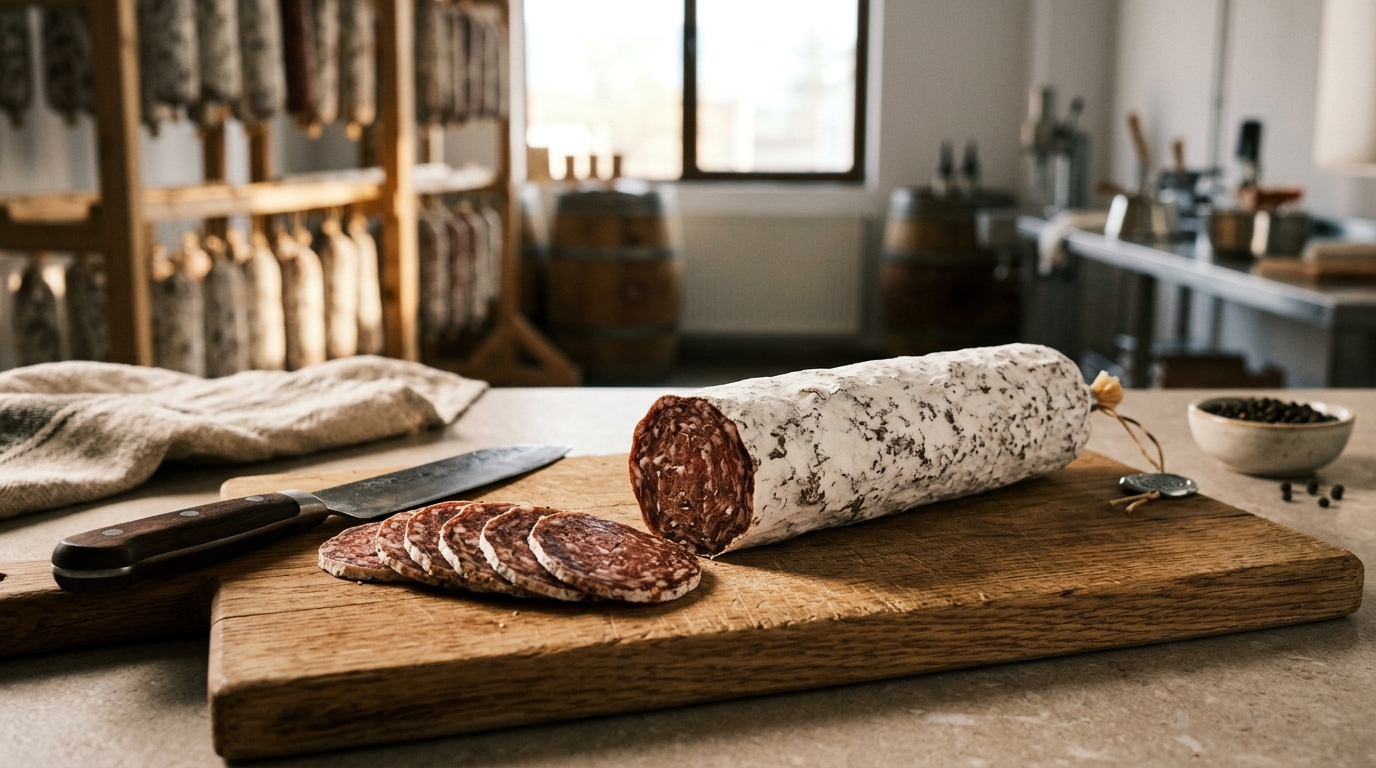
Salam de Sibiu sourcing behaves less like a “deli swap” and more like a constrained-capacity, long-cycle program: the PGI rules narrow the eligible producer pool, and the minimum ~70-day process time makes last-minute switches slow and costly. This case study keeps the story procurement-real (spec, yield, OTIF, claims, and contracting) and is written so sales teams can explain—credibly—why the best outcomes come from pre-qualification and cost-driver logic, not just tougher RFQs.

Salam de Sibiu is not a “swap-in” deli meat—its PGI rules and long curing cycle make last-minute supplier changes slow and expensive, so procurement outcomes depend more on pre-work than on negotiation theatrics.
The EU PGI specification for “Salam de Sibiu” explicitly references a lengthy maturation-drying phase and states that after a minimum of 70 days the finished product must meet defined parameters; producer materials also commonly cite 70 days minimum total production time.
If you treat Salam de Sibiu like a short-lead cooked meat, you’ll under-budget working capital, overestimate responsiveness, and discover too late that “backup suppliers” are not actually qualified for your spec, pack format, and market labeling.
The win condition wasn’t “cheapest €/kg”—it was lowering total cost volatility while reducing single-plant exposure.
A mid-sized EU deli/charcuterie brand achieved measurable improvement by combining dual-sourcing, yield-aware costing, and risk triggers (details below). (Note: company and figures are anonymized; treat as a realistic composite, not a public reference.)
You can credibly position Salam de Sibiu as a category where procurement maturity shows up in continuity and governance, not just price-down.
Their biggest hidden cost driver was not pork price alone—it was the combination of curing lead time, yield loss, and format-driven quality risk (especially sliced packs).
Salam de Sibiu production is time- and environment-dependent; it involves fermentation and long maturation/drying, where moisture loss and defect/downgrade risk can make “true cost per sellable kg” diverge from PO price. The PGI specification also ties the end-product to physico-chemical and microbiological parameters that must be met after the minimum process period.
If your commercial model is based on price/kg delivered, you’ll miss the levers that actually move margin: yield, downgrade rate, and the cost-to-serve differences between whole sticks vs. sliced/MAP.
The company looked like many specialty buyers: strong brand pull, limited technical bandwidth, and a single incumbent supplier relationship that had “worked—until it didn’t.”
This is the exact profile where a disruption turns into a 8–12 week commercial problem because you cannot “make up” matured inventory quickly.
The pain showed up as a mix of cost spikes, service misses, and quality drift—each reinforcing the other.
In a long-aged product, service misses are rarely “logistics only”—they’re often upstream capacity slotting + maturation constraints, which procurement can influence via contracting and forecast discipline.
They didn’t start by bidding the incumbent; they started by making the category measurable (true cost, qualification gates, and risk triggers), then negotiated from a stronger baseline.
The PGI framework narrows the eligible producer pool; the producer association publicly lists a limited set of accredited producers, which structurally increases supplier concentration compared with commodity salami categories.
Expect fewer “like-for-like” alternates; your process must separate (1) PGI compliance, (2) spec/format fit, and (3) capacity/lead-time reliability.
The team used a two-horizon plan: immediate stabilization (stop the bleeding) and structural resilience (reduce dependency).
Timeline below reflects typical qualification lead times for dry-cured products when you include QA, label checks, and production slot booking.
This is a repeatable playbook you can map to any cured-meat program with long maturation.
Weeks 1–2: Rebuilt the cost model around “sellable kg,” not “delivered kg.”
Insight: Yield loss and downgrades are procurement-relevant because they change the effective €/sellable kg.
Data (validated): The PGI specification frames a long maturation/drying stage and end-of-process compliance checks after the minimum production period—conditions where process variability can translate into scrap/downgrades.
Procurement Impact: Negotiations shifted from “unit price” to “price + yield + claims,” enabling defensible trade-offs (e.g., paying slightly more for lower downgrade risk in sliced format).
Weeks 2–5: Split the specification into “identity-critical” vs. “commercial-flex.”
Insight: Overly rigid specs shrink the supplier pool; overly loose specs create brand risk.
Data (validated): PGI labeling/product naming rules must be met; the EU PGI documentation specifies how the PGI designation and related identifiers should appear alongside the manufacturer’s trade name.
Procurement Impact: They locked identity-critical parameters (PGI compliance, sensory profile guardrails) while allowing controlled flexibility (case count per pallet, secondary packaging, delivery cadence).
Weeks 4–10: Qualified a second PGI-capable source for a defined volume band.
Insight: Dual-sourcing in Salam de Sibiu is less about “switching” and more about “standing capacity + proven equivalence.”
Data (validated): The accredited producer base is limited and publicly referenced by the producer association, implying competition for curing-room capacity during peak periods.
Procurement Impact: They created a 55/45 volume split with guardrails: the alternate covered promotions and surge demand, while the incumbent retained base load.
Weeks 6–12: Recontracted with capacity slots + indexed components (not blanket price holds).
Insight: For aged products, capacity reservation can be more valuable than a small €/kg concession.
Data (updated to current market reality as of Jul 2026): EU industrial energy price pressure has generally eased versus the 2022 peak, but volatility and regional price dispersion remain a planning issue—especially relevant for climate-controlled curing rooms. Recent Eurostat and EU energy-market commentary show continued sensitivity of electricity pricing to gas-market dynamics and a trend of declining (but still material) industrial energy price indices into late-2025/early-2026.
Procurement Impact: The contract separated cost drivers into: pork component, packaging, and an “energy/capacity” discussion tied to service levels—reducing disputes and emergency buys.
Ongoing: Implemented a risk trigger register tied to animal health and regional disruption signals.
Insight: Animal disease shocks don’t just raise pork cost—they can trigger movement restrictions and supply discontinuities.
Data (validated directionally): ASF remains an actively monitored risk in Europe, with recurring outbreaks reported over recent years, including in Romania, and ongoing scientific/public monitoring.
Procurement Impact: They defined “if/then” actions (advance buys, promotion rescheduling, alternate activation) instead of improvising under pressure.
The measurable gains came from reducing expediting, improving OTIF, and lowering quality claims—then using that stability to negotiate more rationally.
Results below reflect a 12-month run-rate after implementation (seasonality normalized).
This is the kind of outcome set you can defend internally: it ties procurement actions to P&L and service KPIs.

| Metric | Before | After | What moved it |
|---|---|---|---|
| Total cost-to-serve (€/year) | €6.00M | €5.59M | Fewer expedites, packaging optimization, better price timing |
| Total cost change | Baseline | -6.8% | Yield-aware costing + contract structure |
| Supplier concentration (top supplier share) | 92% | 55% | Qualified alternate + volume bands |
| OTIF | 86% | 95% | Capacity slots + forecast discipline |
| Average lead time (order-to-delivery) | 21 days | 24 days | More realistic planning (less “rush”) |
| Expedite freight share of shipments | 18% | 6% | Planned lane/cadence |
| Claims rate | 1.9% | 0.9% | Format-specific QC + pack specs |
| Promotion fill rate | 88% | 96% | Alternate coverage for peaks |
The category rewards teams that manage constraints (time, capacity, compliance) rather than fighting them with spot buys.
The PGI specification and long maturation/drying cycle are structural—these constraints don’t disappear with better negotiation.
Use the checklist below to decide whether you need dual-source, spec refactoring, or contract redesign.
Most failures come from treating Salam de Sibiu like a commodity deli SKU.
Producer concentration under PGI and ongoing animal health risk signals (e.g., ASF) are recurring realities in Europe.
Avoid these traps:
Treat Salam de Sibiu as a constrained-capacity, long-cycle category and build resilience through pre-qualified alternates plus yield-aware commercial terms.
The product’s long process time (minimum 70 days in the EU PGI documentation and producer materials) and PGI constraints structurally limit rapid substitution.
The logical next step for most teams is not another RFQ—it’s building a decision-ready view of (1) which PGI-capable suppliers can truly meet your format/spec, (2) what capacity/lead-time reliability looks like by season, and (3) which risk signals should trigger alternate activation before service fails.
(Analyzed at: Jul, 2026)
If you’re still contracting Salam de Sibiu on a flat €/kg with “best-efforts” service, you’re paying for volatility twice—once in expedites and again in promo misses. The market signal into 2026 is that EU industrial energy costs have eased versus prior peaks but remain volatile and regionally uneven, which keeps curing-room economics and capacity allocation sensitive; that’s exactly why capacity-slot language and indexed components outperform blanket price holds. Lock a dual-source volume band now (even 20–30% with a PGI-capable alternate) and convert negotiations to €/sellable kg (yield + claims): on a €6M program, it’s reasonable to protect several hundred thousand euros of avoidable expediting and quality leakage when the next disruption hits.


