INDUSTRY TRENDS

How Broad (Fava) Bean Protein Isolate Gets Made—and Why It Prices Like a Yield-and-Utilities Business

Author
Team Tridge
DATE
September 28, 2026
7 min read
broad-bean-protein-isolate Cover
Unlock Full Data
Broad Bean Protein Isolate Market Intelligence
Prices · Trends · Origins · Forecasts

Broad (fava) bean protein isolate is often sourced like a “specialty commodity,” but it behaves more like a processing-led ingredient: the real cost and availability constraints sit in extraction yield, drying energy, wastewater limits, and QA pass-rate—not just the bean price. This guide maps where costs get locked in, what procurement teams should actually benchmark, and how to translate plant realities into better contracts.

Executive Summary

  • Processing is the choke point: Wet extraction + concentration + spray drying typically sets the structural cost floor and the practical capacity limit (utilities and wastewater constraints).
  • It’s a yield-and-pass-rate market: Small shifts in protein recovery yield and QA rejects compound into meaningful $/kg swings.
  • Co-products matter: Starch/fiber outlets help carry fixed costs; when co-product economics weaken, isolate pricing discipline often tightens.
  • “Same protein %” ≠ same performance: pH/heat history, membrane cutoffs, and drying conditions drive denaturation, solubility, and off-notes.

1) The Physical Map: Where Costs Get “Locked In”

Broad bean (fava) protein isolate is not a simple farm commodity—it’s a processed ingredient whose availability and cost are structurally shaped by (1) bean quality at intake, (2) protein recovery yield in wet extraction, and (3) energy-intensive drying. The chain typically runs from seasonal crop production into a smaller set of fractionation/isolation plants, then into food-grade QA, packaging, and long-lead logistics. Wet isolation routes commonly use alkaline extraction with isoelectric precipitation and/or membrane filtration, followed by spray drying—process choices that directly influence yield and functionality.
  • Insight: The tightest “choke point” is usually secondary processing (wet extraction + concentration + spray drying), not farming.
  • Data: Isolate production requires multiple unit operations (solubilization/extraction, separation, concentration, pasteurization where applicable, and drying) where each step can reduce yield and increase rework; commercial wet-extracted isolates are typically spray-dried, and processing severity can change functional properties.
  • Procurement Impact: The supplier’s process capability and consistency typically matter as much as origin—because cost and usable supply are determined by recoverable protein yield and spec pass-rate.

Typical physical flow (simplified)

  • Upstream / Raw Material: Broad beans (whole/dried) → storage/cleaning
  • Primary Processing: Dehulling + milling → flour / pre-fractionated streams (some producers use air classification/dry fractionation as a front-end)
  • Secondary Processing: Wet extraction (often alkaline) → separation (centrifuge/filtration) → protein concentration (membranes/UF in some processes) and/or precipitation → neutralization → pasteurization/thermal step as designed → evaporation/concentration → spray drying
  • Packaging & QA: Sieving, metal detection, lab release, bagging
  • Logistics & Distribution: Ambient, moisture-controlled transport; containerized export lots
A left-to-right process flow showing the major unit operations and where cost/yield gets locked in, from bean intake through cleaning, dehulling/milling, optional dry fractionation, wet extraction, separation, concentration, thermal step, evaporation, spray drying, sieving/metal detection, QA release, packaging, and ambient logistics, with callouts for yield loss risk, utilities/capacity constraints, wastewater constraints, and QA pass-rate gate.

2) Cost and Margin Stack by Node (What Each Step Must Pay For)

Insight: Broad bean isolate economics are a “yield business.” Costs don’t just add—they compound when yield losses and spec failures force more raw input per kg of saleable isolate.

1. Upstream / Raw Material (Farming + Aggregation)

  • Insight: Bean cost is set by agronomy and local competition for human food/feed channels; quality at harvest determines how much of the crop is actually usable for isolate.
  • Data: Key cost drivers are farmgate price, cleaning/drying losses, storage shrink, and quality downgrades (staining, insect damage, moisture drift). Identity preservation (e.g., non-GMO/organic) adds handling segregation cost.
  • Procurement Impact: Even before processing, the chain “locks in” cost through bean grade, moisture, and defect levels—because lower-grade beans often translate into lower protein recovery and higher QA rejects downstream.

2. Primary Processing (Cleaning, Dehulling, Milling; Optional Dry Fractionation)

  • Insight: This node is about preparing a consistent feedstock; variability here shows up later as inconsistent slurry behavior, filtration performance, and sometimes flavor notes.
  • Data: Cost drivers include energy for milling, wear parts, yield loss from hull removal, dust control, and labor/QA. Some suppliers add dry fractionation (air classification) to upgrade protein before wet isolation, but that adds equipment and handling steps and is sensitive to electricity economics.
  • Procurement Impact: Primary processing capability influences downstream consistency (particle size distribution, ash, fiber carryover), which can materially affect isolate solubility and color—often the hidden driver behind “same spec, different performance” complaints.

3. Secondary Processing (Wet Extraction + Isolation + Drying)

  • Insight: This is the cost center and the constraint: utilities, wastewater, and drying energy dominate, and protein recovery yield determines unit cost.
  • Data: Typical cost drivers include water and chemicals for pH adjustment, membranes/filters and centrifugation, evaporation, spray drying energy (often the single biggest utility load), wastewater treatment, and yield loss tied to protein recovery and off-spec disposal/rework. Commercial processes commonly use alkaline extraction with isoelectric precipitation and/or membrane filtration/UF, then spray drying—choices that affect both yield and functionality.
  • Procurement Impact: Two suppliers quoting the “same” protein % can have very different cost structures depending on recovery yield, dryer efficiency, and wastewater constraints—making this node the most important for understanding structural cost floors.

4. Packaging, QA Release, and Food Safety Controls

  • Insight: For isolate, QA is not a formality; it’s a gating step that determines how much production becomes sellable inventory.
  • Data: Cost drivers include micro testing, protein/moisture verification, heavy metals/pesticide screens (market-dependent), metal detection, sieving, rework, and certification overhead (e.g., FSSC/ISO systems, allergen control programs). Packaging includes liners, bags, palletization, and humidity protection.
  • Procurement Impact: Tight microbiological limits and moisture targets can increase “effective cost” via higher reject/rework rates; this is where suppliers with stronger process control often show fewer lot-to-lot surprises.

5. Logistics & Distribution (Ambient, But Not “Easy”)

  • Insight: Isolate is shelf-stable, but it is moisture-sensitive and odor-taint sensitive; physical handling quality affects caking, flowability, and sometimes micro risk.
  • Data: Cost drivers include inland drayage, container availability, ocean freight, demurrage risk, cargo insurance, and working capital tied to long lead times. Moisture ingress risk rises with poor pallet wrap, damaged liners, or long dwell times.
  • Procurement Impact: Landed cost and service level depend on packaging integrity and lane reliability; physical damage or humidity exposure can convert “delivered” supply into non-usable supply.
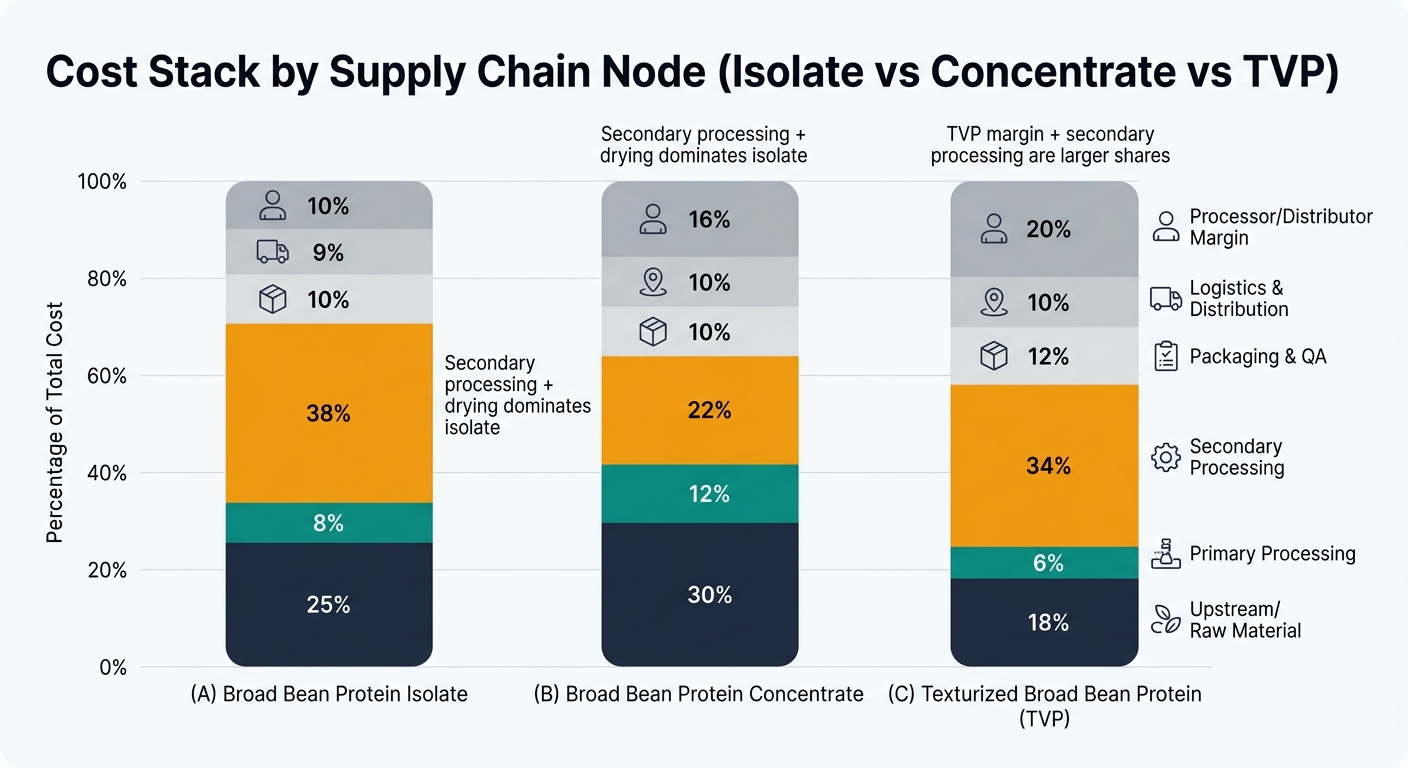
A three-bar 100% stacked chart comparing cost ratios for broad bean protein isolate, concentrate, and TVP, segmented by Upstream/Raw Material, Primary Processing, Secondary Processing, Packaging & QA, Logistics & Distribution, and Processor/Distributor Margin using the article’s percentages, with callouts noting that secondary processing and drying dominate isolate while TVP has larger shares in margin and secondary processing.

Product-Level Cost Breakdown

A) Broad Bean Protein Isolate (80–90% protein powder)

Supply Chain Node Cost Ratio (% of Final Cost) Notes
Upstream / Raw Material 25% Bean price + cleaning/drying/storage losses; quality affects usable yield.
Primary Processing 8% Dehulling/milling; optional dry fractionation adds cost but can stabilize feedstock.
Secondary Processing 38% Wet extraction, separation, evaporation, spray drying; yield + utilities dominate.
Packaging & QA 10% Lab release, metal detection, certifications, food-grade packaging materials.
Logistics & Distribution 9% Inland + ocean freight, moisture protection, working-capital burden.
Processor/Distributor Margin 10% Covers overhead, inventory risk, and channel margin.

B) Broad Bean Protein Concentrate (55–70% protein powder)

Supply Chain Node Cost Ratio (% of Final Cost) Notes
Upstream / Raw Material 30% More mass required per protein unit; bean quality still key.
Primary Processing 12% Dry fractionation/milling often more central than wet isolation.
Secondary Processing 22% Less intensive than isolate; lower drying/chemical/wastewater load.
Packaging & QA 10% Similar QA gates; sometimes broader spec windows reduce rejects.
Logistics & Distribution 10% Similar physical handling needs.
Processor/Distributor Margin 16% Often higher channel margin variability by grade and application.

C) Texturized Broad Bean Protein (TVP) (from concentrate/isolate)

Supply Chain Node Cost Ratio (% of Final Cost) Notes
Upstream / Raw Material 18% Indirect via isolate/concentrate input costs.
Primary Processing 6% Pre-processing and blending before extrusion.
Secondary Processing 34% Extrusion energy, die wear, throughput, drying/cooling; yield losses via fines.
Packaging & QA 12% Particle size/fines control, micro, foreign material controls.
Logistics & Distribution 10% Bulk density affects freight efficiency; fragility can create fines.
Processor/Distributor Margin 20% Higher value-add and inventory complexity by granulation/texture grade.
Sourcing Window Radar
Broad Bean Protein Isolate — Global Harvest Calendar
NETHERLANDS SEASON ACTIVE
🇳🇱 Netherlan.
OCT — NOV
🇨🇳 China
FEB — NOV
🇨🇦 Canada
DEC — DEC
JanFebMarAprMayJunJulAugSepOctNovDec

3) Structural Realities Every Buyer Should Treat as “Constants”

Reality 1: Processing capacity (and wastewater permits) can be the real supply limit

  • Insight: Isolate output is constrained by plant throughput and environmental/utility limits as much as by bean availability.
  • Data: Wet extraction creates significant wastewater load; evaporation and spray drying are energy intensive; maintenance downtime can remove meaningful capacity because the supplier base is narrower than commodity proteins.
  • Procurement Impact: Supply continuity depends on the processor’s unit operations (membranes, centrifuges, dryers) and their ability to run consistently at spec—not just on crop size.

Reality 2: Co-products (starch/fiber) are not side details—they support plant economics

  • Insight: Isolate plants often rely on starch and fiber streams to monetize the full bean; isolate cost structure is linked to co-product outlets.
  • Data: Co-product streams from pulse protein fractionation are real, material side flows; when co-product demand or monetization weakens, processors face more pressure to recover fixed costs from the protein stream (or reduce runs).
  • Procurement Impact: Understanding whether a supplier has stable co-product channels helps explain why isolate availability and pricing discipline can change even when bean costs look stable.

Reality 3: “Same protein %” does not mean “same functionality”

  • Insight: Functional performance (solubility, emulsification, foaming, gel strength, flavor) is process-made, not farm-made.
  • Data: Process choices (pH history, heat load, membrane cutoffs, precipitation route, drying conditions) change protein denaturation level, particle size distribution, and off-note intensity; these differences can exist within a tight protein % spec.
  • Procurement Impact: The physical spec set (protein, moisture, microbiological limits, particle size, color, flavor thresholds) determines how wide the viable supplier pool is and how predictable downstream performance will be.

Key Insights (What to Remember When You Look at Any Supplier or Origin)

  • Insight: Broad bean protein isolate is structurally a processing-led market: yield, utilities, and QA pass-rate decide the cost floor.
  • Data: The largest fixed cost concentration sits in wet isolation + concentration + spray drying, with meaningful secondary impacts from bean quality at intake and moisture-controlled logistics.
  • Procurement Impact: When you evaluate supply options, treat “process capability + spec pass-rate + packaging integrity” as the physical drivers of usable supply—because those factors determine how much product arrives and performs as expected.

4) The Bottom Line for Your Next Contract

(Analyzed at: Oct, 2026)

Lock your next 12–18 months of fava/broad-bean isolate on a structure that protects you from utilities- and capacity-driven premiums, not just bean price movement: use an indexed or reopener-based clause tied to energy/processing cost signals, and require lot-level evidence on moisture control, micro pass-rate, and functionality consistency by lane. This works because the market’s cost floor is still dominated by wet extraction + spray drying constraints, and the supplier base remains relatively narrow even as more players commercialize fava isolates. Teams that treat QA rejects and “in-spec-but-not-functional” lots as a commercial risk (with clear hold/release rules and corrective-action timelines) typically avoid enough rework, downtime, and spot-cover buys to protect on the order of a few percent of annual landed cost—especially in tight quarters when capacity allocation, not farmgate beans, is the binding constraint.

Broad Bean Protein IsolateSupply Chain Intelligence
118 countries tracked
10
Exporters
10
Importers
$657M
Top Export Value
Top Exporters (2024)
🇺🇸
United States
$657M
🇩🇰
Denmark
$452M
🇳🇱
Netherlands
$383M
🇧🇷
Brazil
$245M
🇩🇪
Germany
$186M
+113 more
Top Buyers
🇺🇸 United States $763M🇳🇱 Netherlands $509M🇯🇵 Japan $318M🇨🇦 Canada $210M🇰🇷 South Korea $181M

Related Contents

Subscribe
→
By subscribing you agree to with our Privacy Policy and provide consent to receive updates from our company.
Thank you! Your submission has been received!
Oops! Something went wrong while submitting the form.
Subscribe to receive the latest blog posts, updates, promotions, and announcements from Tridge.
