INDUSTRY TRENDS

How Bockwurst Really Moves (Cook → Chill → Pack) — and Where Procurement Costs Lock In

Author
Team Tridge
DATE
July 20, 2026
9 min read
bockwurst Cover
BockwurstHS 160100
Powered by Tridge Eye
🇺🇦 Ukraine↓ 1.5%
$3.82/kg
Wholesale reference prices across 135 markets

Bockwurst sourcing looks simple on paper—meat in, sausage out—but procurement outcomes are usually decided by a few “physics” constraints: raw material functionality, cook/chill capacity, post-lethality hygiene, and the time–temperature budget of your lane. This guide maps the physical flow and shows where costs become non-recoverable (yield loss, purge, code-life erosion) so you can write specs and contracts that protect landed cost, not just price per pound.

Executive Summary

  • Cost anchor: Meat/fat inputs remain the largest cost block (often ~50–70% depending on channel), so protein market timing matters more than most packaging negotiations.
  • Performance differentiator: The biggest repeatable gaps between suppliers show up in yield control (cook loss + purge) and cook/chill throughput stability.
  • Risk truth: For fully cooked, post-lethality exposed RTE sausage, post-cook handling and Listeria controls are a real constraint—not a QA afterthought (U.S. plants operate under 9 CFR 430.4 expectations). [1]
  • Packaging sets radius: MAP vs vacuum vs frozen is a structural decision that determines feasible lanes, shelf-life, and shrink exposure.

1) The Physical Reality: What Bockwurst Is “Made Of” in Supply-Chain Terms

Bockwurst is a fine-emulsified, typically fully cooked sausage that converts variable raw meat inputs into a standardized, branded-spec product—then immediately becomes a cold-chain logistics problem. The physical chain is short (meat → manufacture → pack → chilled distribution), but the cost base “locks in” early because meat/fat functionality, casing choice, and thermal processing capacity dictate yield, texture, and shelf life.

Insight: Bockwurst cost and availability are structurally anchored by (1) lean/fat trim quality and functionality, (2) cooking/chilling throughput, and (3) packaging format that determines shelf life and distribution radius.

Data (directional): In cooked sausage economics, meat inputs are typically the dominant share of finished cost; conversion (labor/energy/sanitation + yield loss) is the next fixed block; packaging and refrigerated freight scale with format and distance.

Procurement Impact: Treat the chain as a “conversion system”: upstream variability shows up downstream as purge, texture defects, weight loss, and shelf-life compression—costs you can’t recover once product is cooked, packed, and shipped.
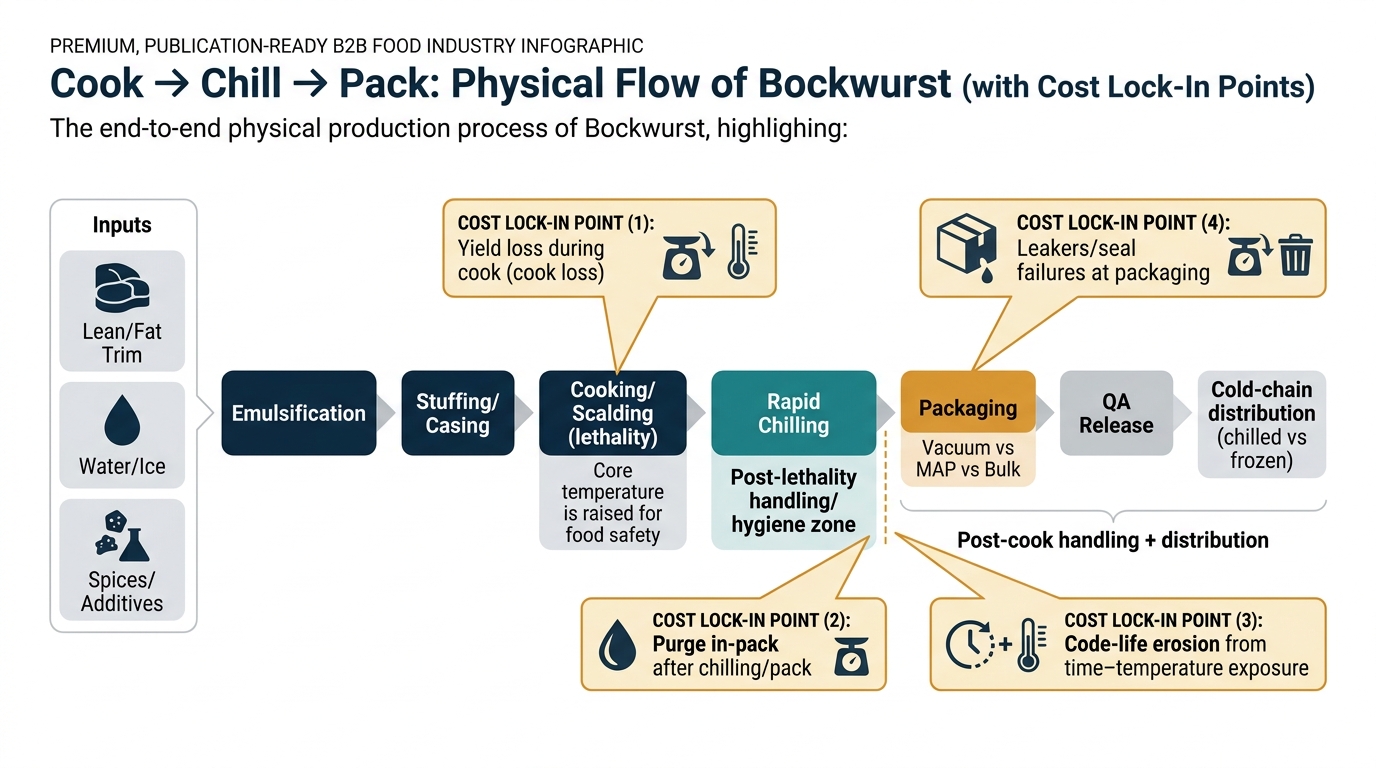
  • Quick win: Map your SKU set by (a) chilled vs frozen, (b) casing type/diameter, and (c) pack format (vac/MAP/bulk). Those three choices largely define your physical supply options and fixed cost structure.
A left-to-right (or top-to-bottom) flowchart showing the end-to-end physical process: Inputs (lean/fat trim, water/ice, spices/additives) → Emulsification → Stuffing/Casing → Cooking/Scalding (lethality) → Rapid Chilling → Post-lethality handling/hygiene zone → Packaging (Vacuum vs MAP vs Bulk) → QA Release → Cold-chain distribution (chilled vs frozen). Overlay 3–4 highlighted “cost lock-in” callouts at the exact steps where costs become non-recoverable: (1) Yield loss during cook (cook loss), (2) Purge in-pack after chilling/pack, (3) Code-life erosion from time–temperature exposure in post-cook handling + distribution, (4) Leakers/seal failures at packaging. Include small icons for thermometer, scale/weight loss, droplet/purge, and clock/code-life. Avoid any dashboard/UI visuals.

2) Where Money Accumulates: Cost & Margin by Node (Physical + Financial)

Insight: The bockwurst chain concentrates value-add in manufacturing (emulsification + thermal kill + chilling) and in packaging/QA (shelf-life assurance), while upstream meat and casings set the non-negotiable input floor.

Data (realistic ordering): Across cooked sausage categories, the largest cost blocks typically rank: meat/fat inputs first, then manufacturing conversion (labor/energy/yield), then packaging, then cold-chain logistics; margins concentrate in branded/retail-ready packaging and in distributors/retailers rather than in raw inputs.

Procurement Impact: If you want a “physical map” of cost, follow mass loss and control points: trim standardization → emulsion stability → cook loss/purge → pack integrity → temperature compliance.
1. Upstream Inputs (Lean/Fat Trims, Water/Ice, Spices/Additives)

  • Insight: Bockwurst is a functionality-driven product: the pH/temperature/protein extractability of lean trim and the consistency of fat trim determine emulsion stability, bite, and purge.
  • Data (process-true): Typical formulations rely on a controlled lean-to-fat balance plus added water/ice; small shifts in raw material quality can force more rework, higher binder/additive use (within label constraints), or higher reject rates.
  • Procurement Impact: Upstream variability becomes downstream cost via yield loss (cook loss + purge), texture defects (fat-out), and shorter shelf life—especially in chilled MAP trays where purge is highly visible.
  • Quick win: Require suppliers to disclose incoming trim temperature controls and fat/lean standardization method (fresh vs frozen blocks; trim spec ranges). That is a physical capability signal, not a commercial one.

2. Casings (Natural vs Collagen; Diameter Consistency)

  • Insight: Casings are both a materials cost and a process constraint: diameter uniformity drives portion control and pack weights; casing strength drives line speed and breakage waste.
  • Data (industry-consistent): Natural casings have higher variability (caliber, defects) and can create higher breakage and sorting labor; collagen offers tighter diameter control and higher stuffing speeds but changes “snap” and label positioning.
  • Procurement Impact: Casing selection directly affects giveaway (weight control), OEE (line stops from breaks), and consumer-perceived quality; it also defines what alternate plants can run without retooling.
  • Quick win: Standardize casing diameter tolerance (tight mm range) and link length spec in the technical sheet; it reduces downstream pack-weight variance and rework.

3. Secondary Processing (Emulsification → Stuffing → Cooking/Scalding → Rapid Chilling)

  • Insight: This is the “value conversion” node: turning variable meat into a safe, uniform cooked sausage. Capacity is constrained by cooker dwell time and chilling throughput, not just grinder size.
  • Data (plant-constraint-true): Key physical cost drivers include labor (skilled operators + sanitation), energy/steam for cooking, refrigeration load for chilling, and yield losses (cook loss, purge). Food safety control (e.g., lethality validation, environmental monitoring) is a fixed overhead that scales with plant complexity; for post-lethality exposed RTE products, controls for Listeria are governed by 9 CFR 430.4 “Alternatives” expectations in the U.S. [1]
  • Procurement Impact: Plants with limited chilling or packaging integration can meet volume but struggle on shelf-life consistency and temperature compliance—raising shrink and complaint risk downstream.
  • Quick win: Ask for the plant’s cook/chill configuration (continuous vs batch; post-lethality handling design). It predicts throughput stability and shelf-life consistency.

4. Packaging & QA Release (Vacuum, MAP Trays, Bulk Packs)

  • Insight: Packaging is where bockwurst becomes “distribution-ready,” and where shelf life is either protected or sacrificed. Pack choice drives oxygen exposure, purge visibility, and handling damage.
  • Data (packaging literature): Vacuum packs generally minimize oxygen but can show purge; MAP trays improve presentation but require tight gas mix control, seal integrity, and film/rigid tray supply. Studies of processed cooked meats show residual oxygen in MAP packs is often around ~0.9–1.1% (vacuum lower), and commercial variability exists—supporting why residual O2 and leaker control matter in practice. [2] QA release also includes label verification (allergens like mustard/dairy if used), weight control, and micro programs aligned to RTE expectations.
  • Procurement Impact: Packaging format determines the feasible distribution radius and shrink profile; it also dictates which co-manufacturers can run your SKU without capex or long changeovers.
  • Quick win: Put measurable pack integrity criteria in the spec (seal strength/leaker-rate targets, and for MAP, residual O2 targets). It’s a physical control that protects shelf life.

5. Cold-Chain Logistics & Distribution (Chilled 0–4°C vs Frozen ≤-18°C)

  • Insight: Cold chain is not just freight—it’s time-temperature budget. Every transfer (dock, cross-dock, DC) consumes shelf life and raises excursion risk.
  • Data (operational reality): Chilled distribution cost scales with distance, delivery frequency, and retailer DC requirements; temperature excursions can force holds, disposals, or accelerated sell-by. Frozen reduces spoilage risk and extends reach but adds freezer energy and can change texture perception.
  • Procurement Impact: The same bockwurst made in the same plant can have materially different landed cost and shrink depending on whether it ships chilled direct, chilled via DC, or frozen with tempering.
  • Quick win: Classify lanes by “temperature risk complexity” (direct-to-DC vs multi-stop) and align packaging choice (vac vs MAP) to the lane’s handling intensity.

Product-Level Cost Breakdown

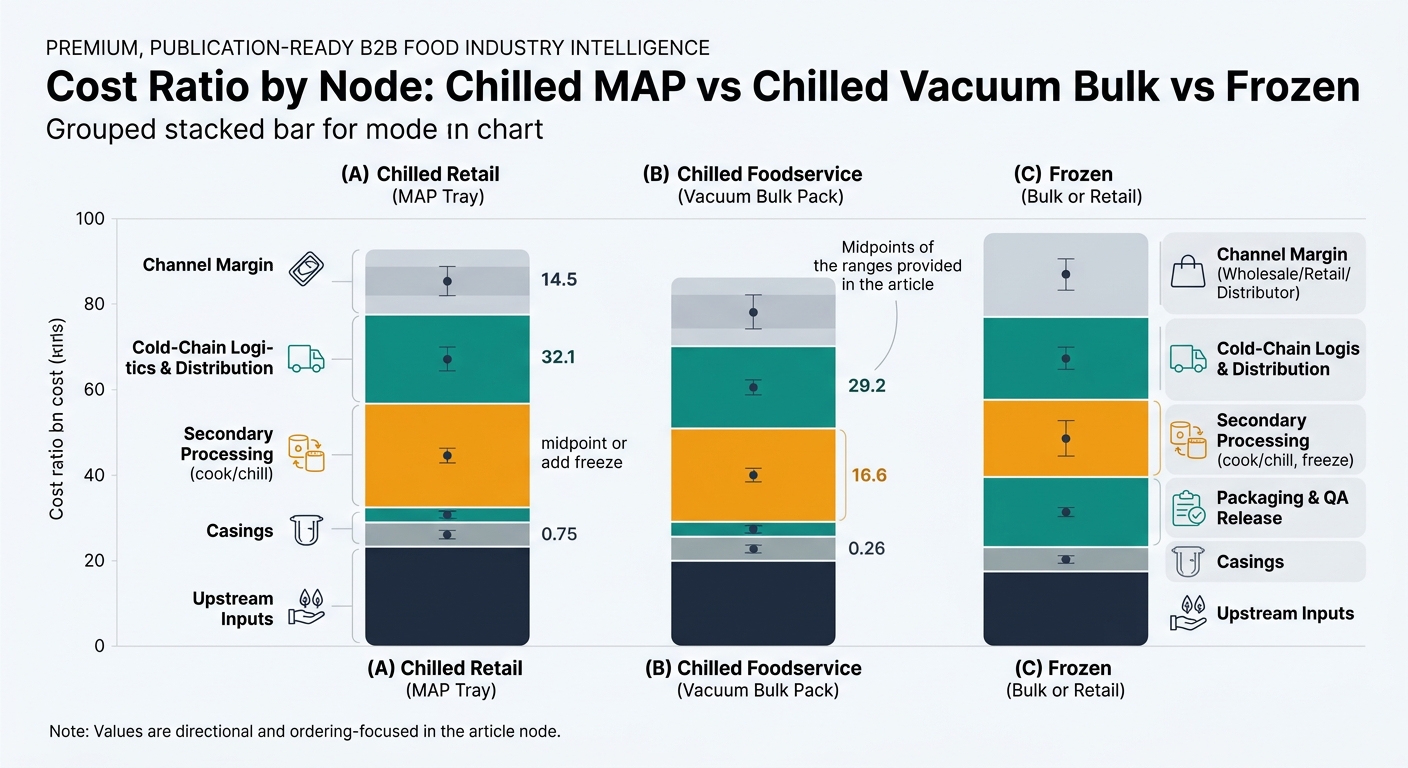
A grouped set of three stacked bars (one per product format): (A) Chilled Retail (MAP Tray), (B) Chilled Foodservice (Vacuum Bulk Pack), (C) Frozen (Bulk or Retail). Each bar is segmented by node: Upstream Inputs, Casings, Secondary Processing (cook/chill; add freeze where relevant), Packaging & QA Release, Cold-Chain Logistics & Distribution, Channel Margin (Wholesale/Retail/Distributor). Use the article’s ranges by plotting midpoints and showing thin error whiskers or shaded bands to indicate ranges. Add a small note that values are directional/ordering-focused. Avoid any product UI or dashboard mockups.

A) Chilled Retail Bockwurst (MAP Tray)

Supply Chain Node Cost Ratio (% of Final Cost) Notes
Upstream Inputs (meat/fat/spices/water) 50–65% Lean/fat trim dominates; functionality affects yield and purge.
Casings 3–7% Natural vs collagen shifts labor, breakage, and uniformity.
Secondary Processing (cook/chill) 12–20% Energy + labor + sanitation + yield loss; capacity constrained by cook/chill.
Packaging & QA Release 8–15% Tray/film/gas + seal integrity + testing/label checks.
Cold-Chain Logistics & Distribution 5–12% Chilled freight, DC handling, temperature compliance cost.
Wholesale/Retail Margin 10–20% Higher for retail-ready, high-service SKUs.

B) Chilled Foodservice Bockwurst (Vacuum Bulk Pack)

Supply Chain Node Cost Ratio (% of Final Cost) Notes
Upstream Inputs (meat/fat/spices/water) 55–70% Higher volume leverage; still input-dominated.
Casings 3–6% Diameter uniformity matters for portioning.
Secondary Processing (cook/chill) 12–22% Similar conversion costs; sanitation and changeovers matter.
Packaging & QA Release 5–10% Less retail presentation cost; strong seal integrity still critical.
Cold-Chain Logistics & Distribution 5–12% Multi-stop foodservice routes can raise excursion risk.
Distributor Margin 8–15% Foodservice distribution adds handling and credit terms.

C) Frozen Bockwurst (Bulk or Retail Packs)

Supply Chain Node Cost Ratio (% of Final Cost) Notes
Upstream Inputs (meat/fat/spices/water) 50–65% Similar input structure; freezing can buffer shelf-life constraints.
Casings 3–7% Casing choice still drives process efficiency.
Secondary Processing (cook/chill + freeze) 15–25% Added freezing energy/time; potential for higher handling.
Packaging & QA Release 6–12% Packaging must withstand freezing and distribution.
Cold-Chain Logistics & Distribution 6–14% Frozen freight + cold storage; less spoilage but higher energy footprint.
Wholesale/Retail Margin 8–18% Varies by channel and pack format.
Sourcing Window Radar
Bockwurst — Global Harvest Calendar
UNITED STATES SEASON ACTIVE
🇺🇸 United St.
JAN — DEC
🇨🇷 Costa Rica
JAN — DEC
🇦🇹 Austria
JAN — DEC
🇸🇬 Singapore
JUL — AUG
🇩🇪 Germany
JAN — JAN
JanFebMarAprMayJunJulAugSepOctNovDec

3) Structural Facts That Don’t Change (But Explain Most Outcomes)

Insight: Bockwurst supply performance is constrained by a few structural “physics” realities: raw material functionality, thermal capacity, and shelf-life/time-temperature budgets.

Data (regulation/process-driven): These constraints show up consistently across regions and suppliers because they’re driven by process design (cook/chill), microbiological control requirements (notably Listeria controls for post-lethality exposed RTE), and refrigerated distribution mechanics—not by brand strategy. [1]

Procurement Impact: If a supplier struggles on these structural points, the symptoms will repeat: inconsistent texture, purge, short code life, late deliveries, and high complaint rates.

Reality 1: Yield loss is the hidden tax (cook loss + purge)

  • Insight: Emulsified cooked sausages lose mass during cooking and can continue to lose sellable quality via purge in-pack.
  • Data (mechanism-true): Cook loss and purge are driven by fat/lean balance, protein extraction, batter temperature control, and chilling rate; packaging format makes purge more or less visible.
  • Procurement Impact: Two suppliers can quote the same finished weight but deliver different “effective yield” once purge, downgraded packs, and rework are counted.

Reality 2: Post-lethality handling design is a shelf-life multiplier

  • Insight: After cooking, product is microbiologically vulnerable; plant layout and handling discipline determine recontamination risk.
  • Data (FSIS framework): For post-lethality exposed RTE products, establishments are expected to operate under one of the 9 CFR 430.4 Listeria control alternatives, supported by sanitation, monitoring, and documentation. [1]
  • Procurement Impact: Shelf-life variability forces conservative code dating, higher safety stock, and more shrink—costs that sit outside the invoice but hit the P&L.

Reality 3: Packaging format sets your feasible supply radius

  • Insight: Chilled MAP trays demand tighter time-temperature control and pack integrity than vacuum bulk packs; frozen changes the entire logistics equation.
  • Data (packaging science and practice): Residual oxygen and seal integrity are critical determinants of quality and shelf-life in MAP and vacuum systems; commercial packs show meaningful variability, reinforcing why procurement should specify measurable pack integrity metrics. [3]
  • Procurement Impact: Your SKU architecture (MAP vs vacuum vs frozen) implicitly selects which plants and lanes can reliably serve you.

Key Insights (What to Remember Before You Look at Any Quotes)

  • Key Takeaways: The biggest fixed cost block is still meat/fat inputs, but the biggest repeatable performance differentiators are cook/chill capacity, yield control (cook loss + purge), and packaging integrity.
  • Key Takeaways: Casings are not a minor detail: diameter consistency and breakage rates translate into line efficiency, portion control, and pack-weight variance.
  • Key Takeaways: Packaging choice is a structural decision: MAP trays buy presentation but demand tighter process control; vacuum bulk buys robustness; frozen buys reach and time.
  • Key Takeaways: Cold chain is a shelf-life budget. Every extra touchpoint (cross-dock, multi-stop routing) consumes code life and increases excursion exposure.

4) The Bottom Line for Your Next Contract

(Analyzed at: Jul, 2026)

Given current U.S. pork supply signals pointing to tighter production in the second half of 2026, you should assume protein-driven volatility will remain a headwind—and stop trying to “solve” it with packaging concessions alone. [4] The highest-conviction move is to write your next bockwurst agreement around lane-level delivered code life + pack integrity KPIs (leaker-rate and, for MAP SKUs, a residual-oxygen spec) with credits tied to measured failures, because those are the nodes where value is lost after you’ve already paid for conversion.

Teams that enforce these controls typically find the recoverable money in shrink, chargebacks, and rework—often enough to matter like a quiet 2–6% landed-cost improvement—while keeping recipe and label constant. The stake is simple: if you don’t measure and contract these failure modes, you’ll keep arguing about price while your P&L bleeds in credits and unsaleables.

BockwurstSupply Chain Intelligence
135 countries tracked
10
Exporters
10
Importers
$962M
Top Export Value
Top Exporters (2024)
🇮🇹
Italy
$962M
🇺🇸
United States
$866M
🇪🇸
Spain
$729M
🇵🇱
Poland
$678M
🇩🇪
Germany
$676M
+130 more
Top Buyers
🇬🇧 United Kingdom $1.00B🇩🇪 Germany $619M🇧🇪 Belgium $372M🇨🇦 Canada $322M🇳🇱 Netherlands $315M

References

  1. ecfr.io — 9 CFR 430.4
  2. sciencedirect.com — Article on residual oxygen in MAP/vacuum packaged processed meats
  3. sciencedirect.com — Article on MAP/vacuum packaging integrity and oxygen-related quality factors
  4. ers.usda.gov — Hogs & Pork Market Outlook

Related Contents

Subscribe
→
By subscribing you agree to with our Privacy Policy and provide consent to receive updates from our company.
Thank you! Your submission has been received!
Oops! Something went wrong while submitting the form.
Subscribe to receive the latest blog posts, updates, promotions, and announcements from Tridge.
