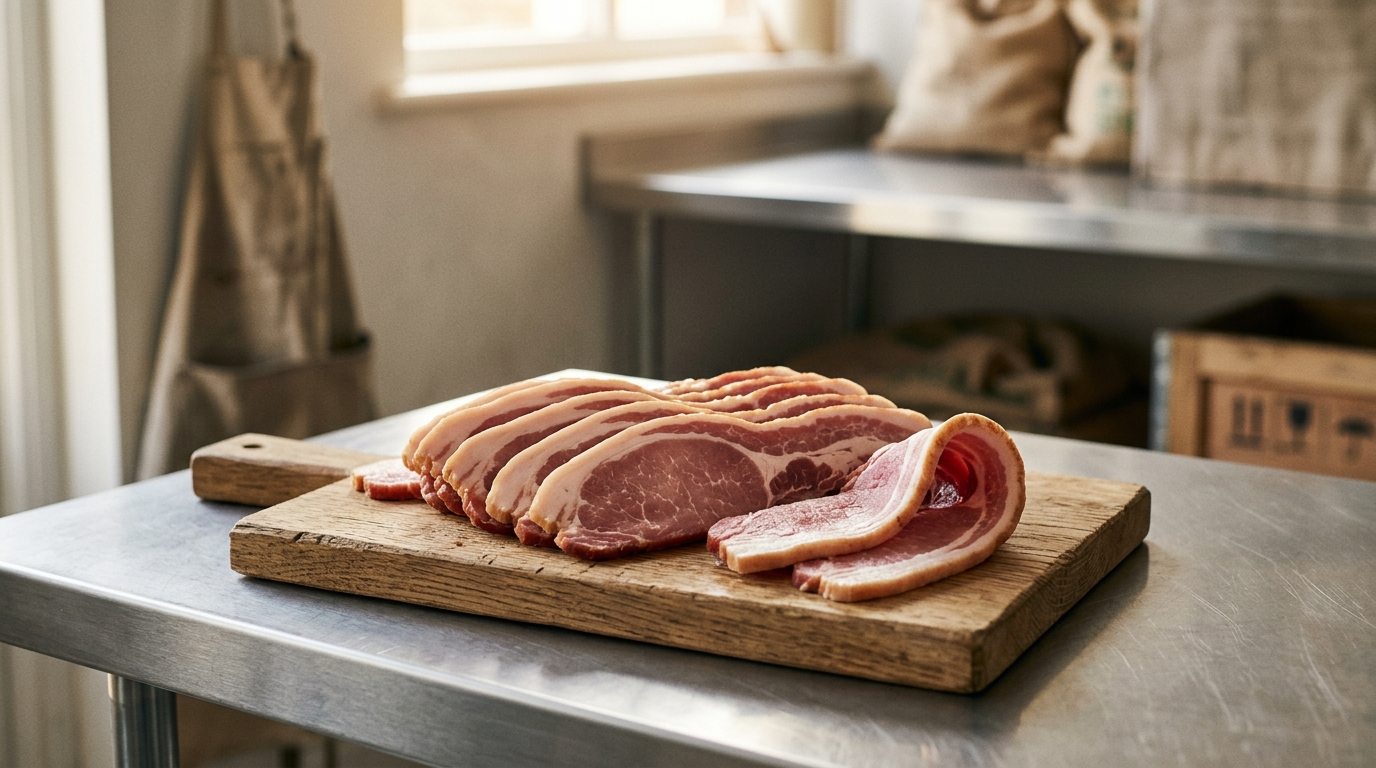
Back bacon is easiest to source well when you treat it as a loin allocation + further-processing + cold-chain execution program—not a generic “bacon” buy. This guide maps the physical flow, where cost structurally locks in, and where service/food-safety risk concentrates, so procurement teams can diagnose price moves and protect continuity without over-specifying themselves into a single-supplier corner.
Back bacon is not a single commodity—it’s a loin-driven program that becomes a cured, sliced, cold-chain-dependent product. Most of the “unavoidable” cost is structurally set upstream (hog + loin economics) and midstream (further-processing yield loss + labor), while the biggest service risks concentrate at slicing/packing and refrigerated distribution.
Most fabrication references place the pork loin in the ~17–24% range of carcass weight (often cited around ~20–22%), and it competes directly with fresh pork chop/roast programs for the same raw material stream. [1]
If you’re buying back bacon, you’re effectively buying (1) access to consistent loin supply, (2) a controlled curing process that protects slice integrity and shelf-life, and (3) a high-hygiene slicing/packing operation that can manage post-process contamination risk while maintaining cold-chain.
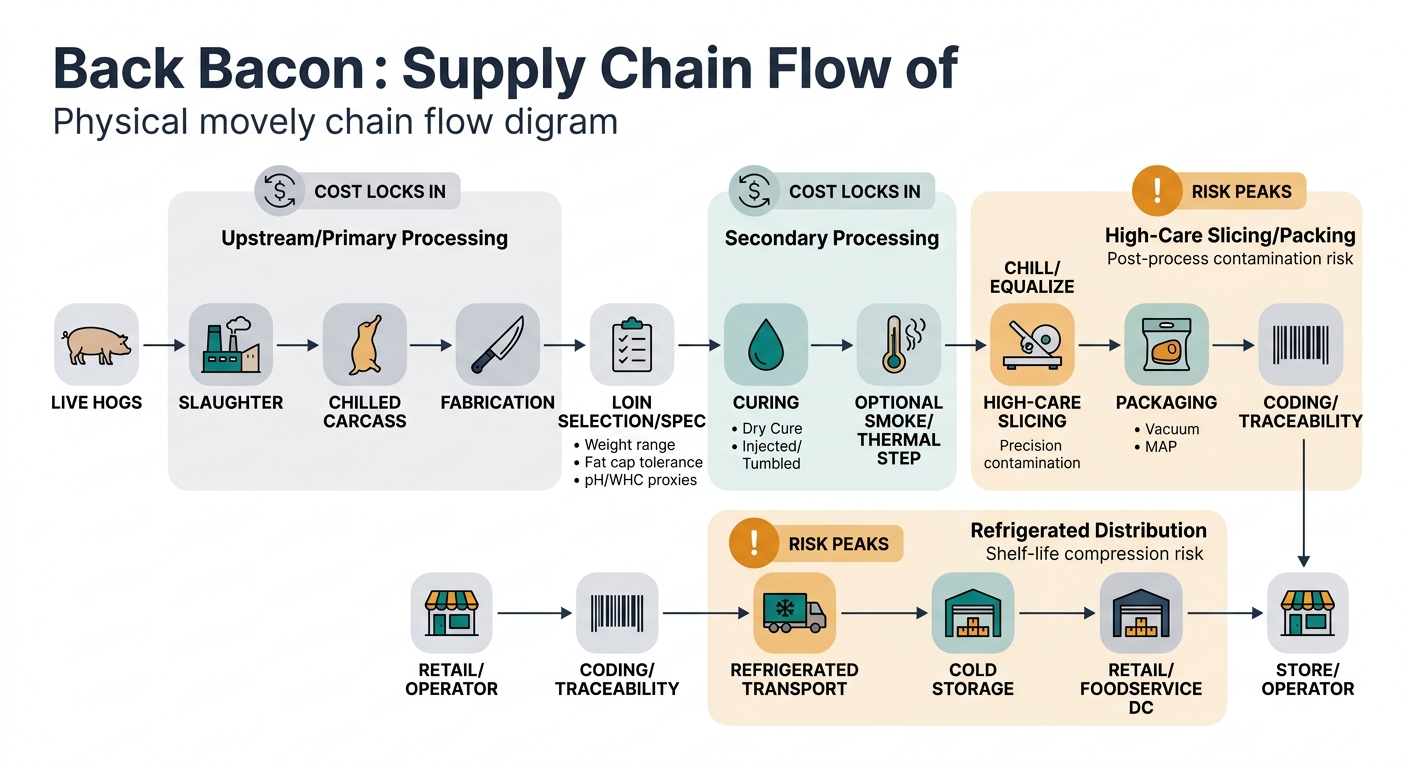
Back bacon’s delivered cost is built from a few non-negotiables: carcass economics (loin availability), conversion yield (trim + pick-up + purge + slice loss), labor intensity in slicing/packing, and cold-chain overhead.
Carcass balance is the structural constraint: the market can’t “make more loins” without also clearing the rest of the carcass, so loin programs can price and allocate differently than belly-led bacon programs even when overall pork supply looks adequate. (The loin’s finite share is consistently shown across fabrication references.) [1]
When you see cost changes, first locate the node: raw loin economics (upstream/primary), conversion yield and labor (secondary/pack), or cold-chain and handling (logistics). That’s the fastest way to diagnose whether the issue is structural (market) or executional (supplier/plant/lane).
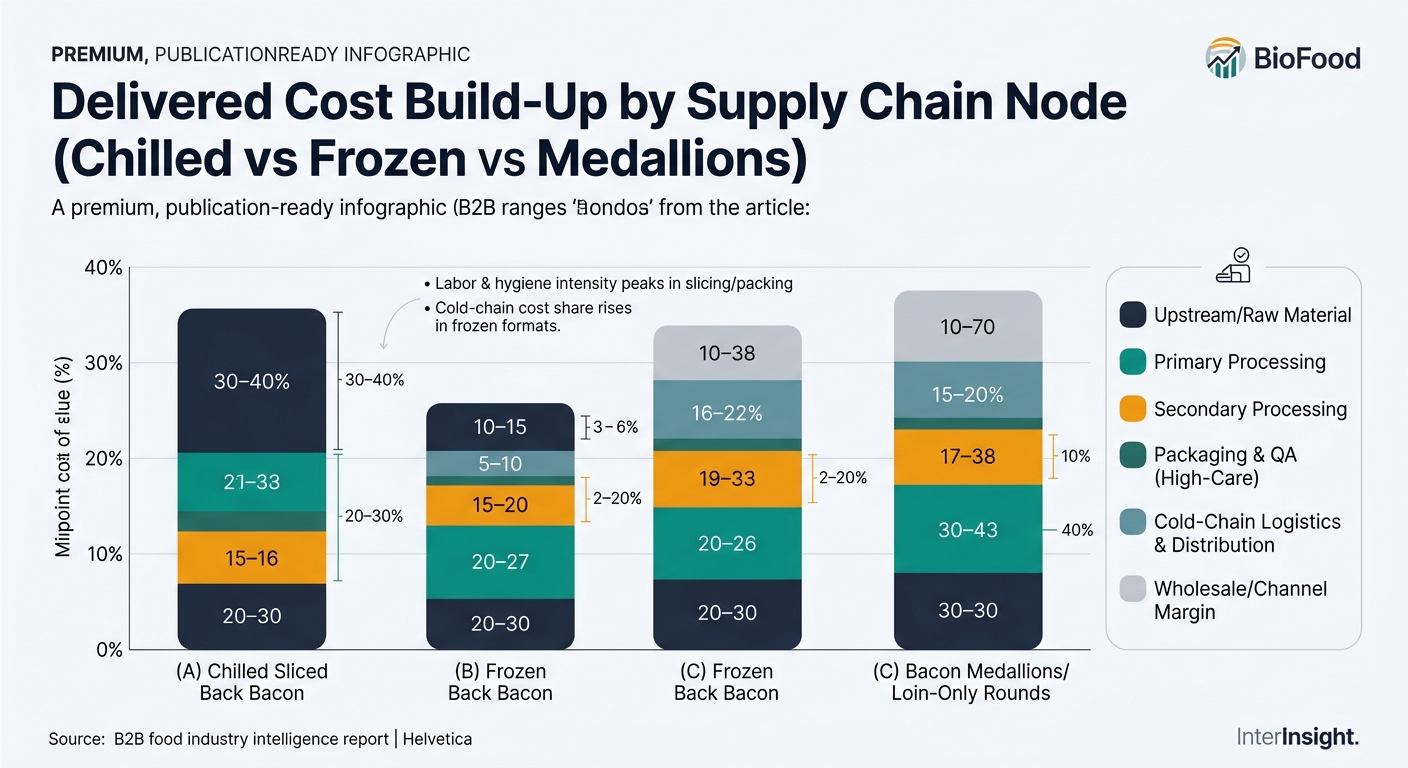
| Supply Chain Node | Cost Ratio (% of Final Cost) | Notes |
|---|---|---|
| Upstream / Raw Material (hog + carcass economics) | 30–40% | Baseline pork cost sets the floor across all primals. |
| Primary Processing (loin selection & fabrication) | 15–25% | Loin is a premium primal; spec tightness drives trim loss. |
| Secondary Processing (cure / equalization / smoke if applicable) | 10–15% | Yield management (pick-up vs purge), energy, process control. |
| Packaging & QA (high-care slicing/packing) | 12–18% | Labor-heavy; hygiene controls and rework/scrap risk concentrate here. |
| Cold-Chain Logistics & Distribution | 8–12% | Reefer freight, cold storage, handling touches, shelf-life loss risk. |
| Wholesale/Retail or Foodservice Margin | 8–15% | Channel margin varies by brand/private label and service model. |
| Supply Chain Node | Cost Ratio (% of Final Cost) | Notes |
|---|---|---|
| Upstream / Raw Material | 28–38% | Similar raw economics, sometimes different cut selection. |
| Primary Processing | 14–22% | Fabrication + freezing-ready specs (lean/fat, size uniformity). |
| Secondary Processing | 10–16% | Cure/smoke steps plus freeze management (shrink/handling). |
| Packaging & QA | 10–15% | Bulk cartons reduce unit packaging cost vs retail packs. |
| Cold-Chain Logistics & Distribution | 12–18% | Freezing, cold storage time, and long-lane reefer add cost. |
| Wholesale/Distributor Margin | 8–14% | Distribution intensity and inventory carrying costs matter. |
| Supply Chain Node | Cost Ratio (% of Final Cost) | Notes |
|---|---|---|
| Upstream / Raw Material | 25–35% | High dependence on consistent loin muscle quality. |
| Primary Processing | 18–28% | Tight sizing specs increase trim and sorting labor. |
| Secondary Processing | 10–15% | Cure uptake must protect texture and portion integrity. |
| Packaging & QA | 15–22% | Portioning + slicing precision raises labor and scrap. |
| Cold-Chain Logistics & Distribution | 8–12% | Similar cold-chain needs; portion formats can be more damage-sensitive. |
| Wholesale/Foodservice Margin | 8–14% | Value-added format typically carries higher margin expectations. |
Back bacon’s availability, quality, and service performance are shaped by a few structural constants—carcass balance, high-care hygiene constraints, and cold-chain physics.
(1) Loin is a defined primal with a finite share of the carcass and broad competing end uses; (2) vacuum/MAP can extend shelf-life but does not eliminate psychrotrophic pathogen risk—Listeria can grow at refrigeration temperatures; (3) cured-meat additive limits constrain formulation and process ranges. [1]
These facts explain why you can’t “solve” back bacon with supplier switching alone—physical constraints persist across the market.
(Analyzed at: Jun, 2026)
With USDA projecting higher 2026 pork production but loin still governed by carcass balance, the most reliable win is to contract around measurable execution rather than hoping the market “behaves.” [4] Require suppliers to state (and hold to) a loin input window (weight/fat tolerance), a minimum shelf-life at ship, and a documented post-process hygiene/Listeria control approach aligned to FSIS expectations for post-lethality exposed operations. [2] It works because it locks down the two nodes where problems become expensive—slicing/packing and cold-chain—so you catch yield loss and shelf-life drift before they turn into OTIF misses and credits. On high-volume programs, preventing even a small uptick in purge/slice scrap and short-dated receipts can easily swing delivered cost by low single digits—often more than you’ll win by squeezing a loin-driven market on price alone.