
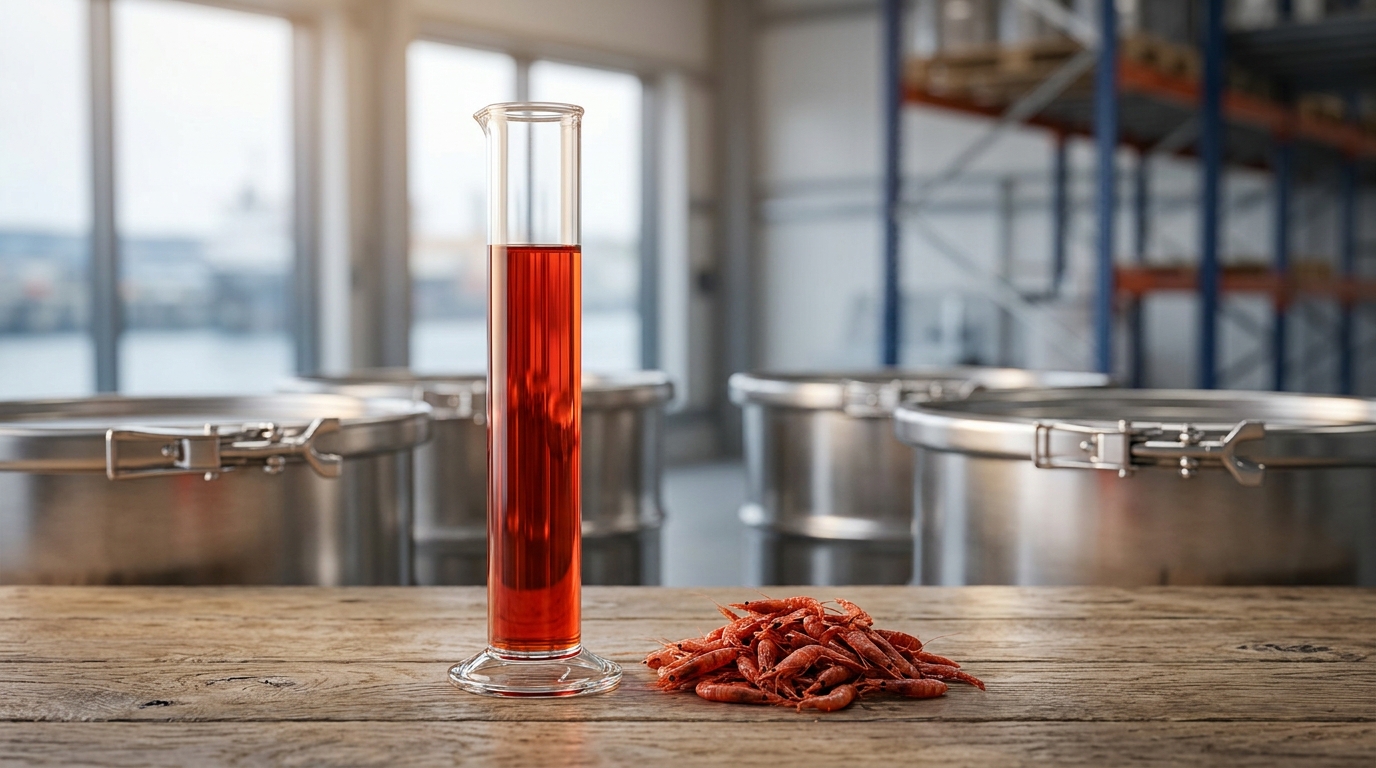
Pure Antarctic krill oil is a constrained, engineered supply chain—not an open commodity flow. For procurement teams, the practical takeaway is that most “avoidable cost” shows up as quality loss (oxidation, odor, rework, downgrades) caused by weak controls between harvest, stabilization, and bulk filling. This guide maps the physical chain and highlights where cost becomes fixed—and where governance can still change outcomes.
Pure Antarctic krill oil is not a typical commodity oil chain. The upstream is a remote, highly regulated fishery in CCAMLR Area 48 near the Antarctic Peninsula, and the downstream value is created by how fast krill is stabilized after capture and how tightly oxidation and composition are controlled through processing and packaging. Once krill is on deck, enzymatic breakdown and oxidation risk start immediately—so the supply chain is engineered around speed, cold, and oxygen control.
Insight: The chain’s economics are “front-loaded” into harvesting days-at-sea and rapid stabilization; later nodes mainly protect (or lose) that value through oxidation control and spec standardization.
Data: CCAMLR applies a precautionary management framework; in Area 48 the combined catch is further limited by a 620,000-tonne trigger level in a fishing season, with distribution rules across Subareas 48.1–48.4 that constrain where catch can be taken. (CCAMLR Fishery Report Area 48, 2025; CM 51-01 and related distribution measures)
Procurement Impact: The physical flow is inherently capacity- and time-constrained: vessel availability, weather/ice downtime, and stabilization capability matter as much as downstream refining capacity.
High-level flow (typical): (1) regulated harvest in the Southern Ocean → (2) onboard primary processing (stabilize biomass; separate crude oil/meal) → (3) secondary processing/refining/fractionation (standardize phospholipids/EPA/DHA; reduce off-odors) → (4) bulk packaging under inert conditions + QA release → (5) long-haul logistics to encapsulators/brands.

Insight: Each node adds cost for a different reason: the fishery buys “access and time,” primary processing buys “stability,” secondary processing buys “spec,” and packaging/logistics buy “shelf-life.”
Data: In CCAMLR Area 48, the trigger level and subarea distribution limits function as structural constraints on harvesting distribution; commercial operations commonly integrate onboard processing to protect quality because krill is highly perishable. (CCAMLR Fishery Report Area 48, 2025; MSC fishery profile for Antarctic krill)
Procurement Impact: When mapping total cost, separate (a) unavoidable structural costs (Antarctic operations, stabilization) from (b) controllable loss costs (oxidation-driven downgrades, rework, rejects).

| Supply Chain Node | Cost Ratio (% of Final Cost) | Notes |
|---|---|---|
| Harvest (vessel ops + compliance) | 35% | Remote operations, fuel/crew, CCAMLR monitoring overhead; constrained by seasonal access. |
| Primary Processing (onboard stabilization + crude separation) | 18% | Rapid stabilization, separation energy, antioxidants/stabilizers, yield loss from delays. |
| Secondary Processing (refine/standardize) | 22% | Deodorization/winterization/filtration, fractionation/standardization, rework risk. |
| Packaging & QA | 10% | Inert filling, drum/IBC materials, full analytical panel and release testing. |
| Logistics & Distribution | 15% | Long-haul freight, storage dwell time, insurance/working capital. |
| Supply Chain Node | Cost Ratio (% of Final Cost) | Notes |
|---|---|---|
| Harvest (vessel ops + compliance) | 30% | Same physical constraint, but higher value-per-kg dilutes harvest share. |
| Primary Processing | 16% | Stabilization still critical; tighter control reduces downstream loss. |
| Secondary Processing (fractionation/standardization) | 30% | More intensive processing and tighter cut points; higher yield loss risk. |
| Packaging & QA | 12% | Tighter oxidation/spec release criteria; potentially more frequent testing. |
| Logistics & Distribution | 12% | Similar lanes; higher sensitivity to excursions increases handling controls. |
| Supply Chain Node | Cost Ratio (% of Final Cost) | Notes |
|---|---|---|
| Harvest + Primary Processing | 45% | Upstream still dominates because it determines base oil quality. |
| Secondary Processing | 20% | Standardization for softgel performance (odor, clarity, stability). |
| Packaging & QA | 15% | Additional handling controls and documentation pack for CM/brand requirements. |
| Logistics & Distribution | 20% | More nodes/handling (warehouse-to-encapsulator), higher stability risk. |
Insight: The krill oil supply chain behaves like a constrained, engineered system—not an open agricultural commodity chain.
Data: CCAMLR Area 48 uses a 620,000-tonne trigger level and subarea distribution limits; these are structural controls that shape how supply accumulates and where it can be taken. (CCAMLR Fishery Report Area 48, 2025; CCAMLR Fishery Report Area 48, 2024)
Procurement Impact: Availability and quality are structurally linked to fishing access rules and to onboard processing speed; downstream buyers cannot “process their way out” of weak upstream stabilization without cost and yield penalties.
Insight: Stabilization speed is the chain’s hidden “quality currency.”
Data: MSC fishery descriptions highlight integrated harvesting and processing systems designed to reduce time from catch to processing and protect product integrity. (MSC Antarctic krill fishery profile)
Procurement Impact: Two oils with identical certificate-of-analysis limits can behave differently in shelf-life if their stabilization histories differ—this is why chain-of-custody and process controls matter as much as the final COA.
Insight: Spatial concentration rules can create localized pressure even when total catch is low.
Data: CCAMLR documentation describes distribution of the trigger level across Subareas 48.1–48.4 (distribution measures linked to CM 51-01), intended to manage localized ecosystem risk. (CCAMLR Fishery Report Area 48, 2024)
Procurement Impact: Physical sourcing is not only “how many tonnes exist,” but “where tonnes can be taken,” which can cascade into vessel routing, port calls, and lead-time variability.
Insight: Sustainability governance is embedded in the physical chain via reporting and traceability.
Data: CCAMLR’s management relies on reporting and monitoring frameworks, and MSC-certified supply chains emphasize chain-of-custody expectations that support traceability from fishery to product. (CCAMLR fishery documentation; MSC fishery profile)
Procurement Impact: Documentation load is not optional overhead; it is a structural requirement that affects batch release timing, audit readiness, and the feasibility of multi-market distribution.
Insight: Krill oil cost and quality are “baked in” upstream, then either protected or degraded downstream.
Data: The Area 48 fishery is constrained by CCAMLR’s trigger level (620,000 tonnes) and subarea rules, while commercial supply chains rely on integrated harvesting and processing to preserve quality. (CCAMLR Fishery Report Area 48, 2025; MSC Antarctic krill fishery profile)
Procurement Impact: When comparing suppliers or lots, ask what physical controls exist at each node: (1) harvest access and days-at-sea constraints, (2) time-to-stabilization and onboard separation, (3) refining/fractionation capability and yield loss handling, (4) inert packaging and QA release discipline, and (5) logistics handling that minimizes temperature/oxygen excursions.
(Analyzed at: Jul, 2026)
Write your next krill oil contract so it buys process control, not just a COA: require documented maximum time-to-stabilization, inert bulk filling (nitrogen blanketing/headspace limits), and a defined temperature-handling protocol through to delivery. This works because CCAMLR’s Area 48 supply is structurally constrained by the 620,000-tonne trigger framework and subarea distribution limits, so you rarely “solve” shortages with last-minute switching—your real savings come from preventing oxidation-driven downgrades and rework on the volume you already secured. In practice, teams that tighten these controls typically avoid the quiet 5–10% total-cost leakage that shows up as rejected lots, expedited replacements, and margin loss from sensory drift—especially when transit legs are long and handling events multiply. The stake is simple: if you don’t contract for continuity from vessel to drum, you end up paying premium pricing for upstream quality you can’t reliably keep.


