
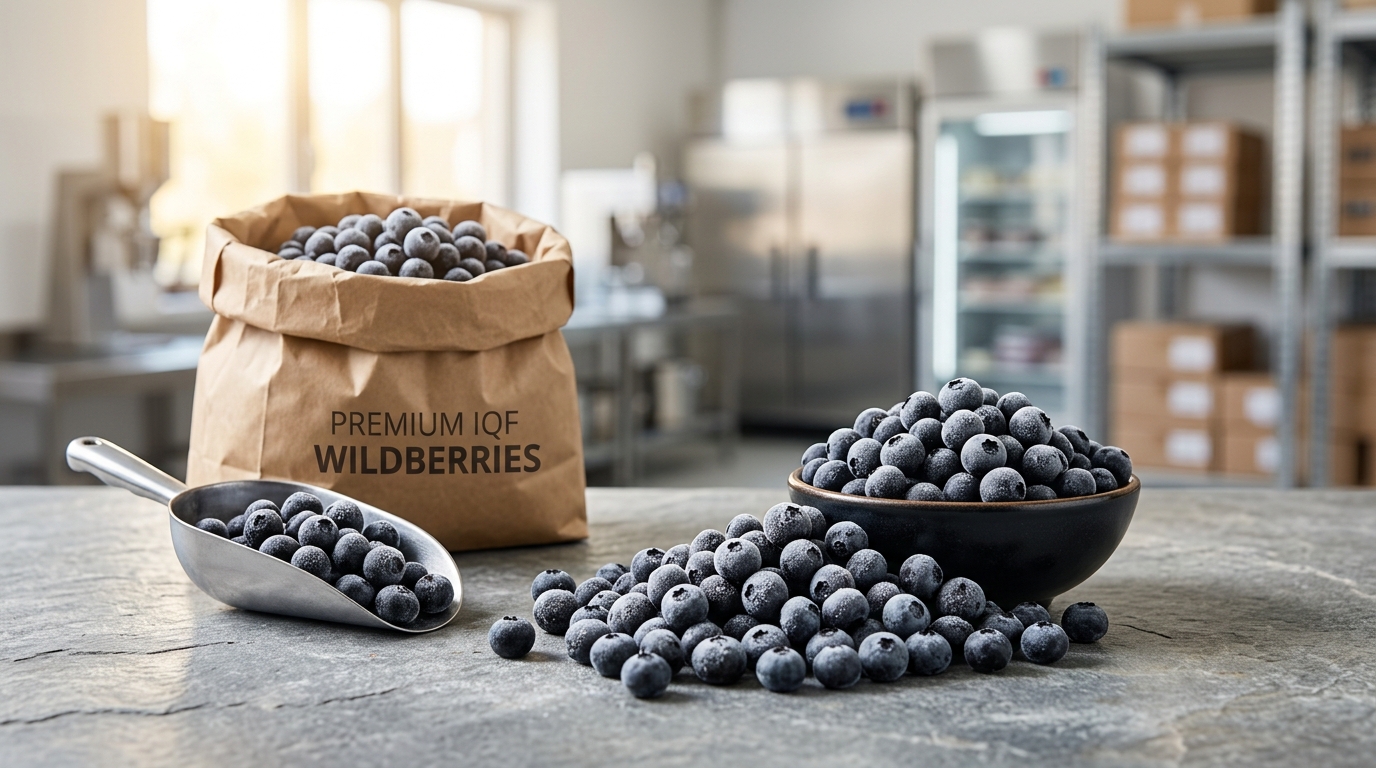
This case study shows a practical way to buy IQF bilberries like a risk-managed ingredient (wild harvest, short season, QA gates), not like a generic frozen fruit. The core message for procurement teams is that “switchability” (pre-qualified backups + spec tiers + logistics rules) is what prevents panic buys and the hidden costs that follow.
IQF bilberries behave less like a “standard frozen fruit” and more like a short-window, wild-harvest ingredient where supply, quality, and compliance risks compound—so the best procurement outcomes come from designing the buy (origins, specs, and QA gates) before the market tightens.
Wild bilberries (Vaccinium myrtillus) are predominantly harvested in a narrow summer window that shifts by latitude; for example, in Finland the bilberry season is typically mid-July through August, and in the far north it can start later (early August) and run into September. (Source example: Willit season calendar; underlying crop monitoring is also published by Finland’s Natural Resources Institute, Luke.)
If you treat bilberries like a commodity and only “shop price,” you typically pay twice—first in headline €/kg, then again in yield loss, claims, or emergency premiums when a single origin or single processor can’t deliver your spec.
The buyer improved outcomes by shifting from “single-origin + annual price negotiation” to a portfolio approach: dual-source coverage, pre-aligned QA gates, and spec-driven commercial levers.
Regulators explicitly recognize that fresh and frozen berries have been linked to human norovirus and hepatitis A outbreaks and have published prevention strategies that emphasize hygienic practices, cross-contamination controls, and verification across the supply chain (not just finished-product testing). (FDA strategy and related outbreak learnings.)
A procurement strategy that builds qualification speed and traceability readiness lowers both disruption risk and the risk premium suppliers bake into quotes.
The buyer’s core issue wasn’t “price too high”—it was a fragile supply design: one dominant origin, one main processor, and a spec that quietly excluded most backups.
Bilberries are explicitly classified and tracked in EU trade and customs nomenclature as a distinct frozen line item (commonly referenced as CN ex 0811 90 50 for wild fruits of Vaccinium myrtillus, frozen), which is one reason documentation/traceability discipline matters in cross-border trade. (EU Implementing Regulation / CN references.)
When the broader frozen fruit complex inflates (energy, cold storage, logistics, and replacement-cost pricing), bilberries—already constrained by wild-harvest supply—tend to show wider quote dispersion and higher “risk premiums” for tight specs.

They didn’t start by negotiating harder—they started by making the supply base “switchable” through spec clarity, QA evidence, and origin options, then used competition to reset price.
Optical sorting and end-of-line inspection are widely used in berry processing to remove defects and foreign material; equipment providers describe use cases for berries and IQF fruit/veg applications and emphasize pre-sort and end-of-line defect removal to reduce defect load and FM risk. (Example sources: TOMRA and other optical sorting solution providers.)
If you don’t ask suppliers how FM/defects are controlled (pre-sort vs post-IQF/end-of-line, optical capability, rework loops), you can’t compare quotes on a like-for-like “true cost” basis.
Weeks 1–3: Rebuilt the spec into a “commercially testable” format
Weeks 4–8: Qualified 3 backup suppliers before price talks
Weeks 9–16: Built an origin portfolio and re-allocated volume
Weeks 17–28: Re-structured contracts (hybrid model)
Weeks 29–52: Locked logistics and cold-chain rules into supplier scorecards
The biggest measurable gains came from eliminating “panic buying” and reducing hidden quality costs—not from squeezing suppliers below replacement cost.
FDA outbreak reporting and prevention materials document HAV outbreak investigations involving berries over multiple years, reinforcing why traceability and preventive controls are procurement-relevant in this category.
When governance and qualification are strong, procurement can safely widen the supplier pool—reducing quote dispersion and lowering the risk premium embedded in offers.

| Metric | Before (12-mo baseline) | After (next 12 mo) | What actually drove it |
|---|---|---|---|
| Net unit cost (blended) | Index 100 | Index 93.2 | Dual-source leverage + fewer spot premiums + reduced rework |
| Annual spend | ~$5.0M | ~$4.66M | 6.8% reduction |
| Single-origin exposure | 82% | 45% | Portfolio rule + pre-qualified alternates |
| OTIF (peak months) | 86% | 94% | Contracted service levels + logistics KPIs |
| FM-related claims | 1.2% of lots | 0.5% of lots | Better sorting capability screening + spec segmentation |
| QA approval cycle | 14–18 weeks | 8–10 weeks | Evidence pack + standardized trial plan |
Unexpected benefit: Finance accepted a tighter budget range because the team could explain cost drivers (spec strictness, yield, storage/logistics) and show contingency coverage.
In IQF bilberries, procurement performance improves fastest when you focus on three levers: (1) switchability, (2) spec economics, and (3) origin risk rules.
Harvest timing varies by region and can shift later in the far north; Finland season guidance and 2026 crop monitoring notes illustrate both timing shifts and regional variability (Luke publishes seasonal forecasts; Willit summarizes timing and cites Luke).
If you wait until “after harvest clarity” to qualify alternates, you’ll likely be negotiating in a seller’s market with limited QA-ready options.
If you’re single-sourcing one origin:
If quotes are all over the place:
If QA slows diversification:
If you sell into retail/private label:
Over-tightening FM/defect limits on all SKUs. It shrinks your eligible supplier pool and increases the probability you’ll pay a premium during tight supply—often without a proportional consumer-perceived benefit.
The highest-ROI move for most bilberry buyers is to build a QA-ready, multi-origin supplier bench before the market tightens—then use spec-tier pricing to negotiate on “true cost,” not just €/kg.
Frozen berries have documented HAV/NoV risk considerations with published prevention strategies, and wild bilberries are explicitly classified under EU CN codes—both of which increase the value of traceability-ready sourcing and governance.
This approach typically reduces spot exposure and risk premiums while preserving service levels—especially for must-ship SKUs.
The decision that separates average from best-in-class bilberry procurement is timing: knowing when supply tightness is building (harvest signals, plant throughput constraints, and logistics/cold-storage pressure) early enough to shift volumes before premiums appear—because once the market turns, “options” that aren’t pre-qualified become theoretical.
(Analyzed at: Sep, 2026)
Reefer logistics volatility has been a real cost swing factor in 2026, and bilberries still concentrate risk into a short, weather- and labor-sensitive harvest window—so the only reliable hedge is to make your supply base switchable before peak season. Use the next RFQ to lock two QA-approved alternates and contract spec tiers (must-have vs premium grading), then allocate 20–30% as flex volume you can actually move. Teams that wait until “market clarity” typically pay for it in spot premiums, expedite costs, and avoidable rework—often a mid-single-digit percentage of total bilberry spend, not just a few cents per kilo.


