
Hardwood-smoked bacon sourcing comparisons usually fail because teams debate “origin” instead of the supply model: where the bellies are sourced, where the bacon is converted (cure/smoke/slice/pack), and whether the program can tolerate frozen buffering. This guide frames U.S., Canada, EU, and import-belly models around the outcomes procurement is measured on: total landed cost, continuity of supply, spec governance, and switching speed.
Hardwood-smoked bacon sourcing decisions are fundamentally a trade-off between (a) pork belly exposure, (b) smokehouse/slicing capacity access, and (c) cold-chain + regulatory friction—so “origin” often matters less than where the bellies come from and where the bacon is processed/packed.
Bacon cost is anchored to the belly primal, which is reported in USDA AMS pork reporting (LM_PK602 / report AMS 2498) and is also a key input into the CME Pork Cutout Index methodology (a five-business-day weighted average of USDA AMS prices from LM_PK602). [1] [6]
Before comparing suppliers, lock the decision frame: are you buying (1) domestic finished bacon, (2) domestic bacon made from imported bellies, (3) imported finished bacon, or (4) a mixed model with frozen buffers? Each model changes landed cost volatility, lead time, QA burden, and your ability to switch plants during disruption.
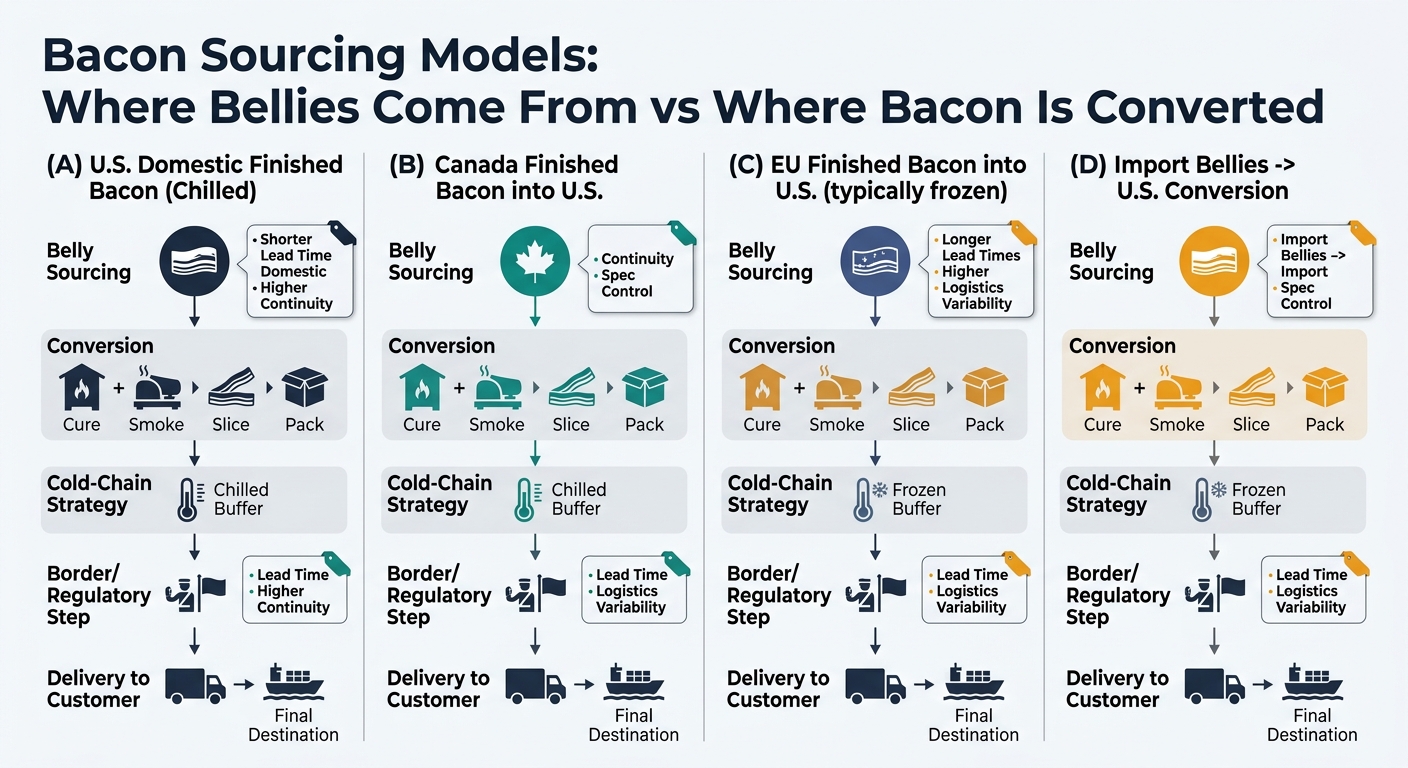
The “best” option changes by whether you’re optimizing for (1) lowest unit cost, (2) highest continuity, or (3) lowest governance/labeling friction.
EU pigmeat supply is concentrated in a few large producers; Eurostat reports Spain and Germany as the two largest pigmeat producers in the EU (2024 figures: Spain ~5.0 million tonnes; Germany ~4.3 million tonnes). [2]
Use this table as a default screening tool, then validate with your exact spec + lane constraints.
| Option (what you buy) | Cost | Quality | Risk | Lead Time | Availability | Bottom line |
|---|---|---|---|---|---|---|
| A. U.S. domestic finished bacon (chilled) | Medium | High (tight spec control) | Medium (plant concentration) | Fastest | High | Best when service level + spec consistency matter more than absolute lowest cost. |
| B. Canada finished bacon into U.S. | Medium | High | Low–Medium | Fast | Medium–High | Strong “nearshore” continuity play when you want cross-border optionality without ocean risk. |
| C. EU (Spain/Denmark/Germany/NL) finished bacon | Variable (can be favorable) | High (process discipline) | Medium (ocean + policy) | Slow | Medium | Works for frozen programs or industrial formats; harder for tight chilled shelf-life programs. |
| D. Import bellies + U.S. processing (convert domestically) | Often competitive TCO when feasible | High (you control final spec) | Medium (belly supply + conversion capacity) | Medium | Medium | Best for large buyers who can secure smokehouse/slicing capacity and manage inventory buffers. |

The cheapest quote is rarely the cheapest program; bacon total cost is dominated by belly input + yield/shrink + packaging + cold-chain failure costs.
USDA AMS publishes pork cut/primal values in its National Daily Pork Report FOB Plant - Negotiated Sales – Afternoon (LM_PK602 / report AMS_2498); the CME Pork Cutout Index is explicitly built from LM_PK602 as a five-business-day weighted average. [1] [6]
Build a “should-cost band” that splits (a) belly index exposure, (b) conversion spread (labor/energy/smokehouse/slicing), (c) packaging, (d) freight/cold storage, and (e) expected shrink/chargebacks.
“Hardwood-smoked” is not a single spec; smoke intensity, wood species, pump/green-weight compliance, slice geometry, and packaging drive consumer perception and operational yield.
U.S. bacon has a clear standard of identity: the weight of cured pork bellies ready for slicing and labeling as “Bacon” shall not exceed the weight of the fresh uncured pork bellies (green weight). [4]
Treat spec equivalence as a matrix, not a yes/no: you can often dual-source if you lock 4–6 “sensory + operational” parameters (slice count/weight, fat/lean tolerance, smoke intensity, purge limits, seal integrity, shelf-life).
Bacon programs fail in two ways: (1) you can’t get product, or (2) you get product that triggers complaints/chargebacks—both are supply risk.
FSIS guidance highlights that products labeled “uncured” require specific labeling statements (including “No nitrates or nitrites added” and explanatory statements when natural sources may contribute nitrates/nitrites). [5]
If your program depends on “uncured/no nitrites added,” your alternate supplier pool shrinks and qualification timelines lengthen—so your contingency plan must be built before disruption.
For hardwood-smoked bacon, lead time is less about distance and more about whether your program can tolerate frozen buffering without brand or operational penalties.
USDA Market News is a primary channel many teams use for market context and reporting access (including LM_PK602 / AMS_2498 via MyMarketNews). [1]
If you must run chilled with tight shelf-life, domestic/nearshore options dominate. If you can run frozen (or IQF pieces), offshore becomes viable and sometimes advantageous.
Scaling bacon is usually limited by smokehouse throughput and slicing/pack line uptime—not by the theoretical availability of pigs.
Eurostat regularly reports on EU livestock production and forecasts; Spain and Germany remain key reference points for EU pigmeat scale. [2]
When you forecast volume growth, ask for capacity evidence (lines, shifts, smokehouse count, slicing speeds, packaging formats) and build a dual-source ramp plan that prevents spec drift disguised as “capacity relief.”
Compliance risk is less about “having a certificate” and more about keeping label/claim substantiation and process controls audit-ready across suppliers.
FSIS labeling expectations for “uncured” and related explanatory statements are explicit and can materially affect how products are formulated and labeled. [5]
A supplier that is “cheaper” but forces a label change, a new claim review, or customer re-authorization can be more expensive than a higher-priced incumbent.
Procurement wins when you quantify trade-offs as ratios (relative deltas) and risk scores, then choose the option that fits your service model.
The belly primal is explicitly reported within USDA AMS pork reporting (LM_PK602 / AMS_2498), enabling consistent index-referenced comparisons across time. [1]
Use these tables to set negotiation guardrails (what you’ll pay more for, and what you won’t).
| Cost component | A. U.S. finished chilled (Baseline=100) | B. Canada finished | C. EU finished (frozen-leaning) | D. Import bellies + U.S. conversion |
|---|---|---|---|---|
| Belly input exposure | 100 | 100–105 | 95–110 | 95–105 |
| Conversion spread (smoke/slice/pack) | 100 | 100–110 | 95–115 | 90–110 |
| Freight & cold chain | 100 | 105–115 | 125–160 | 115–150 |
| Inventory carrying cost | 100 | 105–115 | 120–170 | 120–160 |
| Shrink/chargeback risk | 100 | 95–110 | 110–150 | 105–140 |
| Indicative TCO | 100 | 102–115 | 105–140 | 98–125 |
How to read this: These are directional ratios, not quotes; your actual deltas swing mainly with (1) chilled vs frozen, (2) packaging format, and (3) service-level penalties.
| Dimension | A. U.S. finished | B. Canada finished | C. EU finished | D. Import bellies + U.S. conversion |
|---|---|---|---|---|
| Supply continuity | Medium | Low–Medium | Medium | Medium |
| Logistics reliability | Low | Low–Medium | Medium–High | Medium |
| Regulatory/label friction | Low | Low–Medium | Medium | Low–Medium |
| Spec consistency at scale | Low–Medium | Low–Medium | Medium | Low–Medium |
| Price volatility (net) | Medium | Medium | Medium | Medium |
The right choice is scenario-specific; procurement mistakes happen when buyers optimize for unit price while the business is actually punished by service failures and shrink.
FSIS requires specific labeling/handling statements for “uncured” bacon variants, which can constrain alternates and slow switching. [5]
Use the matrix below to align procurement, QA, and operations on what “best” means for this program.
| Buyer priority | Best default fit | Why |
|---|---|---|
| Minimize stockout risk (chilled) | A or B | Short lead time + easier corrective action. |
| Diversify geography without label change | B (plus A as primary) | Nearshore redundancy with similar governance posture. |
| Lowest unit cost at scale | D | Potentially best TCO if conversion capacity is secured. |
| Frozen industrial supply stability | C or D | Offshore or belly-import models can work with buffering. |
| Fastest qualification of alternates | A | Simplest logistics + fewer moving parts. |
The highest-leverage move in hardwood-smoked bacon is not “finding a cheaper supplier”—it’s building an indexed, spec-governed, dual-source strategy that reduces emergency buys and protects margin.
The CME Pork Cutout Index is built from USDA AMS LM_PK602 (AMS_2498), giving teams a transparent reference for broader pork cutout moves; separately, FSIS rules (including bacon identity and “uncured” labeling expectations) can materially constrain alternate supplier feasibility and switching speed. [6] [1] [5] [4]
If you implement a two-lane sourcing strategy (spec-locked vs spec-flex) and tie pricing to clear cost drivers with triggers, you typically reduce “surprise” resets and shorten time-to-switch during disruption.
The hardest procurement problem to solve with spreadsheets is timing—knowing when belly moves are likely to flow through to finished bacon pricing, and which suppliers are most exposed to service failures (capacity, lanes, claim constraints). Without near-real-time price signals, facility-level risk monitoring, and spec-normalized supplier benchmarking, teams tend to react late—either paying up on emergency buys or conceding spec/service quietly to “hold price.”
(Analyzed at: Jul, 2026)
In mid-2026, the smart play is to contract around two realities you can see in the data: belly-driven cutout moves still set the market tone (LM_PK602 is the reference), and frozen bellies remain an actionable buffer lever (USDA cold storage reporting tracks belly stocks). [1] Lock your primary volume in a spec-locked chilled lane (A or B) with clear index-trigger logic tied to LM_PK602, then pre-qualify a spec-flex or frozen buffer lane (C or D) so you can shift 15–30% of volume when logistics or capacity tightens. Teams that don’t build that second lane typically pay for it in expedite freight, shelf-life shrink, and customer chargebacks—costs that can easily erase a low-single-digit “price win.”


