INDUSTRY TRENDS

Guarana Seed Powder Supply Chain Map (QA/Compliance Lens): Physical Flow, Cost Lock-In Nodes, and Spec Controls

Author
Team Tridge
DATE
August 5, 2026
7 min read
guarana-seed-powder Cover
Unlock Full Data
Guarana Seed Powder Market Intelligence
Prices · Trends · Origins · Forecasts

Guarana seed powder looks like a “simple botanical” on paper, but procurement outcomes (deviations, holds, rework, and audit friction) are mostly decided upstream: drying discipline, cleaning yield, and whether the supplier is truly capable of caffeine standardization. This guide maps the physical flow and the cost lock-in points so Purchase—Quality, Safety, and Compliance teams can write specs and contracts that prevent the most common downstream failures.

Executive Summary

  • Cost locks in early: Drying and cleaning decisions upstream drive mold pressure, foreign-matter risk, and downstream yield loss—issues that cannot be “tested out” cheaply later.
  • Brazil origin reality: National production is concentrated in Bahia (~63% in 2024) and Amazonas (~29% in 2024), with harvest broadly running Oct–Feb depending on state. [1]
  • Caffeine is not a paperwork spec: Standardization requires multi-lot blending + repeated assays and increases holds and lead time.
  • Market signal to bake into contracts: Producer prices have shown large state-to-state spreads (e.g., Bahia ~R$34/kg vs Amazonas ~R$80/kg referenced by CONAB for late-2025), which tends to amplify substitution/adulteration incentives and broker opacity risk. [2]

1) How the Physical Supply Chain Is Built (and Where Costs “Lock In”)

Guarana seed powder is physically simple—harvest, dry, mill, pack—but financially rigid: most avoidable cost is created (or prevented) upstream through post-harvest drying quality, foreign-matter removal, and the degree of standardization required for caffeine consistency. Once a lot is milled into fine powder, rework options narrow and cost becomes dominated by QA holds, reprocessing (re-milling/sieving), and compliance testing.

Insight: The supply chain’s fixed cost-drivers are (1) moisture control from farm through export, (2) cleaning/de-stoning and yield loss during milling, and (3) the choice to sell “natural variability” powder vs. blended/standardized caffeine powder.

Data: Guarana’s value is tied to methylxanthines (notably caffeine) and identity assurance; powder form increases surface area, making humidity exposure and cross-contamination control more operationally sensitive than for whole seeds. [3]

Procurement Impact: Most landed-cost volatility you feel later is physically rooted earlier: drying quality (mold risk), cleaning intensity (yield loss), and standardization/blending (extra lots, extra testing, extra handling).
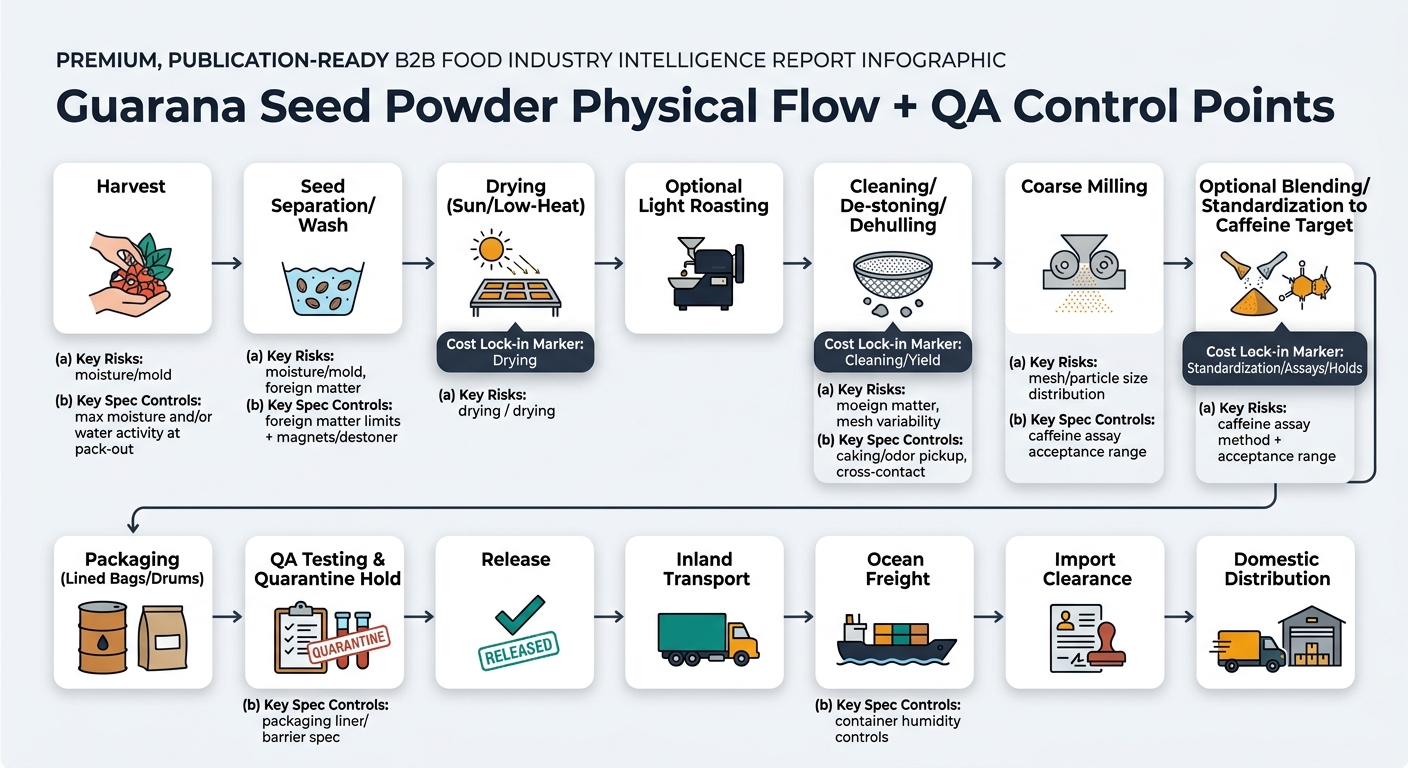
Typical physical flow (simplified)

  • Upstream: Guarana fruit harvested → seeds separated/washed → dried (sun/low-heat) → sometimes lightly roasted
  • Primary processing: Cleaning, de-stoning, dehulling/cracking → coarse milling
  • Secondary processing: Fine milling/sieving to mesh → optional blending to caffeine target → packaging in lined bags/drums
  • QA & release: Identity + caffeine assay + micro + heavy metals/pesticides (program-dependent) → quarantine hold → release
  • Export logistics: Inland transport to consolidation hub → ocean freight → import clearance → domestic distribution
A left-to-right supply chain flowchart for guarana seed powder showing: Harvest → Seed separation/wash → Drying (sun/low-heat) → Optional light roasting → Cleaning/de-stoning/dehulling → Coarse milling → Fine milling/sieving → Optional blending/standardization to caffeine target → Packaging (lined bags/drums) → QA testing & quarantine hold → Release → Inland transport → Ocean freight → Import clearance → Domestic distribution. Overlay each node with compact callouts for (a) key risks (moisture/mold, foreign matter, mesh variability, caking/odor pickup, cross-contact), (b) key spec controls (max moisture and/or water activity at pack-out, foreign matter limits + magnets/destoner, mesh/particle size distribution, caffeine assay method + acceptance range, packaging liner/barrier spec, container humidity controls), and (c) cost lock-in markers at Drying, Cleaning/Yield, and Standardization/Assays/Holds.

2) Where Cost and Margin Accumulate (Node-by-Node)

Insight: In guarana powder, “cost” is not just labor and freight—yield loss (cleaning + sieving), QA quarantine time, and the decision to standardize caffeine are the structural multipliers.

Data: Powder buyers commonly specify mesh, moisture, microbiological limits, and contaminant panels; each added requirement increases sampling, testing frequency, and the probability a lot is diverted, blended, or rejected.

Procurement Impact: You can’t interpret supplier quotes without knowing which node is doing the hard work: farm-level drying discipline, processor-level cleaning yield, or manufacturer-level standardization and QA release.

1. Upstream / Raw Material (Harvest, Seed Separation, Drying)

  • Insight: Drying quality is the earliest “point of no return.” Seeds that enter storage above safe moisture/water activity create mold pressure and higher downstream rejects.
  • Data: Cost is driven by labor for harvest/seed separation, drying time (weather-dependent), and shrink/yield loss from removing damaged or moldy material.
  • Procurement Impact: The upstream node determines how much downstream testing and sorting you’ll pay for indirectly; poor drying typically reappears later as higher micro counts, musty notes, and higher clean-up yield loss at milling.

2. Primary Processing (Cleaning, De-stoning, Dehulling/Cracking, Coarse Milling)

  • Insight: Primary processing is where “merchantable yield” is created—through aggressive foreign-matter removal and controlled cracking/milling.
  • Data: Fixed costs include screens, magnets, destoners, and labor; variable costs include yield loss (foreign matter, hulls, fines) and rework loops when mesh or cleanliness fails.
  • Procurement Impact: Suppliers that quote “cheap powder” often externalize this node’s work to your incoming inspection (more rejects/claims). Cleaner input lots reduce not only safety risk (stones/metal) but also downstream milling wear and reprocessing.

3. Secondary Processing / Manufacturing (Fine Milling, Sieving, Optional Caffeine Standardization)

  • Insight: Fine powder is expensive to make consistently because mesh uniformity and caffeine consistency compete: tighter mesh can concentrate fines; blending to a caffeine target requires more lots and more testing.
  • Data: Cost drivers are milling energy, sieve throughput, dust control, and batch blending time; standardized powder adds extra assays, lot segregation, and documentation.
  • Procurement Impact: If your finished product is caffeine-sensitive, the physical choice is between (a) accepting wider natural variability and managing it downstream, or (b) paying for upstream blending/standardization with higher QA intensity and longer lead times.

4. Packaging, QA Release, and Compliance Documentation (Pre-Export)

  • Insight: For powders, packaging is a functional control—not a marketing add-on. Moisture barrier and odor barrier are what protect quality through long ambient transits.
  • Data: Costs include lined fiber drums or multiwall bags with inner liners, label/traceability controls, sampling, lab testing (identity/caffeine/micro/heavy metals/pesticides as required), and quarantine holding space/time.
  • Procurement Impact: This node often explains “why lead time is long”: testing and holds are physical capacity constraints. If the supplier lacks quarantine space or lab access, they ship “at risk,” shifting the hold and failure cost to your site.

5. Export Logistics and Import Handling (Consolidation, Ocean Freight, Clearance)

  • Insight: Guarana powder logistics are ambient, but humidity exposure is the hidden variable that can convert an acceptable powder into a caked, out-of-spec powder.
  • Data: Costs stack from inland freight (often from remote growing zones to consolidation hubs), container utilization (drums vs. bags), insurance, port/handling, and import clearance; delays increase time-at-humidity risk.
  • Procurement Impact: Physical logistics choices (liner quality, desiccants, container loading discipline) directly affect receiving quality. When a powder cakes, you pay twice: for re-milling/conditioning and for production downtime.
A stacked bar chart with three bars labeled: (A) Natural Guarana Seed Powder (Non-Standardized), (B) Standardized Guarana Powder (Blended to Caffeine Target), (C) Guarana Dry Extract. Each bar is segmented by supply chain node with the article’s percentages: Upstream raw material; Primary processing; Secondary processing (and for B include blending/standardization); Packaging & QA release; Export logistics & import handling; Distributor/processor margin. Add a thin annotation band above the bars labeling the main 'cost lock-in' multipliers: Drying discipline (upstream), Cleaning yield loss (primary), Assays + quarantine holds (standardization/QA). Include a legend and keep colors consistent across bars by node.

Product-Level Cost Breakdown

A) Natural Guarana Seed Powder (Non-Standardized)

Supply Chain Node Cost Ratio (% of Final Cost) Notes
Upstream raw seeds + drying 30% Labor + drying losses; sets baseline quality.
Primary processing (cleaning/coarse milling) 15% Foreign matter removal and yield loss are key.
Secondary processing (fine milling/sieving) 12% Mesh control, dust handling, energy.
Packaging & QA release 18% Testing + quarantine holds + moisture-barrier packaging.
Export logistics & import handling 15% Inland + ocean + port/clearance; delay risk.
Distributor/processor margin 10% Working capital and risk premium.

B) Standardized Guarana Powder (Blended to Caffeine Target)

Supply Chain Node Cost Ratio (% of Final Cost) Notes
Upstream raw seeds + drying 24% Slightly lower share because downstream value-add rises.
Primary processing 13% Cleaning yield still critical to blending efficiency.
Secondary processing + blending/standardization 22% Multi-lot blending, extra assays, segregation, rework loops.
Packaging & QA release 20% Higher testing frequency + tighter documentation.
Export logistics & import handling 13% Similar mechanics; more sensitivity to delays due to QA holds.
Distributor/processor margin 8% Margin spread often shifts into standardization service itself.

C) Guarana Dry Extract (Higher Value-Add Alternative Form)

Supply Chain Node Cost Ratio (% of Final Cost) Notes
Upstream raw material 18% Seed cost diluted by extraction yield economics.
Primary processing 10% Clean input reduces extraction fouling and losses.
Extraction + drying (secondary manufacturing) 34% Solvent/water, equipment, energy, yield, carrier (if used).
Packaging & QA release 20% Potency specs + residual solvent (if applicable) + micro controls.
Export logistics & import handling 10% Often better density; still moisture-sensitive.
Distributor/processor margin 8% Higher working capital due to in-process inventory.
Unlock Full Data
Guarana Seed Powder Market Intelligence
Prices · Trends · Origins · Forecasts

3) Structural Realities You Can’t “Spec Away”

Reality 1: Seasonality + Humidity Make Post-Harvest Drying the Structural Bottleneck

Insight: The chain’s limiting step is not milling capacity—it’s getting seeds dried and stabilized without microbial escalation.

Data: In Brazil, harvest timing is seasonal (e.g., CONAB references harvest starting around October in Amazonas and Bahia, extending into early-year months), so drying windows and storage conditions become the practical bottleneck. [2]

Procurement Impact: Even with identical written specs, two suppliers can have structurally different incoming quality depending on how close they are to farms, what drying infrastructure exists, and how much reconditioning they must do.

Reality 2: “Powder” Magnifies Handling Risk (Caking, Odor Pickup, Cross-Contact)

Insight: Fine powders behave like sponges for humidity and odors; once caked or tainted, recovery is costly and may not restore original performance.

Data: Higher surface area increases moisture sorption; long ambient transits and warehouse cycling (day/night temperature swings) raise condensation risk.

Procurement Impact: Packaging liner spec, container loading discipline, and warehouse humidity control are not secondary details—they are part of the physical manufacturing process that determines usability at receiving.

Reality 3: Standardization Is a Physical Operation with Capacity Limits

Insight: Hitting a caffeine target is not a paperwork exercise; it requires multi-lot blending, segregation, and repeated assays.

Data: Pharmacopeial-style monographs for guarana seed powder explicitly anchor identity/potency expectations (e.g., minimum caffeine on a dried basis), reinforcing that potency control is analytical and process-driven, not declarative. [4]

Procurement Impact: Standardized material tends to have longer and less flexible production slots, especially during peak harvest/ship periods, because blending rooms and quarantine space become the constraint.

Key Insights (What Matters in the Physical Map)

  • Key Takeaways: The earliest fixed cost-driver is drying quality; it determines microbial pressure, odor, and downstream yield loss.
  • Key Takeaways: Cleaning and sieving are where hidden “shrink” lives; aggressive foreign-matter removal improves safety but reduces saleable yield.
  • Key Takeaways: Caffeine standardization is a real manufacturing step that consumes capacity (blending + assays + holds) and structurally lengthens lead time.
  • Key Takeaways: Packaging is a control point for powders; moisture-barrier performance often decides whether product arrives free-flowing or needs rework.

4) The Bottom Line for Your Next Contract

(Analyzed at: Aug, 2026)

Write your contract to force pack-out moisture discipline + lot-level caffeine method transparency, not just a generic “meets spec” statement. CONAB’s recent market reporting shows meaningful producer price dispersion between Bahia and Amazonas (e.g., late-2025 references near R$34/kg vs R$80/kg), which is exactly the kind of backdrop that increases substitution pressure and broker opacity—so your protection is to require (1) max moisture and preferably water activity at pack-out, (2) defined moisture-barrier packaging configuration, and (3) COA fields with stated test methods for caffeine and key contaminants. [2]

This works because caking, quarantine holds, and potency surprises are predictable outcomes of powder physics plus seasonal supply; teams that lock these controls typically avoid the expensive failure mode of “in-spec on paper, unusable in operations,” which can quietly add mid-single-digit percentage points to landed cost through re-milling, extended holds, and line downtime.

Unlock Full Data
Guarana Seed Powder Market Intelligence
Prices · Trends · Origins · Forecasts

References

  1. gov.br (CONAB) — Guaraná (Agosto 2025) PDF
  2. gov.br (CONAB) — Guaraná (Análise Mensal Dezembro 2025) PDF
  3. pubs.acs.org — Journal of Agricultural and Food Chemistry (DOI: 10.1021/acs.jafc.9b03781)
  4. doi.usp.org — USP–NF Monograph (Guarana Seed Powder)

Related Contents

Subscribe
→
By subscribing you agree to with our Privacy Policy and provide consent to receive updates from our company.
Thank you! Your submission has been received!
Oops! Something went wrong while submitting the form.
Subscribe to receive the latest blog posts, updates, promotions, and announcements from Tridge.
