
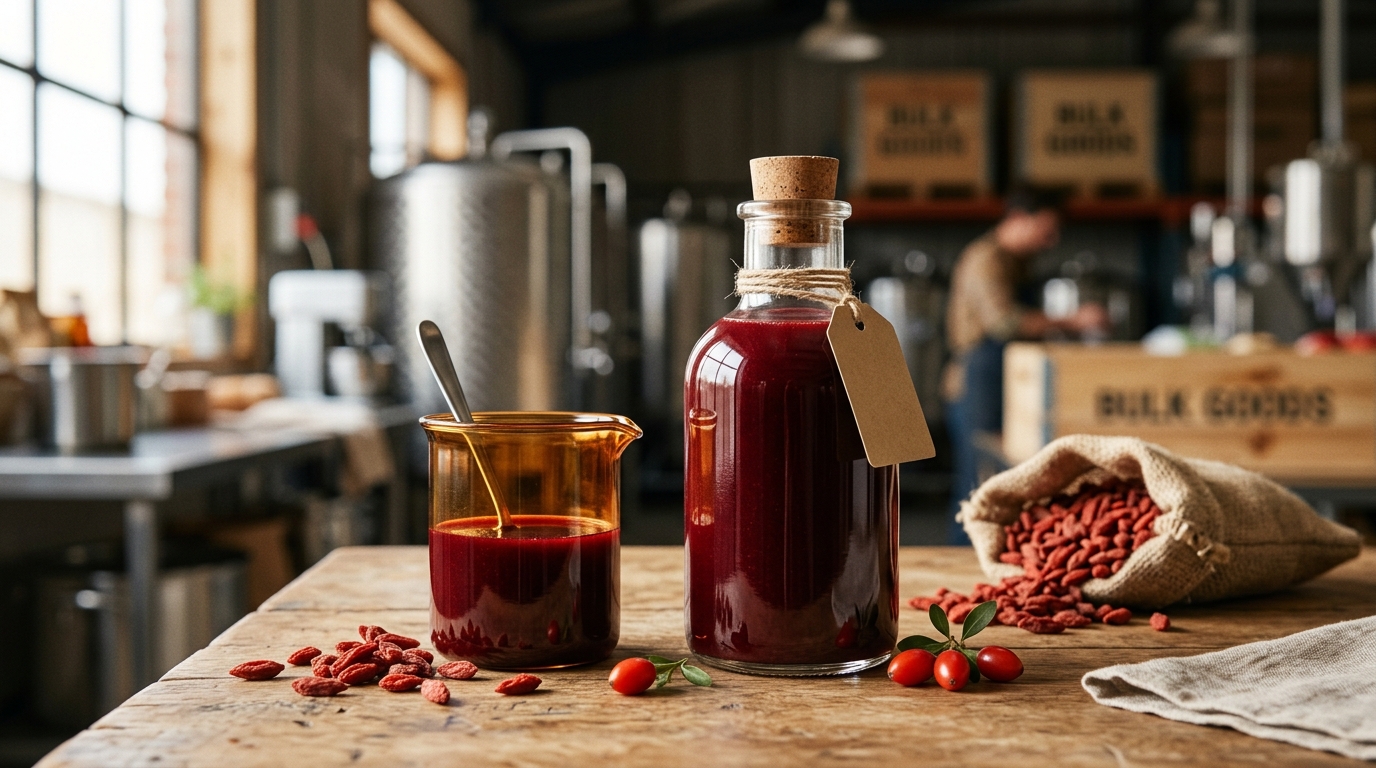
Goji-berry-juice-concentrate looks like a simple ingredient (a Brix number in a drum), but procurement outcomes are usually decided earlier—at yield, heat-history, aseptic discipline, and documentation. This guide maps the physical chain end-to-end and translates each node into what to challenge in RFQs, specs, and supplier qualification so you can reduce disruption exposure without accidentally buying quality risk.
Goji-berry-juice-concentrate is a short agricultural chain with a long compliance tail: berries move quickly from harvest into washing/pressing, then into energy-intensive concentration and aseptic packing, and finally into drum-based ocean freight to industrial users. The fixed cost-drivers are set early (field quality, residue compliance, and usable juice yield) and then amplified downstream (evaporation energy, aseptic validation, packaging, and freight).
Insight: The chain’s economics are governed less by “fancy processing” and more by loss/yield, energy, and documentation discipline at a few bottleneck nodes.
Data: Industrial fruit juice concentrates commonly trade around ~65° Brix (often in the 60–70° range depending on fruit and buyer) and are frequently shipped as aseptic bag-in-drum formats around ~200–250 kg; concentration is typically achieved via vacuum evaporation to reduce heat damage while removing water.
Procurement Impact: If you don’t understand where yield is lost (pressing/clarification) and where costs are non-negotiable (aseptic + freight + compliance testing), you’ll misread why two “similar” offers can land with different total cost and different quality risk.

Insight: Goji concentrate cost is “built” through a small number of irreversible steps: (1) field quality and residue compliance, (2) extraction/clarification yield, and (3) evaporation + aseptic packaging.
Data: In fruit concentrates, the largest structural cost buckets typically cluster around raw material (fruit input), yield losses, energy for evaporation, aseptic packaging materials, and freight/handling for drums.
Procurement Impact: When you map cost by node, you can separate what is structurally expensive (and why) from what is operationally variable (and where quality failures tend to originate).

| Supply Chain Node | Cost Ratio (% of Final Landed Cost) | Notes |
|---|---|---|
| Upstream Raw Material (berries + harvest handling) | 35–55% | Dominated by berry price/grade and field compliance discipline. |
| Primary Processing (pressing + clarification) | 10–18% | Yield losses + filtration/enzymes + labor/water. |
| Secondary Processing (evaporation + aseptic) | 12–22% | Energy + evaporator efficiency + aseptic validation/consumables. |
| Packaging & QA Release | 6–12% | Aseptic bags/drums + test panels + documentation overhead. |
| Logistics & Distribution | 10–20% | Inland + ocean + port/drayage + warehousing; sensitive to dwell time. |
| Importer/Distributor Margin (if applicable) | 0–8% | Depends on whether you buy direct or via consolidator. |
| Supply Chain Node | Cost Ratio (% of Final Landed Cost) | Notes |
|---|---|---|
| Raw Material Inputs (goji + carrier juice concentrates) | 30–50% | Carrier reduces cost but increases authenticity/label governance burden. |
| Blending/Standardization + Processing | 12–22% | Additional batching, QC checks, and standardization steps. |
| Aseptic Packaging & QA Release | 7–14% | Similar packaging system; testing may expand to verify composition. |
| Logistics & Distribution | 10–20% | Similar drum logistics; density and pallet efficiency matter. |
| Importer/Distributor Margin (if applicable) | 0–10% | More common when sold as a “functional blend” ingredient. |
| Supply Chain Node | Cost Ratio (% of Final Landed Cost) | Notes |
|---|---|---|
| Upstream Raw Material | 25–45% | Lower processing intensity but higher volume to ship per unit solids. |
| Primary Processing | 15–25% | Pressing/clarification becomes the main transformation cost. |
| Packaging & QA Release | 8–15% | Packaging varies (drums/totes); micro control is more demanding. |
| Cold Chain / Logistics | 20–35% | Shipping water is expensive; temperature control can dominate. |
| Distributor/Handling Margin | 0–10% | Often higher if storage/temperature services are bundled. |
Insight: Goji concentrate behaves like a “high-value fruit ingredient” category: concentrated origin dependence, seasonal raw material windows, and authenticity governance are structural—not optional.
Data: Global cultivation and processing is widely recognized as China-centered, with premium origin narratives frequently tied to Ningxia; industrial users in North America/Europe commonly rely on drum-based imports; harvest is seasonal with multiple pickings, and processing capacity is most constrained during peak intake.
Procurement Impact: These realities shape what is feasible in specs, lead times, and supplier qualification workload—regardless of market conditions.
Key Takeaways: The fastest way to de-risk this category is to map your internal requirements (clarity/sediment tolerance, micro limits, authenticity expectations, packaging format, and storage conditions) directly to the node that physically controls it.
(Analyzed at: Jul, 2026)
Write your next goji concentrate contract as a process-and-proof agreement, not a Brix purchase: lock in clarified/standardization expectations, aseptic handling requirements, and an agreed authenticity + contaminant test plan (including who pays, methods, and retest rules). This works because the biggest cost and risk inflection points sit in pressing/clarification and in evaporation/aseptic packing—where “same Brix” can still mean materially different yield, stability, and compliance exposure. Given 2026’s still-volatile ocean freight environment, add lane flexibility (alternate ports/carriers, shipment windows) and a small buffer stock policy; late movers routinely end up paying expedited replacements and production disruption costs that can easily add ~8–15% to landed cost in a bad quarter. The point isn’t to over-spec—it’s to specify what actually prevents rejects, rework, and firefighting.


